Quick Answer
Multitasking collapses mind clarity not because the tasks themselves are difficult, but because the brain cannot process simultaneous high-level attention streams. Instead of parallel processing, the brain engages in rapid attention switching. Each switch incurs a “cognitive switching penalty”—a micro-second delay where context is lost and must be reloaded. This creates a state where cognitive load exceeds working memory capacity, resulting in fragmentation. Clarity is restored not by reducing the number of tasks on your list, but by shifting from simultaneous processing to cognitive sequencing—ordering attention so that the brain can close one loop before opening another.
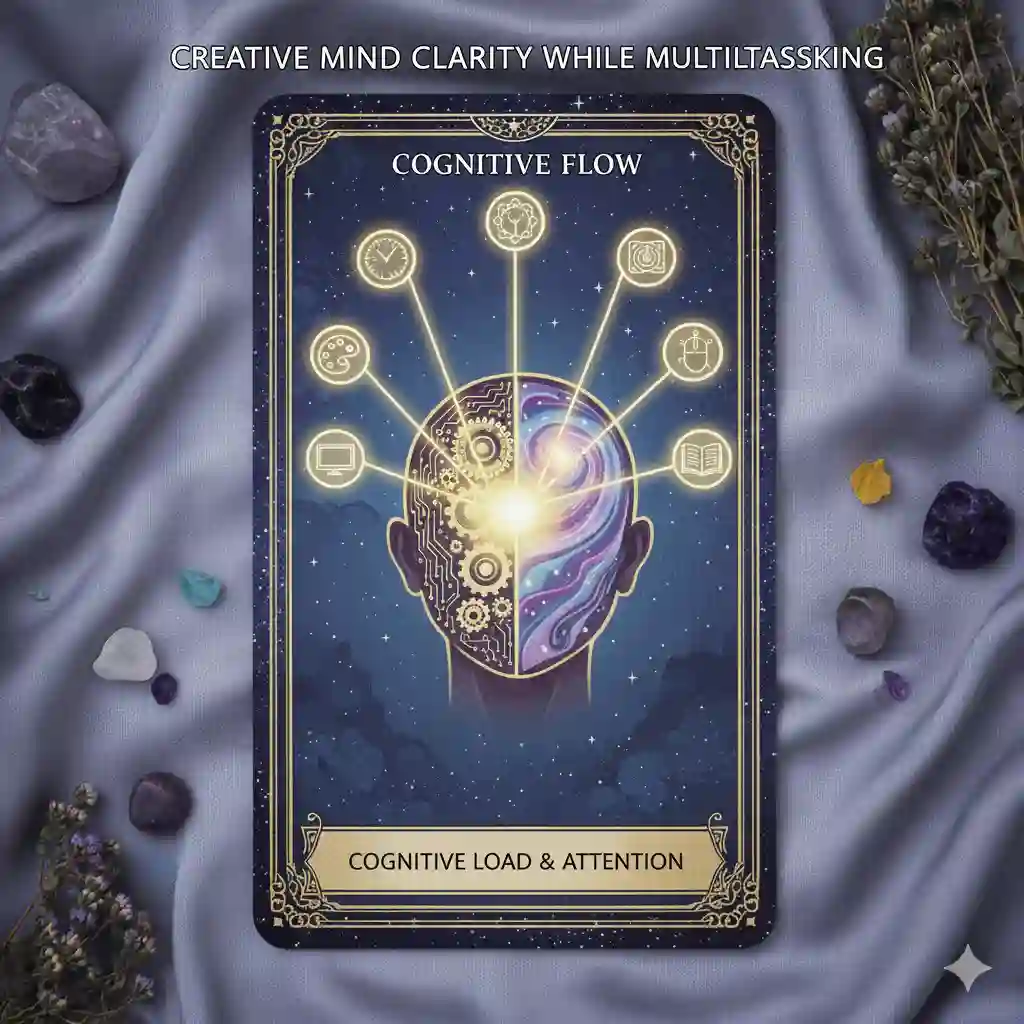
Table of Contents
- Why the Brain Was Never Designed for True Multitasking
- Attention Switching: The Hidden Cost That Breaks Clarity
- Working Memory Saturation and Mental Fog
- Why Effort Increases as Clarity Decreases
- Multitasking vs Cognitive Sequencing
- 3 Core States of Multitasking-Induced Confusion
- Clarity Restoration Framework
- Real-World Scenario: The Communications Collapse
- FAQ: Cognitive Load and Clarity
- Additional Questions on Mental Bandwidth
- Conclusion
Why the Brain Was Never Designed for True Multitasking
The human brain is an evolutionary marvel of pattern recognition and complex decision-making, but it possesses a distinct architectural limitation: it is fundamentally a serial processor for conscious, high-level attention. While the brain can handle autonomic processes in parallel—regulating heartbeat, breathing, and balance while walking—the prefrontal cortex, which governs executive function, decision-making, and focus, operates on a single-threaded basis.
When we believe we are multitasking, we are engaging in a persistent cognitive illusion. Subjectively, it feels as though we are managing a conference call, writing an email, and monitoring a notification feed simultaneously. However, neuroscientific evidence reveals that the brain is rapidly toggling between these tasks. This is not parallel processing; it is rapid serial processing. The brain must disengage from the first task, reorient neural resources to the second, and then engage with the new input. This happens in fractions of a second, creating the seamless illusion of continuity, much like a film reel spinning fast enough to create a moving image.
The cost of this illusion is clarity. The brain’s attention network is metabolically expensive and resource-limited. True clarity requires a state of sustained neural firing where context and memory are robustly maintained. When you force the brain to split this resource, you are essentially asking a single-threaded system to perform multi-threaded operations without the hardware to support it. The result is a degradation of thinking quality. The multitasking paradox emerges here: as you attempt to handle more simultaneous inputs to gain control, you progressively lose the cognitive coherence required to understand any of them fully.
This limitation is not a defect of intelligence or a lack of practice. It is a biological bottleneck. The prefrontal cortex is designed to focus on one complex variable at a time to maximize survival and problem-solving efficacy. By overriding this design through chronic multitasking, we fragment the very mechanism responsible for understanding our environment. We trade depth of processing for breadth of activity, resulting in a state where we are doing many things, but thinking clearly about none of them.
Attention Switching: The Hidden Cost That Breaks Clarity
The mechanism that erodes mind clarity during multitasking is known as the “switch cost.” Every time attention shifts from one target to another—from a spreadsheet to a text message, for example—the brain must execute a two-step process: goal shifting (I want to do this instead of that) and rule activation (I am turning off the rules for the spreadsheet and turning on the rules for texting).
While these shifts occur rapidly, they are not instantaneous. There is a measurable latency, a micro-second gap where the brain is offline, suspended between two contexts. In isolation, a single switch cost is negligible. However, in a modern work environment, individuals may switch contexts hundreds of times per hour. These micro-delays accumulate, creating a significant drag on cognitive performance.
More detrimental than the time lost is the phenomenon of “attention residue,” a concept identified by researcher Sophie Leroy. When you switch tasks, your attention does not transfer 100% to the new object of focus. A portion of your cognitive resources remains stuck on the previous task. If you quickly glance at an email while writing a report, your brain is forced to process the new information (the email) while a fragment of its processing power is still ruminating on the sentence you were just writing (the report).
This residue creates a layering effect. As you switch rapidly between three or four inputs, you leave deposits of attention residue on each one. Consequently, you are never fully present with your current task because your cognitive bandwidth is cluttered with the echoes of the previous three. This is why clarity degrades. You are trying to process new information with only a fraction of your available intelligence, while the rest is tied up in the “background noise” of unfinished cognitive loops.
The subjective experience of this is a feeling of scattered thinking or an inability to “get deep” into a problem. It is not that the problem is too hard; it is that you are attempting to solve it with diminished resources. The constant interrupt-driven cycle prevents the brain from entering a state of flow or deep focus, where complex neural connections are formed. Instead, thinking remains superficial, and the mental landscape feels chaotic because the brain is never allowed to fully load the context of one task before being ripped away to another.
Working Memory Saturation and Mental Fog
Working memory is the brain’s temporary holding space for information processing. It is the mental scratchpad where we hold numbers while doing math, or hold the beginning of a sentence while reading the end. This system is extremely limited in capacity. Cognitive psychologists traditionally estimated that humans could hold “seven plus or minus two” items in working memory, but modern research suggests the limit for complex items is likely closer to three or four.
Multitasking floods this limited capacity. When you juggle multiple tasks, you are forcing the working memory to hold the variables for all of them simultaneously. You are holding the details of the email, the context of the meeting, and the requirements of the project all at once. Because the capacity is so low, new information inevitably pushes old information out. This is why you might walk into a room and forget why you are there, or open a browser tab and forget what you intended to search for. The working memory buffer has been overwritten by a new, distracting input.
When working memory is saturated for prolonged periods, the result is mental fog. This is a physiological signal of information overload and cognitive fatigue. The brain requires significant energy (glucose and oxygen) to maintain information in working memory. Sustaining a high load without release depletes these resources, leading to a sensation of heaviness, slowness, or a “cloudy” mind.
Mental fog is not a sign of weakness; it is a protective mechanism. It is the brain’s way of signaling that the input buffers are full and cannot accept more data until something is processed and cleared. In a multitasking state, however, we rarely clear the buffer. We simply add more noise. This saturation prevents the synthesis of information. Clarity requires the ability to connect disparate pieces of information into a coherent whole. When working memory is overloaded, the brain spends all its energy just trying to hold onto the pieces, leaving no energy for the synthesis required to understand them.
Why Effort Increases as Clarity Decreases
A common misconception is that if we are not thinking clearly, we simply need to try harder. We associate effort with results. However, in the context of cognitive load, increasing effort while multitasking often accelerates the decline in clarity. This counter-intuitive relationship is driven by compensatory cognitive effort.
When the brain detects that performance is dropping due to attention switching and memory saturation, it recruits additional neural resources to compensate. The prefrontal cortex works harder to filter out distractions and force focus on the current task. This feels like “bearing down” or “powering through.” You feel mentally busy, engaged, and exhausted, which creates a false sense of productivity. You equate the sensation of strain with the effectiveness of the work.
However, this added pressure often distorts thinking. Thinking under pressure triggers a stress response, releasing cortisol and norepinephrine. While these chemicals can sharpen focus in short bursts for physical survival, they can inhibit the nuanced, complex thinking required for modern knowledge work. They narrow the field of perception. In a multitasking scenario, this tunnel vision prevents you from seeing the bigger picture, further reducing clarity.
As you push harder against the cognitive bottleneck, you create a feedback loop of diminishing returns. The harder you try to hold onto fragmented threads of attention, the more metabolic energy you consume, leading to faster fatigue. This fatigue lowers your threshold for distraction, making it harder to ignore new interruptions, which leads to more switching, more residue, and less clarity. The sensation of high effort is actually the sensation of cognitive inefficiency. Clarity, by contrast, often feels light and effortless because it arises from a brain that is operating within its design parameters, processing information sequentially and efficiently.
Multitasking vs Cognitive Sequencing
To regain mind clarity, we must distinguish between “handling multiple responsibilities” and “multitasking.” It is entirely possible to manage a complex workload with dozens of competing demands without losing clarity. The differentiator is cognitive sequencing.
Multitasking is the attempt to process inputs parallelly or via rapid, reactive switching. It is driven by external demands: the phone pings, so you look; the email arrives, so you read. Attention is pulled, not directed.
Cognitive sequencing is the deliberate ordering of attention. It acknowledges that while you have ten things to do, the brain can only effectively do one at a time. Sequencing involves arranging these tasks in a linear queue and granting exclusive focus to the current item until a logical stopping point is reached. This aligns with the brain’s serial processing architecture.
When you sequence, you allow the brain to load the full context of a task. You enter the “schema” of that work. Because you are not switching, there is no switch cost and no accumulation of attention residue. You complete the micro-segment of work, close the cognitive loop, and then consciously unload that context before loading the next.
This approach restores coherence. Even if you only spend five minutes on a task before moving to the next, if that five minutes is protected from interruption and focused exclusively on that single item, thinking quality remains high. You are not asking the brain to hold three conflicting realities at once. You are asking it to navigate one reality, then the next, then the next. The workload remains the same, but the cognitive load is drastically reduced because the processing is serial, orderly, and fully focused. Clarity returns because the interference pattern of competing signals is removed.
3 Core States of Multitasking-Induced Confusion
When we ignore the brain’s limits, confusion manifests in three distinct patterns. Identifying which state you are in is the first step toward correcting it. These are not personality flaws; they are the inevitable outcomes of specific types of cognitive mismanagement.
Attention Fragmentation
The State: This is characterized by a feeling of jaggedness or being “scatterbrained.” You find yourself starting sentences you don’t finish, opening tabs you don’t read, or physically moving from room to room without remembering your purpose.
The Cause: Constant switching with no cognitive closure. You are interrupting neural processes before they complete. The brain is engaged in a perpetual state of “loading,” never reaching the “processing” or “completion” phases. The fragmentation comes from the accumulation of open loops—dozens of tiny, unfinished tasks that demand low-level attention, preventing deep thought.
Cognitive Overload
The State: This feels like a pressure headache or a sensation of “too muchness.” You may feel paralyzed, unable to make even simple decisions, or emotionally reactive. You stare at a screen knowing what you need to do but feeling unable to initiate the action.
The Cause: Too many active mental threads at once. Working memory is completely saturated. The brain has exceeded its capacity to hold variables. It is the mental equivalent of a juggler with too many balls in the air; inevitably, they all drop. This state often occurs when trying to hold future tasks in mind while executing a current task.
Mental Fog
The State: A pervasive sense of dullness, slowness, or detachment. It feels as though there is a veil between you and your thoughts. Complex concepts seem slippery or impossible to grasp. Motivation is low, and lethargy is high.
The Cause: Reduced clarity after prolonged attention strain. This is metabolic exhaustion. The prefrontal cortex has depleted its readily available energy reserves due to the high cost of attention switching and filter maintenance. The brain downregulates activity to conserve energy, resulting in a dimming of cognitive sharpness.
Clarity Restoration Framework
Regaining mental clarity does not require you to abandon your responsibilities or retreat to a mountain top. It requires a restructuring of how your attention interacts with your workload. This framework is designed to align your workflow with your cognitive biology.
1. Reduce Active Mental Threads
The first step is to stop the bleeding of cognitive resources. You must reduce the number of open loops your brain is trying to track. This does not mean doing less work; it means holding less work in your head.
- Method: Close the sensory gates. If you are writing, close the email tab. If you are in a meeting, put the phone away. Eliminate visual cues of other tasks. The brain processes everything in its visual field as a potential task. By removing them from sight, you reduce the background processing load required to ignore them.
2. Externalize Memory to Free Bandwidth
Your brain is for processing, not storage. Trying to “remember to do X” while doing Y destroys clarity on both.
- Method: Perform a “brain dump.” Write down every single active task, worry, or requirement currently cycling in your working memory. Once it is captured in a trusted external system (paper or digital), the brain releases the need to actively rehearse it. This immediately frees up cognitive bandwidth for the task at hand. You cannot think clearly about the present if you are cognitively clutching the future.
3. Sequence Attention (The “Parking” Technique)
Instead of splitting attention, practice rapid sequencing. If an interruption occurs, do not simply glance at it and split your focus.
- Method: “Park” your current task. Take five seconds to note where you are and what the very next step is. Then, consciously shift full attention to the interruption. Handle it or defer it. Then, consciously shift back. This deliberate “closing and opening” of tasks minimizes attention residue. It turns a chaotic interruption into a sequenced event.
4. Use Brief Cognitive Pauses
To prevent mental fog and residue buildup, the brain needs reset points. It cannot run at redline indefinitely.
- Method: Implement a short mental pause between major task switches. When finishing a meeting and before starting an email, take sixty seconds to do nothing. Stare at a wall, breathe, or close your eyes. This allows the neural activity of the previous context to dissipate, clearing the working memory buffer so the next task can be loaded with full clarity. Clarity comes from order, and order requires space.
Real-World Scenario: The Communications Collapse
Consider a typical scenario for a project manager, Elena. It is 10:00 AM. She is attempting to write a complex project proposal (High Load). She has Slack open on a second monitor (Variable Load), and her phone is buzzing with family texts (Emotional Load).
The Fragmentation:
Elena writes a sentence of the proposal. A Slack notification pops up—a question from a developer. She stops writing, reads the message, and types a quick reply. As she hits send, her phone lights up. She glances—it’s a text about dinner plans. She worries briefly about logistics, then looks back at her proposal.
The Collapse:
When her eyes return to the document, she has to re-read the last three paragraphs to remember her train of thought. The context of the proposal was “dumped” from her working memory to handle the developer’s question. Now, she has to rebuild the mental model of the proposal. However, a piece of her attention is still stuck on the developer (“Did I explain that clearly?”) and another piece is stuck on dinner (“do we have groceries?”). She feels a rising sense of anxiety. The words on the screen seem abstract. She starts skimming rather than deep reading. Her clarity has collapsed into cognitive overload.
The Restoration:
Elena recognizes the fog. She applies the framework.
- Externalize: She jots down “Check groceries for dinner” on a sticky note. The thought is safe; she can let it go.
- Reduce Threads: She closes the Slack window entirely, deciding to check it only at the top of the hour.
- Sequence: She commits to 25 minutes of exclusive focus on the proposal.
- Reset: She takes three deep breaths to clear the residue of the frantic switching.
Within five minutes, the “fog” lifts. She re-enters the schema of the proposal. The words make sense again. She is no longer fighting her own brain; she is working with its serial design. She is still managing the project, the team, and her life, but she is doing so sequentially, and therefore, clearly.
FAQ: Cognitive Load and Clarity
Does multitasking always reduce IQ?
Studies have suggested that during periods of heavy multitasking, functional IQ can drop significantly—comparable to the effects of losing a night of sleep. This is temporary, caused by the bottleneck in working memory. You are not becoming less intelligent; you are simply unable to access your full intelligence because your processing power is diverted to managing the switching process.
Why do I feel bored when I try to do just one thing?
This is often a dopamine withdrawal response. Multitasking provides a constant stream of novel stimuli (new alerts, new info), which triggers dopamine release. Single-tasking is less stimulating chemically but far more rewarding cognitively. The boredom is actually the withdrawal of that high-frequency stimulation. Pushing through this initial boredom is necessary to reach a state of deep clarity.
Can some people multitask better than others?
Research indicates that “supertaskers”—people who can multitask without performance degradation—are incredibly rare (estimated at less than 2.5% of the population). Most people who believe they are good at multitasking are actually statistically worse at it; they simply lack the self-awareness to realize how much their performance has dropped.
How long does it take to regain clarity after an interruption?
University of California, Irvine research suggests it can take upwards of 23 minutes to fully return to the original level of focus after a distraction. However, this recovery time can be shortened through the sequencing techniques mentioned above, specifically by noting where you left off (cognitive closure) before addressing the interruption.
Is listening to music considered multitasking?
It depends on the music and the task. Instrumental, familiar music often occupies the part of the brain that seeks sensory input, actually helping to block out other distractions. However, music with lyrics competes for language processing resources. If you are reading or writing, lyrical music creates cognitive conflict and reduces clarity.
Additional Questions on Mental Bandwidth
Can meditation improve my ability to handle multitasking?
Meditation improves executive control, which helps you notice when your attention has drifted. It doesn’t make the brain better at parallel processing (which is impossible), but it makes you faster at realizing you are fragmented and returning to a sequenced state.
Why does multitasking make me feel emotionally drained?
The prefrontal cortex, which handles focus, also helps regulate emotions (the amygdala). when your cognitive resources are depleted by multitasking, you have less energy left for emotional regulation. This leads to irritability and anxiety.
Is it better to group similar tasks together?
Yes. This is called “batching.” By grouping tasks that require similar cognitive rules (e.g., doing all emails at once, then all data entry), you reduce the “rule activation” cost of switching, preserving energy and clarity.
Does clutter on my desk affect my mental clarity?
Visual clutter competes for attention. The brain constantly scans the environment. A messy desk creates a low-level drain on cognitive resources as the brain processes the visual noise, leaving less bandwidth for your primary task.
Can physical movement help reset cognitive load?
Yes. Physical movement increases blood flow and oxygen to the brain. It acts as a system reset, helping to flush out the feeling of mental stagnation associated with cognitive overload.
What is the difference between “flow” and multitasking?
They are opposites. Flow is a state of deep, singular focus where self-consciousness disappears and performance peaks. Multitasking prevents flow because the constant interruptions break the intense concentration required to enter that state.
Conclusion
The pursuit of mind clarity in a high-demand environment is not about doing less; it is about respecting the biological architecture of the brain. The sensation of confusion and fog that accompanies multitasking is not a failure of character, but a mechanical inevitable consequence of attention fragmentation. The brain fragments when it is forced to hold too many open loops simultaneously.
True clarity returns when we shift from a model of parallel processing to one of cognitive sequencing. By externalizing our memory, reducing active threads, and deliberately ordering our attention, we allow our cognitive faculties to function as designed: powerfully, deeply, and one thing at a time. The path to mental order is not found in speed, but in the disciplined structure of your attention. You can handle the chaos of the world, provided you do not let that chaos internalize into the structure of your thoughts. By sequencing your focus, you protect your clarity, ensuring that even in the busiest moments, your mind remains a tool of precision rather than a repository of noise.
Internal Links
- Multitasking and clarity paradox
- Information overload and mental strain
- Pressure-distorted thinking
- Micro-decisions and mental order
- Short cognitive reset