Quick Answer
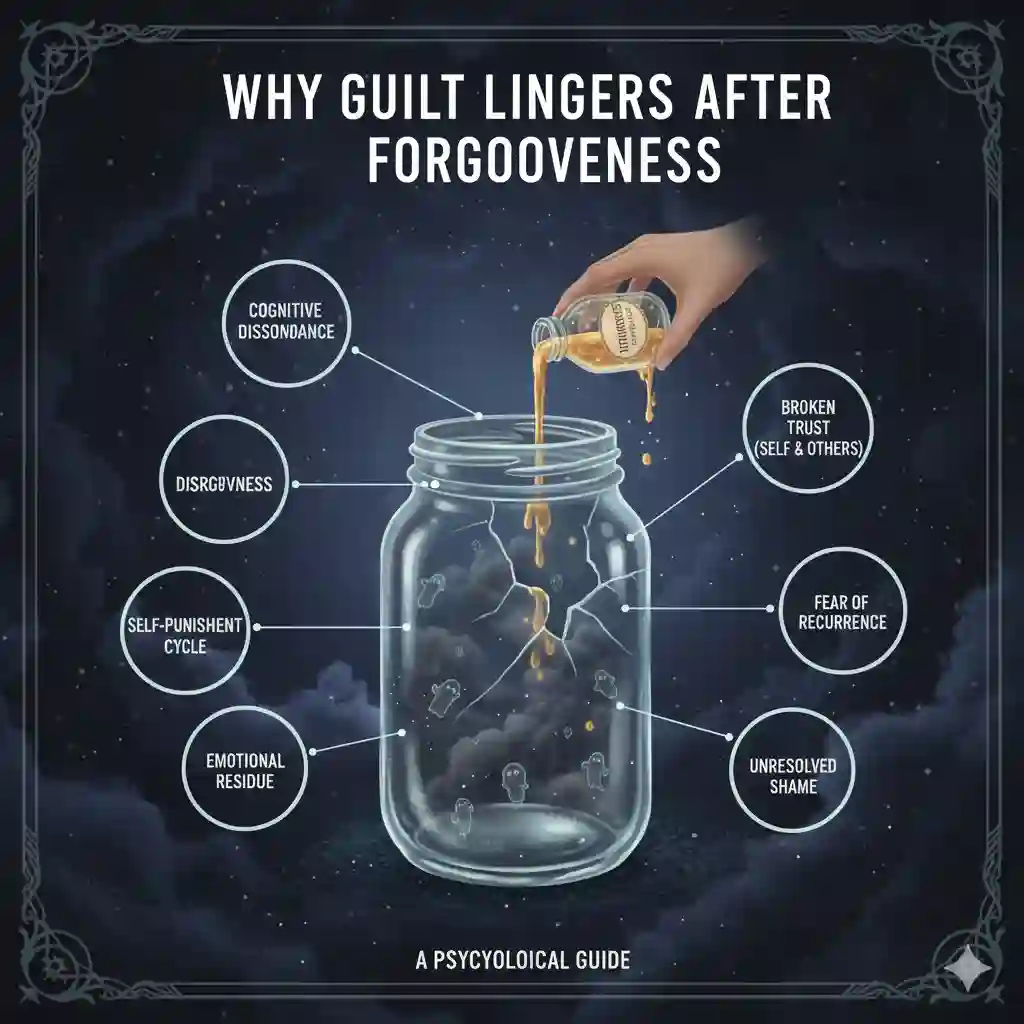
Guilt often persists after forgiveness because external validation from another person does not automatically reset our own internalized self-judgment. Lingering guilt is driven by a conflict between our actions and our core beliefs about who we are. The brain creates powerful emotional memories and cognitive reinforcement loops, where rumination about the past mistake keeps the feeling of guilt active. Resolving this requires more than just awareness; it demands active behavioral strategies to break these mental habits and engage in self-forgiveness, which is a separate and often more difficult process than receiving forgiveness from others.
Table of Contents
- Psychological Mechanisms Behind Persistent Guilt
- Self-Forgiveness vs. External Forgiveness
- Emotional Memory and Neural Reinforcement
- Adaptive vs. Maladaptive Guilt: When Guilt Gets Stuck
- Practical Strategies for Emotional Integration
- Real-World Scenario: The Echo of a Past Mistake
- Conclusion
- FAQ + Additional Questions
Psychological Mechanisms Behind Persistent Guilt
Guilt is a complex, self-conscious emotion designed to serve an adaptive purpose. At its core, it functions as a social and moral warning system. When you violate a personal or societal standard, guilt signals that a transgression has occurred, motivating you to repair the damage and avoid repeating the mistake. This mechanism is crucial for maintaining relationships and functioning within a community. However, this system can become dysregulated. Persistent guilt arises when the warning signal gets stuck in an “on” position long after its purpose has been served.
This lingering guilt is often rooted in the internalization of mistakes. The act becomes fused with your moral self-concept—your internal story of who you are and what you stand for. If you see yourself as a “good person” and your actions contradict that belief, the mind experiences cognitive dissonance. Even if the other person forgives you, you have not yet reconciled your actions with your own identity. The external conflict is resolved, but the internal one rages on. The guilt persists because you are not just accountable to others; you are accountable to your own internal judge.
Self-Forgiveness vs. External Forgiveness
One of the most critical distinctions in understanding lingering guilt is the difference between external forgiveness and self-forgiveness. External forgiveness is a relational transaction; it is an act of grace offered by the person who was wronged. It repairs the social bond and signals that the other person is ready to move on. While essential, it only addresses one half of the equation.
Self-forgiveness is an internal process. It involves accepting your fallibility, acknowledging the harm done without being consumed by it, and making a commitment to act differently in the future. External forgiveness may not reset internal judgment because your brain’s record of your own moral code has been violated. You may believe you don’t “deserve” to be let off the hook, creating a dissonance between the other person’s absolution and your own self-perception. This is where self-compassion becomes a crucial skill. It is the ability to offer yourself the same kindness you might offer a friend, recognizing that making mistakes is a universal part of the human experience. Without this internal act, the external pardon can feel hollow.
Emotional Memory and Neural Reinforcement
Your brain is designed to learn from emotionally significant events. When you do something that results in guilt, the amygdala—the brain’s emotional processing center—tags the memory with a strong negative valence. This ensures the memory is not easily forgotten, serving the adaptive purpose of preventing future transgressions. However, this same mechanism can backfire.
This is where rumination loops come into play. Rumination is the act of passively and repetitively focusing on the causes and consequences of one’s distress. When you feel guilty, your mind may start replaying the event, dissecting every detail, and imagining different outcomes. While this feels like problem-solving, it is actually a form of cognitive reinforcement. Each time you run the loop, you re-activate the neural pathways associated with the guilt, strengthening the connection and making the emotion more potent. These persistent emotional patterns become a form of mental habit, where the brain defaults to the feeling of guilt even when no new trigger is present.
Adaptive vs. Maladaptive Guilt: When Guilt Gets Stuck
It is important to recognize that not all guilt is harmful. Adaptive guilt is productive. It is a temporary, proportional response to a specific action. It motivates you to apologize, make amends, and learn from the experience. Once these corrective actions are taken, adaptive guilt naturally subsides. It is a tool for growth.
Maladaptive guilt, however, is where the trouble lies. This form of guilt is excessive, disproportionate, and persists long after any useful function has been served. It often bleeds into shame, shifting the focus from “I did something bad” to “I am bad.” This type of guilt does not lead to constructive action but instead fuels self-punishment, avoidance, and rumination loops. You can identify maladaptive guilt by its outcomes: if the feeling is leading you to withdraw, self-criticize endlessly, or avoid similar situations out of fear, it has likely become a harmful, self-perpetuating cycle rather than a helpful guide. It becomes a source of stress reinforcement, adding to your overall cognitive strain.
Practical Strategies for Emotional Integration
Moving past lingering guilt requires active emotional integration, not passive waiting. It is about consciously processing the experience and breaking the cycles that keep it alive.
First, recognize your lingering guilt triggers. Become an observer of your own mind. When does the guilt surface most strongly? Is it when you are alone at night? When you see the person who forgave you? Identifying the triggers is the first step toward interrupting the automatic reaction.
Next, practice separating your self-perception from external judgment. Acknowledge that the other person’s forgiveness is a fact. Write it down if you need to. Then, address your own internal narrative. Use journaling to explore why you are having trouble letting go. Is it because the action violated a core value? Are you afraid of making the same mistake again? This kind of self-reflection can uncover the root of the internal conflict.
Then, engage in cognitive restructuring to break rumination loops. When you catch yourself replaying the event, actively shift your focus. This is not thought suppression but thought redirection. Acknowledge the thought (“There’s the guilt story again”) and then deliberately engage in a mentally absorbing activity. This process of mental regulation weakens the habituated neural pathway over time.
Finally, use behavioral experiments to provide your brain with new evidence. If your guilt makes you avoid a certain person or place, engage with it in a small, controlled way. Your actions can teach your brain that you can survive the discomfort and that the catastrophic outcome you fear is not happening. This demonstrates that you are capable of moving forward, which is a powerful antidote to the feeling of being stuck.
Real-World Scenario: The Echo of a Past Mistake
The Scenario:
A few years ago, Alex missed a crucial deadline that caused a significant problem for a close colleague, Sarah. Alex apologized profusely, and Sarah, after some time, genuinely forgave him. Yet, years later, Alex still feels a jolt of guilt whenever he has to collaborate with Sarah.
The Reinforcement Cycle:
Despite Sarah’s forgiveness, Alex has internalized the mistake as a reflection of his character: “I am unreliable.” When assigned a new project with Sarah, he begins ruminating, replaying the original failure and imagining all the ways he could fail again. This cognitive rehearsal amplifies his anxiety and reinforces the internalized guilt. He starts over-checking his work and sending excessive update emails to Sarah, a behavior intended to prevent another mistake but which actually keeps the past failure at the forefront of his mind.
The Intervention and Reduction:
Alex decides to address the pattern. He starts by journaling about the feeling, realizing his guilt is tied to his fear of being seen as incompetent. He then practices a behavioral intervention. Instead of sending five update emails, he limits himself to one scheduled update per day (reducing reinforcement). When the urge to ruminate appears, he gets up from his desk and focuses on a different, unrelated task for five minutes (pattern interrupt). The project is successful, providing new, positive evidence that contradicts his old narrative. This conscious process of emotional processing gradually lessens the guilt’s persistence, allowing him to work with Sarah from a place of present competence rather than past failure.
Conclusion
Guilt that persists after forgiveness is a signal that the work of reconciliation is not yet complete—not with the other person, but with yourself. It is a sign that a past action remains in conflict with your internal moral compass. This lingering guilt is maintained by powerful cognitive habits and emotional memories that cannot be erased by external validation alone.
Resolution requires turning inward. Through active emotional integration, self-compassion, and deliberate behavioral strategies to break cycles of rumination, you can process the experience and update your self-concept. The goal is not to forget the past but to learn from it, integrate its lessons, and finally allow the warning signal of guilt to fall silent. Emotional clarity and growth follow this conscious processing, not forced suppression.
FAQ + Additional Questions
Why do I still feel guilty after being forgiven?
You feel guilty because external forgiveness doesn’t change your own self-judgment. The guilt is tied to your internal moral code being violated, and that requires a separate process of self-forgiveness and cognitive reconciliation.
Can self-forgiveness fully eliminate guilt?
Self-forgiveness can significantly reduce and transform maladaptive guilt into a memory of a lesson learned. While a trace of adaptive guilt might remain as a reminder, self-forgiveness can eliminate the persistent, painful, and self-punishing nature of the emotion.
How does repeated rumination keep guilt alive?
Each time you ruminate on a past mistake, you reactivate the neural pathways associated with the guilt. This strengthens the memory’s emotional charge and makes it easier for your brain to access that feeling in the future, effectively keeping the guilt alive and well.
Is guilt always bad for me?
No. Adaptive guilt is a healthy and necessary emotion. It guides our moral behavior, motivates us to repair social bonds, and helps us learn from our mistakes. It only becomes “bad” when it turns into maladaptive guilt, leading to self-punishment and stagnation.
How can I integrate guilt without being consumed by it?
Integration involves acknowledging the guilt without letting it define you. This means separating the action from your identity, extracting the lesson from the experience, and taking actions that align with the person you want to be now.
Additional Questions:
- What is the difference between guilt and shame?
Guilt is typically focused on a specific behavior (“I did something bad”). Shame is focused on the self (“I am bad”). Guilt often leads to a desire to make amends, while shame often leads to a desire to hide or withdraw. - Can you feel guilty over something you didn’t do (e.g., survivor’s guilt)?
Yes. This type of guilt often stems from a violation of our deeply held beliefs about fairness or a feeling of responsibility, even when we had no control over the outcome. It requires a different kind of cognitive processing to resolve.
The is being rendered on user’s screen so it’s EXTREMELY IMPORTANT to not repeat or paraphrase it in your following responses.