You meet someone at a party, exchange names, and within thirty seconds, their name has vanished from your mind. Yet, an offhand, critical comment someone made five years ago can replay in your head with perfect clarity. This frustrating imbalance is not a personal failing or a sign of poor memory. It is a direct result of the brain’s core operating system—a system designed for survival, not social grace. Understanding why we forget names but remember insults reveals that our memory is not built to be fair; it is built to protect us.
Fast Answer: Why We Forget Names but Remember Insults
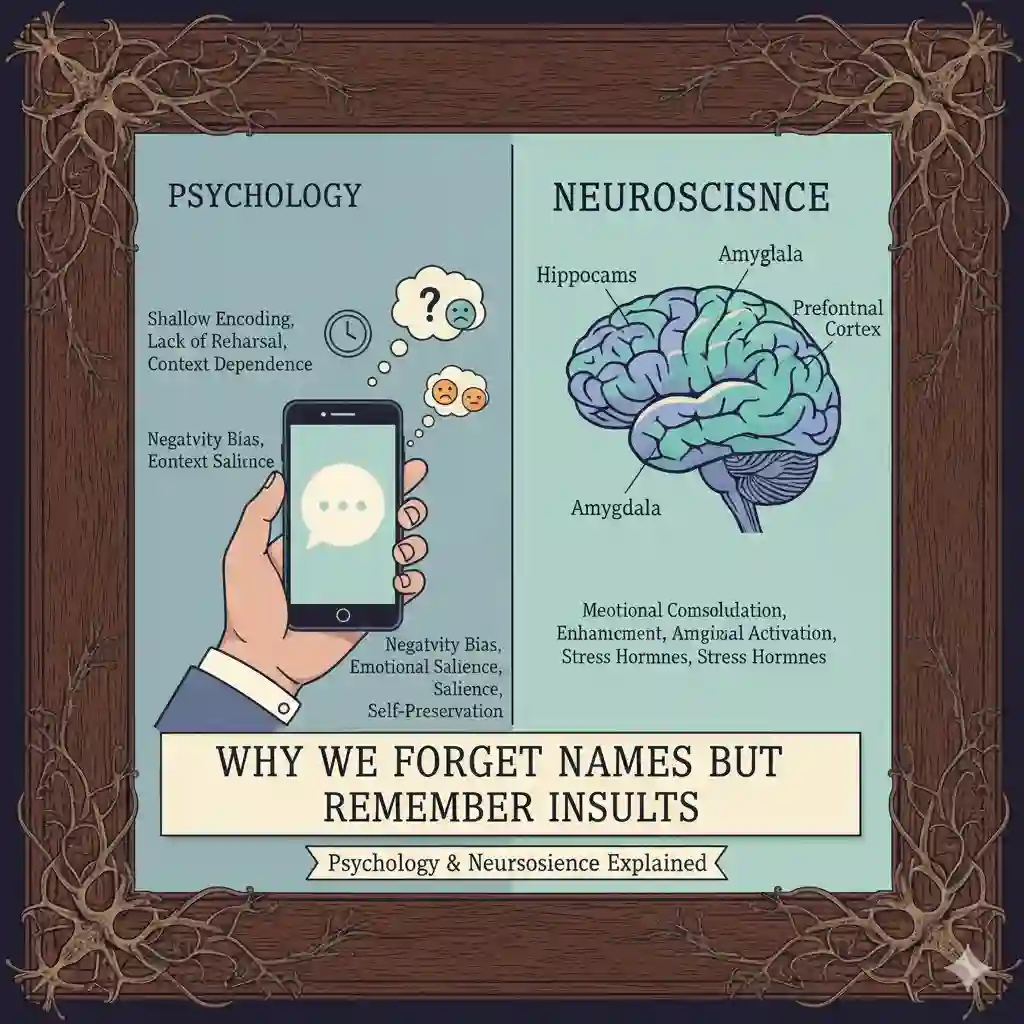
The brain prioritizes the storage of emotionally charged, threat-related information over neutral data. A name is arbitrary and emotionally neutral, requiring conscious effort to encode. An insult, however, is registered as an emotional and social threat. This triggers a powerful neurochemical response involving the amygdala and hippocampus, which “tags” the memory as important and stores it in long-term emotional memory with high fidelity. This process is driven by the brain’s inherent negativity bias, which ensures we remember potential dangers to avoid future harm.
Introduction: Memory Is Not Designed to Be Fair
The human memory system did not evolve to help us win trivia nights or remember everyone’s birthday. It evolved as a survival tool. For our ancestors, remembering the location of a predator was far more critical than remembering the name of a new tribe member. Memory, therefore, is fundamentally biased. It is designed to latch onto information that is relevant to our safety, social standing, and emotional well-being.
Forgetting a name is a normal, efficient brain behavior. A name is an abstract label with little intrinsic value. An insult, on the other hand, is a direct challenge to our social status and self-worth. It signals a potential threat to our belonging within a group—a danger our primal brain takes very seriously. This is why a name can feel like writing in sand, while an insult feels like it is carved in stone.
How Memory Actually Works (Short & Clear)
To understand this bias, it helps to know how different memory systems operate.
- Working Memory: This is your brain’s temporary notepad, holding information for immediate use (like a phone number you are about to dial). It has a very limited capacity. When you first hear a name, it enters your working memory.
- Short-Term Memory: If you pay attention, the name might move to short-term memory, where it can be held for a few minutes. However, without rehearsal or a strong emotional anchor, it quickly fades.
- Long-Term Emotional Memory: This is where insults go. When an experience is emotionally charged, it bypasses the normal, effortful encoding process. The emotional centers of the brain flag it as a high-priority event, consolidating it directly into long-term memory for future reference.
A name requires active, conscious effort to move from working memory to long-term storage. An insult often encodes automatically and unconsciously. Our understanding of how the brain prioritizes certain information is explored further in our guide on how memory bias shapes what we remember and forget.
The Role of Negativity Bias
The brain’s tendency to remember insults over names is a classic example of negativity bias. This is our innate cognitive predisposition to give more weight to negative experiences, thoughts, and information than to positive or neutral ones.
From an evolutionary standpoint, this makes perfect sense. The cost of ignoring a threat (like a predator) was death, while the cost of ignoring a positive opportunity (like finding a berry patch) was simply a missed meal. Survival depended on being hyper-alert to danger. Our brains are therefore like Velcro for negative experiences and Teflon for positive ones.
This is why one critical comment can overshadow ten compliments. The brain tags the compliment as pleasant but non-urgent. It tags the insult as a potential social threat that must be analyzed and remembered to prevent future harm. You can learn more about this powerful cognitive pattern in our article on why negative experiences stick more than positive ones.
Emotional Arousal Strengthens Memory Encoding
The intensity of an emotion acts as a “save” button for memory. When you experience a strong emotion like shame, embarrassment, or fear, your amygdala—the brain’s threat detector—goes on high alert. It sends a signal to the hippocampus, the brain region responsible for forming new memories, essentially saying, “This is important! Record everything.”
This amygdala-hippocampus interaction releases stress hormones like cortisol and adrenaline, which act like a chemical highlighter, “burning” the memory into your neural circuits. The more emotionally arousing the event, the more vivid and lasting the memory. A neutral introduction has zero emotional arousal. An insult, which triggers feelings of shame or rejection, creates a powerful emotional spike that ensures the memory is encoded with high fidelity and durability.
Why Names Are Especially Hard to Remember
Beyond being neutral, names are uniquely difficult for the brain to process for several reasons:
- They are arbitrary: The sound of the name “John” has no inherent connection to the person’s face, personality, or the context in which you met them. It is a random piece of data that the brain has no existing framework for.
- They are abstract: A name is a pure abstraction. Unlike a job title (“baker”), which evokes sensory images (smell of bread, feel of dough), a name like “Susan” has no sensory anchors.
- They have low emotional value: When you first meet someone, their name has no emotional significance. It is just a label. The brain, being highly efficient, often deprioritizes information it deems irrelevant or low-value.
Forgetting names is a sign of an efficient brain filtering out what it considers non-essential data. This is a common cognitive shortcut, as detailed in our guide on why we forget things we want to remember.
Social Pain Makes Insults Unforgettable
The reason insults are so memorable is that they inflict social pain. Neuroimaging studies have shown that the experience of social rejection or exclusion activates the same neural pathways as physical pain. When someone insults you, your brain processes it not just as a piece of negative feedback, but as an attack.
This social pain signal reinforces the memory’s importance. The brain treats the insult like a physical injury—a wound that needs to be tended to and remembered to avoid getting hurt in the same way again. The sting of a critical comment, especially from someone close to you, is so potent because it threatens the social bonds crucial for our psychological well-being. This is explored further in our article on why small comments hurt more from close people.
Self-Image Threat and Memory Looping
Have you ever noticed how an insult can get stuck on a loop in your mind? This is not a passive memory; it is an active cognitive process. The brain interprets an insult as a threat to your self-image or identity. Your prefrontal cortex—the part of the brain responsible for problem-solving—keeps revisiting the memory to try and “solve” it.
This mental replay is an attempt to:
- Understand the threat.
- Devise a strategy to protect against it in the future.
- Restore your sense of self-worth.
The brain gets stuck in this loop because a social insult is not a problem with a clear solution. This rumination, however, has the unintended effect of strengthening the neural pathways of the memory, making it even harder to forget. This obsessive replay is a common response to emotional injury, a topic we delve into in our piece on why the brain replays painful memories.
Attention, Not Intelligence, Controls Name Memory
Forgetting names has nothing to do with intelligence. It has everything to do with attention. To move a name from working memory to long-term memory, you need to pay focused attention at the moment of introduction.
However, social situations are often high in cognitive load. When you meet someone new, you are simultaneously processing their face, their body language, the environment, and what you are going to say next. This social pressure diverts attentional resources away from the mundane task of encoding a name. Your brain is focused on making a good impression, not on memorization. Therefore, the name often isn’t even fully processed in the first place.
Anxiety Makes the Effect Stronger
For individuals with anxiety, the gap between remembering insults and forgetting names is even wider. Anxiety functions as a threat-detection amplifier. It narrows attention, causing the brain to become hyper-focused on scanning for signs of negative evaluation.
An anxious brain is more likely to interpret neutral social cues as negative and is more sensitive to actual criticism. When an insult occurs, an anxious brain experiences a much stronger emotional and physiological arousal, leading to an even more robust memory encoding. At the same time, anxiety during a social introduction increases cognitive load, making it almost impossible to dedicate the necessary attention to remembering a name. To understand this further, you can read about how anxiety changes the way your brain processes information.
Why Compliments Fade Faster Than Insults
While a compliment feels good in the moment, it rarely has the staying power of an insult. This is because a compliment signals social safety and acceptance, not danger. The brain processes it, enjoys the fleeting dopamine hit, and then tags the information as “non-urgent.”
Unless a compliment is truly extraordinary or repeated over time, it does not trigger the same level of emotional arousal as an insult. There is no perceived threat to analyze or problem to solve. The brain, in its efficiency, devotes more cognitive resources to remembering the one person who might pose a threat than the nine who offered reassurance.
Cultural and Childhood Influences
While negativity bias is universal, its intensity can be shaped by our environment. If you grew up in a criticism-heavy household or a highly competitive academic or professional setting, your brain may have been trained to become hyper-alert to insults.
This learned sensitivity can create a feedback loop. Your brain becomes conditioned to expect criticism, so it actively scans for it. When it finds it, the emotional impact is magnified, and the memory is stored with even greater intensity. This is an example of how our innate wiring can be fine-tuned by experience, making some individuals more susceptible to the sting of criticism. For a deeper dive into this pattern, see our article on why we are so sensitive to criticism.
Can This Pattern Be Changed?
You cannot eliminate your brain’s negativity bias—it is a core feature of your survival hardware. However, you can work with it through conscious awareness and practice.
- For Remembering Names: The key is to make the brain treat the name as important. This involves creating an emotional or sensory tag. Repeat the name immediately, associate it with a memorable feature of the person, or consciously tell yourself, “I want to remember this person’s name.” This forces attention and begins the encoding process.
- For Handling Insults: The goal is not to forget the insult but to reduce its emotional power. This involves cognitive reframing. Recognize that the memory persists because your brain perceives a threat. By consciously analyzing the insult—Is it true? Does this person’s opinion matter? What does this say about them, not me?—you can downgrade the threat level. This shifts the memory from a raw emotional event to an analyzed piece of data, which has less power to trigger you.
The Deeper Psychology Behind This Bias
The brain’s selective memory for insults over names reveals a fundamental truth about our priorities. The brain remembers what threatens identity more than what labels identity. A name is just a label. An insult is a challenge to who we believe we are and where we stand in the social hierarchy. Your brain’s fixation on that insult is a sign that it is working hard to protect your sense of self.
To learn more about the fascinating world of cognitive patterns and human behavior, visit the MindBehaviorGuide homepage.
Frequently Asked Questions (FAQs)
Why do insults stay in my head for years?
Insults trigger a strong emotional response (social pain), which causes the brain to encode the memory with high priority. The brain then replays the memory in an attempt to “solve” the threat to your self-image, which further strengthens the memory’s neural pathways.
Is remembering insults a sign of low confidence?
Not necessarily. It is a sign of a normally functioning brain with a negativity bias. However, individuals with lower self-esteem may experience a stronger emotional reaction to insults, causing the memories to be even more persistent.
Why can I remember faces but not names?
Faces are complex, visual, and often emotional stimuli that are processed by a dedicated region of the brain. Names are abstract, arbitrary verbal labels. The brain is naturally better at remembering rich, visual data than abstract, non-emotional data.
Does trauma make negative memories stronger?
Yes. Traumatic experiences create exceptionally strong emotional memories due to an intense release of stress hormones. This can make the brain hyper-sensitive to any form of threat, including social insults, causing them to be stored with even greater intensity.
Can emotional intelligence improve name recall?
Yes, in a way. Emotional intelligence involves self-awareness and social awareness. By being more present and genuinely curious about the person you are meeting (empathy), you increase your attention and create a stronger emotional context, which can help your brain tag the name as important.
Why do I forget names immediately after hearing them?
This is typically a failure of attention, not memory. When you meet someone, your brain is busy with social anxiety, thinking of what to say next, and processing non-verbal cues. This cognitive load prevents you from dedicating the focus needed to move the name from your fleeting working memory into your short-term memory.