Fast Answer: Why This Topic Is Often Misunderstood
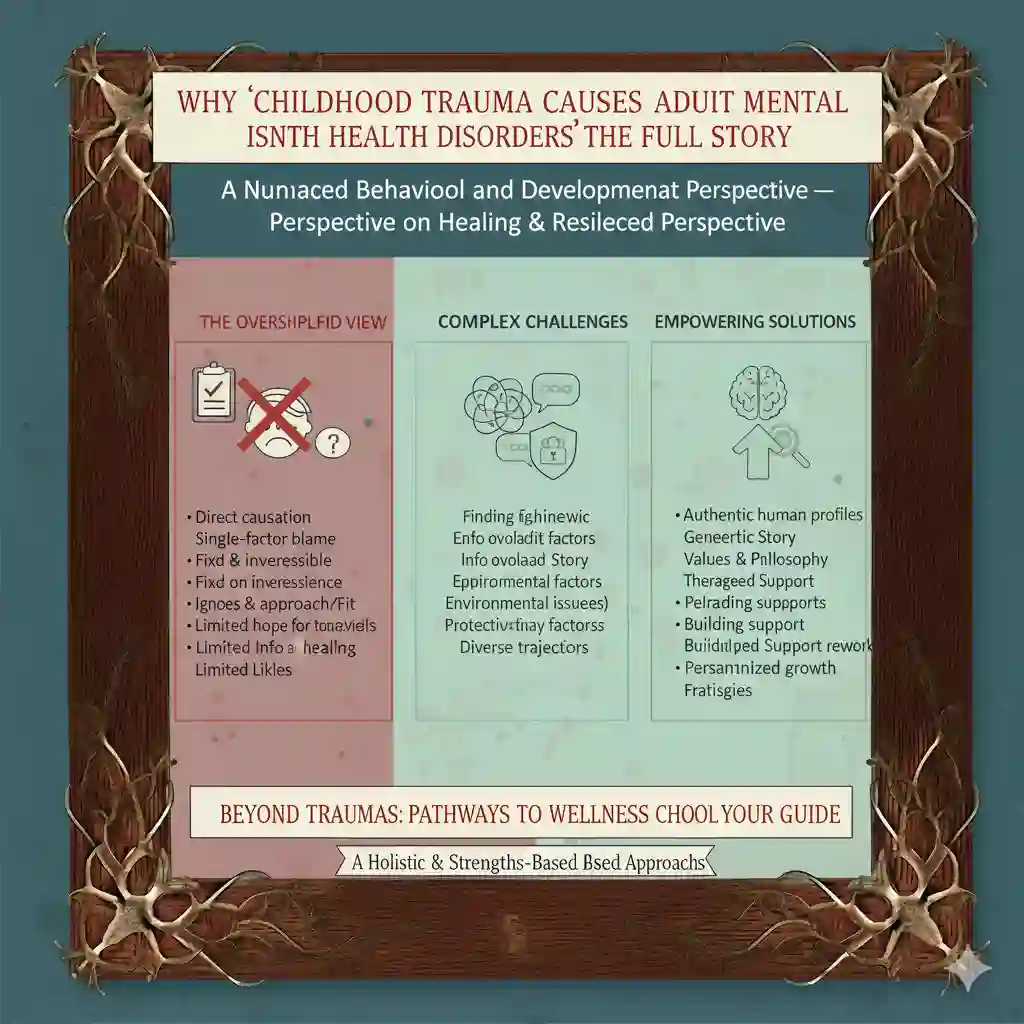
It is true that adverse childhood experiences (ACEs) are statistically associated with a higher risk of adult psychological difficulties. However, this correlation is not a simple cause-and-effect relationship. The popular narrative often frames childhood trauma as a direct pipeline to adult mental health disorders, but the reality is far more complex.
Not everyone who experiences childhood trauma develops a clinical disorder, and many people without significant trauma do. This shows the complex interplay of other critical factors, including biological predispositions, the presence of supportive relationships, learned coping mechanisms, and the meaning an individual makes of their experiences. This article explains the limits of simplistic “trauma leads to disorder” narratives and offers a more nuanced, evidence-informed perspective on childhood trauma adult outcomes.
Introduction: Popular Beliefs vs. Psychological Complexity
The prevailing narrative around childhood trauma is both powerful and straightforward: adverse experiences like abuse, neglect, or loss disrupt a child’s development, alter brain structure, and directly increase the risk of adult mood disorders, anxiety, PTSD, and personality disorders. This story, while rooted in important research, has become so simplified in popular discourse that it often misleads more than it clarifies.
Adult mental health outcomes are not written in stone by childhood events. They emerge from a dynamic and ongoing interplay between our past experiences, our present environment, our biological blueprint, and the resilience we build along the way. While acknowledging the profound impact of early adversity, we must also recognize that human development is not a fixed trajectory. This article provides a childhood trauma mental health critique that moves beyond oversimplification.
What “Trauma” Really Means — Event vs. Impact
To understand why the trauma-to-disorder narrative is incomplete, we must first clarify what “trauma” means. The term is often used as a catch-all for any negative childhood event, but its psychological impact is deeply personal. Trauma is not just the event itself; it is the individual’s experience of that event. An experience that one person finds deeply traumatizing, another might process with less difficulty due to different internal and external resources.
Trauma encompasses a wide range of experiences:
- Abuse: Physical, emotional, or sexual harm.
- Neglect: The absence of care, supervision, or emotional attunement.
- Loss: The death of a parent or caregiver.
- Chaos and Unpredictability: Living in an environment with substance abuse, domestic violence, or severe mental illness.
Developmental psychology teaches us that the impact of these events depends on context. The same event can have vastly different outcomes based on the child’s attachment style, the presence of a supportive adult, and the child’s interpretation of what happened. An event does not automatically become a disorder; it is filtered through the lens of personal meaning, environment, and biology.
Why Babies & Children Do Still Change After Adversity
Acknowledging the complexity of trauma does not mean diminishing its potential impact. Early life is a period of incredible brain plasticity, meaning the brain is highly adaptable and shaped by experience. Adverse childhood experiences can and do influence neurodevelopment, particularly in the systems that regulate stress.
The HPA (hypothalamic-pituitary-adrenal) axis is the body’s central stress response system. Chronic or “toxic” stress in childhood can dysregulate this system, making an individual more sensitive to stress later in life. The amygdala, the brain’s “fear center,” can also become hyper-reactive. This neurodevelopmental stress response can create a biological vulnerability.
Furthermore, early experiences are fundamental to forming attachment patterns. A child who grows up with secure, responsive caregivers learns that the world is generally safe and that relationships are a source of comfort. A child in a neglectful or chaotic environment may develop an insecure attachment style, learning that relationships are unreliable or dangerous. These early interpersonal maps can shape how a person connects with others in adulthood.
However, it is critical to remember that these are vulnerabilities, not certainties. A sensitized stress system does not guarantee an anxiety disorder, and an insecure attachment style does not preordain a personality disorder. They are contributing factors in a much larger equation.
Evidence: Not All Trauma Leads to Adult Disorders
The most compelling argument against a simple trauma-disorder pipeline is the evidence itself. While studies consistently show a correlation between ACEs and adult mental health issues, they also reveal tremendous variability in outcomes.
A significant portion of individuals with documented histories of childhood trauma do not meet the criteria for any psychiatric disorder in adulthood. They build successful careers, form loving relationships, and lead fulfilling lives. This phenomenon, often called resilience, demonstrates that other factors can buffer or override the negative effects of early adversity.
Conversely, many adults with diagnosed mental health disorders do not have a history of significant childhood trauma. Their difficulties may stem from genetic predispositions, later-life stressors, or other environmental factors. This shows that while trauma is a significant risk factor, it is neither a necessary nor a sufficient cause for adult psychopathology. The idea that all anxiety, for example, is rooted in childhood events is a misconception.
Resilience, Meaning, and Life Context — The Moderators of Outcome
If trauma is not destiny, what accounts for the difference in childhood trauma adult outcomes? The answer lies in a set of protective factors and moderators that influence an individual’s developmental trajectory.
Resilience: Often misunderstood as a fixed personality trait, resilience development is a dynamic process. It is the capacity to adapt well in the face of adversity. This adaptation can be fostered by:
- Supportive Relationships: The presence of at least one stable, caring adult in a child’s life can be a powerful buffer against the effects of trauma. This could be a teacher, grandparent, coach, or family friend.
- Cognitive Skills: The ability to solve problems, plan for the future, and maintain a realistic but positive outlook.
- Self-Regulation: The capacity to manage strong emotions and impulses.
Meaning-Making: Humans are narrative creatures. The story we tell ourselves about our experiences profoundly shapes their impact. Two people can endure a similar trauma, but one might frame it as “I am permanently broken,” while the other might frame it as “I survived something difficult, and it made me stronger.” The process of meaning-making after trauma—finding purpose, growth, or lessons from adversity—is a key predictor of positive outcomes.
Life Context: Childhood does not happen in a vacuum, and neither does adulthood. A person who experienced early adversity but then finds a supportive partner, a fulfilling career, and a safe community in adulthood is more likely to thrive than someone who continues to face instability, discrimination, or relational turmoil.
Why Trauma Narratives Can Sometimes Backfire
The widespread conversation about trauma has done immense good by reducing stigma and encouraging people to seek help. However, there is a shadow side. When the “trauma causes disorders” narrative becomes too rigid, it can inadvertently cause harm.
Identity Fusion: For some, “trauma survivor” can become a primary identity. When a person’s entire sense of self is organized around their past suffering, it can create a self-fulfilling prophecy. They may interpret every current difficulty as an inevitable consequence of their past, diminishing their sense of agency and their ability to change present patterns.
Diminished Agency: If trauma is seen as a life sentence, it can foster a sense of hopelessness. It can lead people to believe they are permanently damaged and that recovery is impossible. This perspective overlooks the brain’s lifelong capacity for change (neuroplasticity) and the individual’s power to build new skills and create new experiences.
Focus on the Past Over the Present: While understanding the roots of our struggles is important, an exclusive focus on the past can distract from addressing the present-day behaviors and thought patterns that are maintaining our distress. Healing involves not just excavating the past but also actively building a different future.
When Childhood Trauma Does Predict Adult Challenges
To offer a balanced view, it is crucial to acknowledge that the correlation between adverse childhood experiences (ACEs) and adult difficulties is real and robust. The groundbreaking ACE Study, and subsequent research, has clearly demonstrated that individuals with higher ACE scores are at a statistically higher risk for a range of physical and mental health problems in adulthood.
There is a “dose-response” relationship: the more ACEs a person has, the higher their risk for issues like depression, anxiety, substance use disorders, and heart disease. This is not a deterministic link, but a probabilistic one. It’s like smoking; not every smoker gets lung cancer, but smoking dramatically increases the risk.
Childhood trauma can create what is known as stress sensitization. The brain and nervous system become primed to overreact to subsequent stressors. A minor setback that a non-traumatized person might brush off can trigger a major emotional crisis in someone with a sensitized system. This doesn’t mean a disorder is inevitable, but it does mean that the individual has to work harder at emotional regulation and has a smaller window of tolerance for stress.
Practical Takeaways (Behaviorally Useful)
Moving away from a deterministic view of trauma opens up more empowering and effective ways to approach healing and personal growth.
- Recognize Patterns Without Self-Labeling: You can acknowledge that your past experiences have shaped your tendency to be anxious in relationships without labeling yourself as “irrevocably attachment-disordered.” The goal is to understand your patterns so you can work with them, not to brand yourself with a static identity.
- Focus on Current Regulation Strategies: While your past may have sensitized your stress system, you can build skills today to manage that system. Practices like mindfulness, breathwork, physical exercise, and therapy can help you increase your window of tolerance and regulate your emotional responses in the present moment.
- Prioritize Secure Relationships Now: You cannot change the relationships you had in childhood, but you can choose to cultivate secure, supportive relationships in your adult life. Healthy connections are a powerful corrective experience that can help rewire the brain for safety and trust.
- Understand that Growth is Lifelong: Healing is not about erasing the past. It is about integrating your experiences into a larger life story and ensuring they no longer dictate your present and future. Your brain remains plastic throughout your life, meaning you always have the capacity to learn, grow, and change.
Deep Behavioral Insight (Conclusion)
Childhood adversity doesn’t write your story in permanent ink—it is one chapter among many. Adult mental health emerges from a complex and ongoing interplay of past experience, present meaning, relational support, biological predispositions, and current behavioral patterns. Recognizing this nuance is the key to deeper self-understanding and true empowerment. It shifts the focus from “What is wrong with me because of my past?” to “What can I build in my present to create the future I desire?”