Fast Answer: What Toxic Positivity Really Is — and Isn’t
Toxic positivity is more than just annoying “good vibes only” slogans. It is a form of oversimplified emotional regulation that frames discomfort as a personal failure and suggests that negative feelings are inherently “wrong.” It is the pressure to maintain a facade of happiness, even in the face of pain, loss, or stress.
However, the popular toxic positivity critique often stops at labeling this behavior without offering a deeper solution. Just identifying toxic positivity does not equip people with the skills to handle difficult emotions adaptively. The real goal is not to reject positivity but to build genuine emotional resilience. This requires understanding how emotions actually work as signals, learning to tolerate discomfort, and developing a more sophisticated toolkit for emotional regulation that goes far beyond a simple positive-vs-negative mindset.
Introduction: Why the Topic Matters
Phrases like “just stay positive,” “look on the bright side,” and “everything happens for a reason” are staples of modern encouragement. They are appealing because they offer a quick, simple solution to the messy and often painful reality of human experience. We reach for these platitudes when we don’t know what to say to a friend in distress or when we feel overwhelmed by our own internal state.
The problem is that life is not simple. We navigate ambiguous loss, chronic stress, and profound emotional conflict. In these moments, being told to “just be happy” feels invalidating and dismissive. It creates a disconnect between our internal reality and the external expectation to perform happiness. This article offers a toxic positivity critique that moves beyond surface-level definitions. We will explore the emotional regulation psychology behind why these messages fall flat and what truly helps us build the capacity to navigate our full range of human emotions.
Where the Standard Toxic Positivity Narrative Falls Short
The standard definition of toxic positivity—forcing or faking positive thinking—is a good starting point. But it often misses the deeper psychological nuance of why this behavior is so unhelpful.
The popular narrative often creates a new, unhelpful binary: it casts positivity as “toxic” and negative feelings as “authentic.” This simply swaps one form of judgment for another. It fails to explain the neuroscience of emotion, the adaptive function of difficult feelings, or the contextual appropriateness of a positive outlook.
A truly helpful framework must move beyond toxic positivity by acknowledging that:
- The brain doesn’t just stop feeling. Telling someone to suppress sadness is like telling a pot of boiling water to stop producing steam. The pressure just builds.
- Difficult emotions have a job. Anxiety, guilt, and anger are not design flaws; they are data streams providing information about our environment and needs.
- Context matters. A positive outlook can be a powerful tool for resilience when grounded in reality, but it becomes harmful when used to deny or bypass legitimate pain.
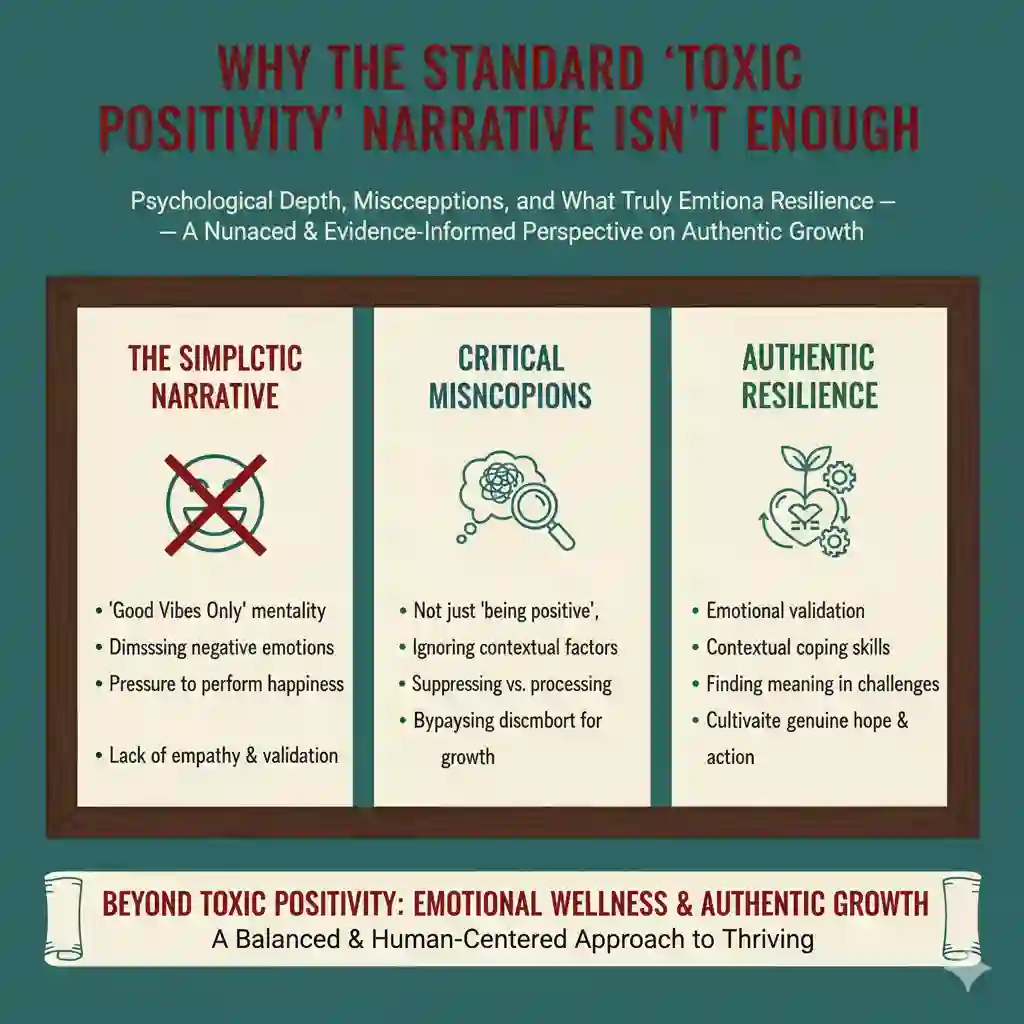
The oversimplification of emotions into “good” or “bad” categories deepens our tendency toward emotional suppression. This is a common pattern for individuals who are outwardly successful but internally struggling.
The Behavioral Science of Emotions — Beyond Labels
To move beyond toxic positivity, we have to understand what emotions are from a behavioral science perspective. Emotions are not moral judgments on your character; they are physiological and cognitive signals designed to guide your behavior.
- Emotions are data, not directives. Sadness might signal a loss. Anxiety might signal a perceived threat. Anger might signal a boundary violation. These feelings provide crucial information. They don’t have to control your actions, but ignoring them is like ignoring your car’s check engine light.
- Emotions are adaptive, even when painful. The discomfort of guilt can motivate us to make amends. The fear of failure can motivate us to prepare more thoroughly. These “negative” emotions evolved to help us survive and thrive.
- Emotional regulation is a skill, not an absence of feeling. Healthy individuals do not feel happy all the time. They feel the full spectrum of emotions, but they have developed the skills to manage them without being overwhelmed. This includes the ability to differentiate between similar feelings (e.g., disappointment vs. despair), a skill known as emotional granularity.
When we are pressured to be positive, we are discouraged from listening to this data. This can lead to a state of disconnection from our own internal world.
Toxic Positivity vs. Healthy Emotional Engagement
The difference between a toxic positive response and a healthily engaged one lies in whether it creates space for the real emotion or attempts to shut it down.
| Toxic Positivity | Healthy Engagement |
|---|---|
| Suppresses discomfort: “Don’t be sad, just think happy thoughts!” | Acknowledges and explores experience: “It sounds like you’re feeling really sad. Tell me more about what’s going on.” |
| Invalidates complexity: “It could be worse.” | Validates nuance: “It makes sense that you would feel both grateful and disappointed at the same time.” |
| Seeks a quick fix: “You just need to get over it.” | Builds sustainable understanding: “It’s okay to feel this way. Let’s figure out what support you need right now.” |
| Avoids negative emotion: “Good vibes only!” | Regulates negative emotion: “I’m feeling really anxious. I’m going to take a few deep breaths to calm my nervous system.” |
In practice, healthy engagement is about co-regulation and validation. It communicates: “Your feelings are normal and acceptable, even if they are painful.” This is a stark contrast to the implicit message of toxic positivity, which is: “Your negative feelings are a problem you need to fix.”
The Role of Cognition in Emotional Discomfort
Why is “just be positive” such ineffective advice? The answer lies in the cognitive mechanisms that process emotional pain. Our brains are not designed to simply delete unwanted feelings.
- Cognitive Dissonance: When we are in deep pain but are forcing ourselves to act happy, our brain experiences cognitive dissonance—a conflict between our internal state and our external behavior. This is mentally exhausting and often increases feelings of inauthenticity and self-alienation.
- The Rebound Effect of Suppression: Research consistently shows that trying to suppress a thought or feeling often makes it stronger. This is known as the “ironic process theory.” Telling yourself “don’t think about a white bear” makes the white bear the star of your mental show. Similarly, trying to force away sadness can lead to obsessive rumination about that very sadness.
- Threat Detection: When we are in a negative emotional state, our brain’s threat detection system (centered in the amygdala) is more active. We are cognitively primed to look for what’s wrong. Platitudes about positivity do nothing to soothe this underlying physiological state of alert.
Cultural and Social Roots of Toxic Positivity
Toxic positivity is not just a personal habit; it is a cultural phenomenon. Many Western societies, particularly in the workplace and on social media, implicitly reward the performance of happiness.
- Workplace Norms: Professional environments often value stoicism and a “can-do” attitude. Expressing sadness, anxiety, or burnout can be seen as unprofessional or a sign of weakness. This forces employees into a state of high-functioning anxiety, where they are performing well while internally crumbling.
- Social Media Culture: Platforms like Instagram are highlight reels. They create a distorted perception of reality where everyone else seems to be living a joyful, effortless life. This amplifies the pressure to project positivity and can make our own struggles feel isolating and abnormal.
- The Spread of Negativity: There’s also a deep-seated social fear of negative emotions being “contagious.” We sometimes offer positive platitudes not to help the other person, but to protect ourselves from the discomfort of their pain.
The Adaptive Role of Discomfort and Negative Emotion
A core part of moving beyond toxic positivity is reframing our relationship with discomfort. Anxiety, sadness, and frustration are not evidence of a broken mind; they are signals from a functioning one.
Emotional pain serves several adaptive purposes:
- It Motivates Change: The discomfort of dissatisfaction with your job is what motivates you to look for a new one. The pain of a broken relationship motivates you to seek healthier connections in the future.
- It Facilitates Processing: Sadness and grief are not obstacles to healing; they are the process of healing. They allow the brain to process a loss and recalibrate to a new reality. Understanding the physiological release that happens when we cry is a powerful tool in this process.
- It Promotes Social Connection: Expressing vulnerability authentically is one of the most powerful ways to build intimacy and trust. When we share our struggles with a trusted friend and are met with empathy, it strengthens social bonds and co-regulates our nervous system.
Practical Emotional Regulation Skills (Beyond Toxic Positivity)
If “just be positive” isn’t the answer, what is? The solution lies in building a toolkit of practical, behavior-anchored emotional regulation skills.
A. Emotional Differentiation (or Granularity)
This is the ability to put specific labels on your feelings. Instead of just feeling “bad,” can you identify if you are feeling disappointed, frustrated, lonely, or guilty? Research shows that the simple act of naming an emotion can reduce its intensity by engaging the prefrontal cortex, the part of the brain responsible for logical thought. Avoid global labels like “positive” or “negative” and get specific.
B. Cognitive Reframing (Not Suppression)
This is not about replacing a “negative” thought with a “positive” one. It is about examining your thoughts as data, not as directives. When you have the thought, “I am a failure,” instead of forcing yourself to think “I am a success,” you can ask:
- “Is this thought 100% true?”
- “What is a more balanced or compassionate way to look at this situation?”
- “What would I say to a friend in this exact situation?”
This creates psychological distance and reduces the thought’s emotional impact.
C. Context-Specific Responses
Different emotions call for different actions. The goal is to match your response to the signal the emotion is sending.
- Sadness might require comfort, rest, and connection.
- Anxiety might require problem-solving, a reality check, or nervous system regulation (like deep breathing).
- Anger might require setting a boundary or taking assertive action.
This approach honors the information your emotions are providing and uses it to inform wise action. It is about learning how to manage your internal state effectively, which is a core component of understanding how stress impacts your responses.
When Positivity Helps — and When It Hurts
Positivity is not inherently toxic. It is a vital component of resilience. The key is the type of positivity and its timing.
- Surface Positivity (Harmful): This is the reflexive, dismissive positivity offered in the face of acute pain. It is about making the discomfort go away as quickly as possible. This is the “look on the bright side” response to a fresh grief. It is invalidating and shuts down processing.
- Constructive Positivity (Helpful): This form of positivity is rooted in acceptance and action. It acknowledges the reality of the pain (“This is incredibly hard right now”) and then gently shifts focus toward agency and hope (“What is one small thing we can do to get through the next hour?”). It is about finding meaning, practicing gratitude, and focusing on controllable actions, but only after the initial emotion has been acknowledged.
Deep Behavioral Insight
“Emotions are not obstacles to positivity — they are data about what matters, what’s unresolved, and what needs our attention. A healthy emotional life does not mean eliminating negative feelings. It means developing the capacity to listen to them, learn from them, and use their energy to inform wiser, more compassionate action. The goal isn’t to avoid the storms of life, but to learn how to navigate them with skill and grace.”
Frequently Asked Questions (FAQs)
Is toxic positivity always harmful?
In moments of acute pain, yes, it is almost always invalidating and unhelpful. However, a generally optimistic outlook, when grounded in reality and not used to suppress feelings, is a strong predictor of well-being. The “toxicity” comes from the inappropriate application and denial of reality.
How do I balance positive thinking with real emotional work?
A good model is “feel, deal, heal.” First, allow yourself to feel the emotion without judgment. Second, deal with it by understanding what it’s telling you and taking appropriate action. Third, as you move through the process, you can integrate healing and constructive positivity to find meaning and move forward.
Why does suppressing emotions make things worse?
Suppressing emotions requires significant mental energy, leading to fatigue. It also triggers the “rebound effect,” where the suppressed thought or feeling comes back stronger. Finally, unexpressed emotions can manifest physically as headaches, digestive issues, or chronic tension.
How can I support someone without being “toxic positive”?
Listen more than you talk. Validate their feelings with phrases like, “That sounds incredibly difficult,” or “It makes sense that you feel that way.” Ask open-ended questions like, “What does support look like for you right now?” Offer your presence, not your solutions.
What is healthy emotional regulation in practice?
It is the ability to experience a strong emotion without being completely overwhelmed by it. It involves recognizing the feeling, understanding its message, and choosing a response rather than reacting impulsively. It is a flexible skill, not a rigid state of calm.
How does cognitive bias affect how we talk about emotions?
We have a negativity bias, meaning our brains are more sensitive to negative information. This can make us fear negative emotions. Culturally, we also have an “optimism bias,” which leads us to believe good things are more likely to happen to us. Toxic positivity arises when our optimism bias clashes with our negativity bias, and we try to force away the discomfort instead of processing it.