If you search for advice on how to start psychiatric care, you will find endless checklists. They tell you how to filter by insurance, how to check credentials, and what paperwork to bring to your first visit. These guides frame the process of finding a provider as a logistical hurdle—a series of administrative tasks to be completed so healing can begin.
While these steps are necessary, they are dangerously incomplete. They assume that access equals outcome. They suggest that once you sit in the chair, the work is simply a matter of the doctor prescribing and you complying. This article challenges that simplistic narrative. It explores the psychological reality of starting psychiatric care, arguing that true mental health outcomes are determined less by the directory you use and more by your cognitive readiness, emotional context, and internal alignment with the treatment.
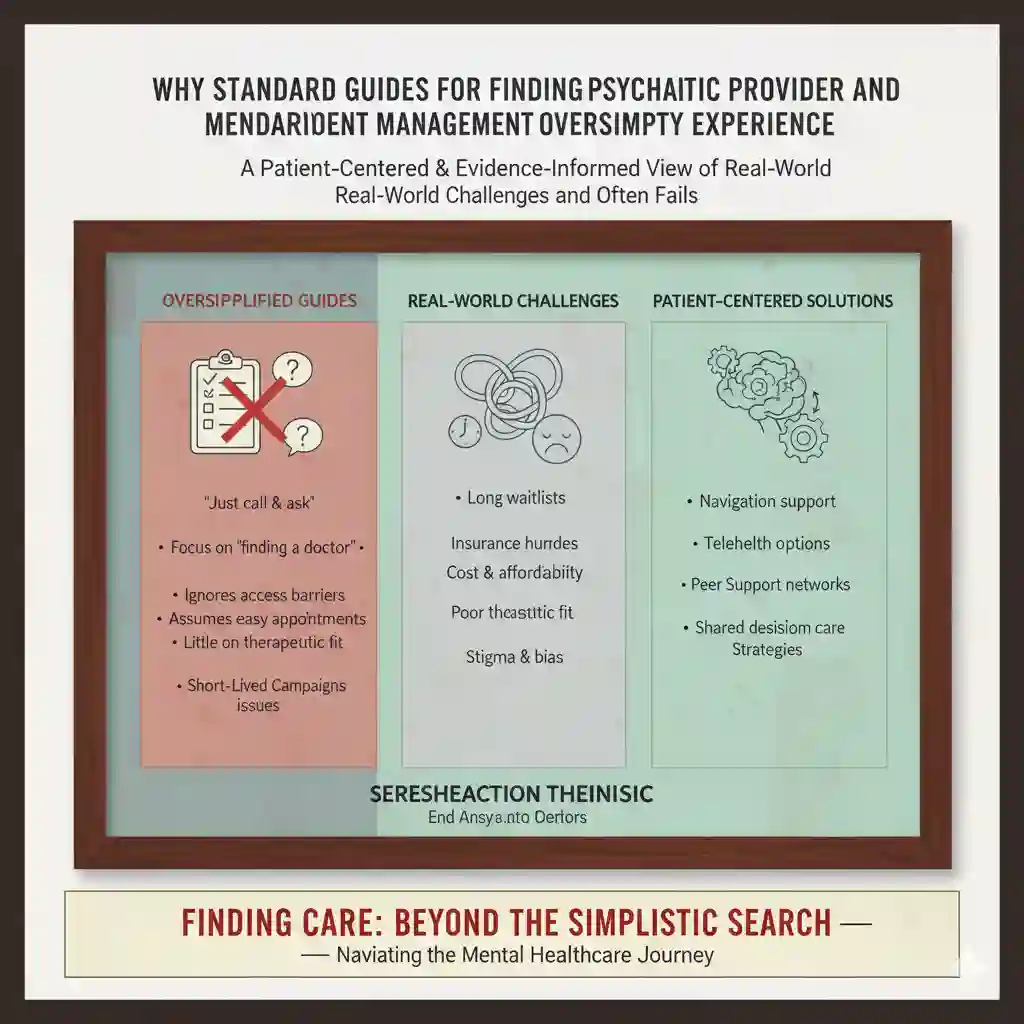
Fast Answer: Why “Find a Psychiatric Provider” Guides Are Incomplete
Standard guides focus almost exclusively on logistics: location, insurance acceptance, and availability. They treat mental health care like fixing a car—find the shop, drop it off, get it fixed. However, effective psychiatric care is deeply relational and internal. These guides rarely address patient mindset, psychological readiness, or cognitive-emotional preparedness.
The reality is that effective care depends less on proximity and more on internal alignment. You can see the most qualified psychiatrist in the world, but if your cognitive load is too high to process their advice, or if your emotional avoidance prevents honest reporting, the treatment will stall. Finding a provider is just the entry point; your psychological readiness is the engine.
Introduction: The Hidden Gap in Psychiatric Provider Guides
Typical advice for finding a psychiatric provider follows a predictable script:
- Search online directories.
- Filter for your specific condition (e.g., anxiety, depression).
- Prepare a list of questions about their philosophy.
- Know what to expect regarding intake forms and co-pays.
This advice isn’t wrong, but it is superficial. It frames the patient as a passive consumer of healthcare services. The hidden gap in these guides is the omission of the patient’s active role in shaping the outcome before the first prescription is even written.
True mental health outcomes are shaped more by your psychological preparation and environmental context than by the provider directory. A patient who understands their own resistance to medication, who has a strategy for managing side effects, and who has cleared mental space for the adjustment period will have a vastly different experience than one who simply shows up hoping for a fix.
Psychological Readiness Matters More Than Location
We often prioritize finding a provider close to home or work, assuming convenience is the key to consistency. But psychological proximity—how close you are to being honest with yourself—matters far more.
Emotional Openness and Tracking
Psychiatry relies on self-reporting. A provider can only treat what you reveal. Psychiatric medication readiness requires a willingness to track subtle shifts in your mood, sleep, and cognition. If you are not ready to be a reliable narrator of your own experience, the provider is working blind.
The Barrier of Cognitive Load
Many patients start care when they are at their breaking point. Their cognitive load—the amount of mental effort being used in working memory—is maxed out. If you are ruminating constantly or engaging in emotional avoidance, you may not hear the nuance in your provider’s instructions. You might miss critical guidance on titration or side effect management because your brain is simply too full.
Social Support and Environment
Standard guides rarely mention that your success often hinges on your environment. If you return from an appointment to a chaotic, unsupportive, or high-conflict home, the biological stabilization offered by medication faces an uphill battle. Your personal environment acts as either a catalyst or a dampener for clinical efficacy.
Why Appointment Prep Guides Often Mislead
Search for “how to prepare for a psychiatric appointment,” and you will be told to bring your medication history, a list of symptoms, and your insurance card. This creates a false sense of preparedness. You might have your papers in order but be completely unprepared for the emotional reality of the visit.
First psychiatric appointment expectations should include preparing for:
- Frustration Tolerance: Psychiatric diagnosis is rarely instant. It is an iterative process of elimination. If you expect a definitive answer in 45 minutes, you may leave feeling unheard or confused.
- Self-Sabotaging Thoughts: You need to prepare for the internal voice that says, “I’m not sick enough to be here,” or “Medication is a crutch.” These thoughts can derail treatment before it starts.
- Emotional Exposure: Recounting your history is draining. Standard guides don’t tell you to clear your schedule after the appointment because you might be emotionally exhausted.
True preparation isn’t about paperwork; it’s about calibrating your expectations to the reality of clinical ambiguity and emotional labor.
The Real Challenge of Psychiatric Medication Decisions
Medication management guides often present a binary choice: to take meds or not. They gloss over the complex interplay between chemistry and lifestyle.
Interaction with Routine and Cognitive Style
Medications don’t just change mood; they can alter energy levels, appetite, and sleep architecture. If your daily routine is rigid, a medication that causes drowsiness might functionally impair you even if it helps your anxiety. Psychiatric medication readiness means understanding how a chemical shift interacts with your specific lifestyle.
Functional Adaptation and Cognitive Tolerance
Success is not just adherence (taking the pill). It is about functional adaptation—adjusting your life to accommodate the medication while it does its work. It involves cognitive tolerance—the patience to wait 4-6 weeks for therapeutic benefits while enduring immediate, often uncomfortable, side effects. Guides that don’t discuss this “messy middle” phase set patients up for early discontinuation.
Emotional Anchoring
You need an “emotional anchor”—a baseline of who you are—to judge if a medication is helping. Without this self-awareness, you might mistake a normal bad day for medication failure, or conversely, mistake medication-induced numbing for “curing” your depression.
Social Context: Who You Talk to Matters
“Talk to your family and friends” is standard advice. It is also potentially hazardous. Social support and psychiatric care are deeply linked, but the quality of that support is variable.
The Risk of Misaligned Advice
If your support system is anti-psychiatry, or if they have their own unresolved trauma, their “support” can amplify your anxiety or guilt. A parent saying, “You don’t need pills, just exercise,” can create immense cognitive dissonance for a patient struggling with a biological mood disorder.
Constructive Feedback Strategies
Instead of broadcasting your decision, assess who in your life possesses the emotional maturity to offer objective feedback. You need observers who can say, “You seem more irritable lately,” without judgment, helping you track medication effects. Standard guides fail to teach this discernment, often leading patients to share vulnerable medical decisions with people who are not equipped to hold them.
Cognitive Load and Mental Clarity Before Psychiatric Care
The process of finding care is, ironically, stressful enough to worsen the condition you are trying to treat. Searching for providers, navigating insurance labyrinths, and scheduling intakes increases cognitive load.
Decision Fatigue
When your brain is overwhelmed, decision-making quality drops. You might choose a provider simply because they answered the phone, not because they are a good fit. Or you might agree to a treatment plan you don’t understand just to end the conversation.
Optimizing Clarity
Before your first appointment, use techniques to reduce mental noise. This might mean “cognitive off-loading”—writing down your narrative beforehand so you don’t have to hold it in working memory. It means recognizing that you are making high-stakes health decisions under duress and giving yourself permission to take notes, record sessions (with permission), or ask for written instructions to bypass your own mental fog.
When a Provider Choice Actually Impacts Outcomes
While internal readiness is paramount, the provider still matters. But not for the reasons usually listed in directories (like “5-star ratings”).
Matching Cognitive and Emotional Styles
Does the provider’s communication style match your cognitive needs? If you are a data-driven person who needs to understand the mechanism of action, a “warm and fuzzy” provider who speaks in vague metaphors might frustrate you. If you are highly sensitive and need validation, a sterile, clinical provider might cause you to shut down.
Alignment of Plans
Effective care aligns therapy, lifestyle, and medication. A provider who prescribes a sedative without asking if you drive a truck for a living is missing the holistic picture. Outcomes improve when the provider considers your cognitive readiness for therapy and medication within the context of your actual life.
Reframing the Purpose of “Finding a Provider”
We need to shift our goal. The purpose of finding a psychiatric provider is not just to “get seen” or “get a script.”
The goal is to create conditions where treatment insights translate into behavioral and emotional change.
When evaluating a provider, look beyond the insurance logo. Ask yourself:
- Does this environment make me feel safe enough to be honest?
- Does this provider’s pace match my processing speed?
- Is this a space where I can dismantle my defenses, or do I feel the need to keep them up?
This reframing moves the metric of success from access (getting an appointment) to alignment (getting the right care).
FAQs
How do I know I’m ready to start psychiatric care?
You are ready when you are willing to be honest about your symptoms, patient enough to endure the trial-and-error process of medication, and committed to tracking your own behavioral changes.
Does it matter which psychiatrist I choose, or just that I start?
Starting is crucial, but fit determines longevity. If you feel dismissed or misunderstood in the first few sessions, you are less likely to adhere to treatment. Psychological safety is a medical necessity, not a luxury.
How can I prepare emotionally for my first psychiatric appointment?
Expect to feel drained afterward. Plan for a quiet evening. distinct from logistical prep, write down your fears about treatment so you can discuss them openly rather than letting them sabotage the process subconsciously.
How do I know if medication is right for me before trying it?
You often cannot know for sure until you try. However, you can assess your readiness for it. Are your symptoms impairing your function? Have non-medical interventions stalled? If the biological noise is too loud to allow for behavioral change, medication is often the logical next step.
How do cognitive patterns affect therapy and medication outcomes?
If you have a pattern of catastrophic thinking, you might interpret a mild side effect as a medical emergency. If you have avoidance patterns, you might skip doses to avoid “feeling like a patient.” Identifying these cognitive patterns helps you separate the medication’s actual effects from your psychological reaction to taking it.