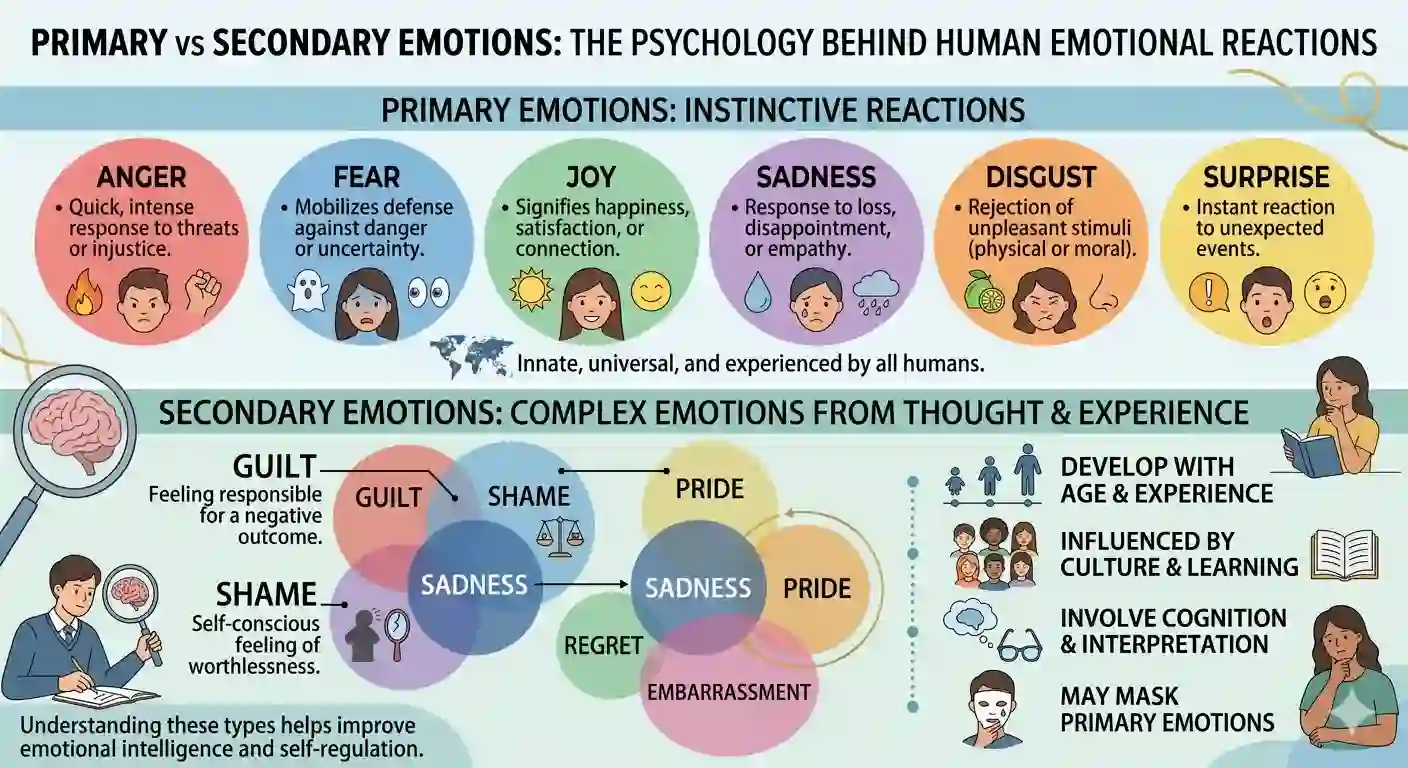
Human emotions are intricate, powerful, and deeply woven into our biology. At any given moment, you might experience a sudden flash of fear, followed closely by a lingering sense of embarrassment or guilt. To make sense of this internal landscape, behavioral scientists have established a clear system of emotion classification. Central to this framework is the distinction between primary and secondary emotions.

But what exactly are emotions? In the realm of emotion theory psychology, an emotion is a complex psychological and biological response to a specific stimulus. It involves physiological arousal, expressive behaviors, and conscious experience. Understanding the difference between emotion vs feeling is also crucial: emotions are subconscious, biological reactions, while feelings are the conscious interpretations of those emotions.
Psychologists classify emotions to help us untangle simple, automatic reflexes from complex emotional responses shaped by thoughts and social conditioning. By understanding primary and secondary emotions, we can decode our behavioral psychology, manage our emotional triggers, and ultimately build healthier, more resilient minds.
What Are Primary Emotions?
Primary emotions are the brain’s first, instinctual response to an external or internal stimulus. They are hardwired into our biology, acting as rapid survival mechanisms. When you encounter a sudden threat, your body does not wait for your conscious mind to analyze the situation; it instantly triggers a primary emotional response to keep you safe.
In basic emotions psychology, primary emotions are viewed as universal. Regardless of culture, upbringing, or geography, all humans experience and express these core emotions in remarkably similar ways. Their evolutionary purpose is straightforward: they prompt immediate action. Fear tells us to run, disgust tells us to avoid toxins, and anger prepares us to fight and defend our boundaries. If you find yourself frequently overwhelmed by sudden rage, you can explore the mechanics of this primary response by reading about why we get angry so fast.
Two major figures dominate this area of emotion theory psychology: Paul Ekman and Robert Plutchik.
Paul Ekman basic emotions theory famously identified six universal primary emotions based on cross-cultural facial expressions:
- Fear
- Anger
- Joy
- Sadness
- Surprise
- Disgust
Alternatively, Robert Plutchik emotions theory introduced a “wheel of emotions,” suggesting there are eight primary emotions grouped into polar opposites (joy vs. sadness, anger vs. fear, trust vs. disgust, and surprise vs. anticipation). Plutchik argued that these primary emotional states blend together to create more complex feelings, much like primary colors mix to create a full spectrum of paint.
List of Primary Emotions (Psychology)
To fully grasp the psychological emotions list, we must look at how each primary emotion functions in the wild. The table below outlines the core primary emotions, their triggers, and their behavioral purposes.
| Emotion | Trigger | Evolutionary Purpose | Typical Behavioral Response |
|---|---|---|---|
| Fear | Immediate threat or danger | Survival and protection | Fight, flight, or freeze |
| Anger | Blocked goals, injustice, or boundary crossing | Defense and problem resolution | Aggression, vocalization, standing ground |
| Joy / Happiness | Achievement, connection, or positive stimuli | Motivation and social bonding | Smiling, engagement, seeking more of the stimulus |
| Sadness | Loss, separation, or failure | Eliciting support and reflecting | Crying, withdrawal, slowing down |
| Disgust | Toxic substances or moral violations | Avoiding illness or social contamination | Wrinkling nose, turning away, physical repulsion |
| Surprise | Sudden, unexpected events | Orienting attention to gather new information | Widening eyes, freezing briefly to assess |
What Are Secondary Emotions?
While primary emotions are biological reflexes, secondary emotions are the reactions we have to our primary emotions. They are the emotional layers that develop after our conscious mind has had a moment to interpret, judge, or analyze the initial event.
In complex emotions psychology, secondary emotions are viewed as learned behaviors. They arise from combinations of primary emotions and are heavily influenced by our thoughts, personal history, and social context. For instance, if you feel a sudden burst of primary anger, you might immediately feel a secondary emotion of shame if you were raised to believe that expressing anger is unacceptable.
Secondary emotions are where the human experience becomes complicated. Because they rely on cognitive interpretation, two people can experience the exact same primary emotion but develop entirely different secondary emotions.
Common examples of secondary emotions include:
- Guilt: Arises when primary sadness or fear mixes with the cognitive belief that you have violated a personal moral code. You can learn more about managing this by exploring how to stop being controlled by guilt, shame, and regret.
- Shame: Stems from the belief that you are fundamentally flawed, often following primary fear of social rejection.
- Jealousy: A complex mix of primary fear (of loss), anger, and sadness regarding a perceived threat to a relationship. See how to navigate this by turning jealousy into personal growth.
- Embarrassment: Triggered by sudden self-consciousness in a social setting, often following a primary emotion of surprise or fear.
- Pride: A secondary response to joy or satisfaction, heavily dependent on social values and self-concept.
- Envy: A mixture of primary sadness and anger directed at someone else’s perceived advantage.
When secondary emotions harden into long-term grudges, they can severely impact mental health. Unpacking these feelings is a critical step in letting go of resentment for emotional freedom.
How Secondary Emotions Develop
To understand how emotions develop, we must look at the cognitive appraisal theory. This psychological framework suggests that our emotional experience depends entirely on how we evaluate (or appraise) a situation.
The emotional response process generally follows these emotional reaction stages:
- The Stimulus: An event occurs (e.g., someone cuts you off in traffic).
- Primary Emotional Response: Your limbic system reacts instantly with a surge of primary fear or anger to protect you.
- Cognitive Interpretation: A fraction of a second later, your prefrontal cortex analyzes the event based on your beliefs, memories, and social conditioning.
- Secondary Emotion: Based on your analysis, a new emotion emerges. If you think, “I am an idiot for letting them cut me off,” your secondary emotion will be shame. If you think, “People are always disrespecting me,” your secondary emotion will be profound resentment.
When you are under pressure, this cognitive interpretation phase can become skewed. High cortisol levels make it difficult for the prefrontal cortex to accurately assess a situation, leading to intense secondary emotional responses. You can see this dynamic in action by learning how stress impacts emotional responses.
Primary vs Secondary Emotions: Key Differences
To solidify your emotional awareness, it helps to view the distinctions between primary and secondary emotions side-by-side.
| Characteristic | Primary Emotions | Secondary Emotions |
|---|---|---|
| Speed of Onset | Instantaneous, automatic, and rapid. | Slower, developing after cognitive processing. |
| Complexity | Simple and direct (e.g., pure fear). | Complex and layered (e.g., guilt mixed with anger). |
| Cognitive Involvement | Low. Bypasses conscious thought initially. | High. Requires memory, judgment, and interpretation. |
| Duration | Typically fleeting, passing once the stimulus ends. | Can last for days, months, or years if ruminated upon. |
| Cultural Influence | Universal across all human cultures. | Highly subjective, learned, and culturally specific. |
| Biological Source | Primarily the limbic system (amygdala). | Heavy involvement of the prefrontal cortex. |
The Neuroscience of Emotional Processing
A deep dive into the neuroscience of emotions reveals exactly why secondary emotions are so difficult to control. Emotional processing in the brain involves a complex dialogue between our primitive survival centers and our advanced, logical brain.
The limbic system is the emotional headquarters of the brain. Within it sits the amygdala, an almond-shaped structure responsible for detecting threats and triggering primary emotions. When the amygdala senses danger, it floods the body with adrenaline and bypasses rational thought, creating a pure limbic system emotions response.
Once the initial threat assessment is made, the prefrontal cortex—the brain’s rational, decision-making center—steps in. The prefrontal cortex attempts to apply logic, social rules, and emotional memory to the situation. It decides whether the amygdala’s reaction was appropriate.
If the prefrontal cortex decides you behaved poorly during your primary emotional spike, it will generate a secondary emotion like guilt or shame. This intricate dance between the amygdala and prefrontal cortex is the biological basis for emotional regulation. Furthermore, our neural pathways are highly sensitive to the emotional states of those around us, a phenomenon deeply connected to the science of emotional contagion.
Real-Life Examples of Primary and Secondary Emotions
To see this psychological phenomenon in action, let us look at common real-life scenarios.
Scenario 1: Receiving Harsh Criticism at Work
- Stimulus: Your boss publicly criticizes your project presentation.
- Primary Emotion: You feel immediate sadness and a physical drop in your stomach.
- Cognitive Interpretation: You think, “I look foolish in front of my colleagues. Everyone thinks I am incompetent.”
- Secondary Emotion: You experience intense embarrassment and shame, which quickly morphs into defensive anger toward your boss to protect your ego.
Scenario 2: Social Rejection
- Stimulus: You are not invited to a close friend’s weekend gathering.
- Primary Emotion: You feel an immediate, sharp pang of sadness (social pain registers similarly to physical pain in the brain).
- Cognitive Interpretation: You begin to assume they do not value your friendship or that you are inherently unlikable.
- Secondary Emotion: You feel deep inadequacy and jealousy toward the people who were invited. To understand the biological weight of this scenario, read why rejection feels physical.
Scenario 3: Relationship Conflict
- Stimulus: Your partner raises their voice during an argument.
- Primary Emotion: Your amygdala detects a threat, triggering sudden fear.
- Cognitive Interpretation: Your brain interprets this fear as vulnerability. You decide that being vulnerable is weak and unacceptable.
- Secondary Emotion: You mask the fear with secondary rage, lashing out verbally to regain a sense of control and safety.
Why Understanding Secondary Emotions Improves Emotional Intelligence
Emotional intelligence (EQ) is the ability to recognize, understand, and manage our own emotions, as well as influence the emotions of others. A foundational pillar of EQ is the ability to distinguish between primary and secondary emotions.
When you lack emotional awareness, you tend to act on your secondary emotions as if they are absolute truths. If you feel secondary anger, you assume someone has wronged you, leading to destructive behavior.
However, when you understand the emotional response process, you can pause and trace your complex secondary emotion back to its primary root. You realize your anger is actually a mask for primary fear or sadness. This self-regulation is the key to psychological resilience. It allows you to communicate your true needs rather than lashing out. If you want to strengthen this mental fortitude, discover the secret behind emotional resilience and learn how to navigate your inner landscape effectively.
Furthermore, unpacking your secondary emotions is essential for dismantling deep-seated self-doubt. You can explore how this cognitive work helps you thrive by overcoming insecurity and building self-worth.
Common Misconceptions About Emotions
There is a vast amount of misinformation surrounding human behavior and emotional processing. Let us clarify a few common myths in behavioral psychology.
Myth 1: “Negative emotions are bad.”
In emotion classification, no primary emotion is inherently “bad.” Sadness, fear, and anger are all vital survival signals. They provide crucial data about our environment and our boundaries. Labeling them as bad causes us to suppress them, which inevitably leads to volatile secondary emotions.
Myth 2: “Secondary emotions are fake.”
Secondary emotions are entirely real and physically felt. The distinction is not about reality, but about origin. A secondary emotion of guilt causes real physiological distress, even if the cognitive interpretation that caused it is flawed.
Myth 3: “Emotions are irrational.”
Primary emotions are highly rational biological responses to stimuli. They happen for a specific evolutionary reason. What often becomes irrational is our cognitive appraisal—the story we tell ourselves about the primary emotion that generates a distorted secondary emotional reaction.
How to Recognize Your Emotional Layers
Gaining control over your psychological response requires active practice. Here are steps to help you peel back your emotional layers:
- Pause and Notice the Physical Sensation: When triggered, stop before reacting. Where do you feel the emotion in your body? Primary emotions often have distinct physical signatures (e.g., heat in the chest for anger).
- Name the Surface Emotion: Identify what you are feeling right now. Is it frustration? Jealousy? Guilt? Acknowledge this secondary emotion without judgment.
- Ask the “What is underneath?” Question: Probe deeper. Ask yourself, “What did I feel immediately before this?” or “What primary emotion am I trying to protect myself from?” Usually, you will find fear, sadness, or surprise hiding beneath complex emotions.
- Challenge the Narrative: Identify the thought that bridged the primary and secondary emotion. Are you making an assumption? Are you catastrophizing? This is a crucial step to prevent mental spiraling, which you can learn more about in why we overthink the psychology and neuroscience of anxiety.
Frequently Asked Questions
What are the 6 primary emotions?
According to Paul Ekman basic emotions theory, the six universal primary emotions are fear, anger, joy, sadness, surprise, and disgust. These are biologically hardwired and recognized across all human cultures.
Can secondary emotions become automatic?
Yes. Through repeated neural reinforcement, a specific stimulus can trigger a secondary emotion so quickly that it feels like a primary response. For example, if you repeatedly experience shame after making a mistake, your brain will eventually bypass the initial primary sadness and jump straight to automatic shame.
Are secondary emotions learned?
Absolutely. Secondary emotions are heavily influenced by cultural conditioning, family dynamics, and personal past experiences. They require cognitive appraisal, meaning you must “learn” the rules of what to feel guilty, proud, or embarrassed about based on your environment.
Are complex emotions universal?
Unlike primary emotions, complex secondary emotions are not entirely universal. While humans everywhere experience things like guilt and pride, the specific triggers for these complex emotions psychology vary wildly depending on societal norms and individual belief systems.
Conclusion
The distinction between primary and secondary emotions is one of the most transformative concepts in behavioral psychology. Emotional layering dictates how we interact with the world: our primary emotions act as a fast, biological alarm system, while our secondary emotions serve as a complex, thought-driven commentary on those initial alarms.
By prioritizing emotional awareness, you can stop reacting blindly to secondary emotions like shame, jealousy, and resentment. Instead, you can learn to sit with your primary emotions—fear, sadness, and anger—processing them healthily as they arise. Understanding this intricate emotional processing in the brain is not just an academic exercise; it is the fundamental key to improving your mental health, mastering your behavioral responses, and cultivating deeper, more authentic human connections.