Table of Contents
- Quick Answer: What Is Habit Formation?
- Summary: Understanding the Science of Habits
- The Psychology and Neuroscience of Habit Formation
- The Habit Loop: Cue → Routine → Reward
- How the Brain Builds and Reinforces Habits
- Breaking Bad Habits and Building Positive Ones
- Habit Formation and Long-Term Behavior Change
- Practical Applications: Turning Science into Daily Practice
- MindBehavior Insight: How Habits Shape Emotions & Cognition
- FAQs: Common Questions About Habit Science
- People Also Ask (PAA) Insights
- Final Thoughts: Rewiring Your Mind for Positive Change
Quick Answer: What Is Habit Formation?
Habit formation is the scientific process by which a behavior becomes automatic through repetition and neural reinforcement. Each time you repeat an action under similar conditions, your brain strengthens the neural pathways that control that action. This process primarily occurs in the basal ganglia, the part of the brain responsible for storing learned behaviors. Over time, the behavior becomes easier and less conscious—forming a habit loop of cue → routine → reward, reinforced by the brain’s dopamine response.
Summary: Understanding the Science of Habits
Habits define much of our lives—they determine how we eat, work, think, and even feel. Scientifically, habits are mental shortcuts that help conserve cognitive energy. Instead of deciding each time whether to act, the brain relies on previously reinforced neural patterns.
This process is not only psychological but also deeply neurological. By repeating certain actions, we reprogram our brain’s wiring—a phenomenon known as neuroplasticity. Over time, what begins as a deliberate action turns into an automatic behavior. Understanding this process empowers us to design better habits, replace negative ones, and create long-lasting behavioral change aligned with our goals.
1. The Psychology and Neuroscience of Habit Formation
How the Brain Turns Actions into Habits
The brain’s ability to form habits is one of its most efficient survival tools. At the center of this process is the basal ganglia, which stores repetitive actions and automates them to save mental energy. When you first start a behavior—like exercising or meditating—your prefrontal cortex (responsible for decision-making) is active. But as the habit strengthens, the control shifts to deeper regions like the basal ganglia, freeing up your conscious mind for new tasks.
Dopamine, the brain’s reward chemical, plays a vital role here. Every time you complete a routine and feel good about it, dopamine reinforces that pathway. This makes the habit more appealing and likely to be repeated. Over time, your brain learns to crave the reward even before you act, making the habit automatic.
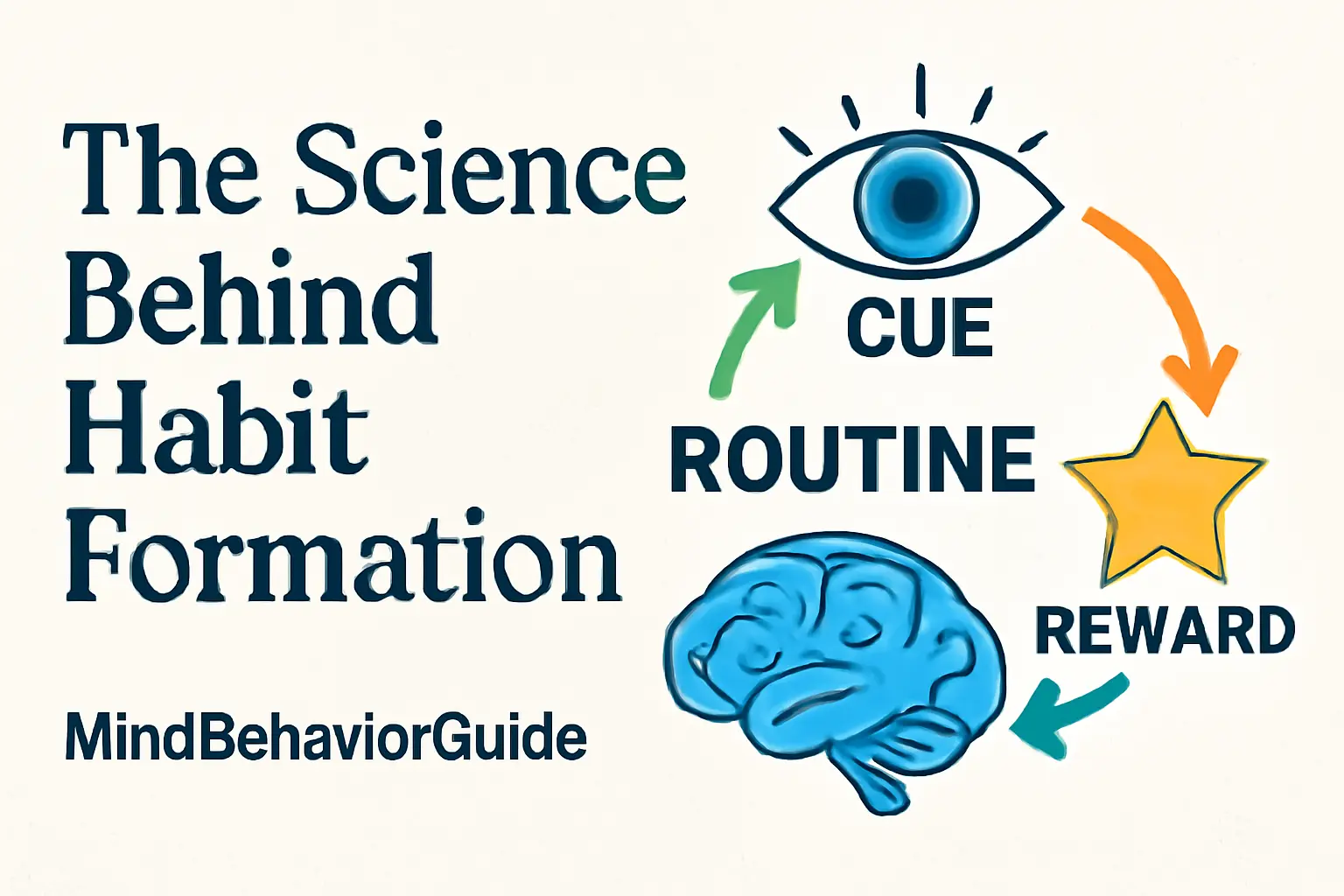
2. The Habit Loop: Cue → Routine → Reward
The habit loop—first introduced by Charles Duhigg—explains how habits form in a cycle of three repeating stages:
| Stage | Description | Example |
|---|---|---|
| Cue | A trigger that tells your brain to start the behavior | Feeling stressed |
| Routine | The behavior itself | Eating sweets |
| Reward | The satisfaction or relief that follows | Feeling calm or comforted |
Over time, the cue becomes linked to the reward in your brain. You no longer think about whether to act—you just do. This explains why bad habits can feel so automatic and why replacing the routine (not just removing it) is the key to successful habit change.
3. How the Brain Builds and Reinforces Habits
When a habit forms, it creates a neural circuit that connects cue, behavior, and reward. Every repetition strengthens the connections—much like a muscle grows stronger with use. This process is called synaptic reinforcement.
The dopamine system rewards successful behavior patterns. When an action leads to pleasure, your brain marks it as valuable. Over time, even anticipating the cue can release dopamine, pushing you to act before you consciously choose to. This is why habits feel “automatic.”
Scientific insight:
- Repetition builds automaticity (actions require less effort).
- Rewards create positive feedback loops.
- Context consistency (same time/place) strengthens neural associations.
4. Breaking Bad Habits and Building Positive Ones
Habits can’t simply be deleted—they must be replaced. The brain resists empty gaps in the habit loop, so the goal is to swap the routine while keeping the cue and reward.
For instance:
- Cue: Feeling anxious
- Old routine: Scrolling social media
- New routine: Deep breathing or journaling
- Reward: Relief and calm
Using this approach, you “trick” your brain into following a new path. Over time, this new pathway becomes stronger while the old one weakens.
Tools for breaking bad habits:
- Awareness journaling: Track triggers and emotional states.
- Environmental redesign: Remove cues linked to the habit.
- Implementation intentions: Plan specific “if-then” strategies (e.g., “If I feel bored, I’ll go for a walk.”)
5. Habit Formation and Long-Term Behavior Change
Willpower alone is unreliable. Science shows that environmental design, repetition, and systems sustain habits better than motivation. When you repeat a behavior in the same context, the brain learns the pattern and eventually automates it.
To make habits last:
- Use habit stacking: Attach new behaviors to existing routines (e.g., “After brushing teeth, I’ll meditate for 2 minutes”).
- Track progress: Visible growth triggers the reward system.
- Celebrate micro-successes: Small wins boost dopamine and motivation.
Sustained habits are not about doing more—they’re about doing less consciously until it becomes identity-driven.
6. Practical Applications: Turning Science into Daily Practice
To apply habit science practically:
- Start small. Tiny habits build momentum.
- Anchor behaviors. Link new actions to stable routines.
- Reward progress. Reinforce with positive feedback or pleasure.
- Reflect weekly. Journaling reinforces awareness and growth.
- Stay consistent. Miss once—recover immediately.
By treating habit formation as a scientific experiment rather than a willpower challenge, you create predictable, sustainable change.
7. MindBehavior Insight: How Habits Shape Emotions & Cognition
At MindBehaviorGuide, we emphasize that habits don’t only control actions—they also shape your emotional patterns and thought processes.
- Emotional Habits: Constant worry, gratitude, or self-criticism are learned emotional responses. They become automatic reactions over time.
- Cognitive Habits: Repeated thinking patterns, such as negative self-talk, become ingrained beliefs.
- Mindfulness as a tool: By becoming aware of your automatic responses, you interrupt the loop and consciously choose new patterns.
This intersection between habit science and emotional intelligence allows deep transformation—rewiring both behavior and mindset for long-term well-being.
8. FAQs: Common Questions About Habit Science
| Question | Detailed Answer |
|---|---|
| What are the 4 stages of habit formation? | Cue, craving, response, and reward—these create a neurological loop that drives repetition. |
| How long does it take to form a habit scientifically? | Research by Dr. Phillippa Lally (University College London) found it takes 21–66 days, depending on behavior complexity. |
| What part of the brain controls habits? | The basal ganglia controls automatic habits, while the prefrontal cortex initiates new behaviors. |
| Can habits change permanently? | Yes—through consistent repetition, reward substitution, and environmental cues, the brain rewires itself. |
| What’s the difference between a habit and a behavior? | A behavior is a single act; a habit is a behavior repeated until it becomes subconscious. |
🔎 9. People Also Ask (PAA) Insights
What is the scientific definition of a habit?
A habit is a learned behavior that becomes automatic through repetition, driven by consistent cues and rewards. Scientifically, it is a neural pattern stored in the basal ganglia that enables quick, energy-efficient actions without conscious effort.
How does dopamine help form habits?
Dopamine is the brain’s reward chemical. When a behavior leads to a satisfying outcome, dopamine signals the brain to remember that action. Over time, dopamine release shifts to the cue that predicts the reward, reinforcing the habit loop.
Can you unlearn a bad habit completely?
You cannot erase a habit from memory, but you can weaken its influence by consistently replacing the behavior with a new routine tied to the same cue and reward. The old neural pathway fades as the new one strengthens through repetition.
How do habits influence motivation and identity?
Habits shape identity by reinforcing beliefs about who we are. When we act in alignment with our goals, we begin to see ourselves as the kind of person who behaves that way. This identity-based motivation sustains habits longer than willpower alone.
Is habit formation the key to personal growth?
Yes. Sustainable personal growth relies on daily actions repeated consistently over time. Habit formation transforms aspirations into systems, making progress automatic and long-lasting.
🧭 Final Thoughts: Rewiring Your Mind for Positive Change
The science behind habit formation shows that change isn’t about force—it’s about structure. By understanding how cues, routines, and rewards interact, you can design behaviors that align with your goals and values.
Whether you’re trying to build focus, improve emotional health, or transform your mindset, habit science gives you a practical roadmap for growth. Every small, consistent action rewires your brain toward a better version of yourself.