Table of Contents
- Introduction: The Brain’s Power to Change Itself
- Step 1: Understanding Neuroplasticity — Your Brain Is a Living System
- Step 2: How Habits and Thoughts Carve Neural Pathways
- Step 3: The Cycle of Repetition, Reward, and Reinforcement
- Step 4: Reflection — The Hidden Accelerator of Change
- Step 5: Emotional Plasticity — How Feelings Shape Neural Growth
- Step 6: Breaking Old Patterns and Building New Ones
- Step 7: Mindfulness and Intentional Neuroplasticity
- Step 8: Designing a Brain That Works for You
- Final Thoughts: Transformation Is Training, Not Magic
- FAQs About Neuroplasticity and Personal Change
Introduction: The Brain’s Power to Change Itself
For centuries, scientists believed the brain was fixed — that by adulthood, its wiring was set in stone.
We now know that’s false.
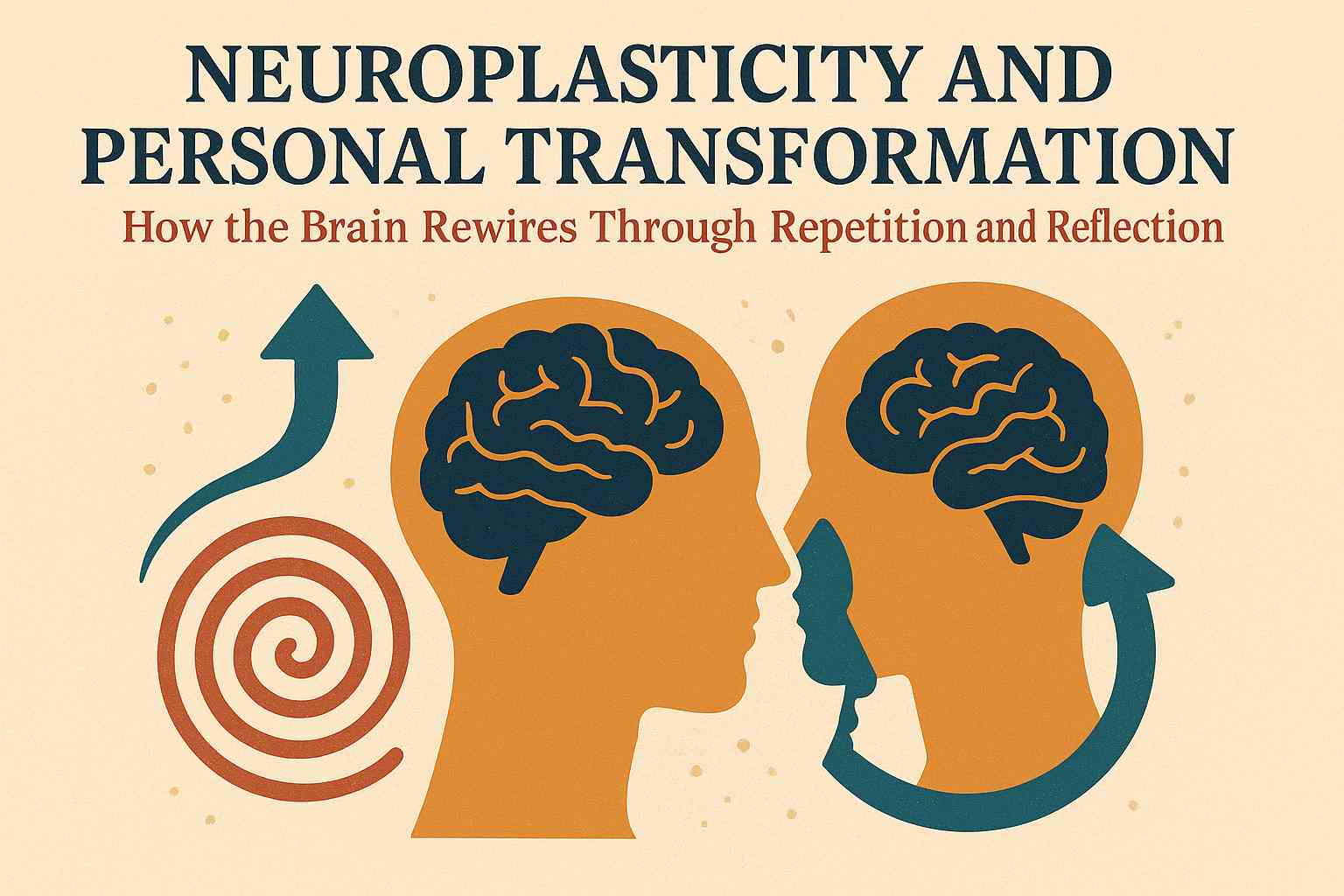
Neuroplasticity is the discovery that your brain continually reshapes itself in response to thought, emotion, and experience. Every repetition strengthens some pathways and weakens others.
In simple terms: you are literally training your brain with everything you do, think, and feel.
Personal transformation, therefore, isn’t about becoming someone new.
It’s about retraining the neural patterns that define who you already are.
Step 1: Understanding Neuroplasticity — Your Brain Is a Living System
The brain contains about 86 billion neurons, each connected to thousands of others. These connections — synapses — form networks that represent your thoughts, skills, memories, and beliefs.
When neurons fire together repeatedly, they form stronger bonds — a process captured by the principle:
“Neurons that fire together, wire together.”
The inverse is also true: pathways that aren’t used begin to fade, a process known as synaptic pruning.
Your brain is like a dynamic ecosystem: the neural connections you nurture grow stronger, and the ones you neglect wither.
Action Step:
Notice your daily mental habits. Every repeated thought (“I can’t,” “I can,” “I’ll try”) strengthens a pathway. Choose them consciously.
Step 2: How Habits and Thoughts Carve Neural Pathways
Every behavior you repeat — from brushing your teeth to scrolling your phone — engrains a neural circuit.
The more consistent the behavior, the less conscious effort it requires. That’s how habits form.
The same applies to thinking patterns: optimism, doubt, anxiety, gratitude — all are mental habits reinforced through repetition.
Action Step:
Reframe unhelpful thoughts before they repeat.
When you catch yourself thinking “I always fail,” rewire it into “I’m still learning.”
Each reframe creates a new neural pattern.
Step 3: The Cycle of Repetition, Reward, and Reinforcement
Neuroplasticity thrives on feedback.
Each time you perform a behavior, the brain evaluates whether it was rewarding or costly — and adjusts accordingly.
This is governed by the dopamine system, which reinforces behaviors that lead to perceived success or pleasure.
- Repetition builds the connection.
- Reward strengthens it.
- Reflection stabilizes it.
Together, these form the three pillars of brain change.
Action Step:
Celebrate small wins — your brain needs immediate positive feedback to reinforce learning. Even self-praise releases reinforcing dopamine.
Step 4: Reflection — The Hidden Accelerator of Change
Repetition wires new behavior, but reflection cements it.
When you pause to think about why something worked or failed, you activate the prefrontal cortex, integrating conscious awareness into neural learning.
Reflection converts experience into wisdom.
Action Step:
After key actions or events, ask:
- “What did I learn?”
- “What emotion did I feel?”
- “What will I do differently next time?”
This reflective loop builds meta-awareness, the foundation of conscious transformation.
Step 5: Emotional Plasticity — How Feelings Shape Neural Growth
Emotions supercharge neuroplasticity.
When an experience carries emotional intensity — joy, fear, love, pride — it embeds faster and deeper.
That’s why emotional learning (both positive and negative) shapes identity so powerfully.
Positive emotions like curiosity, gratitude, and accomplishment enhance dopamine and serotonin levels, amplifying learning.
Chronic stress, on the other hand, floods the brain with cortisol, shrinking the hippocampus (memory center) and impairing growth.
Action Step:
When building a new habit, attach a positive emotional cue.
Pair effort with enjoyment — music, environment, or gratitude. Emotion is the glue of memory.
Step 6: Breaking Old Patterns and Building New Ones
To unlearn an old habit, you must deactivate its neural circuit through non-use and replace it with a stronger alternative.
Suppression alone doesn’t work — replacement does.
Example:
Instead of “Don’t check my phone,” shift to “When I feel the urge, I’ll take 3 deep breaths.”
Over time, the new pathway overrides the old.
Action Step:
Identify your top 1–2 unhelpful patterns.
Then design a replacement routine that fulfills the same emotional need in a healthier way.
Consistency rewires faster than intensity.
Step 7: Mindfulness and Intentional Neuroplasticity
Mindfulness is one of the most scientifically validated methods to intentionally direct neuroplasticity.
By observing thoughts and emotions without judgment, you weaken the automatic circuits that fuel anxiety, impulsivity, and overthinking.
MRI studies show that mindfulness thickens the prefrontal cortex (focus and control) and shrinks the amygdala (fear center).
Action Step:
Spend 5 minutes daily in observation mode:
- Focus on your breath.
- Notice thoughts arising and passing.
- Label them (“thinking,” “worrying,” “remembering”).
Each time you observe instead of react, you rewire awareness itself.
Step 8: Designing a Brain That Works for You
Your brain becomes what you repeatedly do.
If you feed it chaos, it wires for chaos.
If you feed it focus, gratitude, and discipline, it wires for excellence.
Intentional brain design includes:
- Sleep → consolidates new neural pathways.
- Nutrition → supports neurotransmitter production.
- Movement → increases brain-derived neurotrophic factor (BDNF), the “Miracle-Gro” for neurons.
- Learning → keeps neuroplasticity active at any age.
Action Step:
Adopt a “neural training plan”:
- Learn something new weekly.
- Move your body daily.
- Reflect nightly.
Growth becomes a biological rhythm.
Final Thoughts: Transformation Is Training, Not Magic
Neuroplasticity proves something profound:
You are not the sum of your past — you are the sum of your repetitions.
Every skill, emotion, and mindset is a pattern of connections that can be reshaped with intention.
Change doesn’t require perfection — it requires persistence and reflection.
Your brain is always listening.
What you practice, it becomes.
FAQs About Neuroplasticity and Personal Change
Q: How long does it take to rewire the brain?
A: Research suggests 30–90 days of consistent repetition can form new neural pathways, but deep identity shifts occur with sustained practice and reflection.
Q: Can neuroplasticity work at any age?
A: Yes. The brain remains plastic throughout life. Older adults may change more slowly but with greater depth due to experience-based reinforcement.
Q: What’s the fastest way to strengthen new habits?
A: Repetition paired with positive emotion and immediate feedback — that combination locks in neural circuits efficiently.
Q: Can meditation really rewire the brain?
A: Absolutely. Studies show mindfulness increases gray matter in regions linked to attention, empathy, and self-regulation.
Q: How can I track my personal transformation?
A: Journal your reflections weekly. Progress in mindset, awareness, and response to stress signals real neural change long before external results appear.