Table of Contents
- Introduction: Why Resilience Is More Important Than Success
- Step 1: The Psychology of Bouncing Back
- Step 2: What Is Grit, and Why Does It Matter?
- Step 3: The Brain’s Response to Adversity
- Step 4: Reframing Setbacks as Signals, Not Stop Signs
- Step 5: The 3 Levels of Resilience — Mental, Emotional, and Behavioral
- Step 6: Building Grit Through Consistent Discomfort
- Step 7: The Role of Purpose in Resilience
- Step 8: Recovery, Reflection, and the Bounce-Back Blueprint
- Final Thoughts: Resilience Is Built in the Fall, Not the Rise
- FAQs About Resilience, Reframing, and Grit
Introduction: Why Resilience Is More Important Than Success
Success is fragile without resilience.
Discipline is meaningless if you collapse at the first setback.
What separates those who grow from those who give up isn’t luck, talent, or resources — it’s the ability to recover and continue.
Resilience is not about ignoring pain. It’s about facing it, reframing it, and moving through it with wisdom.
You don’t have to avoid falling. You just have to become someone who gets back up stronger.
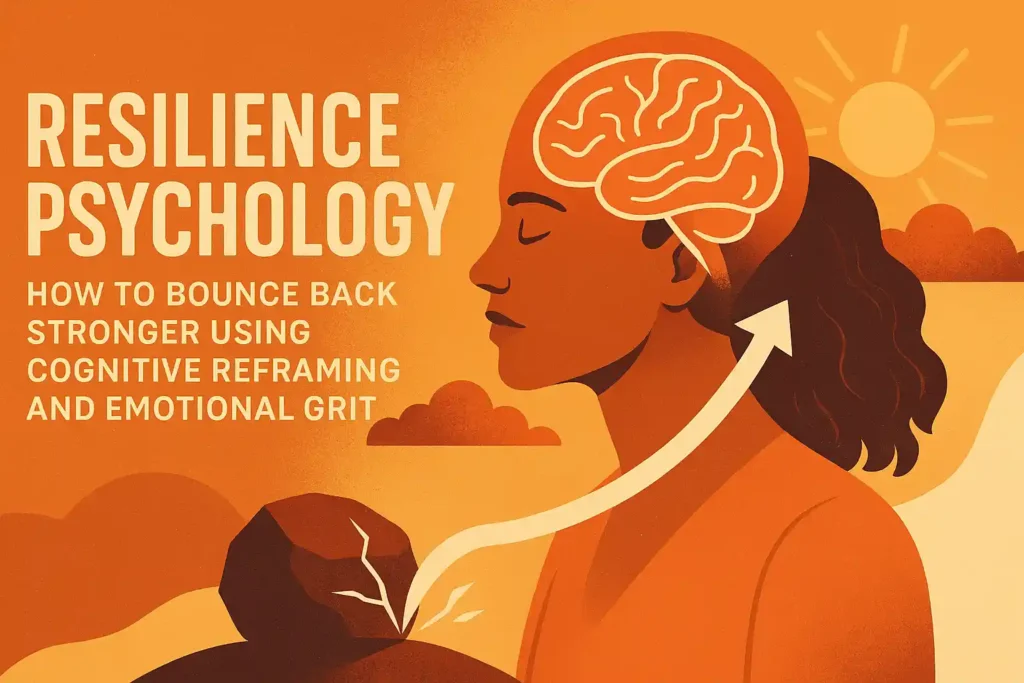
Step 1: The Psychology of Bouncing Back
Resilience is the learned capacity to adapt, recover, and grow through adversity.
It’s not toughness — it’s flexibility.
According to the American Psychological Association (APA), resilience includes:
- Emotional regulation
- Mental agility
- Optimistic thinking
- Connected support
- Purpose-driven action
Action Step:
When something goes wrong, don’t ask: “Why me?”
Ask:
“What is this situation asking me to grow into?”
That shift begins the resilience process.
Step 2: What Is Grit, and Why Does It Matter?
Grit = Passion + Perseverance for long-term goals, as defined by psychologist Angela Duckworth.
It’s the willingness to keep showing up, especially when progress is invisible.
Grit is built through:
- Frustration tolerance
- Emotional self-regulation
- Long-view thinking
- Identity-based persistence
Action Step:
Clarify your “why.” Grit requires fuel.
Ask:
“What is this hard thing ultimately helping me become?”
Meaning sustains effort when motivation fades.
Step 3: The Brain’s Response to Adversity
When you encounter failure, rejection, or pain, your amygdala (emotional alarm center) activates first.
This triggers cortisol release and emotional narrowing — fight, flight, or freeze.
But when the prefrontal cortex gets engaged, you can reframe the event, shift your meaning, and choose a higher response.
This process — known as cognitive reappraisal — is the neuroscience of resilience.
Action Step:
Next time you’re hit with stress, pause and reframe:
“This isn’t happening to me — it’s happening for me.”
Then ask:
“What would the resilient version of me do next?”
Step 4: Reframing Setbacks as Signals, Not Stop Signs
The story you tell about adversity determines how long it controls you.
Victim mindset: “This proves I can’t.”
Resilient mindset: “This is feedback for my next move.”
Setback → Meaning → Identity → Response
Action Step:
After any setback, journal:
- What actually happened?
- What meaning did I assign?
- What belief did that reinforce?
- What belief do I want to reinforce instead?
Reflection rewires reaction.
Step 5: The 3 Levels of Resilience — Mental, Emotional, and Behavioral
To become fully resilient, you need a 3-layered system:
1. Mental Resilience – Flexible thinking under stress
- Practice reframing
- Limit catastrophizing
- Stay present-focused
2. Emotional Resilience – Processing pain instead of avoiding it
- Use breathwork and labeling
- Release suppressed emotion
- Build emotional granularity (nuanced feeling awareness)
3. Behavioral Resilience – Continuing to act despite discomfort
- Create micro-habits
- Build fail-safe routines
- Reduce reliance on motivation
Action Step:
Pick your weakest domain (mental, emotional, behavioral) and build a small daily ritual to strengthen it.
Step 6: Building Grit Through Consistent Discomfort
Grit grows when you repeatedly engage in controlled challenge — situations that stretch you without breaking you.
This is the core of deliberate adversity training, such as:
- Cold showers
- Timed silence/focus
- Physical exercise
- Saying no
- Honest conversations
Your nervous system learns: “I can do hard things — and survive.”
Action Step:
Choose one controlled discomfort per day.
Then reflect:
“What did I learn about myself through that?”
Confidence follows resilience.
Step 7: The Role of Purpose in Resilience
Without purpose, pain feels pointless.
With purpose, pain becomes meaningful.
Neuroscience shows that when people interpret struggle as part of a larger mission, their pain tolerance, emotional endurance, and persistence increase dramatically.
Purpose lights the path through difficulty.
Action Step:
Define your “mission narrative”:
“I’m going through this not just to survive it — but to become someone who can help others navigate it too.”
Purpose transforms pain into power.
Step 8: Recovery, Reflection, and the Bounce-Back Blueprint
Resilience isn’t about pushing endlessly. It’s about recovering intentionally.
True bounce-back requires:
- Physical rest
- Emotional expression
- Mental reflection
- Identity re-anchoring
Reflection is how you lock in growth after hardship — turning temporary pain into permanent strength.
Bounce-Back Blueprint:
- What happened?
- What did I feel?
- What did I learn?
- What will I carry forward?
- What will I leave behind?
Use this process after any challenge — small or large.
Final Thoughts: Resilience Is Built in the Fall, Not the Rise
Strength isn’t measured by how high you climb — it’s measured by how well you rise after falling.
Resilience is not the absence of struggle — it’s the decision to extract meaning from it.
You don’t need to avoid pain to live a powerful life.
You need to face it skillfully, with tools, reflection, and grit.
This is how transformation happens:
Not in the moment you succeed, but in the moment you refuse to quit.
FAQs About Resilience, Reframing, and Grit
Q: Is resilience a personality trait or a skill?
A: It’s a skill. While genetics play a role in baseline temperament, resilience is highly trainable through intentional practice and reframing.
Q: Can I build grit if I tend to give up easily?
A: Absolutely. Grit is built through repeated exposure to small challenges followed by reflection. Start small. Build consistency.
Q: What’s the fastest way to reframe a failure?
A: Ask: “What did I learn?” and “What belief do I want to keep from this?” Reframing shifts the meaning, which changes your identity response.
Q: How do I stay resilient when things keep going wrong?
A: Resilience is not about avoiding setbacks — it’s about anchoring your identity to progress through them. Reconnect to your purpose, reflect, and take the next smallest step.
Q: Does resilience mean suppressing emotion?
A: No. It means processing emotion without being ruled by it. Suppression leads to breakdown; expression with clarity leads to growth.