Quick Answer
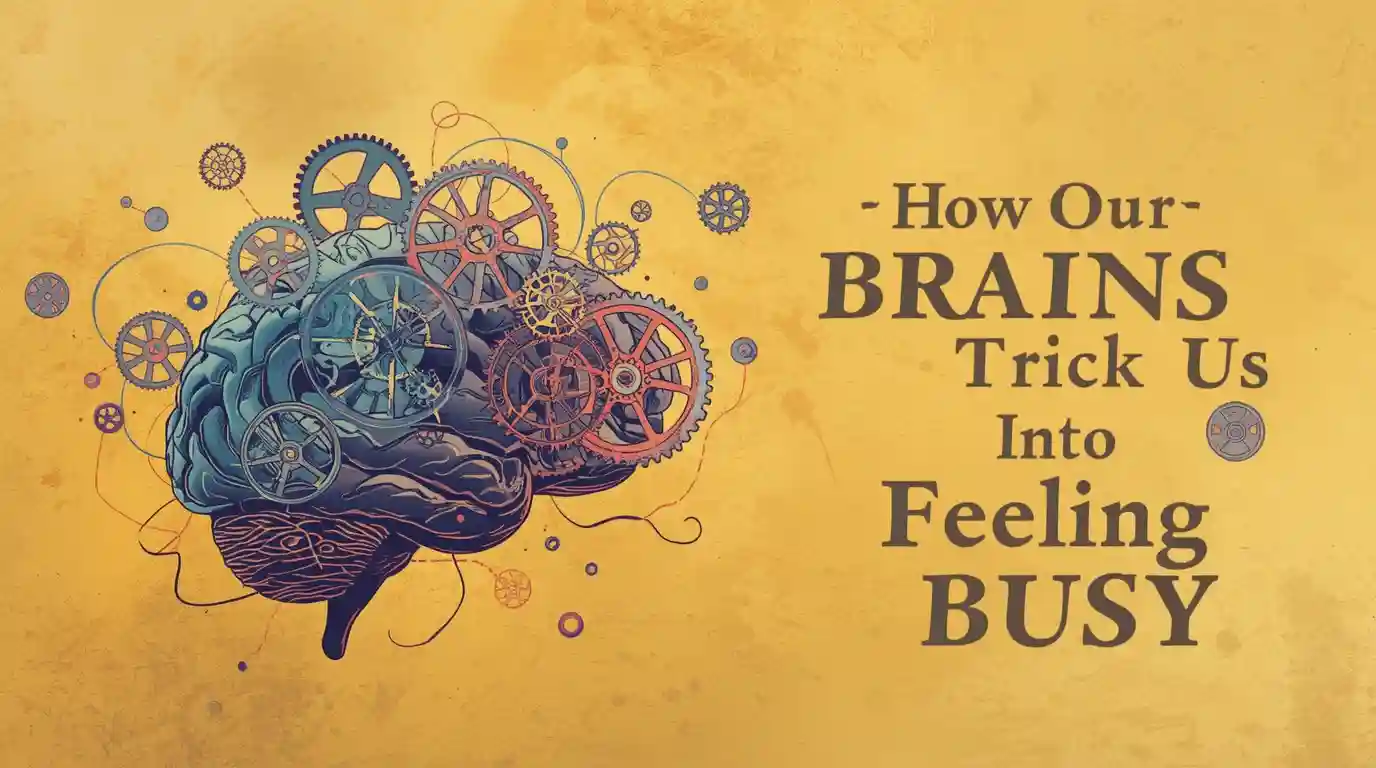
Your brain often mistakes mental activity for meaningful productivity. Just because your mind is racing doesn’t mean you’re achieving more. The brain craves the feeling of motion — not necessarily progress — because busyness provides a comforting illusion of control and success. But in reality, this mental “noise” often hides anxiety, avoidance, and emotional fatigue.
Table of Contents
- The illusion of busyness vs. real productivity
- Why our brains love to feel “in motion”
- The dopamine loop of task switching
- How mental clutter mimics hard work
- The emotional roots of being “too busy”
- Signs you’re caught in the busy trap
- How to reset your brain’s productivity radar
- FAQs: Busy brain vs. effective brain
- Conclusion
1. The Illusion of Busyness vs. Real Productivity
Busyness and productivity are not the same — but your brain often can’t tell the difference. You can reply to every message, check tasks off your list, and fill your schedule to the brim — and still not move any closer to your real goals.
This is the busyness paradox: we equate effort with effectiveness. Our brains inflate low-impact activities to give us the satisfying feeling of accomplishment. We feel valuable because we’re “doing something,” even if it’s not meaningful. It’s mental motion without momentum — a cognitive mirage.
2. Why Our Brains Love to Feel “In Motion”
From an evolutionary perspective, activity meant survival. If you were busy gathering, building, or preparing, you were contributing — and therefore safer. Stillness, by contrast, could feel like vulnerability.
Modern life hijacks this instinct. The brain still craves movement and validation, even when the “threats” are emotional, not physical. We stay “busy” because:
- Stillness feels unsafe. Silence can stir up anxiety or self-doubt.
- Busyness earns social approval. In many cultures, being busy equals being important.
- Activity masks avoidance. We’d rather do a hundred small, easy tasks than face one big, uncertain one.
Busyness gives the illusion of progress — a psychological security blanket that hides deeper discomfort.
3. The Dopamine Loop of Task Switching
Every time you check off a task — no matter how trivial — your brain releases dopamine, the neurotransmitter of reward and motivation. That little “ping” of satisfaction reinforces the behavior.
This creates a dopamine loop:
➡ Small task
➡ Quick reward
➡ Sense of accomplishment
➡ Repeat
The brain doesn’t distinguish between meaningful progress and busywork. That’s why it’s so easy to get trapped in shallow productivity — inbox clearing, calendar tweaking, or constant notifications. These micro-rewards feel good but slowly erode focus, making deep work feel harder and less rewarding by comparison.
4. How Mental Clutter Mimics Hard Work
You know that drained, foggy feeling after a “busy” day — even when you can’t recall what you actually accomplished? That’s mental clutter: your brain stuck in perpetual simulation mode.
Common patterns include:
- Jumping between tasks without finishing any
- Over-planning instead of executing
- Thinking about work instead of doing it
- Ruminating over minor decisions
- Feeling pressure to “stay caught up”
This cognitive churn feels like effort because it burns mental energy. But instead of creating output, it generates stress and self-doubt. Your brain mistakes overload for impact.
5. The Emotional Roots of Being “Too Busy”
Busyness is often emotional camouflage. When you’re constantly in motion, you don’t have to sit with uncomfortable feelings like uncertainty, loneliness, or inadequacy. In that sense, busyness becomes a socially acceptable coping mechanism.
We stay busy to avoid:
- Emptiness: “If I stop, I might realize I’m not sure what I’m doing this for.”
- Failure: “If I’m working, I can’t be failing.”
- Vulnerability: “If I’m busy, no one will see I’m struggling.”
- Boundaries: “It’s easier to say ‘I’m too busy’ than ‘I don’t want to.’”
The irony? The more we use busyness to escape discomfort, the more disconnected we become from meaning — and the more the brain demands more motion to fill that gap.
6. Signs You’re Caught in the Busy Trap
You might be brain-busy (not productive) if:
- You’re always rushing but rarely finishing
- You confuse urgency with importance
- Your to-do list grows faster than it shrinks
- You feel uneasy during rest or silence
- You can’t clearly name your top priorities
- You rely on notifications to feel “in control”
- You end your day exhausted but unsatisfied
This is mental spinning — lots of energy, little progress.
7. How to Reset Your Brain’s Productivity Radar
To escape the illusion of motion, you must retrain your brain to value clarity over activity.
Here’s how:
- Define your “north star” task daily.
Choose one high-impact task that moves you toward a meaningful goal. - Batch and block.
Group similar tasks and protect deep work sessions from interruptions. - Ask “Why?” before every task.
If you can’t explain how it connects to your bigger objective, it’s probably noise. - Schedule whitespace.
Intentional pauses let your brain integrate ideas and recharge creativity. - Reflect weekly.
Ask: “What did I actually create, learn, or move forward?” instead of “How busy was I?” - Measure results, not effort.
Your hours don’t define productivity — your outcomes do.
The brain’s default mode is motion. Productivity requires direction.
8. FAQs: Busy Brain vs. Effective Brain
Q1. Why do I feel anxious when I’m not doing something?
Because your brain equates action with safety. Stillness triggers uncertainty. Reframing rest as recovery — not laziness — helps retrain that response.
Q2. Is multitasking productive?
No. Neuroscience shows multitasking fragments focus, increases stress, and reduces accuracy. It feels faster but is actually shallower.
Q3. How can I stop overloading my schedule?
Use a “stop-doing list.” Eliminate low-impact tasks, automate repetitive ones, and delegate when possible. Prioritize depth, not density.
Q4. Can rest make me more productive?
Absolutely. During rest, the brain’s default mode network consolidates learning, sparks creativity, and forms insights. Rest fuels results.
Q5. What’s the difference between being full and being busy?
A full day aligns with purpose and progress. A busy day is filled with noise and reaction. One nourishes; the other drains.
9. Conclusion
Your brain is brilliant — but it’s wired for survival, not fulfillment. It mistakes motion for meaning, stress for significance, and busyness for success.
But the truth is simple: activity doesn’t equal achievement.
When you pause to prioritize, reflect, and create space for thought, you reprogram your mind to pursue what matters most.
The goal isn’t to do more — it’s to move intentionally.