Table of Contents
- Introduction: Dopamine — The Brain’s Behavioral Currency
- Step 1: Understanding Dopamine’s True Role in Motivation
- Step 2: The Anticipation Effect — Why the Brain Rewards Expectation
- Step 3: The Habit Loop and the Dopamine Prediction Error
- Step 4: The Difference Between Pleasure and Drive
- Step 5: Dopamine Deficits — When the Reward System Backfires
- Step 6: Rebalancing Dopamine Through Behavioral Design
- Step 7: The Power of Delayed Gratification and Reward Calibration
- Step 8: Building Dopamine Discipline — Training Your Reward Circuit
- Final Thoughts: Dopamine, Discipline, and Long-Term Fulfillment
- FAQs About Dopamine and Habit Formation
Introduction: Dopamine — The Brain’s Behavioral Currency
Every habit you form, every goal you chase, and every distraction you fall into has one chemical in common — dopamine.
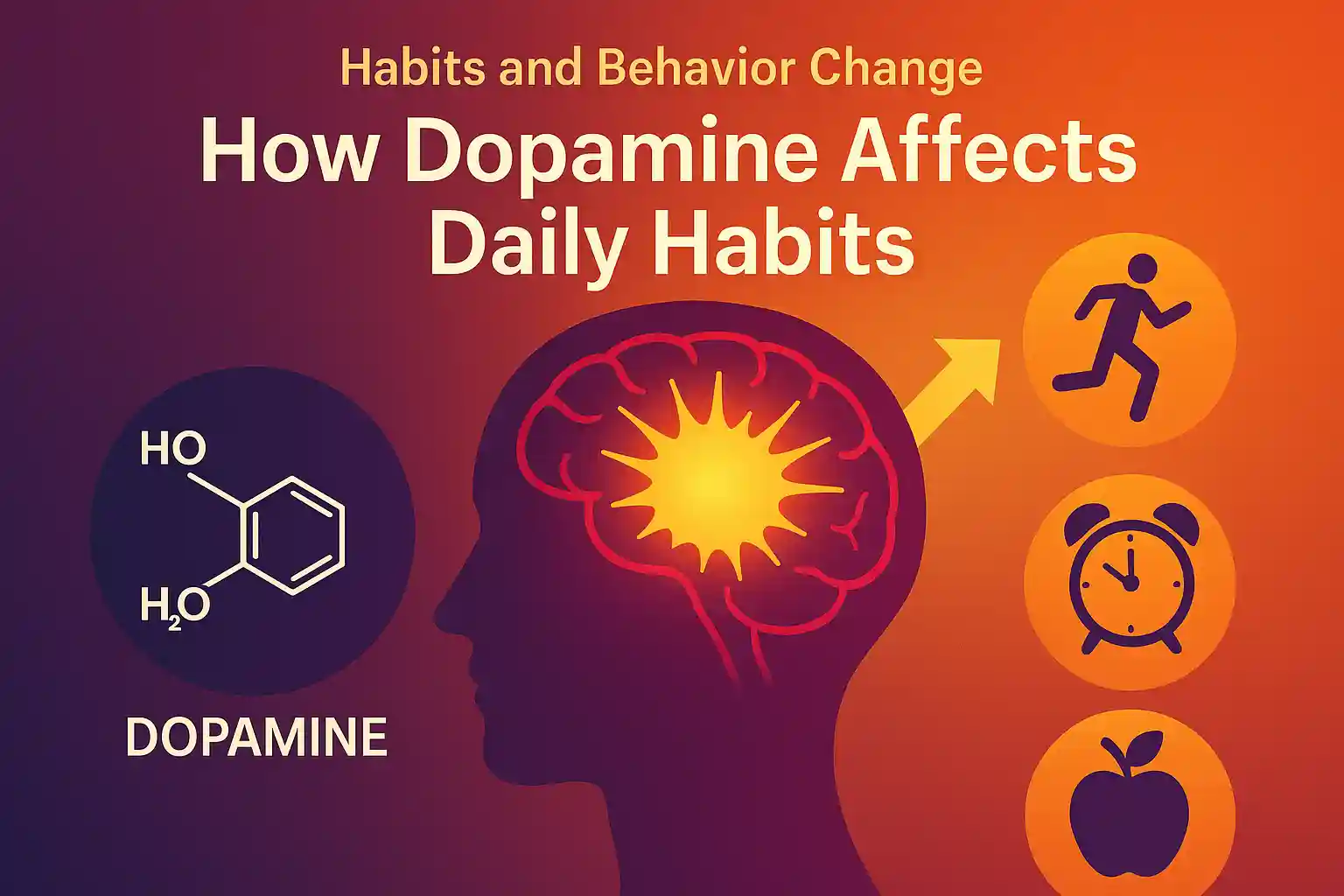
Dopamine is not the molecule of pleasure, as most people assume; it’s the molecule of motivation, anticipation, and pursuit.
It drives the behaviors that help you seek, explore, and achieve — not necessarily enjoy.
Understanding how dopamine shapes your habits gives you the power to direct your drive rather than being driven by it.
When you master dopamine, you master consistency — not by suppressing desire, but by channeling it intelligently.
Step 1: Understanding Dopamine’s True Role in Motivation
Dopamine acts as the brain’s incentive signal.
It surges when you predict a potential reward, not when you actually receive it.
This is why checking your phone feels irresistible — it’s not the message that hooks you, but the possibility of one.
In neuroscience, this is known as the seeking system. It evolved to push humans to explore and survive, not to stay satisfied.
The brain doesn’t crave completion — it craves progress.
Action Step:
Instead of chasing outcomes (e.g., “finish the project”), set process-based milestones that trigger consistent dopamine release (“write for 25 minutes,” “complete one design iteration”).
Small completions keep your motivation system active and renewable.
Step 2: The Anticipation Effect — Why the Brain Rewards Expectation
Dopamine spikes most sharply before a reward — during the anticipation phase.
That’s why you often feel more excitement planning a vacation than actually taking it.
The brain thrives on prediction because it evolved to link cues with outcomes.
Marketers, game designers, and social media platforms exploit this mechanism through variable rewards — unpredictable reinforcement schedules that keep the brain guessing and hooked.
Every time you scroll or refresh, your brain plays a biochemical lottery.
Action Step:
Design healthy anticipation loops.
For instance, schedule your favorite habit (like coffee or music) after completing a deep-work session.
This creates a natural dopamine-driven habit chain that rewards discipline, not distraction.
Step 3: The Habit Loop and the Dopamine Prediction Error
At the core of habit formation lies the dopamine prediction error — the gap between expected and received reward.
If the reward is better than expected, dopamine spikes; if it’s worse, it drops.
This feedback teaches your brain which behaviors to repeat and which to abandon.
For example:
- If a workout leaves you feeling energized (positive error), your brain marks it as worth repeating.
- If it feels punishing (negative error), motivation drops — unless reframed with meaning.
Action Step:
After completing a habit, immediately note one positive outcome you experienced (“I feel clearer,” “I feel proud,” “I feel calm”).
This helps your brain associate the habit with reward, maintaining motivation long-term.
Step 4: The Difference Between Pleasure and Drive
Pleasure and dopamine are related, but not identical.
Pleasure is satisfaction; dopamine is pursuit.
Pleasure calms you down, dopamine winds you up.
The balance between the two determines your emotional rhythm.
Too much dopamine without fulfillment leads to restlessness.
Too much comfort without challenge leads to stagnation.
Peak performance happens in the sweet spot — where dopamine drives effort, and pleasure rewards rest.
Action Step:
Structure your day in alternating rhythms of drive and recovery:
Deep work → reward → reflection → reset.
That’s the natural cycle of sustained productivity and emotional stability.
Step 5: Dopamine Deficits — When the Reward System Backfires
In a hyperstimulated world, your dopamine system is constantly bombarded — notifications, caffeine, fast dopamine from social media or junk food.
Over time, this leads to dopamine desensitization: your baseline motivation drops, and you need bigger hits to feel the same drive.
This is why discipline feels harder in the digital age — not because you lack willpower, but because your reward circuitry is overwhelmed.
Action Step:
Implement dopamine detox periods:
Spend 24 hours without artificial stimulation — no social media, no sugar, no multitasking.
This resets your sensitivity and restores motivation clarity.
Step 6: Rebalancing Dopamine Through Behavioral Design
To rebuild a healthy dopamine balance, design your habits around natural dopamine sources — progress, learning, novelty, and contribution.
These release steady, sustainable dopamine instead of spikes and crashes.
Behavioral scientists call this the self-directed reward system — when you become the source of your own satisfaction through mastery and meaning.
Action Step:
Stack your habits in a reward ladder:
- Start with something easy (momentum trigger)
- Transition into focus work (discipline zone)
- End with an intrinsic reward (reflection, gratitude, journaling)
This cycle converts effort into satisfaction and maintains neurological balance.
Step 7: The Power of Delayed Gratification and Reward Calibration
One of the strongest indicators of long-term success — as shown in Stanford’s famous Marshmallow Experiment — is the ability to delay gratification.
Dopamine control is impulse control.
When you delay rewards strategically, your brain strengthens its executive function — the prefrontal cortex’s ability to override impulsive systems.
Action Step:
Use the “temptation bundling” technique: pair a long-term habit (like exercise) with a short-term reward (like your favorite podcast).
This helps you train delayed gratification without deprivation.
Step 8: Building Dopamine Discipline — Training Your Reward Circuit
True discipline is dopamine mastery.
You don’t eliminate dopamine — you redirect it toward meaningful pursuits.
You teach your brain that progress itself is rewarding.
This is called dopamine transmutation — the art of converting craving into creation.
Action Step:
Each morning, visualize yourself enjoying the process, not the result.
Each evening, reflect on what you accomplished — and anchor gratitude to effort, not outcome.
Over time, this conditions your brain to crave consistency more than novelty.
Final Thoughts: Dopamine, Discipline, and Long-Term Fulfillment
Dopamine is neither good nor bad — it’s neutral energy.
It fuels whatever behaviors you associate with reward.
When you consciously pair it with growth, meaning, and service, it becomes your greatest ally.
The goal isn’t to suppress dopamine — it’s to stabilize it.
To make your brain addicted to progress, not pleasure.
To create habits that feel satisfying because they align with who you’re becoming.
That’s the neuroscience of sustainable discipline — where biology serves identity.
FAQs About Dopamine and Habit Formation
Q: Is dopamine the same as motivation?
A: Dopamine drives motivation but isn’t motivation itself. It’s the chemical that makes effort feel worthwhile.
Q: Can I increase dopamine naturally?
A: Yes — through exercise, deep focus, sunlight, sleep, and meaningful goals. These enhance dopamine sensitivity without artificial overstimulation.
Q: What is dopamine detoxing, really?
A: It’s not about removing dopamine but reducing overstimulation so your natural baseline resets.
Q: Why do habits feel boring after a while?
A: Because dopamine thrives on novelty. Refresh your routine by introducing small variations — new environments, challenges, or progress metrics.
Q: How can I know if my dopamine is unbalanced?
A: Common signs include restlessness, lack of motivation, low focus, and compulsive distractions. The solution is structured routine and reduced sensory overload.