Quick Answer
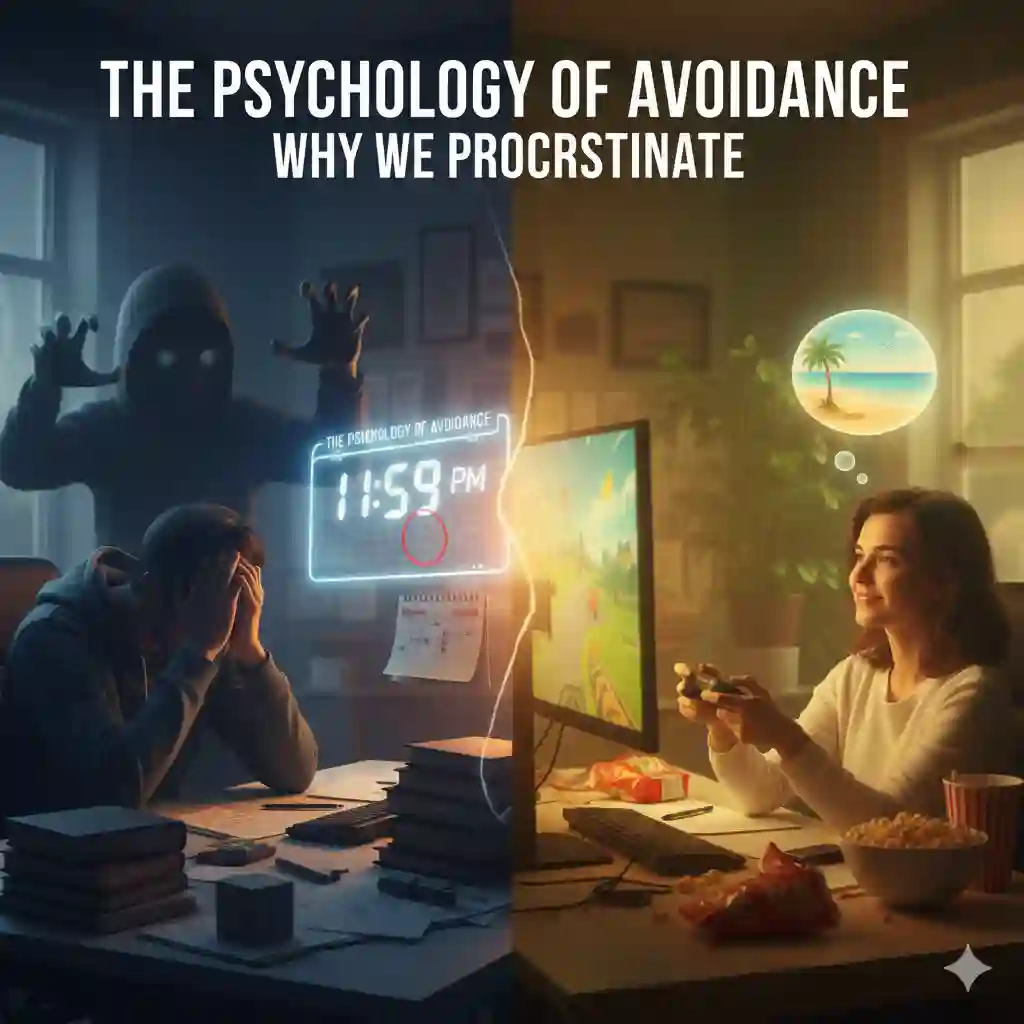
Procrastination repeats not because of a lack of willpower, but because avoidance provides immediate emotional relief. When a task triggers anxiety, boredom, or insecurity, the brain seeks to regulate that negative emotion by avoiding the source. This act of delay generates a momentary sense of calm, which the brain registers as a reward. Over time, this cycle—cue (stress), routine (delay), and reward (relief)—calcifies into a compulsive habit loop. Insight alone fails to break this cycle because understanding the logic of a task does not dismantle the neural pathways reinforced by years of emotional avoidance. Disrupting the cycle requires intercepting the impulse to seek relief before the behavior occurs, rather than trying to force motivation.
Table of Contents
- Why Procrastination Is an Emotional Regulation Strategy
- How Avoidance Becomes a Reinforced Habit
- The Three States of Procrastination
- The Role of Identity and Self-Narratives
- Why Pressure Temporarily Breaks Procrastination
- Why Productivity Advice Often Backfires
- Behavioral Interruption Framework
- Real-World Scenario: The Cycle of Delayed Writing
- Frequently Asked Questions
Why Procrastination Is an Emotional Regulation Strategy
It is a common misconception that procrastination is a time management issue. If it were, calendars and planners would have solved the problem decades ago. Instead, behavioral science suggests that procrastination is fundamentally an issue of emotional regulation. When you face a task that induces negative feelings—whether that is the fear of failure, the frustration of complexity, or simple boredom—your brain interprets that task as a threat. The amygdala, the part of the brain responsible for threat detection, activates a fight-or-flight response. In this context, “flight” is the act of procrastination. By putting the task aside, you are not managing your time poorly; you are managing your mood efficiently. You are prioritizing immediate emotional repair over long-term goals.
This mechanism explains why we delay even when the consequences are severe. The brain is wired to prioritize short-term safety over distant rewards. When you decide to check social media instead of starting a complex report, you are effectively self-medicating the anxiety the report produces. The distraction serves as a buffer, reducing the cortisol spike associated with the daunting task. This is why the behavior persists despite logical knowledge to the contrary; your brain is successfully protecting you from discomfort in the present moment, even if it is simultaneously sabotaging your future self.
Understanding this distinction shifts the focus from laziness to emotional protection. You are not avoiding work; you are avoiding the feelings the work provokes. This is why high-performers and perfectionists often struggle the most. The higher the stakes and the more you care about the outcome, the more intense the emotional threat becomes. Consequently, the urge to regulate that emotion through avoidance becomes stronger. Until you address the hidden reasons for procrastination—specifically the emotional payload of the task—the behavior will continue as a defensive strategy.
How Avoidance Becomes a Reinforced Habit
Procrastination is rarely a one-off decision; it is a learned behavior that follows the mechanics of a habit loop. Every habit consists of a cue, a routine, and a reward. In the context of procrastination, the cue is the negative emotion associated with a task—perhaps the anxiety of starting a difficult email. The routine is the avoidance behavior itself, such as opening a new browser tab or cleaning your desk. The critical component, however, is the reward. The reward here is the immediate, palpable sense of relief you feel when you decide to postpone the task. That release of tension is chemically reinforcing.
When you experience relief after avoiding a stressor, your brain releases dopamine. This neurotransmitter tells your brain, “That was good. Do that again next time you feel this stress.” This creates a powerful feedback loop. You are not just putting off a task; you are training your brain that avoidance is the correct solution to anxiety. This is why habit loops are so difficult to break. The more you procrastinate, the more you reinforce the neural pathway that links “task stress” to “avoidance.” Over time, this reaction becomes automatic. You may find yourself opening your phone before you even consciously realize you are feeling anxious about a task. The behavior has moved from a conscious choice to a subconscious reflex.
This habitual reinforcement explains why chronic procrastinators often feel trapped. The cycle of behavioral reinforcement strengthens with every delay. The relief you get from procrastination is the primary driver of the habit, far more potent than the logical understanding of future punishment. To the primitive parts of your brain, the immediate removal of pain (anxiety) is always preferable to the hypothetical gain of finishing a task. Thus, procrastination is not a failure of character, but a highly successful, albeit maladaptive, habit loop designed to maximize comfort and minimize distress.
The Three States of Procrastination
Anticipatory Avoidance
This state occurs long before the task is due, often the moment it is assigned or conceived. It is characterized by a vague sense of dread that colors your perception of the work. During anticipatory avoidance, the task is not objectively difficult, but your mind projects future discomfort onto it, making it feel heavier than it is. You might find yourself creating reasons why “now isn’t the right time” or waiting for the “perfect mood.” This state is dangerous because it allows the anxiety to incubate. The longer you stay in this state, the more the task transforms from a simple to-do item into a monolithic threat in your mind. The avoidance here is subtle, often masquerading as preparation or planning, but fundamentally, it is a refusal to engage with the initial discomfort of starting.
Relief-Driven Delay
Once the decision to delay has been made, you enter the state of relief-driven delay. This is the “reward” phase of the habit loop mentioned earlier. For a short period, the anxiety dissipates, replaced by a false sense of freedom. You might engage in low-value activities—watching videos, snacking, or doing minor chores—feeling a perverse sense of satisfaction. However, this relief is borrowed time. It is fragile and often accompanied by a low-level background hum of guilt. This state is the most reinforcing part of the cycle because the brain registers the drop in stress as a victory. It validates the decision to procrastinate, embedding the habit deeper into your neural circuitry. You are effectively teaching yourself that the way to handle stress is to turn away from it.
Deadline-Forced Action
Eventually, the timeline runs out, and the pain of not doing the task exceeds the pain of doing it. This is deadline-forced action. The emotional regulation strategy of avoidance collapses because the external threat (failure, firing, humiliation) becomes imminent. In this state, adrenaline and cortisol flood the system, overriding the desire for comfort. You enter a hyper-focused, frantic mode of work. While this state often results in the task getting done, it is metabolically expensive and unsustainable. It relies on fear rather than engagement. Furthermore, because you “survived” the deadline, your brain often misinterprets this as a successful strategy, reinforcing the idea that you can wait until the last minute and still succeed, locking you further into the cycle.
The Role of Identity and Self-Narratives
Procrastination is often sustained by the stories we tell ourselves. Narratives like “I work better under pressure” or “I am just a procrastinator” are not merely descriptions; they are self-fulfilling prophecies that protect the ego. When you claim you work better under pressure, you are rationalizing the adrenaline-fueled panic of the deadline-forced action state. You are reframing a lack of emotional regulation as a unique working style. This narrative serves a protective function: if you believe you need pressure to perform, you give yourself permission to delay until that pressure arrives. It absolves you of the responsibility to manage your emotions earlier in the process.
These identity labels also serve to buffer self-esteem against failure. This is a concept known in psychology as self-handicapping. If you procrastinate on a project and get a mediocre grade or result, you can tell yourself, “I only had one night to do it. If I had more time, it would have been perfect.” This protects your sense of ability. If you tried your hardest for weeks and still failed, that would be a direct hit to your competence. By procrastinating, you create a built-in excuse that preserves your self-image. However, this narrative rigidity prevents behavior change. As long as you identify as someone who needs a crisis to function, you will unconsciously manufacture crises to validate that identity.
Why Pressure Temporarily Breaks Procrastination
It is important to understand why the deadline actually works, and why it is not a sustainable solution. The “panic monster” effectively breaks the procrastination loop because it fundamentally alters the neurochemical landscape of your brain. During the avoidance phase, dopamine is driving the desire for relief. When a deadline looms, the brain shifts from seeking reward to avoiding danger. The amygdala screams that the threat of the task is now smaller than the threat of the consequences. This shift releases significant amounts of norepinephrine and adrenaline, chemicals that mobilize the body for action and narrow focus.
However, relying on this chemical override leads to stress accumulation. While the work gets done, the quality of the experience is traumatic. The brain learns to associate work with high stress and panic, which only increases the resistance to starting the next task. You are not building a work ethic; you are building a trauma response. The relief felt after meeting a deadline is not satisfaction; it is the cessation of pain. Over time, this leads to mental overload and burnout, as the adrenal system cannot sustain these spikes indefinitely. The temporary break in procrastination comes at a high physiological cost.
Why Productivity Advice Often Backfires
Standard productivity advice often fails chronic procrastinators because it addresses the wrong symptoms. Tools like time-blocking, complex planners, or the Pomodoro technique assume that the problem is a lack of structure or organizational skill. However, for someone dealing with emotional avoidance, these tools can become sources of shame. When you create a detailed schedule and then fail to adhere to it because of an emotional block, the schedule itself becomes evidence of your failure. It reinforces the belief that you are incapable of discipline, deepening the shame spiral that fuels further avoidance.
Furthermore, productivity systems often increase decision fatigue. Maintaining a complex system requires executive function—the very resource that is depleted when you are wrestling with anxiety and resistance. Adding more rules and steps to a process that is already emotionally taxing contributes to mental depletion. The brain, seeking to conserve energy and reduce cognitive load, will reject the complex system in favor of the established, easy habit of avoidance. Effective intervention requires lowering the barrier to entry, not building a scaffolding that requires high energy to climb.
Behavioral Interruption Framework
To address the root cause of procrastination, we must move beyond willpower and intervene at the level of the habit loop. This requires a specific framework for breaking avoidance habits.
Pause When Resistance Appears
The first step is cultivating the awareness to notice the physical sensation of resistance. Usually, this manifests as a tightness in the chest, a sudden urge to clean, or a mental fog. Most people act on this sensation immediately by switching tasks. The goal here is to simply pause. Do not try to force yourself to work, but do not allow yourself to escape. Sit with the discomfort for thirty seconds. This pause disrupts the automatic firing of the neural pathway between stress and avoidance.
Identify the Emotional Trigger (Not the Task)
Once you have paused, ask yourself what specific emotion you are feeling. Is it boredom? Is it the fear that your work won’t be good enough? Is it resentment that you have to do this at all? By naming the emotion, you move activity from the amygdala (emotional center) to the prefrontal cortex (rational center). You are no longer “stressed”; you are “experiencing anxiety about quality.” This detachment reduces the emotional intensity of the trigger.
Shrink the Task to Remove Threat
The brain procrastinates because the task feels like a threat. To bypass this, you must make the task so small it no longer registers as dangerous. If you are avoiding writing a report, the goal is not “write the report.” The goal is “open the document.” If that feels too heavy, the goal is “turn on the laptop.” You are not looking for productivity yet; you are looking for a non-threatening entry point. By lowering the stakes, you lower the emotional barrier.
Act Before Relief Arrives
The critical moment is taking that micro-action before your brain can offer you the “reward” of distraction. You must initiate the work while the discomfort is still present. This teaches the brain a new association: discomfort can be survived, and action can reduce anxiety better than avoidance can. It rewires the reward system to find relief in progress rather than in escape.
Real-World Scenario
Consider the scenario of a marketing manager needing to draft a quarterly strategy document. The emotional trigger hits the moment she opens her calendar and sees the deadline. A wave of insecurity washes over her—what if the numbers are down? What if my strategy is rejected? This anxiety is the cue. Almost instantly, her brain offers a solution: Check email. It feels like work, but it’s safe.
If she follows the habit, she enters habit reinforcement. She spends an hour clearing her inbox. She feels productive and relieved (the reward), but the strategy document remains untouched. The anxiety is temporarily sedated, reinforcing the belief that email is the cure for strategy-induced stress.
To apply interruption, she must catch herself reaching for the inbox. She stops and acknowledges, I am not checking email because it’s urgent; I am checking it because I am scared of the strategy document. She refuses to open the email tab. Instead, she shrinks the threat. She tells herself, I do not have to write the strategy right now. I only have to create a blank document and type the header. She takes this micro-action. The moment she types the header, the monolithic nature of the task collapses. The unknown becomes known. Restored clarity follows—the task is just work, not a judgment of her worth.
Frequently Asked Questions
Why do I procrastinate even on things I enjoy?
This often stems from perfectionism or a fear that the reality of the activity won’t match your expectations. Even hobbies can carry performance pressure, triggering the same avoidance mechanisms as work tasks.
Is procrastination a sign of ADHD?
While chronic procrastination is a common symptom of ADHD due to executive function deficits, not all procrastinators have ADHD. Neurotypical brains also form avoidance habits based on emotional regulation.
Can fear of success cause procrastination?
Yes. Success often brings higher expectations, more responsibility, and increased visibility. If these outcomes feel threatening or overwhelming, your brain may use procrastination to sabotage success and maintain the safety of the status quo.
Does visualizing the completed task help?
Research suggests that visualizing the process is more effective than visualizing the outcome. Fantasizing about the result can actually release enough dopamine to make you feel like you’ve already achieved it, reducing motivation to act.
Why does my procrastination get worse when I’m tired?
Emotional regulation requires cognitive energy. When you are tired, your prefrontal cortex (responsible for willpower and long-term planning) is weaker, making it harder to override the emotional impulses of the amygdala.
Additional Questions
How long does it take to break the procrastination habit?
There is no set timeline, as it depends on how deeply reinforced the habit loop is. However, consistent interruption of the cycle usually yields noticeable shifts in behavior within a few weeks of practice.
Is it possible to never procrastinate again?
No. Procrastination is a natural human response to stress. The goal is not elimination, but management—reducing the duration of the delay and the severity of the emotional impact.
Does “eating the frog” (doing the hardest task first) work for everyone?
Not always. For those with high anxiety, starting with the hardest task can induce paralysis. Sometimes starting with a small, easy win builds the momentum necessary to tackle the larger task.
Conclusion
Procrastination is a complex psychological mechanism, not a simple flaw in character. It functions as a protective shield, defending the mind against the discomfort of difficult emotions, uncertainty, and fear. While effective in the short term, this strategy creates a habit loop where relief reinforces delay, trapping you in a cycle of avoidance. Understanding that you are fighting biology and habit—not a lack of motivation—is the first step toward change.
Breaking this cycle does not require herculean effort or punishing discipline. It requires the quiet, analytical work of noticing your triggers and refusing to accept the immediate relief of avoidance. By interrupting the habit loop and taking micro-actions before comfort arrives, you can dismantle the neural pathways of delay. Sustainable action comes from regulating your emotions, not just managing your time.