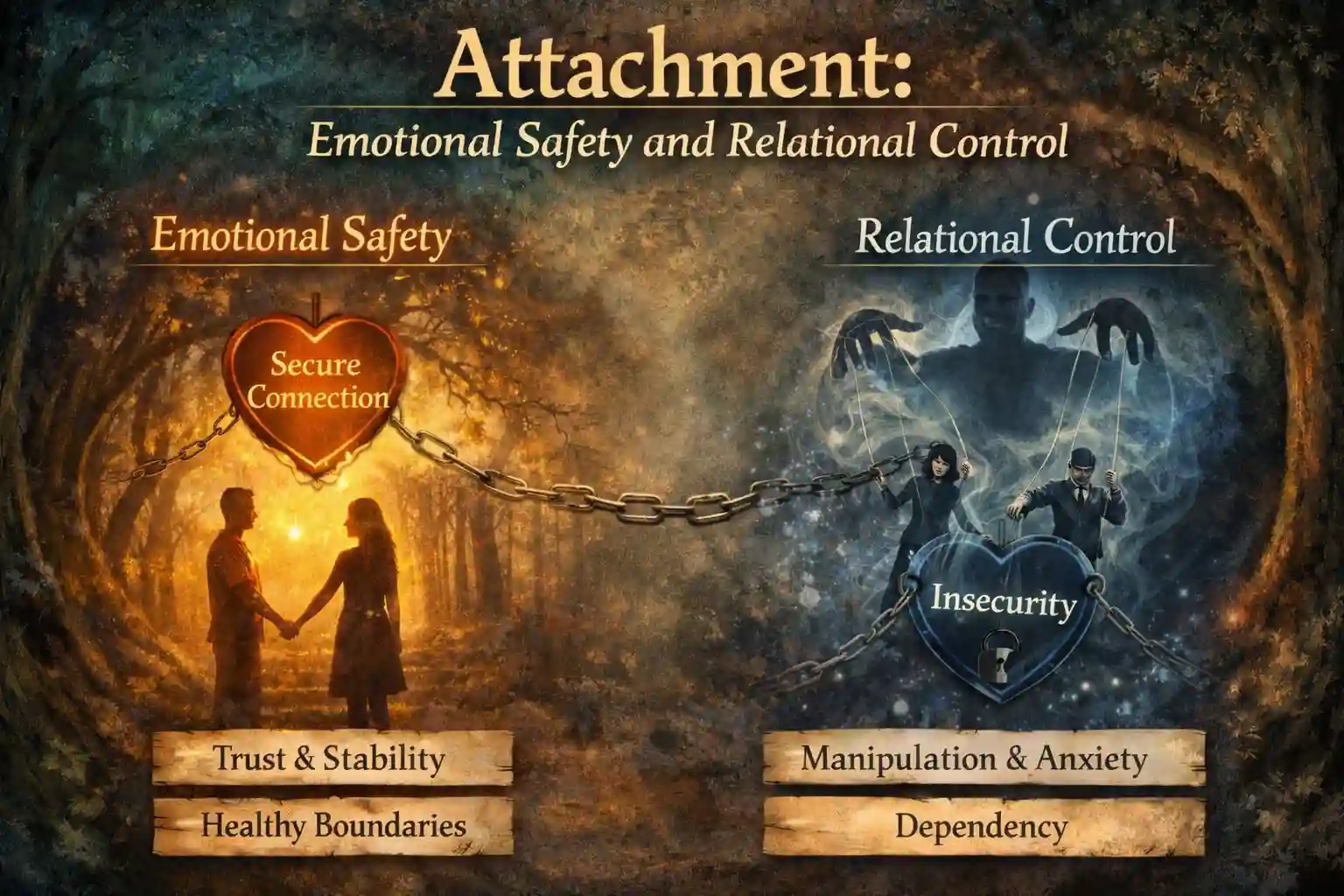

Fast Answer: Why Attachment Patterns Feel Automatic
Attachment styles are not personality traits or fixed identities; they are deeply ingrained emotional regulation systems designed to manage safety and distance. These patterns feel automatic because they operate through the nervous system, bypassing conscious thought to react to perceived threats in milliseconds.
Behavior maintains these patterns more than feelings do. When you act on an impulse—whether reaching out frantically for reassurance or withdrawing into silence—you reinforce a feedback loop that confirms your internal fears. Relationships trigger the strongest reactions because they strike at the core of human survival mechanisms: the need for proximity and the fear of abandonment or engulfment. Changing attachment responses requires interrupting the automatic behavioral reaction and replacing it with conscious emotional regulation, retraining the nervous system over time.
Table of Contents
- Attachment as Regulation: Safety and Connection
- Activation: How Relationships Trigger Threat Perception
- The Feedback Loop: How Behaviors Reinforce Patterns
- Why Insight Fails: The Limits of Awareness
- The Emotional Payoff: Why We Cling to Dysfunction
- Core Behavioral Responses in Adult Relationships
- The Behavioral Regulation Framework
- Real-World Scenario: De-escalating the Loop
- FAQs and Additional Questions
Attachment Styles as Emotional Regulation Systems
Most popular discussions about attachment focus on categorization. We label ourselves and our partners, treating these styles as static boxes we fit into. However, from a behavioral psychology perspective, attachment is far more dynamic. It is a sophisticated, real-time emotional regulation system. Its primary function is not just “bonding” in a romantic sense, but managing physiological arousal and safety detection.
At its core, attachment governs how you regulate your internal state in the presence (or absence) of a significant other. It is the mechanism that determines whether emotional proximity feels like safety or a threat. When this system is functioning securely, it allows for seamless transitions between autonomy and connection. You can move close to someone without losing yourself, and you can step away without feeling abandoned. This flexibility is the hallmark of effective emotional regulation and mental clarity, allowing the nervous system to remain within a window of tolerance even during stress.
When the system is insecure, it becomes a rigid strategy for managing distress. The anxious (hyper-activated) system regulates anxiety by seeking external soothing through closeness. The avoidant (de-activated) system regulates anxiety by reducing stimulation and increasing distance. These are not emotional needs in the abstract; they are physiological attempts to return the body to a baseline state of calm. Understanding attachment as a regulation system shifts the focus from “fixing a broken personality” to managing a biological safety mechanism that is misfiring.
This reframing is crucial because it explains why logic often fails during relationship conflict. You cannot reason your way out of an attachment reaction because the reaction is not cognitive; it is regulatory. Your body is attempting to solve a problem—perceived danger—using the only tools it has practiced. The “clinging” or the “shutting down” are functional behaviors intended to restore equilibrium, even if they damage the relationship in the process.
What Activates Attachment in Adult Relationships
In adult relationships, attachment activation is rarely a conscious choice. It happens before you have time to think, triggered by subtle cues that the brain interprets as threats to the relational bond. These triggers are often microscopic: a shift in tone, a delayed text message, a moment of distraction during a conversation, or a sudden burst of intimacy that feels overwhelming.
Uncertainty is perhaps the most potent activator. The human brain craves prediction; it constantly scans the environment to forecast what will happen next. In a relationship, inconsistency creates a prediction error. If a partner is warm one day and cold the next, the attachment system sounds an alarm. For the nervous system, ambiguity is dangerous. It signals a potential loss of access to the attachment figure or, conversely, an impending intrusion.
Emotional distance acts as another primary trigger. For some, distance signals abandonment, triggering a spike in cortisol and a frantic drive to close the gap. For others, emotional closeness signals engulfment, triggering a defensive shutdown to preserve autonomy. This activation is tied closely to stress accumulation and emotional overload. When the background stress levels are already high, the threshold for attachment activation lowers. A minor disagreement that might be manageable on a calm day becomes a catastrophe when the system is primed for threat.
Perceived rejection is the final major activator. Importantly, the rejection does not need to be real to activate the system. If you interpret a neutral face as angry, or a busy schedule as disinterest, your body reacts as if the rejection is factual. This creates a physiological cascade—heart rate increases, muscles tense, and the prefrontal cortex (the logic center) goes offline. By the time you are consciously aware that you are upset, the attachment system has already seized the controls.
How Attachment Behaviors Reinforce Themselves
Attachment patterns are self-perpetuating loops. They survive not because they are effective at creating love, but because they are effective at confirming internal beliefs. This happens through a feedback loop: Behavior → Response → Interpretation → Reinforcement.
Consider the anxious-avoidant trap. Person A feels anxiety (Trigger) and texts Person B five times in an hour (Behavior). Person B feels overwhelmed and turns off their phone (Response). Person A interprets this silence as confirmation that they are being abandoned (Interpretation). This heightens their anxiety for the next time, making the behavior more likely to repeat (Reinforcement). Even though the behavior failed to get the desired result (connection), it succeeded in proving the fear (abandonment is real). This is how behavioral patterns and learned emotional responses become entrenched habits.
These loops are insidious because they shape reality to fit the fear. If you believe people will leave you, you may act in ways that exhaust them until they do leave. If you believe people will smother you, you may push them away until they become demanding just to get a response. The attachment system effectively creates the very environment it is trying to defend against.
Furthermore, repetition creates efficiency in the brain. Every time you engage in a protest behavior or a withdrawal tactic, the neural pathway for that action becomes stronger and faster. Over years of adult relationships, these responses become the path of least resistance. The brain prefers the familiar misery of a known pattern over the terrifying uncertainty of a new behavior. This explains why we often find ourselves in identical relationship dynamics with completely different partners. The faces change, but the behavioral loop remains constant.
Why Awareness Doesn’t Automatically Change Attachment Reactions
A common frustration for people working on their relationships is the gap between insight and change. You can read every book on attachment theory, understand your childhood origins perfectly, and label your style with precision—and still react with identical dysfunction during a fight. This occurs because awareness is cognitive, while attachment is physiological.
Attachment reactions are conditioned into the nervous system. They are procedural memories, similar to riding a bike or driving a car. You don’t “think” about how to balance on a bike; your body just does it. Similarly, you don’t think about shutting down when criticized; your body simply executes the maneuver. This automation is a survival feature, designed to react faster than thought.
Insight generally arrives too late. By the time you realize “I am being avoidant right now,” the neurochemical cocktail of adrenaline and cortisol has already been released. The body is already in a state of fight, flight, or freeze. Trying to use logic to stop a physiological survival response is like trying to stop a speeding train by standing on the tracks and asking it to slow down.
Additionally, emotional stuckness and repetitive relationship patterns often persist because the body confuses familiarity with safety. Even if a secure relationship is logically what you want, it may feel “boring” or “wrong” to a nervous system accustomed to chaos or distance. The system interprets the absence of the old trigger as a new kind of threat, prompting behaviors designed to recreate the familiar tension. True change requires somatic (body-based) regulation, not just intellectual understanding.
The Emotional Payoff Behind Each Attachment Response
We do not repeat behaviors that do not offer some form of reward. Even painful attachment behaviors provide a hidden emotional payoff. Understanding this “secondary gain” is essential for breaking the cycle. If you assume your behavior is purely self-destructive, you miss the function it serves.
For those who lean toward hyper-activation (anxiety), the payoff is often illusionary control. Worrying, checking up on a partner, or demanding reassurance feels like “doing something.” It alleviates the passivity of waiting. The emotional payoff is a temporary reduction in the terrified feeling of helplessness. Even if the conflict is negative, it provides contact. For the anxious system, negative contact is often preferable to no contact at all because it confirms the other person is still there.
For those who lean toward de-activation (avoidance), the payoff is invulnerability and predictability. By shutting down emotions or pushing a partner away, the individual reclaims a sense of self-sovereignty. The chaos of another person’s emotions is walled off, restoring a feeling of calm and order. The payoff is the cessation of demand. It feels like taking a deep breath after being held underwater.
In disorganized patterns, the payoff is chaos as distraction. The internal conflict is so painful that creating external chaos serves to externalize the struggle. It is easier to fight a partner than to feel the internal fragmentation of the self.
Recognizing these payoffs allows you to see the behavior as a strategy. You are not “crazy” or “cold”; you are purchasing safety at a very high price. The goal of growth is to find cheaper, healthier ways to buy that safety.
Core Attachment Responses (Behavioral)
To change attachment, we must move away from identity labels (“I am anxious”) and look at specific behavioral responses. Identity is static; behavior is malleable. In any given relationship, a person might exhibit different responses depending on the dynamic.
Hyper-Activation
This response system is characterized by an up-regulation of emotion and behavior. The goal is to force the attachment figure to pay attention and provide soothing.
- Behavioral Markers: Excessive texting or calling, inability to focus on other tasks until the partner responds, protesting distance through accusations (“You don’t care about me”), and over-functioning in the relationship to ensure indispensability.
- Internal State: “If I don’t make something happen, I will be forgotten.”
- Regulatory Goal: To close the gap and reduce the anxiety of separation.
De-Activation
This response system down-regulates emotion and behavior. The goal is to minimize attachment needs to avoid disappointment or intrusion.
- Behavioral Markers: delaying responses to messages, focusing intensely on work or hobbies to the exclusion of the partner, withholding personal information, dismissing the partner’s emotional distress as “drama,” and physical withdrawal during conflict.
- Internal State: “If I show need, I will be hurt or controlled.”
- Regulatory Goal: To create distance and reduce the anxiety of dependency.
Disorganized Switching
This is a collision of the first two systems, resulting in a “push-pull” dynamic. The person seeks closeness but becomes terrified when they get it, leading to erratic switching.
- Behavioral Markers: Initiating intimacy and then suddenly withdrawing, picking fights during peaceful moments, sending mixed signals (e.g., “Go away, why are you leaving me?”), and dissociating or “checking out” during emotional intensity.
- Internal State: “I need you, but you are dangerous.”
- Regulatory Goal: To navigate an impossible bind where the source of safety is also the source of fear.
Secure Regulation
Secure attachment is not the absence of difficult emotions; it is the ability to regulate them within the relationship. It is a behavioral strategy of flexibility.
- Behavioral Markers: Clearly stating needs without blame, giving a partner space without assuming abandonment, seeking repair after a rupture, and tolerating uncertainty without acting out.
- Internal State: “We can be disconnected and still be okay. We can repair this.”
- Regulatory Goal: To maintain the bond while preserving the self.
Behavioral Regulation Framework
Changing attachment styles requires a pivot from “why do I feel this?” to “what am I doing with this feeling?” The following framework outlines how to interrupt the automatic loop. This is a practice of manual override.
Step 1: Recognizing Somatic Activation
Before the emotion becomes a story (“He doesn’t love me”), it is a sensation in the body. You must catch the activation here. For hyper-activation, this might be a racing heart, a tightness in the chest, or a “buzzing” energy in the limbs. For de-activation, it might be a feeling of numbness, sleepiness, a “wall” coming down behind the eyes, or a physical urge to turn away. Identify your unique physical signature of threat.
Step 2: Identifying the Regulating Behavior
Once you feel the sensation, pause and identify what your body wants to do to make the feeling stop. Does it want to send a third text? Does it want to walk out of the room? Does it want to say something hurtful? Label this impulse as a “regulatory attempt,” not a truth. Say to yourself, “My body is trying to regulate anxiety by making me want to withdraw.”
Step 3: Interrupting the Automatic Response
This is the hardest step. You must inhibit the automatic behavior. If the urge is to cling, you must put the phone down. If the urge is to flee, you must stay in the room (even if you remain silent). This creates a temporary spike in discomfort. You are denying the system its usual drug. This is where understanding emotional reactions becomes vital—you are surfing the wave of discomfort rather than drowning in it.
Step 4: Replacement with Stabilizing Action
The vacuum left by the interrupted behavior must be filled with a reality-based action.
- For Hyper-Activation: Self-soothing is the priority. Engage in slow, rhythmic breathing, physical movement, or grounding exercises. Once the pulse drops, fact-check reality. Is there evidence of abandonment, or just a delay?
- For De-Activation: Engagement is the priority. Use “micro-connections.” You don’t have to bear your soul, but you can maintain eye contact or say, “I am feeling overwhelmed and need twenty minutes to think, but I will come back.” This bridges the gap without total withdrawal.
Regulation must precede secure behavior. You cannot act securely while your nervous system is screaming that you are in danger. You must regulate the physiology first, then choose the action.
Real-World Relationship Scenario: The “Read Receipt” Spiral
Let’s examine a common modern scenario: The Delayed Text.
The Situation:
Sarah (leaning anxious) texts Mark (leaning avoidant) at 2:00 PM: “Can we talk about plans for the weekend?” Mark sees the text but is in the middle of a stressful work project. He feels a flash of pressure—the demand for “plans” feels like another task on his to-do list. He thinks, “I’ll deal with this later,” and swipes the notification away.
The Escalation (Automatic Loop):
By 4:00 PM, Sarah sees that the message was read but not answered.
- Activation: Her chest tightens. Her brain spins a story: “He’s ignoring me. He’s annoyed about last night.”
- Behavior: To regulate this anxiety, she sends a “ping” text: “???”
- Reaction: Mark sees the question marks. The pressure intensifies. He feels controlled and annoyed. His regulation strategy kicks in: De-activation. He puts his phone on Do Not Disturb.
- Result: Sarah spirals. Mark shuts down. When they finally speak, it is an argument about “respect” and “suffocation,” rather than a conversation about the weekend.
The Regulated Alternative:
Let’s replay this with behavioral regulation.
- Sarah’s Pivot: At 4:00 PM, Sarah sees the “Read” status. She feels the chest tightness. She recognizes it: “I am activated.” She notices the urge to send the “???” text. She interrupts it. She puts her phone in a drawer and goes for a ten-minute walk. She regulates her breathing. She reminds herself: “Mark is at work. Silence is not necessarily rejection.” She decides to wait until 6:00 PM.
- Mark’s Pivot: Mark sees the text at 2:00 PM. He feels the pressure. He recognizes the urge to swipe it away and forget it (avoidance). He interrupts it. He knows that total silence creates problems. He chooses a micro-engagement. He types: “Swamped at work. Will reply tonight.” It takes five seconds.
- Outcome: Sarah feels reassured by the timeline. Mark feels autonomous because he set a boundary (“tonight”) rather than succumbing to immediate demand. The cycle is broken.
Small behavioral shifts, executed consistently, rewire the relationship dynamic.
FAQs
Can you have different attachment styles with different people?
Yes. Attachment is relational. You might be secure with a predictable partner but anxious with an inconsistent one. However, your baseline “go-to” strategy under stress usually follows a consistent pattern.
How long does it take to change an attachment style?
There is no set timeline. It depends on the frequency of your “reps”—how often you interrupt the old behavior and practice the new one. With consistent behavioral regulation, significant shifts can happen within 6 to 12 months.
Is it possible for two insecure attachers to have a secure relationship?
Absolutely. It requires both partners to be aware of their patterns and committed to regulation. This is often called “earned security.” It is built through the hard work of conscious behavior change, not just finding the “perfect” partner.
Does medication help with attachment anxiety?
Medication can manage the symptoms of anxiety or depression that accompany attachment distress, but it does not change the attachment style itself. The style is a learned behavioral strategy that must be unlearned through experience.
Why do I feel bored in secure relationships?
If your nervous system is adapted to the “highs and lows” of insecure attachment, consistency can feel flat or even dead. It takes time for the brain to recalibrate and recognize that safety is not boredom—it is the platform for true intimacy.
Additional Questions
What is the role of the nervous system in attachment?
The nervous system is the hardware on which attachment software runs. It dictates your window of tolerance and how quickly you move into fight-or-flight. Healing attachment is largely about widening this window of tolerance.
Why does my attachment style get worse when I am tired?
Fatigue reduces the prefrontal cortex’s ability to inhibit emotional impulses. When you are tired, your “brakes” are worn out, making automatic attachment reactions much harder to stop.
How do I explain my attachment style to a new partner without scaring them?
Focus on needs, not labels. Instead of saying “I have an anxious attachment style,” try “I really value consistency in communication; it helps me feel settled.” This frames it as a positive preference rather than a pathology.
Can trauma therapy fix attachment issues?
Trauma therapy, especially somatic modalities, is highly effective because it targets the body’s safety mechanisms directly. It helps resolve the underlying fears that drive the behavioral loops.
Conclusion
Attachment styles are not life sentences; they are regulation systems that have been programmed by experience. They were clever solutions to past environments, but they often become problems in current ones. By shifting focus from “who am I?” to “how am I behaving right now?”, you gain leverage over the mechanism.
Behavior keeps attachment patterns alive. Every time you refrain from a protest behavior or lean into a moment of vulnerability despite the fear, you are voting for a new reality. Relationships activate our deepest safety mechanisms, but they are also the laboratory where those mechanisms can be upgraded. Regulation—not labels, not analyzing the past, but real-time regulation—is the path to security.
Image Prompt Ideas
- Conceptual Elasticity: A minimalistic 3D render of two abstract figures connected by a glowing elastic band. The band is stretched thin, vibrating with tension, symbolizing the strain of distance and the pull of attachment.
- The Door Mechanism: A surreal image of a doorway standing in a void. The door is blurring, appearing to be simultaneously slamming shut and swinging open, representing the disorganized “push-pull” dynamic.
- Protected Core: An illustration of a glowing, warm anatomical heart surrounded by shifting, translucent geometric walls. The walls are moving like sliding puzzles, protecting the heart but also trapping it.
- The Relational Compass: A close-up of a compass where the needle is spinning wildly between “Closeness” and “Distance” instead of North and South, set against a calm, dark background.