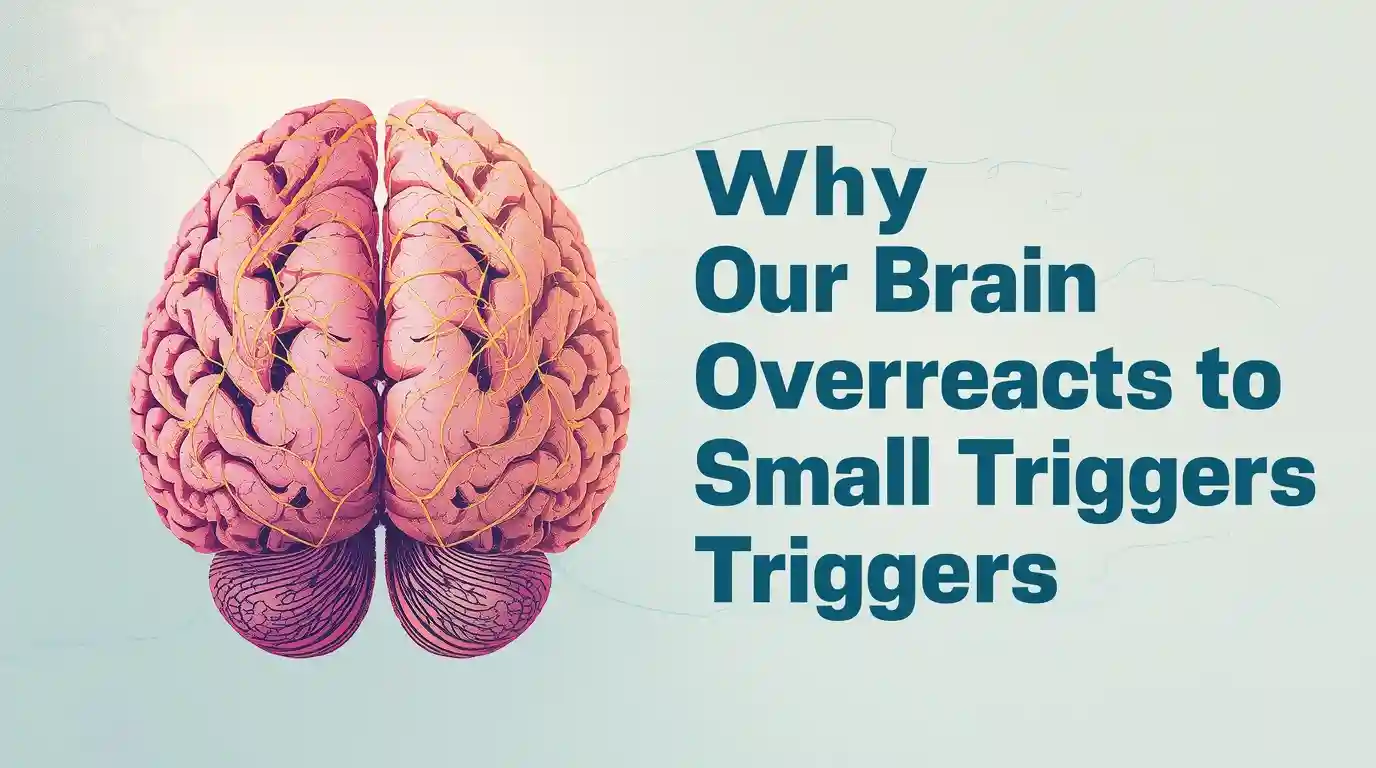
Quick Answer: Why Do We Overreact to Small Triggers?
Our brain overreacts to small triggers due to a process called “amygdala hijack,” where the brain’s emotional center perceives a minor event as a major threat, bypassing rational thought. This is driven by cognitive patterns like emotional stacking (the accumulation of unresolved stress), negative confirmation bias (seeking evidence to support a negative mood), and the lingering effects of past trauma or sensitive attachment styles. Essentially, the small trigger is not the real cause; it’s just the final straw that unleashes a disproportionate, pre-loaded emotional response.
Table of Contents
- Introduction: The Spark That Starts a Wildfire
- The Amygdala Hijack: Your Brain’s Alarm System Gone Haywire
- Emotional Stacking: The Last Straw Phenomenon
- Confirmation Bias: Seeing What You Already Feel
- The Echo of the Past: How Trauma Creates Hair Triggers
- The Role of Attachment Styles in Emotional Reactivity
- All-or-Nothing Thinking: The Cognitive Distortion of Extremes
- The Impact of Physical State: Hunger, Fatigue, and Stress
- How to Lengthen Your Fuse: Strategies for Emotional Regulation
- Frequently Asked Questions (FAQs)
- Conclusion: From Reactive to Responsive
Introduction: The Spark That Starts a Wildfire
Someone cuts you off in traffic, and you erupt in a fit of rage. Your partner leaves a dish in the sink, and it triggers a massive argument. A coworker makes a slightly critical comment, and you spend the rest of the day spiraling in anxiety. These small, everyday triggers can unleash emotional reactions that are wildly out of proportion to the event itself. If you’ve ever looked back on an outburst and wondered, “Why did I get so upset over that?” you’ve experienced this perplexing cognitive pattern. This overreaction is not a sign of being irrational or “crazy.” It’s a predictable, albeit problematic, function of your brain’s ancient survival wiring getting crossed with modern-day stressors and past experiences. Understanding the psychology behind these emotional explosions is the first step toward defusing them and reclaiming control over your responses.
Let’s begin by examining the brain’s built-in alarm system.
The Amygdala Hijack: Your Brain’s Alarm System Gone Haywire
The primary culprit behind your overreactions is a small, almond-shaped structure in your brain called the amygdala. The amygdala is your emotional command center and threat detector. When it perceives a threat—real or imagined—it can trigger a rapid, intense emotional response before your rational brain (the prefrontal cortex) has a chance to weigh in. This is called an “amygdala hijack.” The small trigger acts as a false alarm. Your amygdala, primed by stress or past experiences, misinterprets the minor event as a major threat to your safety or well-being. It floods your system with stress hormones like adrenaline and cortisol, preparing you for a “fight or flight” response. Your logical brain is temporarily offline, which is why in that moment, your extreme reaction feels completely justified and proportional.
This hijack is often made possible because of an accumulation of unprocessed feelings.
Emotional Stacking: The Last Straw Phenomenon
Think of your emotional capacity like a container. Throughout the day or week, small frustrations, anxieties, and disappointments get dropped into it: a stressful work meeting, a bill you forgot to pay, a disagreement with a friend. You might not consciously process each one, but they begin to stack up, raising the level of unresolved emotion in your container. The small trigger—the dish left in the sink—is simply the final drop that causes the container to overflow. The subsequent emotional outburst is not really about the dish. It’s the release of all the pent-up frustration and stress that came before it. The small trigger becomes the focal point for a much larger, pre-existing emotional burden, leading to a reaction that seems wildly out of proportion to an outside observer.
Our current mood also dictates what our brain chooses to notice in our environment.
Confirmation Bias: Seeing What You Already Feel
Confirmation bias is the cognitive pattern where we tend to seek out, interpret, and remember information that confirms our pre-existing beliefs. This also applies to our emotional states. If you are already feeling irritable, stressed, or insecure, your brain will actively scan the environment for evidence to justify that feeling. This is a negative confirmation bias. When you’re in a bad mood, a neutral comment from a colleague is more likely to be interpreted as a criticism. A simple question from your partner (“What’s for dinner?”) can be heard as a demanding complaint. The small trigger doesn’t create the negative feeling; it validates it. Your brain seizes on the event as proof that your negative emotional state is correct, leading to an overreaction that reinforces the very mood it stemmed from.
Often, our triggers are not random but are connected to wounds from our past.
The Echo of the Past: How Trauma Creates Hair Triggers
Our brains are wired to learn from experience to protect us in the future. If you’ve experienced trauma, your amygdala becomes hyper-vigilant, constantly on the lookout for anything that resembles the past threat. As a result, a seemingly benign, present-day trigger can activate a powerful emotional memory from the past. For example, if you were harshly criticized by a parent as a child, a minor critique from your boss today could trigger the same feelings of shame and fear you felt as a child. This is an “emotional flashback.” Your brain is not reacting to the current situation; it is re-experiencing the emotional intensity of the original wound. Your overreaction is a delayed response to a much older, deeper pain. This is a core reason why our brain avoids discomfort associated with these old wounds.
Our earliest relationships also set the stage for our emotional reactivity.
The Role of Attachment Styles in Emotional Reactivity
Our early attachment style, formed in infancy, dictates our expectations for safety and connection in relationships. If you have an anxious attachment style, you may have a deep-seated fear of abandonment. A small trigger, such as a partner needing a night alone or not texting back quickly, can be perceived by your amygdala as a sign of imminent rejection. This triggers an intense protest behavior—an overreaction designed to pull your partner back and get reassurance. Conversely, if you have an avoidant attachment style, you may have a heightened sensitivity to feeling controlled or suffocated. A simple request for more time together from a partner can trigger a strong reaction of pulling away. The overreaction is a defense mechanism rooted in your core attachment anxieties.
The way we think about events can also amplify our emotional response.
All-or-Nothing Thinking: The Cognitive Distortion of Extremes
All-or-nothing thinking (also called black-and-white thinking) is a cognitive distortion where you see things in absolute, extreme terms. There is no middle ground. A small mistake means you are a “total failure.” A minor disagreement means the “relationship is ruined.” When you apply this pattern to a small trigger, you magnify its significance exponentially. The coworker who forgot to include you on an email isn’t just forgetful; they are “intentionally excluding you.” This catastrophic interpretation of a minor event naturally leads to an extreme emotional response. Your reaction matches the distorted, high-stakes narrative you’ve created in your mind, not the objective reality of the small trigger itself.
We can’t forget that our minds and bodies are inextricably linked.
The Impact of Physical State: Hunger, Fatigue, and Stress
Your brain’s ability to regulate emotion is highly dependent on your physical resources. When you are hungry, tired, or physically unwell, your prefrontal cortex—the part of your brain responsible for rational thought and impulse control—has less energy to function effectively. This gives the reactive amygdala more power. The phenomenon of being “hangry” is a perfect example: low blood sugar can lead to increased irritability and a shorter fuse. Similarly, a lack of sleep impairs emotional regulation, making you more susceptible to overreacting. Your physical state lowers your resilience, meaning the small triggers you could normally handle with ease suddenly feel overwhelming.
Knowing the triggers is the first step. Learning to manage them is the next.
How to Lengthen Your Fuse: Strategies for Emotional Regulation
You can train your brain to be less reactive and more responsive.
- The 90-Second Rule: When an emotion is triggered, it takes about 90 seconds for the chemicals to be flushed out of your system. When you feel an overreaction coming on, commit to pausing for 90 seconds. Breathe deeply and just observe the feeling without acting. This gives your rational brain time to come back online.
- Name It to Tame It: Simply putting a label on your emotion (“I am feeling angry,” “I am feeling anxious”) can help reduce its intensity. This act of naming moves the activity from your reactive amygdala to your thinking prefrontal cortex.
- Address Your Physical Needs (HALT): Regularly check in with yourself. Are you Hungry, Angry, Lonely, or Tired? Addressing these basic needs first can prevent many overreactions before they start.
- Identify Your Stacking Pattern: At the end of each day, take a moment to reflect on the small frustrations you “stacked” away. Acknowledging them can help release the pressure before it builds to an explosive level.
Frequently Asked Questions (FAQs)
1. Does overreacting mean I have an anger problem?
Not necessarily. While overreactions can manifest as anger, they can also be fits of anxiety, crying spells, or shutting down. It’s about the disproportionate intensity of the emotion, whatever that emotion may be.
2. Why do I only overreact with people I’m close to?
We often feel safest with our loved ones, which paradoxically means we let our emotional guards down. Your brain knows that a partner or family member is less likely to abandon you for an outburst than a boss or a stranger, so the regulatory systems can become lax.
3. Can medication help with overreacting?
In some cases, yes. If the overreactions are a symptom of an underlying condition like an anxiety disorder, depression, or PTSD, medication can help regulate the brain chemistry that contributes to hyper-reactivity. This should always be discussed with a medical professional.
4. How can I apologize after I’ve overreacted?
A good apology involves acknowledging your behavior without making excuses. You can say something like, “My reaction was out of proportion to the situation, and I’m sorry for how I spoke to you. I was feeling stressed about other things, but that’s not an excuse to take it out on you.”
Conclusion: From Reactive to Responsive
Overreacting to small triggers is a frustrating and often painful experience, both for you and for those around you. But it is not an unchangeable part of your personality. It is a signal—a message from your brain that it is overwhelmed, carrying unresolved stress, or replaying an old wound. By understanding the cognitive patterns at play, from the amygdala hijack to emotional stacking, you can stop judging yourself and start cultivating self-awareness. You can learn to pause, identify the real source of your distress, and choose a response that aligns with the person you want to be. The goal is not to stop feeling, but to stop letting your feelings hijack you, transforming your relationship with your emotions from one of reaction to one of thoughtful response.