The elevator doors close, and the low hum of music disappears. Instantly, the air thickens. You stand beside a stranger, acutely aware of your own breathing, the soft rustle of your clothes, and the unspoken pressure to say something—anything. Nothing is wrong, yet everything feels tense. This discomfort is a universal human experience. Silence, in its purest form, can feel deeply unsettling, activating a primal sense of unease that we rush to fill.
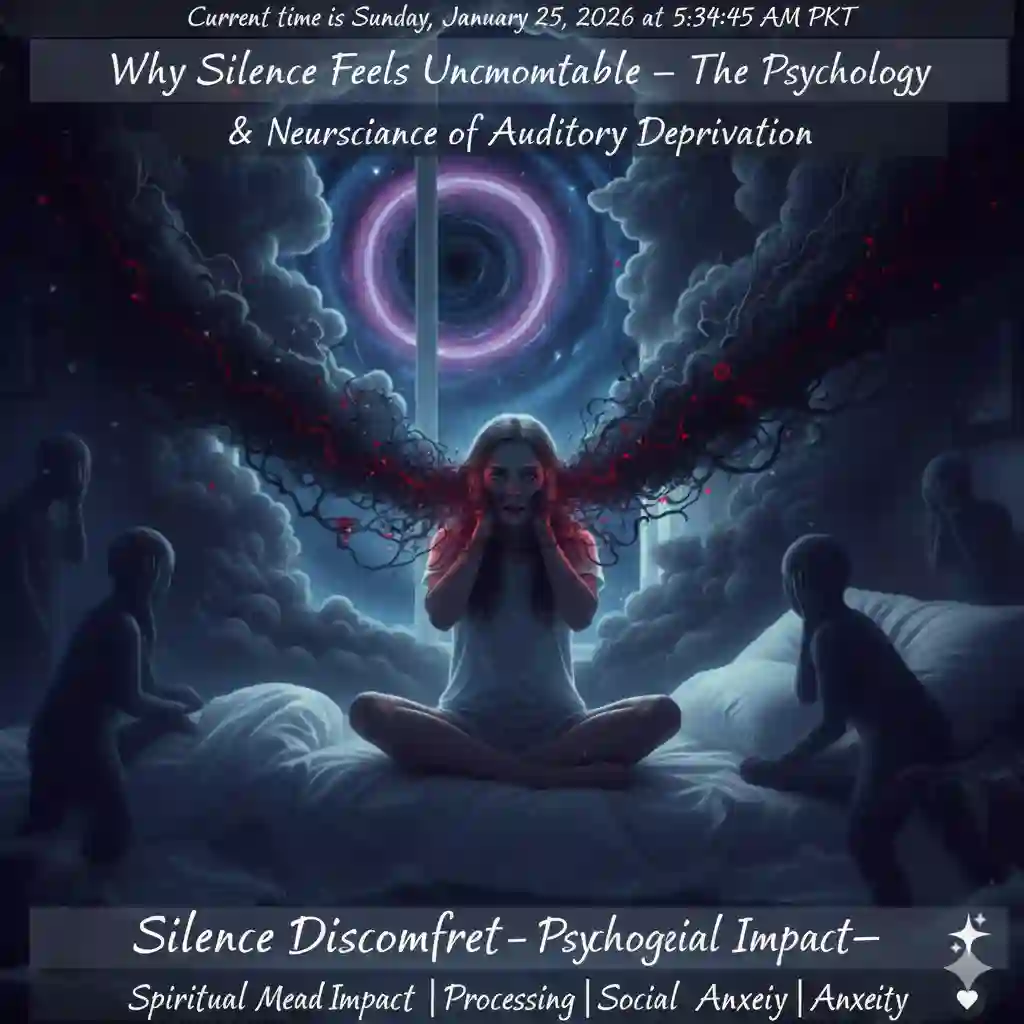
The human brain is a social organ, wired over millennia to seek connection, stimulation, and feedback. We rely on external cues—a nod, a smile, a background noise—to feel safe and oriented. When those cues vanish, silence creates a vacuum. It strips away the distractions that shield us from our inner world, leaving us alone with our thoughts, feelings, and insecurities. Understanding why silence feels so uncomfortable is not a sign of weakness; it is a profound insight into how our minds work to protect us, even when no danger is present.
How Silence Awakens the Brain’s Threat System
Our brains are prediction machines, constantly scanning the environment for information to confirm our safety. In a social context, a steady flow of conversation provides data: the other person is engaged, the connection is stable, and there is no immediate threat. Silence disrupts this flow. It is an absence of data, and the brain often interprets missing information as a potential danger.
This activates ancient, deep-seated survival mechanisms. The amygdala, the brain’s alarm system, may flag the silence as a sign of social rejection or exclusion—a threat that was once tantamount to a death sentence for our tribal ancestors. This is why a sudden pause in conversation can trigger a subtle jolt of anxiety. Your mind is asking, “Did I say something wrong? Are they angry with me? Am I being judged?”
Without external reassurance, the brain turns inward, and the default mode network (DMN) kicks into high gear. The DMN is the brain system active when we are not focused on an external task; it’s responsible for self-reflection, daydreaming, and thinking about the past or future. In silence, an overactive DMN can trap us in a loop of self-evaluation and worry. We become hyper-aware of our own thoughts, our physical sensations, and our emotional state. The quiet space becomes a gallery where our deepest insecurities are put on display.
Why Silence Feels Louder Than Noise
For many, the most unsettling part of silence is not the absence of sound but the presence of what it reveals. When external distractions disappear, the unresolved emotions we carry—the quiet anxieties, the lingering sadness, the suppressed anger—surface with startling clarity. This is why silence can feel so loud; it is filled with the noise of our own inner world.
Feelings that we successfully keep at bay during a busy day have nowhere to hide when it’s quiet. The silence acts as an amplifier for our internal state. If you are feeling anxious, the quiet will feel tense. If you are feeling sad, the quiet will feel heavy and lonely. This experience is not imaginary; it is a direct confrontation with the emotional energy you carry. Sometimes, people experience this as a physical sensation, like a tightness in their chest or a feeling of pressure. This is because strong emotions can trigger real physiological responses in the body, which is a phenomenon explored in our article on why emotional pain feels heavy in the chest.
In this way, silence doesn’t create new feelings; it simply reveals what is already there. It forces an intimacy with ourselves that can be deeply uncomfortable if we are not at peace with what we find.
The Social Psychology of Awkward Silence
Our discomfort with silence is not just neurological; it is also deeply social. From a young age, we are conditioned to view conversation as a sign of successful interaction. A lively chat means connection, while a prolonged pause can signal awkwardness or failure.
Silence as a Threat in Conversation
In a dialogue, silence is rarely neutral. It can signify disagreement, disapproval, or a breakdown in communication. Our brain, wired for social connection, interprets this as a threat to the bond. This can trigger a fear of judgment or abandonment. The thought process might be, “If I don’t fill this gap, they will think I am boring, unintelligent, or weird.” This fear is so potent because social rejection lights up the same neural pathways as physical pain. This is why a cold shoulder or an unanswered text can hurt so much, a topic we cover in depth in our guide on why rejection feels physical.
The Rush to Fill the Void
This fear of judgment compels us to become “silence-fillers.” We rush in with meaningless small talk or nervous laughter, not because we have something important to say, but because the alternative—sitting in the shared quiet—feels too vulnerable. We use words as a shield, a way to manage the other person’s perception of us and to prove that the connection is still intact.
This behavior is reinforced by cultural norms. In many Western cultures, silence in a social setting is seen as a problem to be solved. In other cultures, however, silence is valued as a sign of respect, thoughtfulness, and comfort between individuals. This shows that a significant part of our discomfort is learned.
Emotional Avoidance in the Quiet
At its core, the frantic need to fill silence is often a form of emotional avoidance. When it’s quiet, we are left alone with our thoughts. For many, this is an unwelcome prospect. Silence forces us to confront the anxieties, insecurities, and regrets that we successfully suppress with the noise of daily life.
By filling the silence with chatter, we are not just avoiding social awkwardness; we are avoiding ourselves. The noise becomes a buffer, a way to keep our own challenging thoughts and feelings at a safe distance. Many of us unconsciously learn to do this over time, which is related to the reasons why we bottle up our feelings. When that buffer is removed, we are forced to sit with what we’ve been avoiding.
Navigating Silence in Everyday Situations
Our reaction to silence varies depending on the context.
- Silence in Elevators or Waiting Rooms: This is a classic example of social awkwardness. Surrounded by strangers, the lack of interaction can make us feel exposed and judged. We stare at our phones or the floor not just out of boredom, but to create a private bubble and signal that we are not a threat, nor are we inviting interaction.
- Silence During Arguments: In a conflict, silence is a powerful and often weaponized tool. It can be used to punish, to signal withdrawal, or to create tension. When someone gives you the silent treatment, it activates a primal fear of abandonment. Conversely, a mutual, calming silence can be a necessary pause to de-escalate, but it often feels fraught with unspoken anger. Stressful situations like arguments can dramatically change how we perceive silence, a process explained in our article on how stress impacts emotional responses.
- Silence After Sending a Message: The agonizing wait after sending a vulnerable text or important email is a modern form of silent torture. The lack of an immediate reply creates a cognitive void that our minds rush to fill with worst-case scenarios: “They’re ignoring me,” “I offended them,” “They don’t care.”
- Silence When Alone at Night: This is perhaps the most profound form of silence. Without the distractions of the day, the quiet of the night can amplify feelings of loneliness, anxiety, or existential dread. It is in this deep quiet that our unresolved thoughts and feelings often come to visit.
Why Silence Activates Old Emotional Memories
Our discomfort with silence is not always about the present moment. For many, it is rooted in the past. The brain is associative; a present-day experience can trigger the emotional residue of a past event without our conscious awareness.
If you grew up in an environment where silence preceded anger, criticism, or punishment, your nervous system learned to equate quiet with danger. As an adult, even a neutral silence can put your body on high alert, bracing for an impact that never comes. This is a trauma response, where the past is constantly intruding on the present.
Similarly, experiences of childhood neglect can create a deep-seated fear of being ignored. For someone who had to fight for attention or who was often left alone with their feelings, silence in a relationship can feel like a reenactment of that early abandonment. It can trigger a profound sense of invisibility and emotional distress. In some cases, prolonged exposure to such emotional states can lead to a feeling of being disconnected or numb, a protective mechanism discussed in our guide to the psychology of emotional numbness. The discomfort is not just awkwardness; it is the echo of an old wound.
Additional Questions People Ask
Why does silence make me anxious?
Silence often makes people anxious because it removes external social cues that the brain uses to feel safe. This lack of data can be interpreted as a potential threat, like social rejection or disapproval. It also creates a mental space where worries, self-criticism, and anxious thoughts, which are normally quieted by distraction, can become much louder.
Is discomfort with silence linked to trauma?
Yes, a strong or persistent discomfort with silence can be linked to trauma. If you experienced neglect, or if silence in your childhood was often followed by anger, criticism, or emotional volatility, your nervous system may have learned to associate quiet with danger. As a result, even safe silence in adulthood can trigger a physiological stress response.
Why do I overthink more when it’s quiet?
When external stimulation decreases, the brain’s default mode network (DMN) becomes more active. This is the part of your brain responsible for self-reflection, memory recall, and thinking about the future. For individuals prone to anxiety or worry, an overactive DMN in a quiet environment can lead to rumination and overthinking, as the mind tries to fill the sensory void with its own internal chatter.
Can learning to tolerate silence improve emotional health?
Absolutely. Learning to sit with silence is a powerful practice for emotional regulation. It helps you become more aware of your own thoughts and feelings without immediately reacting to them. By tolerating the initial discomfort, you teach your nervous system that silence is not a threat. This practice can reduce anxiety, increase self-awareness, and allow you to process emotions that you might otherwise suppress.
Conclusion: Reframing Silence as a Mirror
Our instinct is often to treat silence as a threat—an empty space to be filled, a social failure to be corrected, or a danger to be avoided. But what if we reframed it not as a void, but as a mirror? The discomfort that arises in the quiet is not a flaw in our character; it is a reflection of our inner emotional landscape. It shows us where we are holding tension, where we are craving reassurance, and which feelings we have been trying to outrun.
By learning to sit with silence, even for a few moments at a time, we begin to change our relationship with ourselves. We learn to listen to the subtle whispers of our own heart and mind. The awkwardness may never disappear completely—it is a deeply human trait—but it can transform from a source of anxiety into an invitation for deeper self-understanding. In the end, the goal is not to love silence, but to no longer be afraid of what it might show us.