Meta Information
Meta Title: Long-Term Mental Health Care: A Critical Guide
Meta Description: Discover what effective long-term mental health care truly involves beyond symptom management. Learn about skills, goals, and sustainable wellness.
Fast Summary: What the Original Page Promotes
If you have ever explored options for psychiatric support, you have likely encountered pages describing “Long-Term Care.” These sections typically highlight a clinic’s commitment to providing stable, ongoing support for chronic mental health conditions. They emphasize consistent medication management, regular therapy sessions, and the benefit of a stable treatment environment.
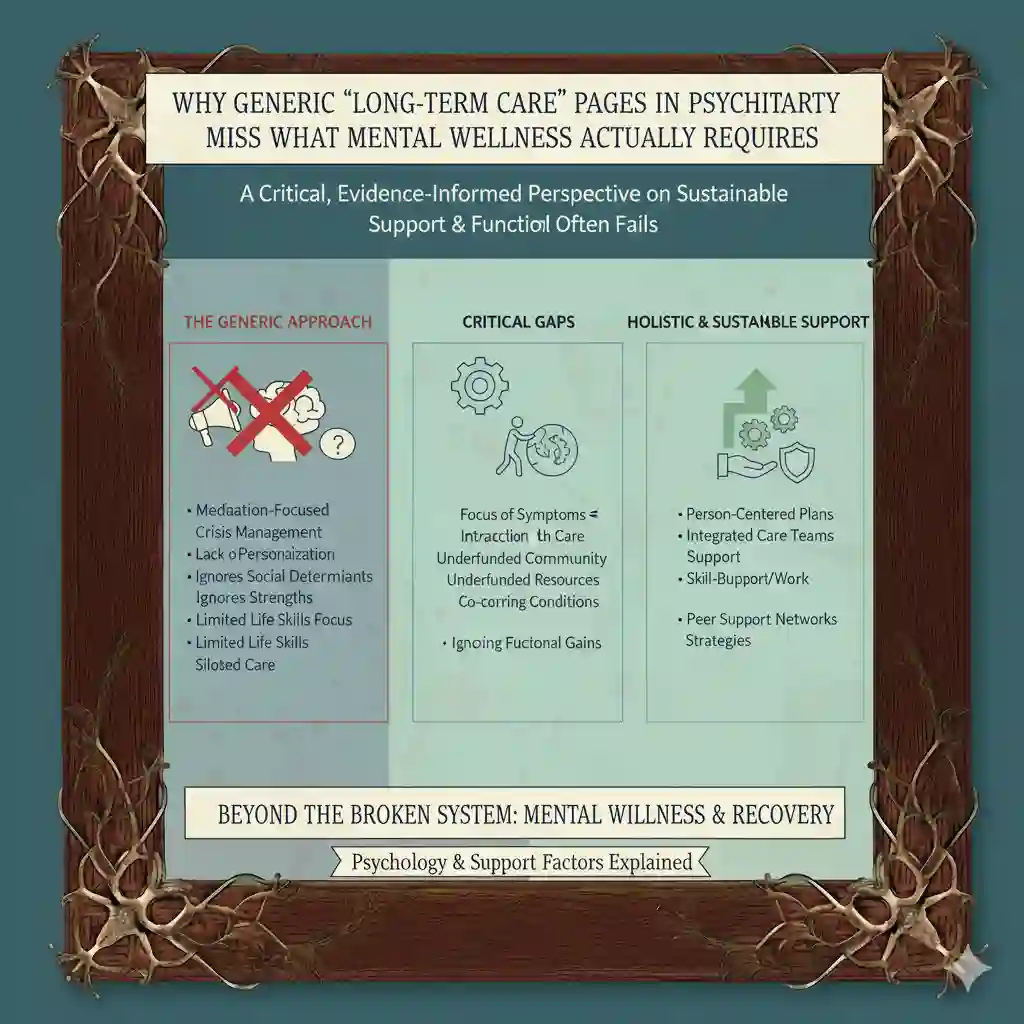
While continuity of care is undeniably important, the broader picture of sustainable mental wellness is far more nuanced. This article addresses the problems with long-term mental health care pages by showing how they often oversimplify what it takes to build a resilient, functional life. True long-term wellness goes beyond just managing symptoms; it involves developing psychological skills, addressing social and environmental factors, and focusing on functional outcomes, not just clinical check-ins.
Why the Term “Long-Term Care” Is Often Misleading in Mental Health
In general medicine, “long-term care” has a relatively clear meaning. It might refer to managing a chronic illness like diabetes or providing supportive services in a nursing facility. In mental health, however, the term is far more ambiguous. Mental health conditions are not a monolith; the long-term needs for someone with treatment-resistant schizophrenia are vastly different from someone managing recurrent major depression or complex PTSD.
When clinical websites use “long-term care” as a blanket term, it can inadvertently mislead patients. It can create the impression that the goal is indefinite treatment rather than progressive empowerment. It suggests a one-size-fits-all model where the primary metric of success is simply remaining in care.
This framing often overlooks a crucial question: What is the goal of this long-term care? Is it merely to prevent crisis, or is it to build a life where the patient is no longer defined by their diagnosis? An effective approach must be dynamic, adaptive, and focused on eventual self-management, not just perpetual treatment.
The Limits of Long-Term Symptom Management
One of the most significant critiques of generic long-term care psychiatry models is their frequent over-reliance on symptom management, particularly through medication. While psychotropic medications can be life-saving and are a cornerstone of treatment for many severe conditions, a strategy focused solely on symptom suppression often falls short of fostering true wellness.
Reducing the intensity of anxiety or lifting the fog of depression is a critical first step, but it is not the final destination. A person can have their symptoms medically managed yet still lack the skills to navigate life’s challenges. They might feel “less sad” but still be unable to maintain relationships, hold a job, or find a sense of purpose. This is the difference between symptom reduction and functional improvement.
Sustainable wellness requires building capacity in areas that medication alone cannot touch:
- Emotional Regulation: The ability to tolerate distress and manage emotional responses without being overwhelmed.
- Cognitive Restructuring: The skill of identifying and challenging the distorted thought patterns that fuel anxiety and depression.
- Behavioral Pattern Change: The process of replacing maladaptive habits (like avoidance or rumination) with adaptive ones.
Mistaking symptom management for recovery is a common pitfall. As we explore in our guide on why standard stress vs. anxiety articles fall short, persistent anxiety is often maintained by behavioral patterns, not just a chemical imbalance. A long-term plan must address these patterns directly.
The Role of Psychological Literacy in Long-Term Wellness
Perhaps the most critical element missing from many long-term care descriptions is the concept of psychological literacy. Effective long-term support is not a passive process where a patient receives treatment; it is an active, educational process where the patient learns to become the expert on their own mind.
A patient does not just need treatment continuity; they need skills in self-understanding. They need to learn:
- What their emotional triggers are and why they exist.
- How their thought patterns influence their feelings and behaviors.
- What their early warning signs of a relapse look like.
- Which specific coping strategies work for their unique nervous system.
This educational component is what transforms a patient from being dependent on a clinician to being an empowered self-manager of their condition. The quality of the therapy and psychoeducation provided matters far more than the sheer duration of treatment. It’s about building a person’s internal toolkit so they are not reliant on an external one forever. Understanding the “why” behind your reactions is a cornerstone of this literacy, as we discuss in the science of emotional triggers.
Structural & Social Factors That Clinical Pages Ignore
A clinical office is a controlled environment. Real life is not. The most brilliant therapy or the most effective medication can be undermined by external life factors that most “long-term care” pages fail to mention. Sustainable mental wellness insights must acknowledge that a person’s well-being is inextricably linked to their environment.
Factors that profoundly affect long-term outcomes include:
- Social Connection: Chronic loneliness is as detrimental to health as smoking. A long-term plan that doesn’t address social isolation is missing a key ingredient.
- Work and Financial Stability: The stress of financial insecurity or a toxic work environment can overwhelm any clinical intervention.
- Physical Health: Sleep, nutrition, and physical activity are not “add-ons” to mental health; they are foundational.
- Trauma History and Cultural Context: A person’s history of trauma and their cultural identity shape how they experience and express distress. A “one-size-fits-all” clinical model will fail if it does not account for these factors.
When a person experiences emotional numbness, it is not just a symptom to be medicated; it’s often a signal of deep disconnection from self and environment. To understand this further, read our guide on why emotional numbness happens. A truly long-term plan must look beyond the clinic walls and address the person’s whole life.
Behavioral Patterns That Predict Long-Term Success
Beyond just attending appointments, there are specific behavioral patterns that research has shown to be strong predictors of long-term wellness. These are the skills that should be the focus of any effective care plan.
- Habit Formation and Cognitive Reframing: Success is not about willpower; it is about building systems. This includes creating routines that support mental health (like a consistent sleep schedule) and actively practicing cognitive reframing. This is about recognizing that negative thought loops, like overthinking, are often habits that can be changed, not fixed personality flaws. For more on this, see our article on why overthinking is a habit.
- Emotional Self-Monitoring: This is the ability to check in with oneself and notice subtle shifts in mood or energy before they become a full-blown crisis. It is about developing an internal “dashboard” to monitor your mental state.
- Adaptive Coping Rather Than Avoidance: Avoidance is the fuel for anxiety. Individuals who achieve long-term stability learn to face discomfort in manageable doses rather than running from it. They develop a flexible toolkit of coping strategies and know when to apply them.
- Awareness of Early Warning Signs: Just as someone with diabetes learns to recognize the signs of low blood sugar, a person with a chronic mental health condition can learn to recognize their personal “yellow flags”—the subtle changes in sleep, appetite, or social behavior that signal a potential downturn.
What Effective Long-Term Support Actually Looks Like
If generic “long-term care” is insufficient, what does a robust, effective model of functional mental health support look like? It moves beyond passive treatment to active collaboration.
a. Integrated Multidisciplinary Care
This involves a team-based approach. A psychiatrist might manage medication, a therapist provides psychotherapy, and a skills coach or case manager helps with practical life challenges like finding housing or employment. The care is coordinated and holistic.
b. Psychoeducation Instead of Passive Treatment
In this model, every appointment is an opportunity for learning. The clinician explains the “why” behind a treatment, teaches the patient about their condition, and collaboratively troubleshoots challenges. The patient is an active student, not a passive recipient.
c. Functional Goals (Not Only Symptom Scales)
While reducing symptoms on a rating scale (like the PHQ-9 for depression) is important, it is not the whole story. Functional goals are about real-life outcomes.
- “I want to be able to go to the grocery store without having a panic attack.”
- “I want to rebuild a relationship with my sibling.”
- “I want to be able to complete a project at work without burning out.”
These goals are meaningful, measurable, and directly tied to improving quality of life.
d. Patient Empowerment and Self-Management Skills
The ultimate goal of effective long-term support is to make the patient the leader of their own care team. This involves teaching them the skills to manage their condition independently, so that formal treatment can be reduced to periodic check-ins or be discontinued altogether.
The Pitfall of Equating Time With Progress
A central problem with many long-term mental health care pages is the implicit assumption that duration equals quality. A person can be in therapy for ten years and make very little progress if the therapy is not targeted, goal-oriented, and adaptive.
This can lead to “care loops,” where a patient gets stuck in a cycle of routine appointments that provide temporary comfort but no lasting change. The sessions might become a form of dependency, reinforcing the patient’s identity as a “sick person” rather than building their competence and resilience.
Effective care should be reflective. Both the clinician and the patient should regularly ask: “Is this still working? Are we making progress toward our goals? Does the plan need to be adjusted?” Care should be dynamic, evolving as the patient’s needs change.
Patient-Centered Questions to Ask About Long-Term Care
To empower yourself when exploring care options, use this checklist to move beyond the marketing language and get to the heart of what is being offered.
- What is the evidence base for your long-term approach to my condition? (Are they using methods proven to work?)
- How will we define and measure progress beyond just symptom reduction? (Are they focused on functional goals?)
- What specific skills will I learn in our sessions to help me manage my condition on my own? (Is there an educational component?)
- What is a typical session like? Is it structured or open-ended? (Does their style fit your needs?)
- How often will we reassess the treatment plan? What happens if I am not making progress? (Is the plan adaptive?)
- What is your philosophy on reducing or discontinuing treatment over time? (Is the goal empowerment or perpetual care?)
Asking these questions transforms you from a passive consumer into an active collaborator in your own wellness journey.
Balancing Appreciation With Critical Insight
This long-term care psychiatry critique is not meant to diminish the importance of ongoing support. For individuals with severe and persistent mental illnesses like schizophrenia, bipolar disorder, or severe, recurrent depression, consistent, long-term care is not just helpful; it is essential for stability and safety.
The argument is not against long-term care itself, but against the oversimplified and often passive way it is framed. Effective long-term care is an active, collaborative, and educational process. It is about more than just maintaining the status quo; it is about systematically building the skills, resources, and self-understanding necessary to live a full and meaningful life, whether symptoms are present or not. It is a partnership aimed at building resilience, not just managing decline.