Countless guides attempt to untangle the difference between stress and anxiety. They offer symptom checklists and timelines, suggesting that if your feelings of unease persist long after a stressful event has passed, you are likely experiencing anxiety. While not incorrect, this explanation often leaves people feeling misunderstood. It addresses the “what” but completely misses the “why.” You know the feeling won’t go away; what you want to understand is why it has become a permanent resident in your mind and body.
The issue is that persistent anxiety is often misframed as just a lingering emotion. A more accurate way to view it is as a regulation problem—a learned pattern that the nervous system has adopted for reasons that once made sense. This article explores what that chronic anxious state is really signaling, moving beyond surface-level distinctions to offer a deeper, more compassionate understanding of why your anxiety doesn’t seem to go away.
1. Why Stress vs. Anxiety Is the Wrong Starting Question
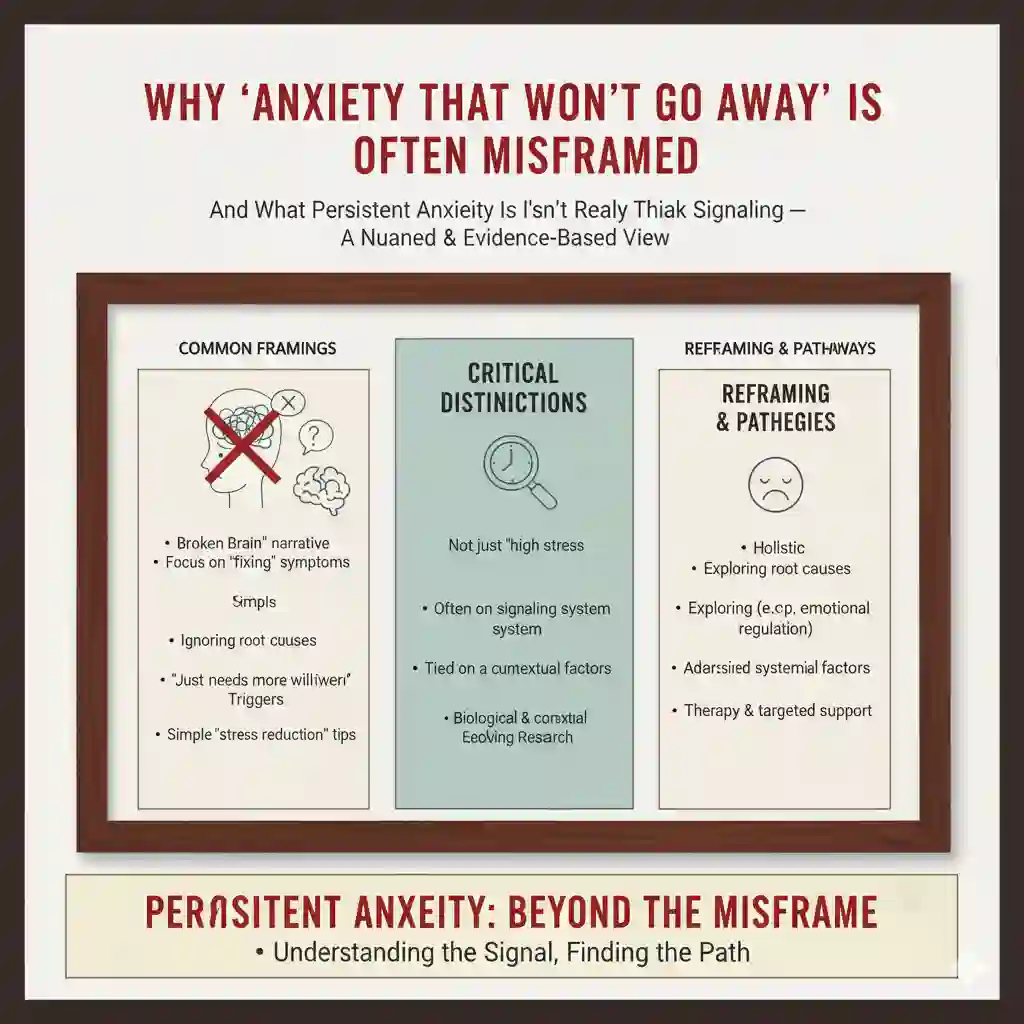
Many articles begin by asking you to differentiate between stress (a response to an external trigger) and anxiety (a response that continues without one). While a useful starting point, this framework quickly breaks down for those experiencing a chronic anxious state. The significant overlap in physical and mental symptoms—racing heart, muscle tension, spiraling thoughts—often causes mislabeling. You might assume you are just “very stressed” for months on end, even when life is relatively calm.
The defining characteristic of persistent anxiety is not just its duration but its pattern. It is a system that has learned to run in the background, independent of external triggers. This is precisely why standard stress vs anxiety articles fall short; they fail to explain how anxiety becomes a self-sustaining loop. The real question isn’t whether you’re stressed or anxious, but why your system has learned to default to a state of alert.
2. Persistent Anxiety Without a Clear Trigger (What Most Guides Miss)
Many people with persistent anxiety struggle to name a specific trigger for their feelings. This is because the anxiety is not always a reaction to a present danger but a pattern of anticipation. This can manifest in several ways that most guides overlook.
Anticipatory Anxiety Without Danger
This is the feeling of bracing for an impact that never comes. Your mind constantly scans the horizon for potential threats, creating a low-grade hum of dread even on a peaceful day. It’s the feeling that something is about to go wrong, without any evidence to support it.
“Background Anxiety” That Never Spikes
Unlike a panic attack, this form of anxiety doesn’t always have sharp peaks. It’s more like static or a constant, quiet hum that runs beneath the surface of your daily life. It’s the reason you can’t fully relax on vacation or enjoy a quiet moment without your mind immediately jumping to a “what if” scenario.
Functional Anxiety That Hides Behind Productivity
For many, a chronic anxious state is masked by high achievement. The fear of failure or of dropping the ball fuels a relentless drive to work, plan, and organize. From the outside, you look successful and put-together. Internally, you are running from a feeling of impending doom. This is often why high-functioning anxiety feels invisible; it camouflages itself as a positive trait.
3. When Anxiety Becomes a Learned Safety Strategy
Your brain’s primary job is to keep you safe. If, at some point in your life, worrying or being hypervigilant helped you avoid a negative outcome, your brain logged that as a successful strategy. Over time, this can create a paradoxical situation where the very thing causing you distress—anxiety—is the thing your brain believes is keeping you safe.
This learned pattern operates in a few key ways:
- Worry is confused with preparedness: Your brain develops the belief that if you worry about a problem enough, you can control its outcome. You feel unprepared or irresponsible if you are not actively worrying.
- Hypervigilance gets rewarded: If you were once blindsided by a difficult event, your nervous system may have learned that constant alertness is the only way to prevent it from happening again.
- Calm feels unsafe: When you have lived in a state of high alert for long enough, a state of calm can feel foreign and dangerous. It can feel like you are letting your guard down, making you vulnerable.
This internal logic drives behaviors like avoidance (steering clear of situations that might trigger anxiety), control (micromanaging your environment to minimize uncertainty), and reassurance-seeking. The cycle reinforces itself because, from your brain’s perspective, it works. This is how anxiety masks as control, creating a rigid system designed to prevent the very discomfort it perpetuates.
4. Why “Managing Stress” Doesn’t Fix Chronic Anxiety
If you have persistent anxiety, you have likely been told to meditate, do yoga, or “manage your stress.” While these practices are beneficial, they often fail to resolve the underlying issue for one simple reason: they treat the symptom, not the pattern.
- Relaxation doesn’t retrain prediction circuits: A 10-minute meditation can calm your body in the moment, but it doesn’t change the brain’s underlying belief that it needs to be on high alert. The moment you stop meditating, the prediction loop can switch right back on.
- Removing stressors doesn’t reset threat bias: Quitting a stressful job or ending a difficult relationship may provide temporary relief. But if your nervous system has a baked-in threat bias, it will simply find new things to worry about. The “what” changes, but the “how” remains the same.
- Coping is not the same as rewiring: Coping mechanisms help you endure the anxiety. Rewiring involves teaching your nervous system that it no longer needs the anxiety pattern to stay safe.
True change comes from pattern interruption, not just stress removal. It requires showing your brain, through new experiences and behaviors, that it can feel safe without running the old anxiety program.
5. The Overlap With ADHD, Emotional Dysregulation & Misdiagnosis
It is also important to consider that what feels like persistent anxiety may sometimes be a secondary signal of a different underlying issue. Without diagnosing, it is helpful to understand the overlap.
A mind that struggles with executive functions, as is common in ADHD, may generate anxiety as a byproduct of trying to keep up with deadlines, organizational demands, and time management. The constant feeling of being behind can create a chronic state of unease. This is one example of why simple ADHD guides can be misleading, as they may not account for how these primary challenges manifest as secondary emotional states. Similarly, difficulty with emotional dysregulation can create a cycle where small feelings quickly escalate, leaving a person in a prolonged state of distress that looks and feels like anxiety.
In these cases, treating only the anxiety is like treating the smoke without looking for the fire.
6. When Persistent Anxiety Actually Needs Professional Help
Recognizing that anxiety is a pattern is empowering, but it is not a substitute for professional support. The time to seek help is not when the anxiety becomes “bad enough,” but when it consistently gets in the way of you living the life you want to live.
This is about functional impairment, not fear. Consider seeking help if your anxiety pattern consistently interferes with your relationships, your work, your health, or your ability to experience joy and rest. This is not a sign of weakness, but a courageous step toward reclaiming your well-being. For a critical, evidence-based perspective on when to see a psychiatrist, understanding these functional markers is key.
Reframing the Question the Reader Should Ask
If you have been living with anxiety that won’t go away, it may be time to stop asking, “Why am I always anxious?” That question often leads to self-blame and a frustrating search for a trigger that may not exist.
Instead, try asking a more compassionate and curious question: “What pattern is my nervous system trying to maintain, and what does it believe it is protecting me from?”
This reframe shifts the focus from judging the emotion to understanding the mechanism. It opens the door to self-compassion and a more effective path forward—one that involves gently teaching your system that it is safe to finally let its guard down. The feeling of persistent anxiety is a real and valid experience, but it does not have to be your permanent reality. It is a signal, and once you learn to interpret its message correctly, you can begin to respond differently.