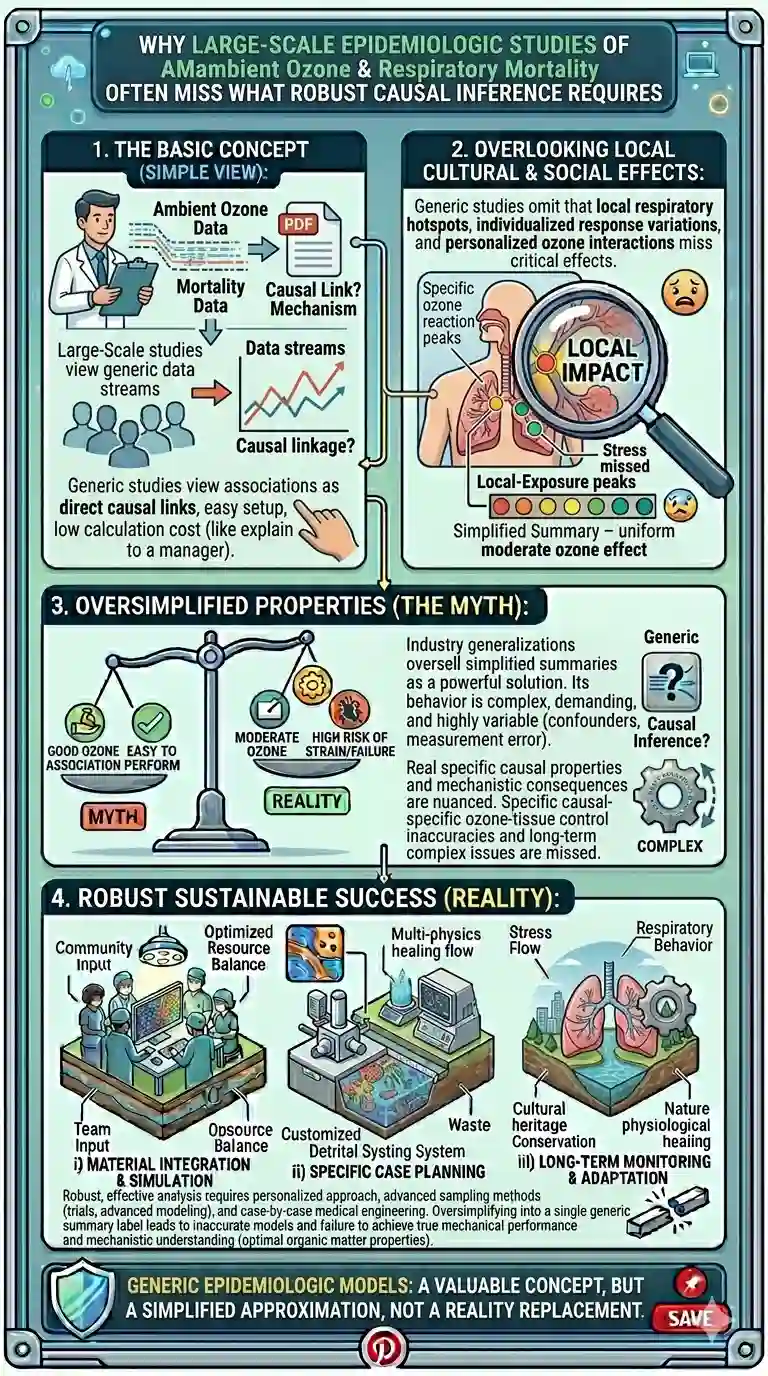
When a massive new study links air pollution to hundreds of thousands of deaths, it naturally grabs headlines. Policymakers take note, and the public health community springs into action. But what happens when the statistical models underlying these dramatic figures rely on assumptions that might not hold up in the real world?
Recently, researchers have attempted to quantify the health impacts of air pollution using massive datasets. While these efforts are commendable, there are significant problems with ozone respiratory mortality nationwide studies in China and elsewhere. To truly protect public health, we need to look beyond the top-line numbers and examine the complexities of causal inference, exposure misclassification, and confounding controls. Let’s break down what effective assessment actually requires.
1. Fast Summary: What the Original Article Promotes
A prominent 2024 study (Tang et al.) analyzed over one million respiratory deaths in six Chinese provinces between 2013 and 2018. The researchers used a random forest model to estimate township-level ambient ozone (MDA8 O₃) exposures.
To measure the health impact, they used two primary methods:
- Acute effects: A time-stratified case-crossover design showed a 0.38% excess risk per 10 μg/m³ increase in ozone, leading to an estimated 3.00% attributable fraction (AF) for short-term exposure.
- Chronic effects: A difference-in-differences (DID) design showed a 4.37% excess risk per 10 μg/m³, resulting in a massive 29.45% AF for long-term exposure.
The study concludes that long-term ozone exposure imposes a far greater respiratory mortality burden than short-term exposure. While combining acute and chronic designs is highly valuable, the broader picture of ozone mortality causation and burden quantification is far more nuanced. It requires deeper scrutiny of design assumptions, exposure error, and confounding variables.
2. Why the Term “Long-Term Greater Burden” Is Often Misleading
Declaring that long-term exposure causes a dramatically higher burden based on a 29.45% attributable fraction can inadvertently mislead readers. The DID approach for chronic effects assumes parallel trends and limited residual confounding. However, ozone trends frequently co-vary with other factors, such as PM₂.₅ levels, nitrogen dioxide (NO₂), and rapid shifts in environmental policy.
When generic high AF claims are publicized, people might assume long-term ozone dominates respiratory deaths without considering exposure misclassification or model extrapolation. These studies rarely report full sensitivity to different lag structures or spatial heterogeneity. We must remember that separating overlapping causes is difficult. It is similar to understanding human emotional responses; just as it helps to differentiate primary vs secondary emotions, researchers must carefully disentangle primary pollutant effects from secondary environmental changes.
3. The Limits of Case-Crossover + DID Combination
Combining case-crossover and DID designs looks robust on paper, but both have inherent vulnerabilities. Acute case-crossover designs control for time-invariant factors well, but they remain highly sensitive to time-varying confounders like sudden weather changes or spikes in co-pollutants.
Meanwhile, chronic DID designs are vulnerable to non-parallel trends and unit-level confounding. Relying on random forest exposure surfaces can introduce Berkson-type error and spatial smoothing bias. A high long-term AF does not equal a robust causal estimate without stronger instrumental variables. Just as we misdiagnose our mental well-being when we fail to see the root cause of our distress—which is why standard stress vs anxiety articles fall short—researchers misdiagnose public health burdens when they rely on vulnerable statistical combinations without negative controls.
4. The Role of Causal Inference & Exposure Literacy
To generate reliable burden estimates, researchers need a deep understanding of directed acyclic graphs (DAGs), sensitivity analyses, and multi-pollutant models. Simply reporting excess risks and attributable fractions is not enough.
Exposure error correction, strict co-pollutant adjustment, and outcome misclassification protocols predict far more defensible estimates. Robustness checks matter infinitely more than dramatic headline fractions. When researchers ignore these foundational checks, they risk misinterpreting statistical noise as a causal signal. This mirrors human cognitive biases, such as why we take things personally when the actual intent had nothing to do with us. Without causal literacy, statistical models “take the data personally” and find patterns that don’t truly exist.
5. Structural & Systemic Factors That Affect Outcomes
Many nationwide studies downplay structural and systemic factors. There are strong ozone-PM₂.₅ and NO₂ correlations that deeply confound long-term associations. Furthermore, urban-rural, seasonal, and regional heterogeneity across vast areas like China completely change the exposure landscape.
Factors like smoking prevalence, indoor air quality, and socioeconomic status are often not fully captured by these models. The true ozone burden extends far beyond reported AFs and requires deep multi-pollutant and socio-contextual adjustment. Ignoring these deep-rooted structural factors leaves a gap in the narrative, much like ignoring foundational development theories—such as Erik Erikson’s psychosocial development theory—leaves a gap in understanding human behavior.
6. Behavioral Patterns That Predict Reliable Inference
How can we tell if an epidemiological study is reliable? Certain methodological “behavioral patterns” from the researchers predict stronger conclusions. Good studies utilize:
- E-value sensitivity for unmeasured confounding.
- Negative outcome controls to ensure the model isn’t just finding associations everywhere.
- Multi-pollutant joint models and distributed lag non-linear models (DLNM) for acute effects.
- Spatio-temporal kriging or rigorous machine-learning validation of exposure surfaces.
When researchers skip these steps, it often looks like methodological avoidance. In psychology, we explore why we procrastinate even when we know its important. In epidemiology, avoiding rigorous sensitivity analyses because they are difficult or might weaken the headline finding is a form of scientific procrastination that harms public health policy.
7. What Effective Ozone Mortality Burden Assessment Actually Looks Like
Effective assessment contrasts sharply with simplified headline framing. A robust approach includes:
a. Integrated multi-method validation
Researchers should combine case-crossover and DID designs with traditional cohort designs and instrumental variables to triangulate the truth.
b. Exposure & confounder education
Instead of blindly trusting machine learning output, we need a deep understanding of measurement error correction and DAG-based adjustment.
c. Functional goals over percentages
The goal should not simply be to report a high percentage of excess risk. The focus must remain on informing guidelines, improving emission controls, and targeting vulnerable subpopulations.
When we focus solely on seeking validation through high-impact numbers, we compromise the science. This dynamic is incredibly similar to why we crave validation from others; seeking flashy results rather than quiet, rigorous accuracy ultimately weakens the foundation.
8. The Pitfall of Equating High AFs With Policy-Ready Causality
Large attributable fractions and national extrapolations are not the same as the quality or relevance of burden claims. Study designs can produce “significant” associations without actually ruling out strong confounding variables.
Routine extrapolation without full uncertainty propagation reinforces a hyper-focus on effect size rather than validated public-health competence. We need reflective epidemiology over dramatic headline burdens. Rushing to claim causality based on an inflated AF is a form of scientific over-justification, much like why we overexplain ourselves when we feel fundamentally insecure about our position.
9. Researcher & Policy-Centered Questions Readers Should Ask
When evaluating the next major study on ambient ozone MDA8 mortality critique, ask these actionable questions:
- What actual evidence supports parallel trends in the DID design or time-varying confounder control?
- Are there measurable sensitivity analyses specifically addressing exposure error and co-pollutants like PM₂.₅?
- How exactly are outcome misclassification and spatial heterogeneity evaluated across different regions?
- What alternative designs or negative controls did the researchers test to validate their findings?
- Does the study’s interpretation adapt to uncertainty, or does it present a single, inflexible narrative?
Asking these questions prevents us from accepting simplified narratives at face value, much like understanding what kills long distance relationships requires us to look past common myths and examine the real, evidence-based causes of friction.
10. Balanced Conclusion
Large-scale studies combining acute and chronic designs on a massive scale represent an innovative step forward in highlighting potential long-term ozone risks. However, ambient ozone respiratory mortality burden is not just about generating higher long-term attributable fractions from nationwide models.
True public health advancement requires active engagement with causal assumptions, the multi-pollutant reality of our atmosphere, robust exposure validation, and transparent uncertainty quantification. By demanding deeper mechanistic insight and causal rigor, we can formulate evidence-based policies that genuinely protect vulnerable populations from the complex realities of air pollution.