Long-distance relationships are incredibly common. From college students studying in different states to professionals relocating for career advancement, millions of couples navigate the challenging terrain of loving someone who is hundreds or thousands of miles away. But despite their prevalence, these partnerships suffer from notoriously high failure rates, leaving many to wonder exactly what kills long distance relationships.
If you search for answers online, you will likely encounter simplistic lists detailing “7 reasons” or “10 signs” your long-distance relationship is doomed. While these articles might touch on recognizable symptoms—like lack of communication or financial stress—they frequently fail to explain the underlying behavioral science driving the breakdown. They treat relationship issues as isolated incidents rather than interconnected psychological patterns.
Understanding relationship dissolution factors requires more than a superficial checklist. It requires a deep dive into relationship psychology. To truly grasp why geographical separation tears couples apart, we must examine emotional regulation, attachment styles in relationships, and the complex intimacy dynamics that govern human connection.
This comprehensive guide will critique the oversimplified myths surrounding long-distance breakups, expose the actual psychological mechanisms that erode relational bonds, and provide evidence-based strategies to help you bridge the emotional and physical miles.
Why Lists Can Oversimplify Relationship Dynamics
When couples experience turmoil, it is natural to seek out clear, easily digestible explanations. Popular psychology articles often cater to this desire by providing numbered lists of relationship killers. However, in the realm of relationship psychology, these lists can severely oversimplify deeply complex human dynamics.
Relationship problems are rarely caused by a single, isolated factor. They are multi-layered, evolving issues deeply influenced by individual histories, environmental stressors, and interpersonal communication patterns. For example, a popular list might claim that “lack of communication” is what kills long-distance relationships. While technically true on the surface, this explanation is woefully incomplete. Why did the communication stop? Was it due to a fear of vulnerability? Was it an avoidant attachment response to emotional pressure? Was it digital fatigue?
Context matters immensely. The simple reasons often presented in mainstream articles describe the symptoms of a dying relationship, not the disease itself. Without understanding the underlying psychological mechanisms, couples are left treating surface-level arguments without ever addressing the root cause of their disconnection. To effectively utilize relationship maintenance behaviors, we must move beyond the symptoms and analyze the cognitive and emotional forces at play.
Flaws in the “7 Reasons” Framework
Many popular articles, such as those detailing the “7 reasons” long-distance relationships fail, rely on a framework that lacks clinical depth. By critically examining these common lists, we can identify several significant flaws in how they approach relationship trust and insecurity.
Correlation vs. Causation
Oversimplified lists frequently confuse correlation with causation. For instance, they might state that arguing over text messages kills relationships. In reality, arguing over text is a symptom of deeper emotional dysregulation and poor conflict management skills. The medium is not the cause; the inability to self-regulate and extend grace to a partner is the true relationship killer.
Lack of Attachment Theory Integration
Most mainstream relationship lists completely ignore the foundational principles of attachment theory. You cannot accurately explain relationship expectations mismatch or the fear of abandonment without examining a person’s inherent attachment style. A secure partner and an anxiously attached partner will experience physical distance in radically different ways.
Ignoring Individual Differences
These lists often assume a one-size-fits-all approach, failing to account for individual psychological differences. Introverts and extroverts, for example, have vastly different needs for social support systems and daily contact. What feels like “smothering” to one person might feel like “bare minimum effort” to another.
Failure to Integrate Coping Strategies
Perhaps the most damaging flaw in standard relationship lists is that they identify problems without offering adaptive coping strategies. Telling a couple that “jealousy” will ruin their relationship is unhelpful if you do not provide evidence-based methods for managing cognitive distortions and rebuilding trust.
| Flaw in Popular Lists | Why It Is Problematic | The Psychological Reality |
|---|---|---|
| Focuses on Symptoms | Ignores the root cause of the issue. | Behaviors are driven by deep psychological needs and fears. |
| Ignores Attachment | Treats all partners as having the same emotional baseline. | Early childhood attachment dictates how we handle separation. |
| Lacks Coping Tools | Leaves readers anxious without solutions. | Adaptive coping strategies are required to rewrite behavioral loops. |
Attachment Styles and Long-Distance Strain
To understand the core of long distance relationship psychology, we must examine how the brain processes separation. John Bowlby’s attachment theory is the gold standard for understanding these dynamics. Our attachment style—formed in early childhood—dictates how we perceive intimacy, trust, and physical proximity.
When a relationship transitions to long-distance, the physical separation acts as a massive trigger for the attachment system. How a person reacts depends entirely on their attachment predisposition:
- Secure Attachment: Secure individuals possess a strong internal sense of self-worth and trust their partners. They view physical distance as a temporary logistical challenge, not an emotional threat. They are comfortable with emotional vulnerability and can maintain intimacy without needing constant reassurance.
- Anxious Attachment: For the anxiously attached, distance is a crisis. Their attachment system becomes hyperactivated. They equate physical proximity with safety. When separated, they often experience intense relationship trust and insecurity issues, requiring constant texts, calls, and validation to quiet their internal panic. If a partner is busy or unavailable, they internalize it as rejection.
- Avoidant Attachment: Avoidantly attached individuals might initially prefer a long-distance setup because it provides a built-in barrier against intense emotional intimacy. However, when their partner inevitably seeks deeper connection or reassurance, the avoidant partner feels suffocated and will actively pull away, utilizing distance as an excuse to avoid vulnerability.
Attachment insecurity amplifies relationship breakdown because it creates a toxic cycle. An anxious partner demands more attention, causing the avoidant partner to retreat further, which in turn spikes the anxious partner’s panic. Healing this cycle requires profound internal work. If you struggle with attachment-based anxiety, exploring overcoming insecurity to build self-worth is a vital step toward relational stability.
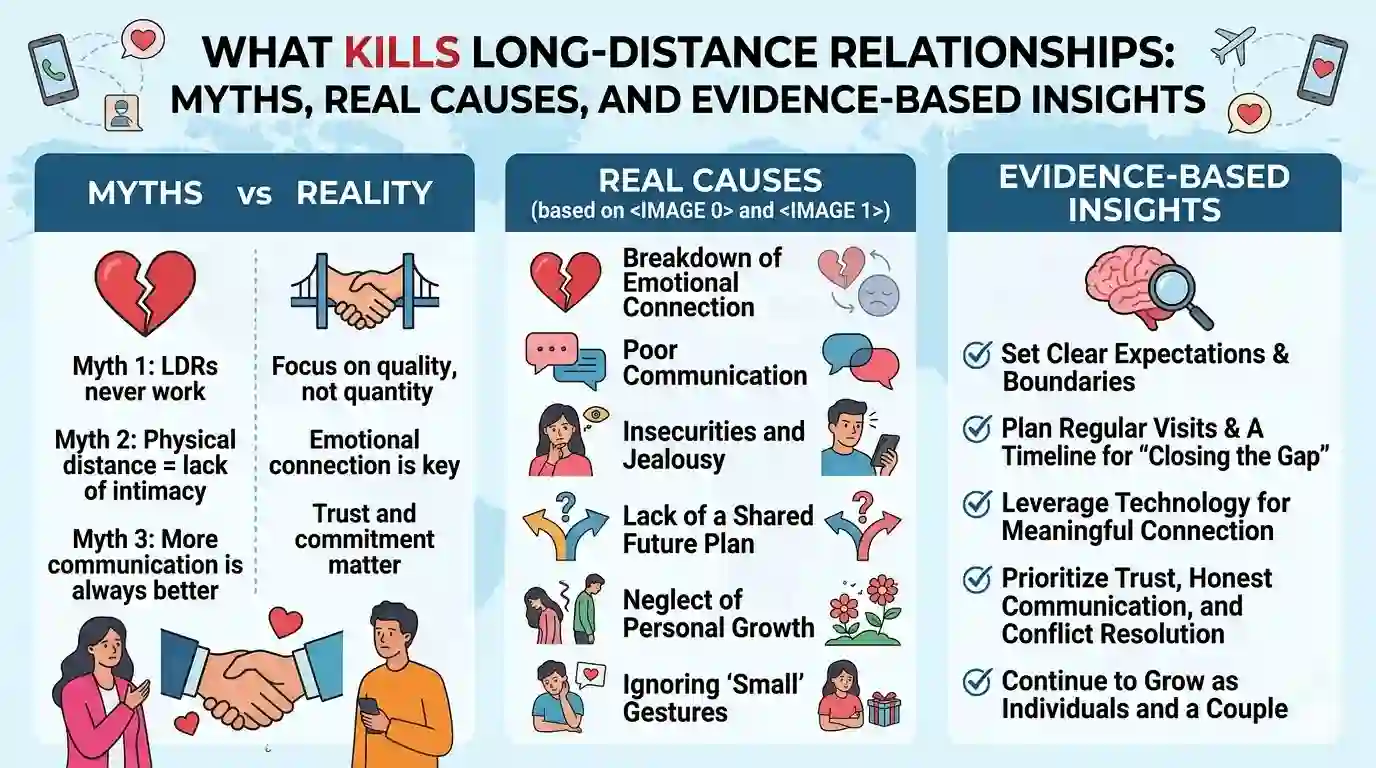
Communication Quality vs Communication Quantity
A pervasive myth in long-distance relationship advice is that couples simply need to “talk more” to survive. This leads to exhausting schedules of mandatory daily video calls and endless text threads. However, relationship communication issues are rarely solved by sheer volume. It is the quality of the communication, not the quantity, that sustains intimacy.
Relying on constant, superficial texting creates a false sense of connection while actively contributing to digital fatigue. Sending fifty text messages about what you ate for lunch does not build emotional intimacy. In fact, forced communication often breeds resentment, turning a loving partnership into an exhausting administrative chore.
Healthy communication patterns require three essential psychological components:
- Emotional Self-Disclosure: This is the act of sharing your inner world—your fears, your hopes, your insecurities, and your joys. It requires vulnerability. A ten-minute conversation involving genuine emotional self-disclosure does more to solidify a bond than three hours of passive small talk.
- Active Listening: When your partner is sharing, you must be fully present. Active listening means setting aside distractions, validating their emotions, and responding with empathy rather than immediately trying to “fix” their problems.
- Responsive Communication: Responsiveness is the cornerstone of trust. It means showing up for your partner emotionally when they make a “bid” for connection. If they express sadness, you respond with comfort.
Trust, Jealousy, and Cognitive Bias
Distance acts as a magnifying glass for our deepest insecurities. Without the ability to observe your partner’s daily life, the brain inevitably attempts to fill in the blanks. When trust breakdowns occur, they are frequently driven by cognitive biases rather than actual betrayal.
Jealousy in a long-distance relationship is rarely about the partner’s actions; it is usually about the jealous individual’s internal cognitive distortions. Two of the most destructive distortions are:
- Catastrophizing: Taking a minor event and assuming the worst possible outcome. (e.g., “She didn’t text me goodnight; she must have met someone else and wants to break up.”)
- Mindreading: Assuming you know exactly what your partner is thinking without any evidence. (e.g., “He sounds quiet on the phone; he is definitely losing interest in me.”)
These distortions trigger the brain’s threat-response system, leading to accusations and interrogations that push the partner away. Furthermore, social comparison effects—such as scrolling through a partner’s social media and obsessing over who they are spending time with—fuel a perpetual cycle of paranoia.
To save the relationship, individuals must learn to challenge these cognitive distortions. You can discover actionable frameworks for disarming these destructive thoughts in this guide on turning jealousy into personal growth. Moreover, managing the mental spirals that accompany jealousy requires a deep understanding of why we overthink the psychology and neuroscience of anxiety and worry.
Psychological Impact of Uncertainty
The human brain is biologically wired to crave predictability and safety. Intolerance of uncertainty is a well-documented psychological trait that dictates how much stress an individual experiences when the future is unknown.
In long-distance relationships, uncertainty is often the default state. Couples frequently grapple with ambiguous commitment. When will we live in the same city again? Who will relocate? What is the ultimate timeline for this distance?
When a couple lacks a clear, mutually agreed-upon future plan, the relationship exists in a state of chronic psychological limbo. This lack of structure breeds severe anxiety about outcomes. Without a light at the end of the tunnel, the daily sacrifices required to maintain the relationship begin to feel pointless. Relationship commitment psychology dictates that humans are willing to endure significant present-day hardship if they have a guaranteed future reward. If the timeline is ambiguous, the motivation to maintain the connection rapidly deteriorates.
Emotional Intimacy: Not Just Physical Proximity
A critical misunderstanding of relationship psychology is the conflation of emotional distance vs physical distance. Many couples believe that because they are physically separated, their emotional intimacy must naturally decline. This is a myth.
Intimacy dynamics are built on emotional attunement, not just shared physical space. Emotional attunement is the ability to read, understand, and respond to your partner’s emotional state. It involves shared vulnerability and the consistent demonstration of supportive behaviors.
You can share a bed with someone and be completely emotionally disconnected. Conversely, you can live on opposite sides of the globe and be deeply emotionally entwined. Building intimacy across distance requires deliberate effort to share your internal worlds.
When couples fail to maintain this emotional bridge, the resulting disconnection feels like a physical wound. The brain registers social and emotional neglect using the same neural pathways it uses to process bodily injury. To understand the profound biological impact of this emotional separation, read about why rejection feels physical and the neuroscience of social pain.
Conflict Patterns That Kill Relationships
Every relationship experiences conflict. However, distance severely complicates conflict resolution in relationships. Without the ability to read non-verbal cues, offer a comforting touch, or physically step away to cool down, disagreements can easily spiral out of control.
Clinical psychologist Dr. John Gottman identified four specific conflict patterns—known as the Four Horsemen—that are highly predictive of relationship dissolution. In a long-distance context, these patterns become lethal:
- Criticism: Attacking your partner’s character rather than addressing a specific behavior. Over text, criticism reads much harsher because it lacks tonal inflection.
- Defensiveness: Refusing to take accountability and playing the victim.
- Stonewalling: Shutting down and withdrawing from the interaction. In a long-distance relationship, stonewalling is incredibly easy; you simply ignore a text or hang up the phone. This causes immense psychological distress for the other partner.
- Contempt: Acting with superiority, sarcasm, or mockery. Contempt is the single greatest predictor of relationship failure.
When couples rely on avoidance or aggressive escalation to handle disputes, the relationship becomes a source of stress rather than a safe haven. Harboring unresolved anger from these mismanaged conflicts destroys emotional warmth. Rebuilding requires learning the psychological mechanisms of letting go of resentment and grudges for emotional freedom.
Real Causes Backed by Research
If simplistic lists and myths do not explain what kills long distance relationships, what does the empirical research actually say? Behavioral science points to several core relationship dissolution factors:
- Insecure Attachment Activation: The inability to self-soothe when the attachment system is triggered by physical absence.
- Chronic Communication Breakdown Patterns: Falling into rigid cycles of demand-withdrawal, where one partner relentlessly pursues connection while the other continuously retreats.
- Mismatch in Relationship Goals: Discovering that your fundamental life plans (career, location, family) do not align, making the long-distance sacrifice moot.
- Psychological Stress and Coping Deficits: Failing to manage the external stressors of life, allowing that anxiety to bleed into the partnership.
- Lack of Repair Attempts: Failing to apologize, reconnect, and heal the bond after an argument.
Successful long-distance couples are not immune to these issues; they simply possess the tools and the willingness to actively repair the damage when these issues arise.
Why Some Long-Distance Relationships Thrive
While the failure rates for long-distance couples can seem daunting, a significant percentage of these relationships actually thrive. In fact, some studies suggest that long-distance couples can develop higher levels of idealization and relationship satisfaction than geographically close couples, provided certain protective factors are in place.
Thriving couples excel in emotional regulation. They do not allow a missed phone call to ruin their day, and they do not project their own insecurities onto their partner. They lean into secure attachment behaviors, giving their partner the benefit of the doubt and trusting in the strength of the bond.
Furthermore, these couples understand that emotions are highly transferable. They actively work to transmit positivity, humor, and calm over the miles, leveraging the psychology of human connection. You can explore how we subconsciously absorb our partner’s moods in the science of emotional contagion and why we catch feelings. Ultimately, surviving the distance requires immense mental fortitude. You can learn how to cultivate this protective mindset in the secret behind emotional resilience as a learned skill.
Evidence-Based Strategies to Save Long-Distance Relationships
If you are navigating the miles, hope is not lost. By replacing toxic habits with adaptive coping strategies, you can build a resilient, fulfilling partnership. Here are evidence-based long distance relationship coping strategies rooted in psychological research:
1. Establish Intentional Communication Routines
Ditch the obligation of constant, mindless texting. Instead, establish predictable, high-quality communication routines. Agree on specific times for deep, focused conversations. Treat these digital dates with the same respect and attention you would give to an in-person dinner date.
2. Create Shared Goals and a Concrete Timeline
Eliminate the psychological distress of uncertainty by building a shared roadmap. Discuss your relationship expectations mismatch openly. You must have a mutually agreed-upon end date for the distance, along with actionable steps for how you will eventually reunite. A shared goal provides the psychological anchor necessary to weather the difficult days.
3. Practice Emotional Awareness and Regulation
Before you text your partner in a panic, pause. Are you actually upset with them, or are you just lonely, tired, or stressed from work? Learning to regulate your own nervous system is vital. Understand how external pressures warp your interactions by reviewing how stress impacts emotional responses and managing reactions. Do not make your partner entirely responsible for your emotional stability.
4. Master Conflict Repair Methods
When arguments happen—and they will—prioritize the repair over being “right.” If a text conversation is escalating, call a time-out and switch to a phone call or video chat to reintroduce vocal tone and facial expressions. If you have acted poorly, take immediate accountability. Forgiving yourself and your partner is essential for moving forward; learn more about releasing past mistakes in how to stop being controlled by guilt, shame, and regret.
5. Cultivate Independent Social Support Systems
Your partner cannot be your only source of joy and interaction. To prevent resentment and enmeshment, you must build robust social support systems in your own geographical location. Invest in your friendships, hobbies, and personal growth. A healthy relationship consists of two complete, fulfilled individuals choosing to share their lives, not two halves desperately trying to make a whole across a distance.
| Strategy | Psychological Benefit | Implementation |
|---|---|---|
| Concrete Timeline | Reduces uncertainty and anxiety. | Sit down and map out a one-year and three-year plan together. |
| Quality over Quantity | Prevents digital fatigue and resentment. | Swap all-day texting for a 30-minute undistracted video call. |
| Independent Hobbies | Reduces hyper-reliance and attachment panic. | Schedule specific days of the week dedicated to your local friends. |
Frequently Asked Questions
Are long-distance relationships more likely to fail?
While physical distance introduces unique stressors, research indicates that long-distance relationships do not inherently have higher failure rates than proximate relationships. The success of the partnership depends entirely on the couple’s communication patterns, attachment security, and conflict management skills, rather than the mileage between them.
Can psychological traits predict long-distance success?
Yes. Individuals with a secure attachment style, high emotional intelligence, and a strong tolerance for uncertainty are significantly more likely to maintain relationship satisfaction across a distance. Conversely, individuals who rely heavily on physical proximity for emotional validation will struggle without targeted therapeutic intervention.
How to maintain intimacy across distance?
Intimacy is maintained through shared vulnerability. Beyond traditional communication, couples can maintain intimacy by reading the same book, watching a movie simultaneously, playing online games, or scheduling dedicated time to discuss their internal emotional states rather than just logistical updates.
What are early warning signs of breakdown?
Early warning signs include a consistent pattern of stonewalling, a noticeable drop in emotional self-disclosure, feeling drained rather than energized after conversations, and a growing sense of apathy or avoidance regarding future planning.
Conclusion
Understanding what kills long distance relationships requires us to look far past the superficial lists and generalized advice found on the internet. Physical separation does not destroy a bond; rather, it exposes the pre-existing psychological vulnerabilities that both partners bring to the table.
The original “7 reasons” framework is limited because it identifies the symptoms of a dying relationship—like poor communication or jealousy—without explaining the complex attachment theories, cognitive distortions, and emotional regulation deficits that actually cause the demise.
By shifting our focus toward evidence-based relationship care, we can change the narrative. Cultivating a secure attachment, mastering conflict repair, demanding high-quality communication over sheer volume, and mapping out a concrete future are the true hallmarks of relational survival. A long-distance relationship is undeniably a crucible, but with the right psychological tools, it can also be the environment where your deepest, most resilient intimacy is forged.