
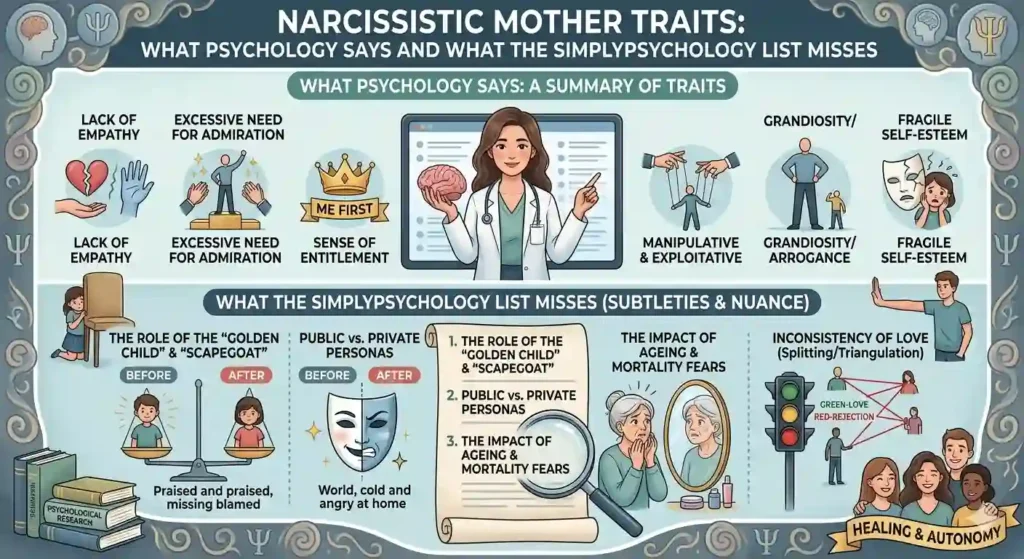
Understanding the complexities of the parent-child relationship is one of the most vital endeavors in behavioral science. Recently, the internet has seen a surge in content regarding toxic family dynamics, with millions of readers seeking to understand their childhoods. Central to this online discussion are articles detailing “narcissistic mother traits.” While recognizing these behaviors can provide profound validation for survivors of maternal narcissistic abuse, popular psychology articles—such as the 13-point list popularized by SimplyPsychology—often oversimplify incredibly nuanced clinical phenomena.
When we rely on bullet-point lists to diagnose complex family systems psychology, we risk pathologizing normal parenting struggles while simultaneously failing to grasp the deep psychological trauma caused by actual clinical narcissism. To truly understand the narcissistic parent impact on children, we must move beyond simplistic behavioral checklists.
This comprehensive guide explores what behavioral science actually says about narcissistic mother traits. We will critique the limitations of mainstream lists, dive deeply into attachment theory, distinguish between overt and covert presentations, and provide evidence-based adult child coping strategies for those navigating the aftermath of childhood emotional trauma.
What Is Narcissistic Personality Disorder (NPD)?
To accurately discuss narcissistic mother traits, we must first define the clinical baseline. Narcissistic Personality Disorder (NPD) is a complex mental health condition categorized in the DSM-5. It is characterized by a pervasive pattern of grandiosity (in fantasy or behavior), a constant need for admiration, and a profound lack of empathy.
Individuals with NPD often display a sense of entitlement, exploiting interpersonal relationships to bolster their own fragile self-esteem. They struggle immensely with emotional regulation and are highly reactive to criticism, often responding with narcissistic rage or profound withdrawal.
However, it is crucial to recognize a fundamental principle of clinical psychology: possessing narcissistic traits does not automatically equate to a full NPD diagnosis. Narcissism exists on a spectrum. A mother may exhibit highly self-centered behaviors or utilize parental emotional manipulation without meeting the clinical threshold for a personality disorder. Conflating traits with a clinical diagnosis leads to a misunderstanding of NPD parenting behaviors and prevents effective psychological intervention.
Why “Traits Lists” Can Be Misleading
Mainstream articles often present a rigid list of “signs” to identify a narcissistic mother. While these lists offer a starting point for self-reflection, they are fundamentally limited in several ways.
Oversimplification of Complex Psychology
Traits lists can severely mislead readers by reducing multifaceted behaviors into binary bullet points. Human behavior is rarely black and white. A mother who is occasionally critical or seeks validation is not inherently a narcissist. Simplistic lists fail to account for the frequency, intensity, and underlying motivation of the behavior.
Lack of Clinical Boundaries
Simply listing traits often pathologizes normal parenting stress. Raising children is inherently challenging, and all parents exhibit moments of selfishness, frustration, or poor emotional regulation. By framing every instance of parental failure as a “narcissistic trait,” these lists blur the lines between normal human fallibility and severe psychological abuse.
Potential Bias and Confirmation Error
When an adult child reads a list of narcissistic mother traits after a recent family argument, they are highly susceptible to confirmation bias. They may selectively recall memories that fit the list while ignoring moments of genuine maternal warmth or sacrifice. Readers often self-diagnose their parents without understanding the strict psychological criteria required for an NPD diagnosis.
Lack of Coping Strategy Guidance
Finally, a simple list of signs leaves the reader stranded. Identifying a toxic dynamic is only the first step. Readers need research-based guidance on psychological boundaries, self-esteem recovery, and processing complex grief—elements entirely missing from basic checklists.
Overt vs Covert Narcissism in Parenting
One of the most glaring omissions in basic trait lists is the failure to differentiate between covert vs overt narcissism traits. This limits our understanding of how narcissistic behaviors vary in expression.
Overt Narcissistic Mothers
Overt (or grandiose) narcissism is the stereotype most people recognize. An overt narcissistic mother is blatantly self-absorbed, demanding, and explicitly critical. She views her children as direct extensions of her ego. If the child succeeds, the mother aggressively claims the credit. If the child fails, the mother views it as a personal attack on her image.
Covert Narcissistic Mothers
Covert (or vulnerable) narcissism is far more insidious and harder to detect using standard trait lists. A covert narcissistic mother relies on the victim role. She utilizes guilt, martyrdom, and passive-aggression to control her children. Instead of demanding admiration, she demands sympathy. Her narcissistic supply is derived from the constant reassurance and caretaking she forces her children to provide. This dynamic breeds a unique kind of childhood emotional trauma, as the child is trained to believe they are eternally responsible for their mother’s emotional survival. Often, covert narcissism is driven by deep-seated envy of the child’s youth or opportunities. Understanding this dynamic is crucial, and you can learn more about reshaping these feelings in the guide on turning jealousy into personal growth.
| Feature | Overt Narcissistic Mother | Covert Narcissistic Mother |
|---|---|---|
| Primary Focus | Grandiosity and admiration | Victimhood and suffering |
| Control Tactic | Demands, anger, explicit criticism | Guilt, withdrawal, passive-aggression |
| Response to Success | Claims the child’s success as her own | Feigns support while subtly undermining or playing the victim |
| Public Image | The “perfect,” high-achieving mother | The “sacrificing,” perpetually exhausted martyr |
Attachment Theory and Narcissistic Parenting
Another major critique of the simplistic SimplyPsychology list is the absence of developmental context. You cannot discuss narcissistic mother traits without examining attachment theory.
The parent-child relationship forms the blueprint for how a child perceives the world. In a healthy dynamic, the caregiver provides a secure base. The mother attunes to the child’s needs, validating their emotions and fostering safe independence.
NPD parenting behaviors utterly disrupt this process. Because a narcissistic mother lacks empathy and views the child as an object to serve her needs, she cannot provide consistent emotional attunement. Her love is highly conditional.
This leads to insecure attachment styles in the child—often anxious or avoidant. The child learns that love must be earned through compliance, perfection, or caretaking. The profound emotional neglect parenting causes the child to develop a deep-seated belief that their authentic self is unlovable. When a child’s fundamental need for connection is repeatedly denied, the brain interprets this social rejection as a visceral threat. You can dive deeper into the neuroscience of this pain by exploring why rejection feels physical.
Emotional Manipulation vs Normal Parental Frustration
To maintain clinical integrity, we must draw a firm line between everyday parenting struggles and clinically meaningful parental emotional manipulation.
Normal Parental Frustration
Parents get tired. A mother who loses her temper, yells, and later apologizes for her outburst is exhibiting normal human stress. A mother who expresses disappointment when her child breaks a family rule is utilizing standard discipline. The key components here are accountability, repair, and a foundational respect for the child’s autonomy. To understand how external pressures can momentarily warp a parent’s behavior without making them a narcissist, consider how stress impacts emotional responses.
Narcissistic Emotional Manipulation
In contrast, a narcissistic mother uses manipulation as a continuous system of control. This includes gaslighting psychology, where the mother systematically denies the child’s reality (“That never happened,” or “You are too sensitive”). It involves boundary violations, where the mother reads private diaries or demands inappropriate emotional intimacy. Crucially, there is no genuine repair or apology. If an apology occurs, it is manipulative (“I’m sorry you feel that way, but if you hadn’t done X, I wouldn’t have reacted”).
The Trauma Continuum: Impact on Adult Children
Growing up under the shadow of a narcissistic mother places individuals on a complex trauma continuum. The effects rarely vanish in adulthood; instead, they manifest as deeply ingrained behavioral patterns and psychological scars.
Adult children of narcissistic parents frequently battle severe deficits in self-esteem psychology. Because they were raised in an environment characterized by enmeshment vs healthy autonomy, they struggle to separate their own desires from the expectations of others. They often become chronic people-pleasers, terrified of setting psychological boundaries because doing so in childhood resulted in emotional withdrawal or rage.
Furthermore, these individuals often carry an intense, internalized critical voice. The mother’s constant devaluation becomes the adult child’s inner monologue. Reversing this damage requires a dedicated, conscious effort to rebuild one’s psychological foundation. A vital step in this recovery involves learning about overcoming insecurity to build self-worth.
When Traits Are Not Narcissism
Before labeling a parent, we must critically examine how context matters. Many behaviors that mimic narcissistic mother traits are actually rooted in entirely different psychological mechanisms.
Anxiety and Overcontrol
A mother suffering from severe, untreated generalized anxiety may exhibit highly controlling behaviors. She might hover, dictate choices, and react with extreme emotional volatility when her child asserts independence. While this looks like narcissistic control, the underlying mechanism is fear, not grandiosity or a lack of empathy. Understanding the cognitive loops of anxiety can clarify this distinction; you can read more about why we overthink and the neuroscience of worry.
Generational Trauma and Cultural Socialization
In many cultures, the concept of enmeshment and strict familial obedience is the social norm, not a pathological disorder. A mother who demands strict loyalty and views her child’s life choices as a reflection of the family honor may simply be operating within her cultural framework. Furthermore, mothers who are survivors of their own severe childhood trauma may lack the tools for emotional regulation, displaying emotional neglect parenting without harboring an actual personality disorder.
How Stereotypes Affect Perception of Mothers
The discourse surrounding maternal narcissistic abuse is heavily influenced by societal stereotypes and gender role expectations.
Society places an impossible burden of perfection on mothers. The “myth of the perfect mother” dictates that women must be endlessly self-sacrificing, eternally patient, and solely responsible for their child’s psychological outcome. When a mother fails to meet these unrealistic ideals, society is incredibly quick to pathologize her.
This creates a “mother-blame bias” in both pop psychology and clinical settings. We must be cautious that in our pursuit of identifying toxic family dynamics, we do not weaponize the term “narcissist” to punish mothers for exhibiting basic human flaws, systemic burnout, or the effects of their own unhealed trauma.
Diagnosis vs Labeling in Psychology
Pop psychology articles empower readers with terminology, but they often blur the crucial line between labeling and clinical diagnosis.
Why does psychology actively discourage armchair diagnosis? Because diagnosing a personality disorder requires extensive clinical observation, comprehensive psychological testing, and an understanding of differential diagnoses. When adult children label their mothers as “narcissists” based on a blog post, they run the risk of terminating relationships or making life-altering decisions based on incomplete psychological data.
Recognizing narcissistic mother traits is highly valuable for the victim’s own validation and boundary-setting. However, utilizing the label “NPD” as a definitive medical fact without a professional assessment is ethically and clinically unsound. The focus should remain on the impact of the behavior, rather than the clinical assignment of a label.
Coping Strategies for Adult Children
Identifying toxic traits is only the beginning. A comprehensive psychological approach must provide adult child coping strategies. Healing from a narcissistic parent requires actively reprogramming how you interact with yourself and the world.
1. Establishing Narcissistic Mother Boundaries
Boundaries are not designed to change the mother’s behavior; they are designed to protect your peace. This might mean enforcing low contact, dictating specific topics that are off-limits during conversations, or, in severe cases of abuse, moving to no contact. Setting boundaries will inevitably trigger guilt. Learning to tolerate this guilt without caving to it is essential.
2. Cognitive Reframing and Radical Acceptance
You must radically accept that you cannot cure or fix your mother’s psychological deficits. Letting go of the fantasy that she will one day wake up and offer the validation and criticism-free love you crave is painful, but necessary. Releasing this chronic hope also means releasing the anger tied to it. You can explore strategies for this emotional offloading in the guide on letting go of resentment and grudges for emotional freedom.
3. Reparenting and Self-Validation
Because you lacked a securely attached caregiver, you must learn to “reparent” yourself. This means actively offering yourself the compassion, grace, and validation that was withheld from you in childhood. It involves recognizing that the shame you carry belongs to your mother’s disorder, not your identity. Processing this misplaced shame is a critical milestone, detailed further in how to stop being controlled by guilt, shame, and regret.
4. Building Emotional Resilience
Survivors of maternal narcissistic abuse must build robust psychological armor. Therapy—specifically trauma-informed modalities like EMDR or Dialectical Behavior Therapy (DBT)—is highly effective. Building resilience allows you to navigate the world without viewing every interpersonal conflict through the lens of your childhood trauma. Discover the mechanics of this process in the secret behind emotional resilience as a learned skill.
Frequently Asked Questions
Can a mother be narcissistic without having NPD?
Absolutely. Narcissism is a spectrum of personality traits. A mother can display high levels of selfishness, a lack of empathy in specific scenarios, and manipulative behaviors without meeting the strict, pervasive diagnostic criteria required for Narcissistic Personality Disorder.
Are these traits harmful if not severe?
Yes. Even mild to moderate narcissistic traits can deeply affect child development. Chronic emotional invalidation, even if not accompanied by overt abuse, teaches a child to suppress their authentic self, leading to anxiety, people-pleasing, and boundary issues in adulthood.
Can adult children heal from narcissistic parenting?
Yes. While the childhood emotional trauma leaves a lasting imprint, neuroplasticity and dedicated psychological intervention allow adult children to rewire their attachment styles, build profound self-worth, and establish healthy, fulfilling relationships independent of their family of origin.
When should someone seek professional help?
You should seek the guidance of a licensed trauma or family systems therapist if you are experiencing symptoms of C-PTSD, if your family dynamics are causing severe anxiety or depression, or if you find yourself continually repeating toxic relationship patterns in your adult life.
Conclusion
The fascination with narcissistic mother traits has undeniably helped millions of people name the invisible pain of their childhoods. However, when we rely on oversimplified lists that lack clinical boundaries, developmental context, and actionable coping strategies, we do a disservice to the complex reality of human psychology.
Narcissistic parenting is a profound disruption of the parent-child relationship. It warps attachment, instills deep-seated psychological trauma, and forces the child to navigate a world built on conditional love and emotional manipulation. Yet, identifying these traits should not be an exercise in mere labeling. It must be the catalyst for healing. By understanding the true clinical mechanisms of narcissism, recognizing the difference between overt abuse and covert manipulation, and applying evidence-based coping strategies, adult children can break the cycle of generational trauma and reclaim their psychological autonomy.