Quick Answer
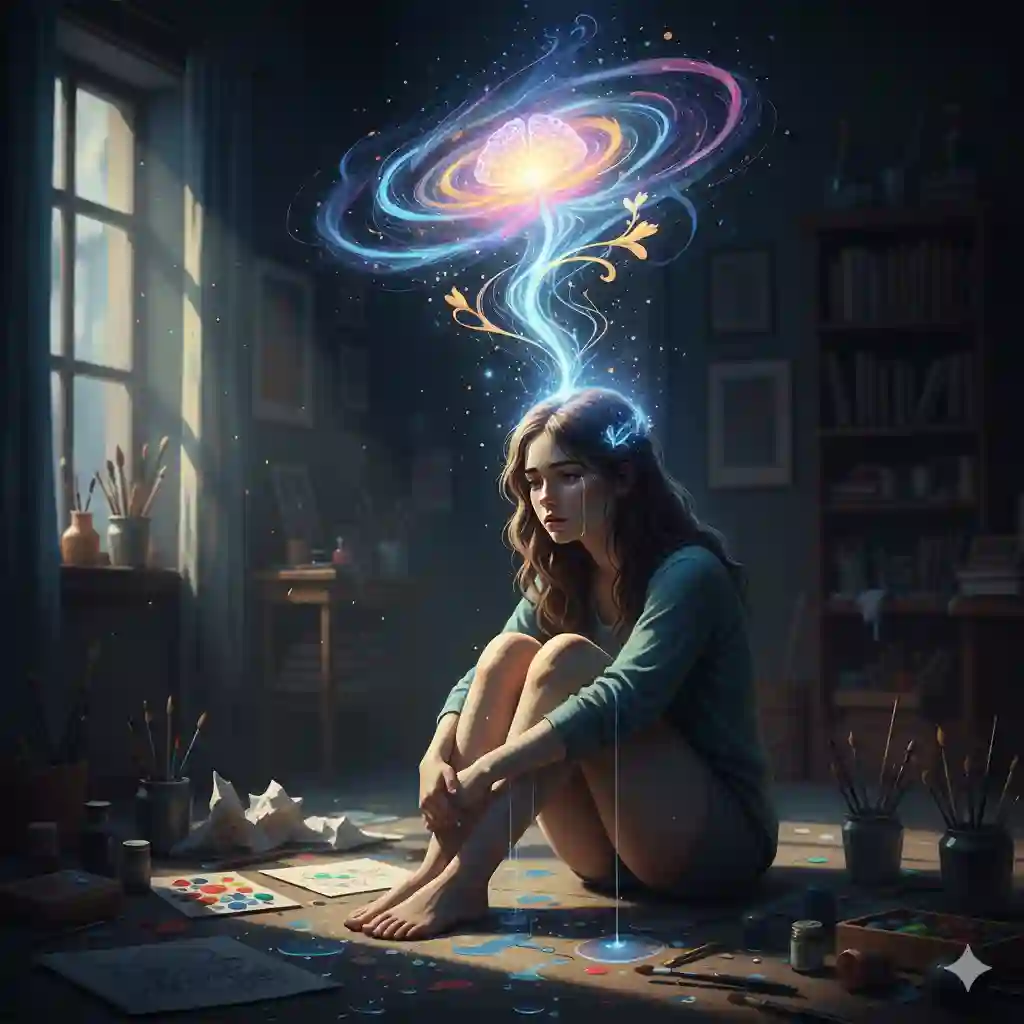
How does sadness enhance creativity? Neurologically, sadness is a low-approach-motivation state, meaning the brain is less interested in seeking external rewards or novel stimuli. This disengagement from the outside world triggers an inward attentional shift, fostering a state of deep, sustained, and uninterrupted focus. This introspective focus allows for more detail-oriented, analytical thinking, reducing reliance on mental shortcuts. The emotional complexity of sadness supports creative synthesis by promoting the integration of memory, personal meaning, and abstract concepts, leading to more profound and nuanced creative insights.
Table of Contents
- How Sadness Alters Attention and Focus
- The Role of Sadness in Meaning-Making
- Memory Access and Emotional Depth
- Why Sadness Supports Detail-Oriented Thinking
- When Sadness Stops Helping Creativity
- The Three Creative States of Sadness
- An Emotional Intelligence Framework for Creation
- Real-World Scenario: Creative Emergence from Disappointment
- Frequently Asked Questions
How Sadness Alters Attention and Focus
Positive emotional states, like happiness or excitement, are biochemically linked to exploration and reward-seeking. They broaden our attention, encouraging us to scan the environment for opportunities and engage with new stimuli. Sadness, in contrast, operates as a cognitive stop signal. It is a low-approach-motivation state that effectively tells the brain to pause external exploration and turn its analytical resources inward. This is not a defect but a functional adaptation. The purpose of sadness is often to signal that a current strategy or situation is not working, prompting a period of analysis and reassessment.
This inward attentional shift is the first step toward a creative cognitive mode. When we are sad, we are physiologically less distractible. The dopamine-driven urge to check our phones, seek social interaction, or find novel entertainment is dampened. This reduction in external noise allows for sustained cognitive engagement with a single problem or idea. The mind, no longer pulled in multiple directions, can allocate its full processing power to the internal landscape of thoughts, memories, and emotions.
This state of sustained focus is a prerequisite for deep creative work. It enables what psychologists call “deliberate practice”—the intense, focused effort required to solve complex problems or produce nuanced art. While a happy mood might be better for brainstorming a wide array of superficial ideas, a sad mood is better suited for developing one of those ideas with precision and depth. It creates a mental container free from the usual clutter of daily life, providing the quiet space necessary for subtle connections and insights to emerge.
The Role of Sadness in Meaning-Making
Human beings are narrative creatures. We make sense of our lives by constructing stories that connect our experiences, emotions, and beliefs. Sadness acts as a powerful catalyst for this meaning-making process. It often arises from loss, disappointment, or the gap between our expectations and reality. This discrepancy forces us to stop and reflect on our internal models of the world. Why did this happen? What does it mean for who I am? What do I value?
This reflective processing is fundamentally a creative act. It involves taking the raw, often chaotic data of an emotional experience and shaping it into a coherent narrative. During periods of sadness, the brain engages more deeply with autobiographical reasoning, sifting through past events and feelings to build a new or revised story. This process is not about finding a “happy ending” but about integrating the difficult experience into the larger tapestry of one’s life. This integration creates a sense of coherence and purpose, which is itself a form of creative problem-solving.
This integration of emotional experience is a cornerstone of artistic expression. A novel, a song, or a painting that resonates deeply is often one that successfully communicates a complex emotional truth. The artist, having navigated their own internal landscape of sadness, is able to translate that integrated experience into a form that others can understand and feel. The creative work becomes a vessel for the meaning that was forged during the period of introspection. The emotional depth of the work is a direct result of the artist’s own successful journey through reflective processing.
Memory Access and Emotional Depth
Memory is not a neutral filing cabinet. It is highly state-dependent, and our ability to recall specific memories is strongly influenced by our current emotional state. This phenomenon, known as mood-congruent memory, means that when we are sad, we have preferential access to other memories encoded during sad times. While this can lead to negative loops in a depressive state, in a state of reflective sadness, it becomes a powerful tool for creativity.
This enhanced access to a specific subset of memories allows for a deeper and more nuanced exploration of personal history. It brings forth rich, detailed autobiographical data that might be inaccessible during a neutral or happy mood. A writer might suddenly recall the specific texture of a coat worn at a funeral years ago, or a musician might tap into the precise feeling of a past heartbreak. This flood of mood-congruent information provides the raw material for creative work that feels authentic and emotionally resonant.
Furthermore, sadness facilitates complex associative thinking. Because the brain is not seeking a quick, simple solution (as it might in a more action-oriented state), it is more willing to sit with ambiguity and connect seemingly disparate ideas. It can link a current feeling of loss to a historical event, a line of poetry, a scientific concept, and a personal memory. This ability to form remote associations is a hallmark of creative insight. The emotional depth provided by sadness creates a fertile ground for these complex, non-obvious connections to be made, leading to work that is layered, textured, and profound.
Why Sadness Supports Detail-Oriented Thinking
Cognitive psychology distinguishes between two main processing styles: heuristic and systematic. Heuristic processing relies on mental shortcuts, gut feelings, and general impressions—it’s fast, efficient, and often used when we are in a positive mood. Systematic (or analytic) processing, on the other hand, is slow, deliberate, and detail-oriented. Research consistently shows that low moods, particularly sadness, promote a shift from heuristic to systematic processing.
This cognitive shift has significant implications for creativity. When we are sad, our brains are less likely to accept easy answers or rely on established patterns. Instead, we engage in more careful, bottom-up analysis of information. We pay closer attention to details, scrutinize arguments more critically, and persist longer on difficult tasks. For a creative individual, this means a greater capacity for precision. A sad programmer might be better at catching bugs in their code. A sad editor might be more adept at spotting grammatical errors or inconsistencies in a manuscript.
This analytic style is particularly beneficial for the refinement stage of the creative process. While a happy mood might excel at generating a flurry of initial ideas, a sad mood excels at evaluating, honing, and perfecting those ideas. The reduced reliance on heuristics means the creator is less likely to be satisfied with a “good enough” solution. Instead, they are driven to deconstruct the problem, analyze its components, and build a more robust and elegant solution. The thinking quality becomes more rigorous, which can elevate a good idea into a great one.
When Sadness Stops Helping Creativity
The line between productive sadness and debilitating distress is a critical one. While mild, reflective sadness can enhance certain creative faculties, intense or chronic sadness—particularly clinical depression—has the opposite effect. The benefits of sadness for creativity exist within a narrow window, and exceeding that window leads to cognitive and creative inhibition. The same mechanisms that help in moderation become harmful in excess.
One key distinction is between reflection and rumination. Reflection is an active, constructive process of meaning-making. Rumination is a passive, cyclical, and self-critical loop of negative thought. While reflection can lead to creative insight, rumination consumes cognitive resources without producing any resolution. It creates a high emotional load, leading to mental exhaustion and an inability to focus on anything other than the source of the pain. This is a state of emotional dysregulation, not creative contemplation.
Furthermore, as sadness deepens into depression, it often brings with it anhedonia (the inability to feel pleasure) and avolition (a severe lack of motivation). The cognitive narrowing that was once helpful becomes a suffocating tunnel vision. The energy required for sustained creative work disappears, replaced by profound fatigue. At this point, the brain is not in a state of deep focus; it is in a state of shutdown. The cognitive overload is too great, and the mind’s primary goal becomes conserving what little energy it has left. In this state, creativity is not only difficult, it is often impossible.
The Three Creative States of Sadness
The relationship between sadness and creativity is not monolithic. The nature of the creative process changes dramatically depending on the intensity and character of the sadness. We can distinguish between three primary states.
Reflective Sadness
This is the most creatively productive state. It is a mild to moderate, low-arousal sadness characterized by a quiet, inward focus. The individual is not overwhelmed by the emotion but is instead using it as a lens for contemplation. In this state, the mind is calm, analytical, and open to exploring complex feelings and memories. It is a period of quiet meaning-making and problem-solving. The person in reflective sadness is not trying to escape the feeling but to understand it, and this curiosity fuels the creative drive. This state promotes the deep focus and detail-oriented thinking necessary for refining creative work.
Integrative Sadness
This state occurs at moments of insight within a period of reflective sadness. It is the “aha” moment when disparate ideas, memories, and emotions connect to form a new, coherent whole. During integrative sadness, the emotional depth of the mood-congruent memories merges with the analytical clarity of systematic processing. It is the point where the writer finds the perfect metaphor for their grief, or the composer discovers the chord progression that captures their feeling of loss. This state is often fleeting but transformative, representing the successful synthesis of emotional experience and cognitive analysis. It is where the raw data of sadness is alchemized into creative insight.
Inhibiting Sadness
This is the state where sadness crosses the threshold into impairing distress or depression. The emotional intensity becomes too high, leading to cognitive overload and rumination. The inward focus ceases to be productive and becomes a trap. The brain is no longer analyzing; it is perseverating on negative thoughts. This state is characterized by a loss of mental and physical energy, a feeling of hopelessness, and an inability to initiate or sustain tasks. In inhibiting sadness, the neural systems that support creativity are effectively shut down. The drive for meaning-making is replaced by a desire for simple relief, and creative expression becomes impossible.
An Emotional Intelligence Framework for Creation
Leveraging the cognitive benefits of sadness without falling into a state of inhibition requires a high degree of emotional intelligence. It is not about seeking out pain to be creative, but about skillfully navigating the emotional reactions that life inevitably brings.
First, one must develop the ability to recognize the difference between reflective and ruminative sadness. Reflection feels curious and constructive, even if it is painful; it has a sense of forward movement. Rumination feels stuck, cyclical, and self-critical. By labeling the state accurately, you can make a conscious choice: if it’s reflection, you can lean into it; if it’s rumination, you know you need to engage in strategies to break the loop, such as physical activity or engaging with an external task.
Second, it is crucial to allow emotional depth without becoming completely immersed. This involves a practice of mindful observation—acknowledging the sadness, feeling its contours, and accessing the memories it brings up, without identifying with it completely. It is the difference between “I am sad” and “I am experiencing sadness.” This psychological distance allows you to use the emotional data without being consumed by it, maintaining enough executive function to guide the creative process.
Third, the insights gained during the introspective state must be translated into a creative form. This is the act of externalizing the internal process. It requires moving from a state of pure reflection to a state of active creation. This step is crucial because it gives the internal work a purpose and prevents it from spiraling into aimless brooding. The act of writing, painting, or coding becomes a container for the emotional insight.
Finally, one must be able to restore emotional balance after the creative work is done. This involves consciously shifting out of the sad state and re-engaging with the external world. After a period of deep, introspective work, it is important to seek out positive affect, social connection, or physical activity. This prevents the creative process from becoming dependent on a low mood and ensures that you can recover from the emotional overload of deep work.
Real-World Scenario: Creative Emergence from Disappointment
Elena, a landscape architect, had spent months developing a proposal for a large public park, a project she felt deeply connected to. When she learned her firm had lost the bid, she experienced a profound sense of disappointment and loss. For a few days, she was in a state of low energy and found it difficult to engage with her other projects.
Emotional Tone and Cognitive Shift: Instead of trying to force herself to “be positive,” Elena allowed herself to feel the sadness. Her emotional state was one of quiet, reflective sadness. She noticed her attention had shifted inward. She felt little desire for social distraction and found herself replaying aspects of the project in her mind, not with self-criticism, but with a kind of analytical melancholy. She was drawn to the details, remembering the specific plant species she had chosen and the rationale for the winding paths she had designed. Her thinking became more systematic and granular.
Creative Emergence: One evening, while looking over her old sketches, she was in a state of integrative sadness. The memory of her original vision for the park (the meaning) connected with her detailed knowledge of botany (the analysis) and her current feeling of loss (the emotion). A new idea emerged, completely unrelated to the lost project. She envisioned a small, private memorial garden designed specifically to evoke feelings of contemplation and peace. The design was intricate, precise, and emotionally resonant in a way her previous, more commercially-minded work had not been. The creative insight was not a rejection of her sadness but a direct product of the cognitive state it had induced. She had translated the emotional depth of her disappointment into a new, more personal creative form.
Frequently Asked Questions
Does this mean I need to be sad to be creative?
Absolutely not. Sadness is not a prerequisite for creativity. Many forms of creativity, especially brainstorming and divergent thinking, thrive in positive moods. The key takeaway is that different emotional states support different types of creative cognition. Sadness specifically facilitates a deep, analytical, and detail-oriented mode of creativity.
What is the difference between the emotional depth of sadness and clinical depression?
Emotional depth from sadness is typically transient, tied to a specific event, and allows for reflection and meaning-making. Clinical depression is a persistent, pervasive low mood often accompanied by anhedonia (inability to feel pleasure), hopelessness, and a loss of function. While sadness can be a creative catalyst, depression is almost always a creative inhibitor.
Is this why so many famous artists seemed to be “tortured souls”?
The “tortured artist” is a romanticized trope that often confuses correlation with causation. While many artists have certainly dealt with mental health challenges, it is more likely that they were creative despite their suffering, not because of it. Their creativity may have been a way to process their difficult emotional states, but it’s a mistake to believe that the suffering itself was the source of their talent. The cognitive states produced by mild sadness can be useful, but severe suffering is debilitating.
How can I manage sadness constructively for creativity without letting it overwhelm me?
The key is emotional intelligence. Practice recognizing the difference between constructive reflection and destructive rumination. Set time limits for deep, introspective work, and then purposefully shift to a different activity. Maintain healthy baseline habits (sleep, nutrition, exercise) to ensure you have the physiological resources to manage the emotional load.
Can happiness also make you creative?
Yes, but in a different way. Happiness and other positive emotions are linked to the release of dopamine, which promotes cognitive flexibility, divergent thinking, and brainstorming. A happy mood is excellent for generating a wide variety of novel ideas. A sad mood is better for taking one of those ideas and developing it with depth and precision.
Additional Questions
Does the creative benefit of sadness apply to all fields, like science and business?
Yes. While often associated with the arts, the cognitive style promoted by sadness—sustained, analytical, detail-oriented thinking—is highly valuable in any field that requires deep problem-solving. A scientist debugging code, an engineer searching for a design flaw, or a business strategist analyzing market data can all benefit from this focused cognitive mode.
Why does creative work produced during sadness often feel more “profound”?
Work created from a place of sadness often feels more profound because it is the result of a deeper level of processing. It emerges from a state of meaning-making and the integration of complex personal experience. This gives the work an emotional and intellectual weight that is often absent in work produced from a more superficial cognitive state.
Can artificially inducing sadness make someone more creative?
While some studies have shown that inducing a temporary low mood (e.g., by listening to sad music) can temporarily boost performance on detail-oriented tasks, this is not a recommended or sustainable creative strategy. Relying on induced sadness can lead to a negative association between creativity and pain, and it bypasses the authentic meaning-making process that gives sadness its creative power.
Conclusion
The enduring link between sadness and creativity is not born from a romantic notion that suffering is necessary for art. It is a cognitive phenomenon, rooted in the way different emotional states recalibrate the brain’s processing style. Sadness, in its milder, reflective form, is not a flaw in our wiring but a functional adaptation. It narrows our attentional focus, pulls us away from external distraction, and shifts the mind into a more analytical, systematic, and detail-oriented mode.
This introspective state creates the ideal conditions for the deep integration of memory and emotion, facilitating the meaning-making process that lies at the heart of profound creative expression. It is a state, however, not a requirement. When sadness intensifies into debilitating distress or depression, it becomes a powerful inhibitor of the very creative faculties it once supported.
Ultimately, navigating this complex relationship requires emotional intelligence. It demands the ability to recognize when sadness is serving a reflective purpose and when it is spiraling into rumination. By understanding the cognitive mechanics of our emotions, we can learn to work with our full affective range, finding opportunities for focus and depth not just in our joy, but in our sorrow, all while preserving the emotional balance essential for a healthy and sustainable creative life.