Fast Answer: Why Blue Ticks Trigger Anxiety
The reason why blue ticks trigger anxiety is that they create a state of perfect visibility without a guaranteed response, activating our deepest fears of social rejection. When a message is marked as “Read,” it removes the comforting ambiguity of “Delivered,” confirming the recipient has seen it. This creates a moment of intense social evaluation. For the brain, this silence is not neutral; it’s interpreted as a potential social threat, triggering uncertainty and activating rejection sensitivity. The anxiety stems from this sudden loss of control and emotional exposure, not necessarily the content of the message itself.
Introduction: The Moment You See “Read”
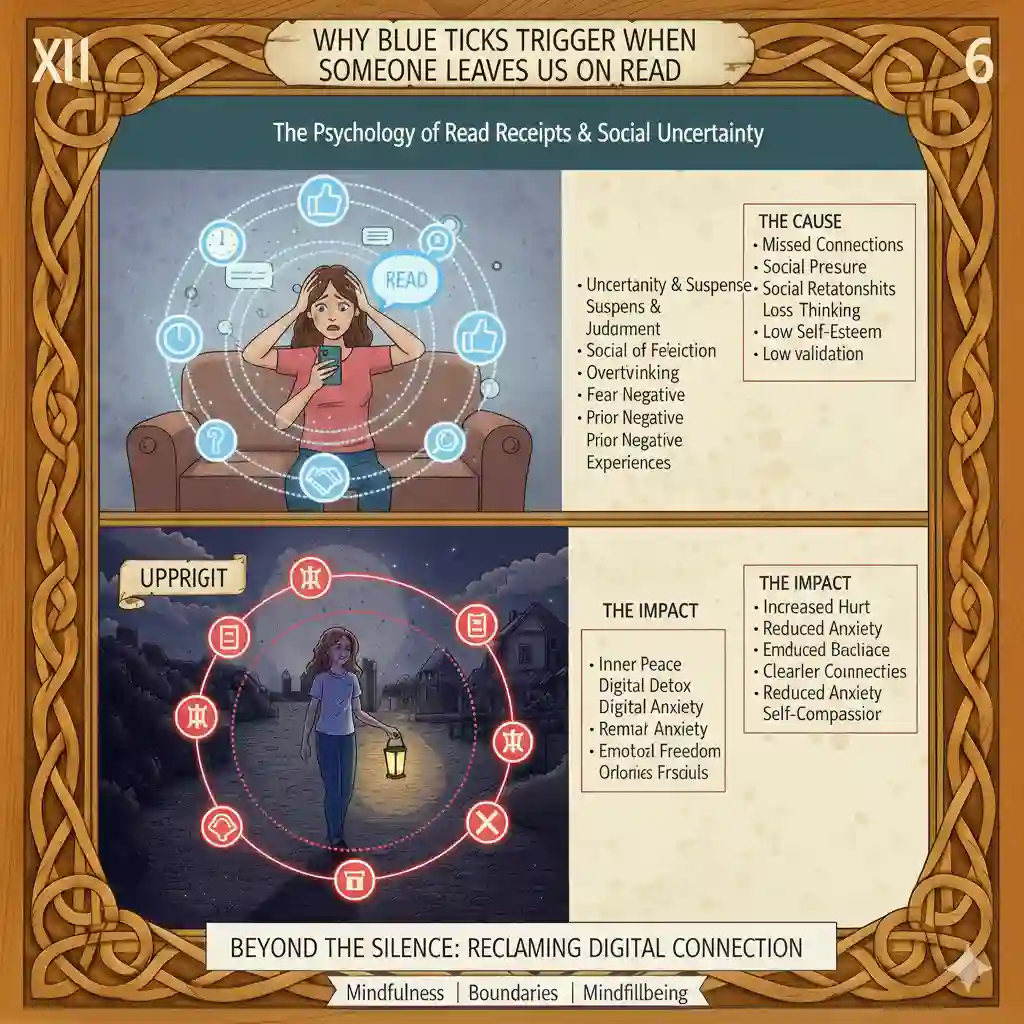
You send a message. It could be a simple question, a vulnerable confession, or a witty remark you’re particularly proud of. For a moment, it sits there, marked as “Delivered.” Then, it happens. The two small checkmarks turn blue. You see “Read.” And then… nothing.
In that silent space, a subtle shift occurs. Your chest might feel a little tight. Your mind, which was calm a second ago, starts to replay the message. Did I say something wrong? Was that not funny? Are they mad at me? You might put your phone down, only to pick it up thirty seconds later, compelled by an invisible force.
This experience, common across platforms like WhatsApp, iMessage, and Instagram, is not you “overreacting.” It is a direct result of your brain’s ancient cognitive wiring clashing with modern technology. The blue tick is more than a feature; it is a powerful psychological trigger that transforms a simple digital exchange into a high-stakes social performance. This article will explore the deep psychology of read receipts, explaining why this tiny digital signal can create such a profound sense of anxiety.
The Psychology of Uncertainty
At its core, the human brain is a prediction machine. It strives to understand the world and anticipate what will happen next to ensure survival. It thrives on certainty and despises ambiguity. This is known as intolerance of uncertainty. When faced with an unresolved situation or an “open loop,” the brain activates its threat-detection system.
An unanswered message is a classic open loop. Until the blue ticks appear, there is plausible deniability. You can tell yourself, “They’re probably busy,” “Their phone is off,” or “They just haven’t seen it yet.” This ambiguity, while slightly tense, is manageable.
The moment the ticks turn blue, that ambiguity vanishes and is replaced by a new, more potent form of uncertainty: the uncertainty of intent. You now have one hard fact—the message has been seen—but you have no information about the recipient’s emotional response or intention to reply. The brain, hating this vacuum of information, tends to fill it with the worst-case scenario. It defaults to negative explanations over neutral ones as a protective measure. The lack of closure doesn’t just create a question; it fuels a deep, primal anxiety.
Rejection Sensitivity & Social Threat Detection
Our brains are hardwired with a powerful need for social belonging. For our ancestors, being accepted by the tribe was a matter of life and death. Exclusion meant vulnerability to predators and starvation. As a result, we evolved a highly sensitive social threat detection system that is constantly scanning our interactions for signs of disapproval or potential rejection.
Being “left on read” is a modern-day trigger for this ancient alarm system. The silence after the blue ticks is interpreted by the brain’s more primitive parts not as a neutral pause, but as a potential sign of social exclusion. This is especially true for individuals with higher rejection sensitivity—a tendency to anxiously expect, readily perceive, and intensely react to social slights.
For someone with heightened rejection sensitivity, often linked to attachment insecurity, the experience is not just awkward; it feels dangerous. Their brain enters a state of hypervigilance, and the unanswered message becomes proof that their fear of being ignored or abandoned is coming true. The anxiety you feel is your evolutionary survival wiring misfiring in a low-stakes digital context.
Why “Seen” Feels Worse Than “Delivered”
The psychological distance between a message being “Delivered” and “Seen” is vast. “Delivered” is a state of logistical uncertainty. Your message is in their inbox, but their awareness of it is unknown. You are not yet socially exposed.
“Seen” changes everything. It confirms awareness without offering validation. It is the digital equivalent of making eye contact with someone across a room, smiling, and having them stare back blankly before turning away. The moment they see your message, you are no longer just a sender; you are a performer being evaluated.
This triggers a form of performance anxiety. You’ve put a piece of yourself out there—your humor, your vulnerability, your intellect—and now it is under review. The silence that follows feels like a judgment on that performance. This is why being left on read feels so much more personal and painful than a message that simply goes unanswered. It’s the difference between being unheard and being heard and then ignored.
The Illusion of Digital Transparency
Read receipts were designed to add clarity to digital communication. They promised to end the “Did you get my text?” follow-ups. However, in practice, they created an illusion of digital transparency by providing only partial information.
Blue ticks tell you that a message has been seen, but they provide no context. Was it seen while the person was rushing into a meeting? Was it opened accidentally? Was it read carefully, with the person now thoughtfully composing a reply? Or was it glanced at and dismissed? The feature removes the natural ambiguity of old communication methods (like email or voicemail) but fails to replace it with the rich context of face-to-face interaction (like tone of voice and body language).
This has fundamentally changed the pacing of our communication. It creates a perceived social accountability, an unspoken expectation that “seen” should be followed by an immediate reply. When that expectation is not met, the social contract feels violated, leading to anxiety and frustration.
The Overthinking Loop After Blue Ticks
Once the blue ticks appear and silence follows, the brain’s overthinking engine roars to life. This is the start of a rumination cycle, where you get stuck in a loop of negative thoughts about the interaction.
- Mental Simulation: You start imagining worst-case scenarios. “They’re annoyed with me,” “They think what I said was stupid,” or “They’re crafting a reply with their friends about how weird I am.” These simulations feel real and trigger genuine emotional distress.
- Tone Re-analysis: You re-read the message you sent, dissecting every word. You scrutinize your punctuation and emoji choice, searching for the “mistake” that caused the silence.
- Catastrophic Thinking: Your mind jumps to the most extreme conclusions. A simple delayed reply from a new romantic interest is interpreted as, “This is over. I’ve blown it.”
This overthinking spiral is exhausting. It takes a small, neutral event—a pause in conversation—and turns it into a referendum on your self-worth and the stability of your relationship. For those who frequently overthink, the blue tick is not a feature but a catalyst for anxiety, often leading to behaviors like obsessively saving conversations for later analysis, a topic explored in why we screenshot conversations.
Why Some People Don’t Get Anxious (Attachment Styles)
Not everyone is thrown into a panic by read receipts. A person’s reaction is often a strong indicator of their attachment style—their ingrained pattern of relating to others.
- Secure Attachment: Individuals with a secure attachment style generally have a positive view of themselves and others. They are comfortable with both intimacy and independence. When they are left on read, they are more likely to assume neutral intent. Their internal monologue sounds like, “They must be busy; they’ll get back to me when they can.” They are comfortable with silence because their sense of self-worth is not dependent on constant external validation.
- Anxious Attachment: Those with an anxious attachment style often crave closeness and fear abandonment. For them, silence is a significant threat. They are prone to interpret silence as a sign of withdrawal or rejection and are far more likely to engage in “protest behaviors” like sending follow-up texts or repeatedly checking their phone. They desperately seek reassurance to calm their activated attachment system.
- Avoidant Attachment: People with an avoidant style value their independence and may feel uncomfortable with too much closeness. They are often the ones who delay replies to manage their own space. As such, they are typically less bothered by being left on read and are more detached from digital validation.
Is This Linked to Social Media Conditioning?
Our anxiety around response times has been dramatically amplified by the conditioning of modern social media platforms. Apps like TikTok and Snapchat are built on a model of instant feedback. You post a video and immediately see views and likes. You send a Snap and get a reply within seconds.
This has trained our brains to expect and crave immediate gratification. Our brains have become accustomed to a rapid-fire dopamine-driven reply cycle. Dopamine is released not just when we receive a reward (a reply), but in anticipation of one.
When we send a text and see the blue ticks, our brain anticipates the dopamine hit of a response. When that response doesn’t come, it creates a reward prediction error. The expected reward fails to materialize, which is a neurologically frustrating and disappointing experience. We have been conditioned for instantaneous feedback, so any delay feels like a system failure.
Why Blue Ticks Feel Personal
The primary reason blue ticks cause so much pain is that we almost always take the silence personally. This is due to a trio of cognitive distortions.
- Personalization Bias: This is the tendency to relate external events to yourself when there is no basis for doing so. We see the silence and our immediate thought is, “This is because of me.” We rarely consider external factors affecting the other person.
- Mind-Reading Distortion: We assume we know what the other person is thinking and feeling, without any real evidence. “I know they saw my message and they are deliberately ignoring me to send a message.”
- The Spotlight Effect: We believe we are being noticed far more than we actually are. We assume our message is the most important thing on the other person’s mind, so any delay in response must be a conscious and meaningful act.
Together, these distortions create a powerful narrative: “They saw my message and are purposefully ignoring me because of something I did.” This makes the experience feel like a direct, personal rejection rather than a simple pause in communication.
Real-Life Scenarios (Deep Examples)
- The Dating Phase: You send a text asking someone on a second date. The blue ticks appear, and an hour passes with no reply. Psychological Mechanism: High-stakes performance anxiety and fear of rejection. The silence is interpreted as a “no” before they’ve even said it.
- Situationship Confusion: You send a vulnerable “thinking of you” text to someone you’re casually seeing. They see it but don’t reply for a day. Psychological Mechanism: Attachment anxiety and uncertainty intolerance. You are seeking reassurance about the status of the relationship, and the silence amplifies the ambiguity.
- Workplace Message Anxiety: You message your boss on Slack with an urgent question. You see their green “active” dot, but they don’t reply. Psychological Mechanism: Social hierarchy and fear of negative evaluation. You worry you are bothering them or that they are displeased with your work.
- Friend Group Dynamics: You post a message in a group chat, and you can see that several people have read it, but no one responds. Psychological Mechanism: Fear of social exclusion. The collective silence feels like the group is implicitly rejecting your contribution. This is particularly hurtful, as it taps into the core fear that explains why small comments hurt more from close people.
When Blue Tick Anxiety Becomes Unhealthy
A fleeting moment of discomfort after being left on read is normal. However, this anxiety can become an unhealthy, chronic pattern when it starts to dominate your emotional state.
Signs that blue tick anxiety is becoming problematic include:
- Constant Checking: You find yourself opening the app dozens of times an hour just to check for a reply or monitor their online status.
- Emotional Dependency: Your mood for the entire day is dictated by someone’s response time.
- Panic and Catastrophizing: A delayed reply triggers a genuine panic response, leading you to believe the relationship is over.
- Online Status Monitoring: You begin tracking when they are online or last seen, using this data to build a case against them.
This pattern moves beyond normal discomfort into a cycle of obsessive anxiety. It indicates that your sense of safety and self-worth has become dangerously entangled with digital validation, a craving that is difficult to satisfy. The need for a reply becomes less about communication and more about a desperate need to feel seen and valued, a key element behind why we crave validation.
The Neuroscience of Social Silence
The anxiety you feel from blue ticks is not “all in your head”; it’s a real neurochemical event. When you perceive social rejection, your brain’s amygdala, the fear and threat-detection center, springs into action.
This activation triggers a stress hormone response. Your adrenal glands release cortisol, the primary stress hormone, which prepares your body for a “fight or flight” response. This is why you might feel a racing heart, a tight chest, or a knot in your stomach. Your body is physically reacting to a perceived social danger.
Neuroimaging studies have shown that the pain of social exclusion activates some of the same neural pathways as physical pain. In essence, your brain processes being left on read as a genuine form of pain. This isn’t a sign of weakness; it’s a testament to how deeply our brains are wired for connection.
How to Reduce Blue Tick Anxiety
You can learn to manage the anxiety that comes with read receipts. This involves a combination of behavioral changes and cognitive shifts.
- Response-Time Reframing: Consciously remind yourself that response times are not a measure of affection or respect. People have complex lives outside their phones. Create a mantra: “Their response time is about their schedule, not my worth.”
- Delayed Notification Exposure: When you send an important message, put your phone away for a set period (e.g., 30 minutes). Go do something engaging in the physical world. This breaks the cycle of anxious checking and builds your tolerance for uncertainty.
- Cognitive Restructuring: Actively challenge your negative thoughts. When you think, “They’re ignoring me,” force yourself to generate three alternative, neutral explanations. This trains your brain to be more flexible and less catastrophic.
- Secure Attachment Building: Work on building your sense of self-worth outside of your relationships. When you feel secure in yourself, you become less dependent on constant validation from others.
- Reducing Message Over-analysis: Practice sending a message and letting it go. Trust that you communicated clearly and that the other person is capable of responding when they are able. Resist the urge to re-read and dissect your own words.
Should You Turn Off Read Receipts?
One common piece of advice is to simply turn off read receipts. This can be an effective strategy for some, but it’s not a cure-all. Here’s a balanced look:
Pros:
- Reduces Social Pressure: It removes the expectation of an immediate reply for both you and the other person.
- Lowers Immediate Anxiety: You are no longer exposed to the direct pain of seeing “Read” followed by silence.
- Promotes Healthier Pacing: It encourages a return to a more asynchronous, less frantic style of communication.
Cons:
- May Increase Ambiguity: For an anxious mind, not knowing if a message has been seen can be just as stressful as knowing it has.
- Can Shift Anxiety Elsewhere: The anxiety might simply migrate to checking their “last seen” status or other indicators of activity.
- It’s a Form of Avoidance: It removes the trigger rather than teaching you how to cope with the underlying anxiety.
The best approach is an intentional choice. If turning them off brings you genuine peace, it’s a great tool. If it just replaces one anxiety with another, the real work lies in building your internal resilience.
Signs This Anxiety Is About More Than Texting
If your anxiety around blue ticks is persistent and intense, it is likely a symptom of deeper emotional patterns. It often points to:
- A Deep-Seated Fear of Abandonment: The silence after a read receipt can trigger a primal fear that you will be left.
- A Need for Constant Reassurance: You may rely on others to regulate your emotions and feel secure.
- Self-Worth Tied to Responsiveness: You may have learned to equate being valued with being responded to quickly.
- Broader Emotional Dependency Patterns: The anxiety may be part of a larger pattern of needing others to validate your existence and choices.
Recognizing this is not a cause for shame. It is an opportunity for self-discovery. The anxiety is a signal, pointing you toward the deeper work of building emotional security and self-worth from within, rather than outsourcing it to the digital world. Even seemingly positive validation, like a compliment, can be complex, as explained in how compliments can backfire psychologically.
Frequently Asked Questions (SEO Block)
Why do blue ticks make me anxious?
Blue ticks make you anxious because they confirm your message has been seen without providing a response. This creates uncertainty and activates your brain’s social threat system, making you feel vulnerable to rejection.
Is it normal to feel stressed after someone reads my message?
Yes, it is a very normal and common experience. It is a result of our evolutionary wiring for social connection clashing with the ambiguous signals of modern technology.
What does it mean if someone reads but doesn’t reply?
Most of the time, it means they are busy, distracted, or thinking about what to say. While it can sometimes signal disinterest, our brains are biased to jump to the most negative conclusion. The true meaning is often far more neutral than we assume.
Why do I overthink after being left on read?
You overthink because your brain is trying to solve the uncertainty. It enters a rumination loop, analyzing the situation from every angle to regain a sense of control and predict the social outcome.
Should I disable read receipts?
Disabling read receipts can be a helpful strategy to reduce immediate anxiety and social pressure. However, it’s not a complete solution if the underlying anxiety is not addressed, as the worry may simply shift to other digital cues.
Is blue tick anxiety a sign of insecurity?
It is often linked to attachment insecurity, particularly an anxious attachment style. It reflects a heightened sensitivity to potential rejection and a stronger need for reassurance to feel secure in a relationship.