
When you look up how people make purchasing decisions, standard academic summaries paint a highly logical picture. They describe a neat, step-by-step journey from recognizing a need to evaluating alternatives and making a rational purchase. However, human beings rarely operate like programmable calculators.
Currently, there are major problems with consumer science overview pages. They present a simplified, theoretical ideal that frequently fails to match the complex, emotionally driven reality of modern shoppers. To make ethical marketing decisions and craft effective public policy, we must look beyond basic utility models. Let us explore what a truly robust understanding of consumer decision-making requires.
1. Fast Summary: What the Original Pages Promote
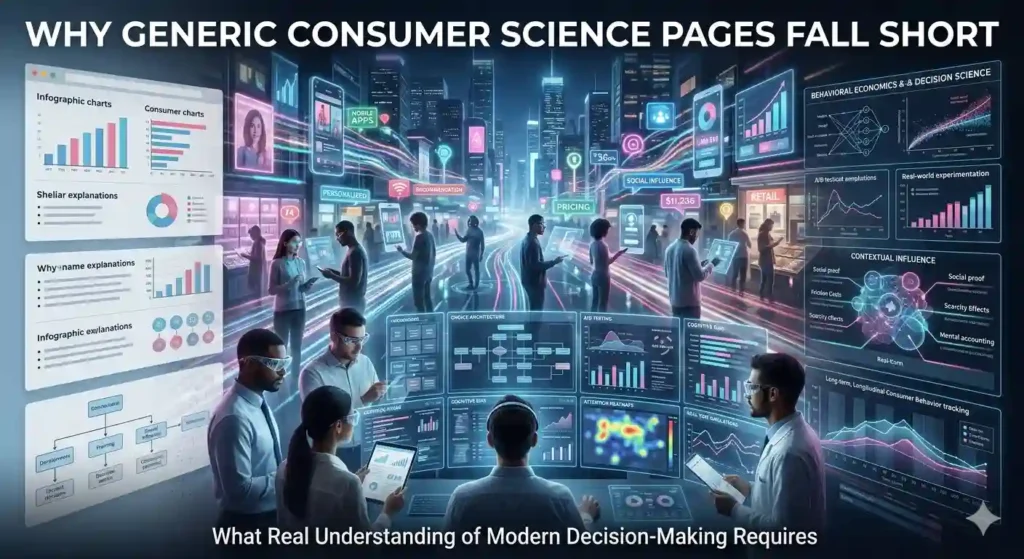
If you visit a typical educational site or a ScienceDirect Topics page, you will find a straightforward definition of consumer science. It is usually described as an interdisciplinary field combining psychology, economics, sociology, and marketing. Its primary focus is how individuals and groups select, purchase, use, and dispose of goods or services to satisfy their basic needs and wants.
These pages cover core topics like decision-making processes, information search strategies, and post-purchase evaluation. They highlight the drivers of customer satisfaction and brand loyalty. While this interdisciplinary framing is technically accurate, the broader picture of contemporary consumer behavior is far more nuanced. It requires deeper scrutiny of bounded rationality, affective influences, contextual sensitivity, and the ethical implications of modern marketing.
2. Why “Consumer Science” Is Misleading in Educational Overviews
Calling the study of purchasing behavior a perfect “science” implies a high degree of predictable, rational accuracy. This label downplays decades of evidence highlighting systematic deviations from logic.
A central consumer science critique rational choice advocates share is that generic descriptions lead readers to assume consumers always maximize their utility. These summaries ignore the modern replication crisis in classic psychology and fail to address how digital environments manipulate our choices. When researchers compare static consumer groups without understanding their unique environments, it mirrors the flaws found in a poorly designed between-subjects design in psychology. Context is everything.
3. The Limits of Rational and Attitude-Based Models
Heavy reliance on traditional expectancy-value models overlooks how the human brain actually works. Most of our routine purchases are driven by fast, automatic, System 1 thinking. We rely heavily on heuristics biases consumer decision-making processes use to save mental energy.
Standard textbooks also ignore affective forecasting errors. Consumers are notoriously bad at predicting what will actually make them happy, leading to post-purchase regret. When marketers misunderstand the true drivers of a purchase, it is similar to misdiagnosing our mental health; understanding why standard stress vs anxiety articles fall short helps us realize that surface-level symptoms rarely reveal the deeper underlying cause. Furthermore, choice overload and default effects easily override a consumer’s stated preferences.
4. The Role of Contextual and Affective Literacy
To accurately understand buyers, researchers need deep contextual and affective literacy. Relying solely on lab-based attitude surveys is insufficient. Professionals must understand emotional regulation, temporal discounting, and modern digital choice architecture.
Situational factors heavily influence what we buy. A sudden stressor or an environmental cue can prompt an unplanned purchase. Recognizing these cues requires understanding the science of emotional triggers. Furthermore, we must distinguish between the initial impulse to buy and the deeper emotional need driving it, much like separating primary vs secondary emotions. Field experiments and large-scale transaction data predict real-world behavior far better than a hypothetical questionnaire.
5. Structural and Modern Factors Affecting Outcomes
Generic overview pages frequently ignore the structural realities of the modern marketplace. Today, dark patterns in digital interfaces intentionally confuse users, driving regret and over-spending. Massive transnational corporations deploy algorithms designed to exploit our psychological vulnerabilities.
Social media amplifies status-driven consumption. We buy things we do not need because of why we crave validation from others. Additionally, the modern subscription economy locks consumers into recurring payments. When people feel trapped by endless financial obligations, they often stop checking their bank accounts to avoid the stress. This avoidance behavior perfectly illustrates why do I feel emotionally numb when dealing with persistent financial pressure.
6. Behavioral Patterns Predicting Long-Term Well-Being
True consumer science should focus on improving lives, not just increasing sales. We must balance long-term satisfaction vs immediate gratification. Evidence-based predictors of positive outcomes include the use of pre-commitment devices, such as savings auto-enrollment or mandatory cooling-off periods for large purchases.
When consumers fall into the trap of impulse buying, they engage in a form of financial harm that explains why we self-sabotage. Conversely, endlessly researching a minor purchase drains mental energy, demonstrating why overthinking is a habit, not a personality flaw. Healthy consumption requires mindful spending interventions, transparent pricing, and a clear awareness of early warning signs like post-purchase dissonance.
7. Effective Consumer Science Application
Effective application of consumer science looks very different from simply mapping out a theoretical purchase funnel. A robust approach includes:
- Integrated contextual methods: Combining lab data, field experiments, and transaction histories to track long-term well-being.
- Ethical choice architecture: Understanding the ethics of nudging, regulating dark patterns, and respecting consumer autonomy.
- Functional goals: Prioritizing higher life satisfaction, lower financial regret, and sustainable consumption patterns over raw conversion rates.
A brand’s relationship with its consumers should evolve maturely. Just as human relationships build trust over time, mimicking the stages in Erik Erikson’s psychosocial development theory, companies must move past initial transactions to foster genuine loyalty. This requires advancing to higher ethical standards, aligning with the upper tiers of Kohlberg’s stages of moral development.
8. The Pitfall of Equating Textbook Models With Real Consumer Welfare
Achieving high marks on a customer satisfaction survey does not mean a company is actually improving consumer welfare. Interventions based solely on stated preferences routinely fail when deployed in real, messy environments.
When a marketing strategy fails, teams often look for external excuses rather than examining their flawed models. This defensive reaction highlights why we take things personally. Brands might release public statements defending bad practices, perfectly illustrating why we overexplain ourselves. Sometimes they issue empty apologies to appease the public, reflecting why we apologize even when its not our fault. If executives ignore poor long-term outcomes to maintain their quarterly metrics, they practice willful denial. Recognizing the difference between repression vs suppression in psychology helps us identify when corporations consciously bury negative consumer data.
9. Practitioner-Centered Questions Readers Should Ask
To ensure consumer research is genuinely useful, practitioners must ask critical questions that go beyond basic attitude scaling:
- What empirical evidence demonstrates that this behavioral model holds up in real, high-stakes purchasing environments?
- Are we tracking measurable long-term well-being or financial regret metrics post-purchase?
- How accurately have we accounted for contextual moderators, digital fatigue, and emotional drivers?
- What ethical safeguards govern our use of marketing nudges and choice architecture?
- Does our strategy respect consumer autonomy, or does it exploit behavioral biases?
Do not rely on a single focus group. Just as third date psychology proves that reality only sets in after the initial presentation phase, true consumer sentiment only reveals itself months after the transaction. Marketers often get stuck analyzing the same flawed data without adjusting their tactics, running in endless analytical circles much like why we replay conversations in our head. If a campaign harms consumer trust, leaders must intervene immediately rather than delaying action, overcoming the natural instinct that explains why we procrastinate even when we know its important.
10. Balanced Conclusion
Consumer science provides foundational frameworks for understanding market behavior. It remains an essential discipline for marketers, product designers, and policymakers. However, a theoretical utility model is just a starting point, not an absolute truth.
Robust understanding of modern consumer decision-making requires active engagement with contextual sensitivity, emotional realism, and ethical intervention design. By stepping past the oversimplified textbook summaries and embracing the messy reality of human heuristics, professionals can build strategies that maximize both business success and long-term consumer welfare.