Silence is rarely empty. In the space between words, a flurry of psychological and neurological activity takes place. For many, a pause in conversation or a quiet room doesn’t feel peaceful; it feels heavy, charged with unspoken expectations and internal noise. If you have ever felt a sudden spike of anxiety during a lull in dialogue, or found yourself reaching for your phone the moment you are alone, you have experienced the profound discomfort that silence can provoke. This reaction is not a personal quirk; it is a complex interplay of brain function, social conditioning, and emotional regulation.
Fast Answer: Why Silence Feels Uncomfortable
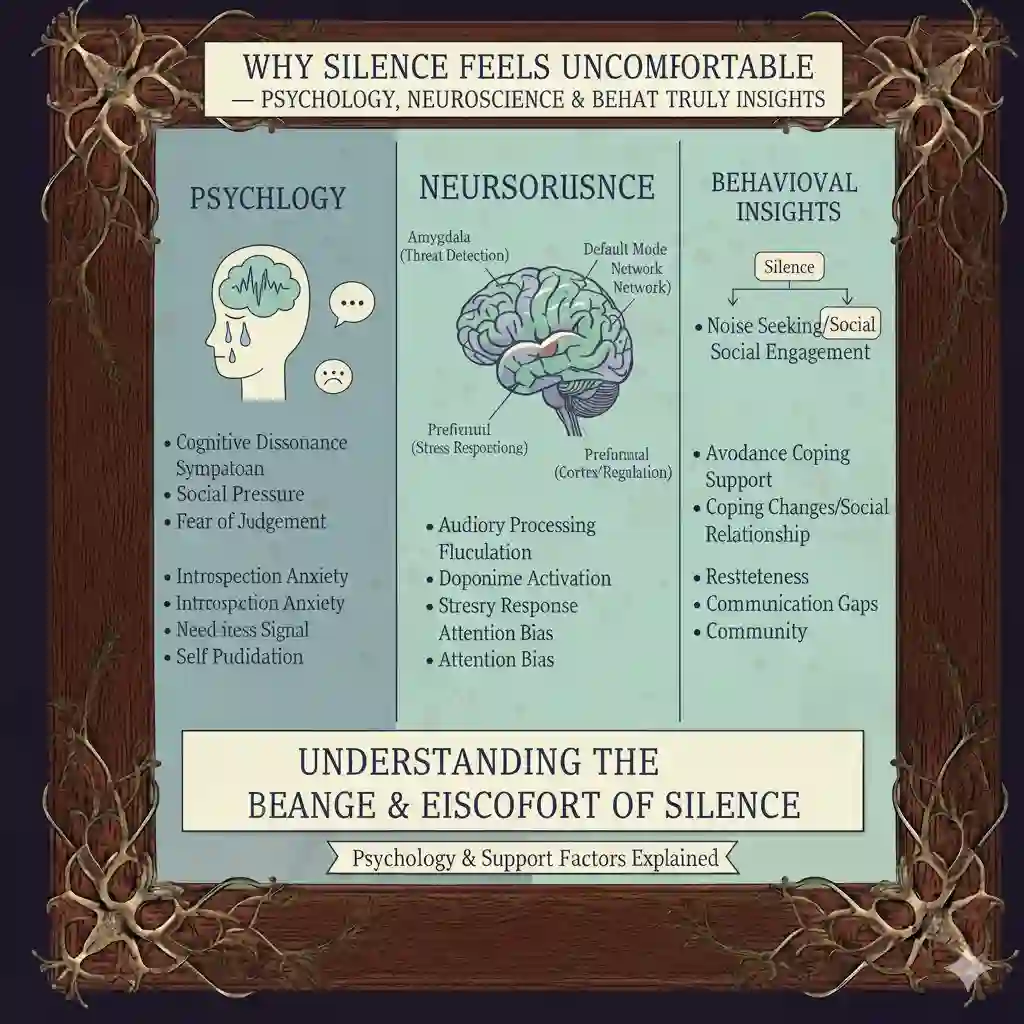
Discomfort in silence often reflects a state of cognitive alertness, social anxiety, heightened emotional self-awareness, or the brain’s innate craving for stimulation. When external noise stops, the brain shifts its focus inward, amplifying thoughts and feelings that distractions usually keep at bay. Furthermore, in social contexts, we are conditioned to view silence as a signal of disconnection or judgment. It is important to recognize that this discomfort is a natural psychological phenomenon, not a flaw. It signals that your mind is active, socially attuned, and processing information deeply.
Introduction: The Hidden Power of Silence
Humans are social creatures wired for connection and feedback. For thousands of years, sound—whether the rustle of leaves indicating a predator or the chatter of a tribe indicating safety—has been a primary survival signal. Silence, therefore, is not just the absence of noise; to the primitive parts of our brain, it can signal ambiguity or the unknown.
From a neuroscience perspective, silence is far from passive. When the auditory cortex stops receiving external input, other regions of the brain wake up. Silence activates neural pathways associated with self-monitoring and social cognition. This heightened state of internal awareness can be unsettling because it removes the external buffers we rely on to regulate our emotions.
We also carry deep-seated social beliefs about what silence means. In many cultures, a continuous flow of conversation is equated with a healthy relationship or a successful interaction. A pause can be misinterpreted as a failure, a sign of boredom, or a subtle rejection. Understanding the hidden power of silence helps us decode why we react to it with tension and how we can learn to navigate it with greater ease.
Psychological Reasons Silence Feels Uncomfortable
The unease we feel in quiet moments often stems from specific psychological triggers. These are not necessarily conscious thoughts but ingrained patterns of thinking and feeling.
Fear of Judgment or Social Evaluation
One of the primary drivers of silence discomfort is the fear of negative evaluation. In a social gap, the mind races to fill in the blanks of what the other person is thinking. Without verbal reassurance, we often project our own insecurities onto the silence. We worry, “Are they bored?” “Did I say something wrong?” “Is this awkward?” This projection transforms a neutral pause into a perceived judgment.
Awareness of Unresolved Emotions
Noise is a distraction. It allows us to focus outward rather than inward. When silence descends, that distraction is removed, and we are left alone with our internal emotional landscape. If there are suppressed feelings—anxiety, sadness, frustration—they tend to surface when the room goes quiet. The discomfort we feel is often the resistance to confronting these unresolved emotions.
Cognitive Overload or Overthinking Tendencies
For individuals prone to overthinking, silence is a vacuum that pulls in worries. The brain, lacking immediate stimulation, begins to ruminate on past mistakes or future anxieties. The quiet becomes a canvas for the mind to paint its fears upon. This cognitive overload can make silence feel physically exhausting, as the brain works overtime to process internal narratives.
Social Conditioning and Learned Behaviors
We learn early on that silence can be used as a punishment (the “silent treatment”) or a sign of disapproval. If you grew up in an environment where silence signaled anger or neglect, your nervous system may be conditioned to interpret quiet as a precursor to conflict. This learned association can trigger an automatic stress response, even in safe, neutral situations.
Neuroscience of Silence Discomfort
To understand why silence feels uncomfortable, we must look at what happens inside the brain when the noise stops.
Brain’s Reaction to Lack of External Stimuli
The human brain is an information-processing machine. It constantly scans the environment for cues to ensure safety and orientation. When external stimuli (like conversation) cease, the brain experiences a form of “sensory deprivation.” This lack of data can be interpreted by the brain as uncertainty. The brain prefers predictability, so an ambiguous silence triggers an alertness response to figure out what is happening.
Default Mode Network (DMN) Activation
When we are not focused on a specific external task, a network of brain regions known as the Default Mode Network (DMN) becomes active. The DMN is responsible for self-referential thought—thinking about ourselves, our memories, and our place in the world. Silence facilitates the switch to this network. While this can lead to creativity, it can also lead to intense self-scrutiny and rumination, particularly for those with anxiety.
Amplification of Stress Signals
In the absence of auditory input, the brain’s “volume knob” for internal signals turns up. This means that physical sensations of stress—a racing heart, shallow breathing, muscle tension—become more noticeable. This phenomenon is closely related to the neuroscience of silence discomfort, where the brain interprets the lack of external signal as a reason to heighten internal vigilance.
Behavioral Insights: How People React to Silence
Our internal discomfort often manifests in observable behaviors. These are coping mechanisms designed to alleviate tension and restore a sense of control.
Filling Gaps with Chatter
The most common reaction is the “chatter reflex.” We rush to say something—anything—to break the tension. This often leads to small talk about the weather or stating the obvious. The goal is not meaningful communication but the restoration of auditory rhythm to soothe the nervous system.
Oversharing or Diverting Conversations
In an attempt to bridge the gap quickly, some individuals may impulsively share personal information. This “forced intimacy” is a way to demand a reaction and ensure the connection is still alive. Understanding why some people overshare immediately reveals that this behavior is often an anxiety-driven attempt to manage the uncertainty of silence.
Avoiding Eye Contact or Seeking External Stimulation
When silence hits, you might notice people looking away, checking their phones, or fiddling with objects. We tend to avoid eye contact with strangers or even friends during silence because eye contact increases intimacy. Combined with silence, that intimacy can feel too intense or exposing. Looking away reduces the sensory load and provides a momentary escape from the social pressure.
Fidgeting and Self-Soothing
Physical movements like tapping a foot, crossing arms, or touching one’s face are self-soothing behaviors. They discharge the nervous energy that builds up during a quiet moment. These micro-movements are the body’s way of saying, “I am uncomfortable, and I am trying to regulate.”
Common Scenarios & Interpretations
Silence is context-dependent. A pause in a boardroom feels different from a pause in a bedroom.
Silence in Meetings or Group Settings
In professional settings, silence can feel like a loss of momentum. It triggers fears of incompetence (“Does no one have an idea?”) or disagreement (“Do they hate my proposal?”). However, silence here can also indicate deep processing. A team that can sit in silence while thinking is often more effective than one that fills every second with noise.
Silence During Intimate Conversations
In relationships, silence is heavy with meaning. It can signal comfort and safety (“We don’t need to perform for each other”) or distance and resentment (“We have nothing left to say”). The discomfort here often arises from not knowing which one it is.
Alone with Your Thoughts in Quiet Spaces
Being alone in a quiet house or a confined space can be daunting. We often feel awkward in these moments because we are stripped of our social masks. The sensation of being trapped with oneself is explored in our article on why we feel awkward in lifts/elevators, which highlights how physical confinement and silence amplify social self-consciousness.
Moments After Conflict
Perhaps the most charged silence occurs after an argument. This silence is rarely peaceful; it is an active “cooling off” or a passive-aggressive “shutting down.” The discomfort stems from the ambiguity of the resolution—is the fight over, or is it just paused?
Emotional States Amplified by Silence
Silence acts as a magnifying glass for our emotional state. Whatever you are feeling, silence will make it louder.
- Anxiety or Restlessness: If you have underlying anxiety, silence will make you feel jittery. The lack of distraction allows the adrenaline to circulate without an outlet.
- Self-Consciousness or Insecurity: Silence can make you feel exposed. You become hyper-aware of your physical presence, your posture, and your breathing.
- Awareness of Unresolved Emotions: Grief, sadness, and anger often wait for quiet moments to emerge. This is why many people keep the TV on or listen to podcasts constantly—to keep these feelings submerged.
- Mind Wandering and Introspection: On the positive side, silence allows for mind wandering. We often stare at random places during deep thinking to disengage from the visual world and enter the internal world of ideas. Silence facilitates this cognitive withdrawal, which is essential for creativity and problem-solving.
Practical Reflections and Self-Awareness
To master the discomfort of silence, we must first understand our personal relationship with it.
Understanding Personal Triggers
Ask yourself: When does silence feel worst? Is it with authority figures? Is it on a first date? Is it when you are alone at night? Identifying the specific trigger helps you understand whether your discomfort is rooted in social anxiety, fear of abandonment, or simple boredom.
Mindfulness and Cognitive Reframing
Instead of viewing silence as “awkward,” try reframing it as “processing time.” Remind yourself that a pause does not equal a problem. Mindfulness teaches us to observe the silence rather than react to it. Notice the tension in your chest without judging it.
Using Silent Moments for Self-Reflection
Rather than reaching for a distraction, try sitting with the silence for just one minute. What thoughts come up? What is your body telling you? This practice builds tolerance and turns silence into a tool for checking in with yourself.
Social Lessons of Silence Discomfort
Our reaction to silence teaches us valuable lessons about communication and social dynamics.
How Silence Impacts Communication
Silence is a form of nonverbal communication. It can emphasize a point, show respect for what was just said, or signal that a topic is heavy. If we rush to fill it, we often trample over these nuances. Learning to wait allows for a deeper level of exchange.
Recognizing Others’ Discomfort
If you notice someone else becoming jittery or overly talkative during a silence, you are witnessing their discomfort. Responding with a calm presence can be a powerful act of co-regulation. This is connected to the science of emotional contagion; by remaining calm in the silence, you can help their nervous system settle down.
Strengthening Emotional Resilience
The ability to tolerate silence is a sign of emotional maturity. It shows that you are secure enough in yourself and the relationship to not need constant validation through words. It indicates that you can be with another person in a state of “being” rather than just “doing.”
Guidance to Embrace Silence
Moving from fearing silence to embracing it is a gradual process.
- Stepwise Approach: Start small. In a conversation, wait three seconds before responding. In your car, drive for five minutes without the radio. Gradually increase the duration as your tolerance builds.
- Cognitive Exercises: When you feel the urge to fill a silence, pause and ask, “Does this silence need to be filled, or am I just anxious?” This simple question engages your prefrontal cortex and dampens the emotional reaction.
- Mindful Breathing: Use your breath as an anchor. When the silence feels heavy, focus on the sensation of inhaling and exhaling. This gives your mind a focal point that is internal but neutral.
- Laugh it Off: sometimes, acknowledging the awkwardness breaks the power of the silence. Nervous laughter is a common release mechanism, as detailed in our exploration of why we laugh when we’re scared or nervous. Acknowledging the tension can actually build rapport.
- Reframe as Clarity: View silence as a mental palate cleanser. It wipes the slate clean and allows for a fresh thought to emerge.
Also, remember that stress impacts emotional responses, so if you are already stressed, your tolerance for silence will be lower. Be patient with yourself on difficult days.
Deep Psychological Insight
Discomfort in silence reflects our brain’s complex relationship with thoughts, emotions, and social perception—understanding it allows us to turn quiet moments into tools for self-awareness, creativity, and emotional mastery.
Frequently Asked Questions (FAQs)
Why does silence feel awkward in social settings?
It feels awkward because we are socially conditioned to interpret continuous conversation as a sign of connection. A break in that flow creates ambiguity, which the brain perceives as a potential social threat or rejection.
Can silence increase anxiety?
Yes, for people prone to anxiety, silence removes external distractions, allowing internal worries and intrusive thoughts to become louder and more persistent.
Is discomfort in silence linked to overthinking?
Absolutely. Silence provides the mental space for rumination. Without new information to process, the brain often defaults to replaying past events or worrying about future scenarios.
How can I train myself to tolerate quiet moments?
Practice mindfulness and intentional pauses. Start by sitting in silence for short periods daily. In conversations, resist the immediate urge to speak and observe the feeling of the pause instead.
Are some people naturally more sensitive to silence?
Yes. High self-monitors (people highly attuned to social cues) and those with high social anxiety are often more sensitive to silence because they interpret it as a reflection of their social performance.