Quick Answer
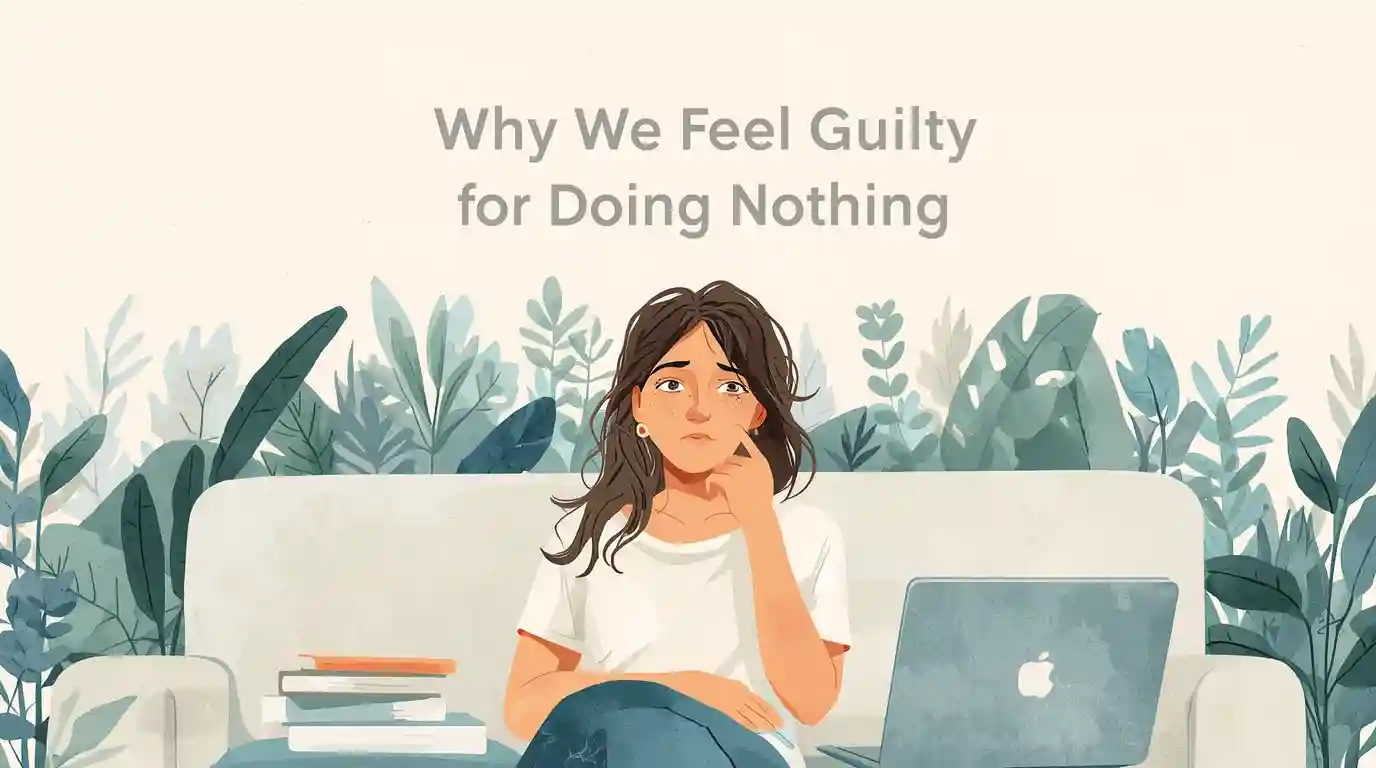
We feel guilty for doing nothing because our brains confuse rest with laziness.
In a world that glorifies productivity, stillness triggers an internal alarm — a clash between biology, culture, and identity. Our nervous systems crave downtime, but our conditioned minds equate it with failure or worthlessness. That guilt isn’t weakness — it’s a symptom of living in a society that measures value by output instead of being.
Table of Contents
- The neuroscience of guilt and rest
- How productivity culture rewired our self-worth
- The brain’s bias toward action
- Why stillness feels unsafe to the nervous system
- The emotional roots of “I should be doing more”
- How guilt disguises deeper needs
- The paradox of rest: recovery as responsibility
- How to unlearn guilt and rest without shame
- FAQs: Rest, guilt, and mental health
- Conclusion
1. The Neuroscience of Guilt and Rest
When you stop “doing,” your brain doesn’t necessarily stop working — it shifts modes.
During rest, the default mode network (DMN) activates — the part of the brain involved in self-reflection, creativity, and emotional processing.
But here’s the paradox:
If your identity is tied to activity, the DMN’s inward focus can trigger guilt. The brain starts scanning for danger or deficiency:
“Am I falling behind?”
“Should I be doing something?”
This activates the anterior cingulate cortex, the region that monitors social rules and moral behavior — including the sense of “doing something wrong.”
In short: your guilt for resting isn’t laziness — it’s neural conditioning.
2. How Productivity Culture Rewired Our Self-Worth
Modern society equates busyness with virtue.
We’re praised for being “driven,” “dedicated,” and “always on,” but rarely for being balanced.
From childhood, we’re taught to earn approval through performance — grades, effort, results. Over time, the brain links self-worth to output.
That’s why when you rest, your reward circuitry goes quiet. Without external validation or measurable progress, your brain interprets the pause as loss of purpose.
You don’t feel guilty because rest is bad — you feel guilty because you’ve been trained to believe worth = work.
3. The Brain’s Bias Toward Action
Evolution shaped the brain to favor movement over stillness. For early humans, doing nothing could mean missing food or danger.
As a result, the dopaminergic system — which drives motivation — rewards effort, not idleness.
Even today, this ancient wiring persists. When you stop acting, dopamine dips, creating discomfort.
The modern mind interprets that dip as guilt or anxiety.
So while rest is essential for cognitive restoration, your brain’s primal circuitry resists it — mistaking safety for stagnation.
4. Why Stillness Feels Unsafe to the Nervous System
Stillness doesn’t just challenge your mindset — it challenges your body.
If you live in a constant state of “fight or flight,” slowing down can feel physically threatening.
The sympathetic nervous system thrives on momentum. It equates stillness with vulnerability:
“If I stop, I might feel everything I’ve been avoiding.”
That’s why rest often surfaces discomfort — sadness, fatigue, self-doubt — emotions suppressed during activity.
We don’t always fear rest itself. We fear what rest reveals.
5. The Emotional Roots of “I Should Be Doing More”
The guilt of rest often hides deeper emotional narratives, such as:
- Fear of inadequacy: “If I stop, I’ll fall behind or be forgotten.”
- Need for control: “Doing keeps me from feeling powerless.”
- Inherited beliefs: “Hard work equals moral worth.”
- Emotional avoidance: “If I stay busy, I don’t have to feel.”
These patterns stem from attachment and identity conditioning.
When love, approval, or self-esteem were tied to achievement, rest became emotionally unsafe — a trigger for shame, not peace.
6. How Guilt Disguises Deeper Needs
Guilt isn’t always about wrongdoing — it’s often about unmet needs.
When you feel guilty for resting, your brain may actually be signaling:
- A need for permission: to pause without punishment.
- A need for purpose: to feel valuable beyond productivity.
- A need for belonging: to exist without proving worth.
Guilt becomes a distorted compass — it points not to what’s wrong, but to what’s missing.
If you follow the guilt instead of suppressing it, you can uncover the emotional need beneath it.
7. The Paradox of Rest: Recovery as Responsibility
Rest isn’t the opposite of progress — it’s part of it.
The brain consolidates learning, repairs neural connections, and restores creativity during rest. The hippocampus and prefrontal cortex literally function better after downtime.
In other words, rest isn’t indulgence — it’s maintenance.
Just as athletes build recovery into training, the mind needs mental stillness to sustain performance.
But because recovery is invisible — no external metrics, no applause — it’s harder to validate.
To reclaim rest, we must redefine productivity as a cycle: work → rest → renewal.
8. How to Unlearn Guilt and Rest Without Shame
Relearning rest is less about doing and more about allowing. Here’s how to begin:
- Name the guilt.
Awareness interrupts automatic shame. Say, “This is just conditioning, not truth.” - Redefine productivity.
See rest as strategic — a vital investment in clarity and longevity. - Schedule rest like work.
Treat recovery as a non-negotiable appointment, not a leftover privilege. - Practice mindful stillness.
Let your nervous system learn that calm isn’t danger — it’s safety. - Celebrate being, not doing.
Replace “I accomplished” with “I existed with presence today.”
Over time, you retrain the brain’s association: rest becomes rewarding, not wrong.
9. FAQs: Rest, Guilt, and Mental Health
Q1. Why does resting make me anxious?
Because your nervous system is used to constant stimulation. Stillness activates suppressed emotions your body hasn’t had time to process.
Q2. How can I rest without feeling unproductive?
Reframe rest as action — “I’m recharging my energy.” Measurable rest (journaling, walking, meditating) helps transition from guilt to grounding.
Q3. Why do I feel “lazy” when I’m tired?
Because fatigue triggers guilt when your identity is tied to productivity. Rest isn’t laziness — it’s biological necessity.
Q4. How do I know if I’m truly resting or numbing out?
Rest restores; numbing distracts. After real rest, you feel calm and present. After numbing, you feel disconnected or foggy.
Q5. Can rest improve motivation?
Yes. Mental rest replenishes dopamine and focus, leading to higher creativity, patience, and self-control.
10. Conclusion
Doing nothing isn’t a failure of willpower — it’s a return to balance.
Your worth isn’t measured by motion, and your value doesn’t vanish when you rest.
The guilt you feel isn’t truth — it’s programming.
The moment you let stillness become sacred instead of shameful, you begin to heal from the illusion that being busy is being enough.
Sometimes the most productive thing you can do is stop trying to prove you’re productive.
Because peace isn’t earned — it’s allowed.