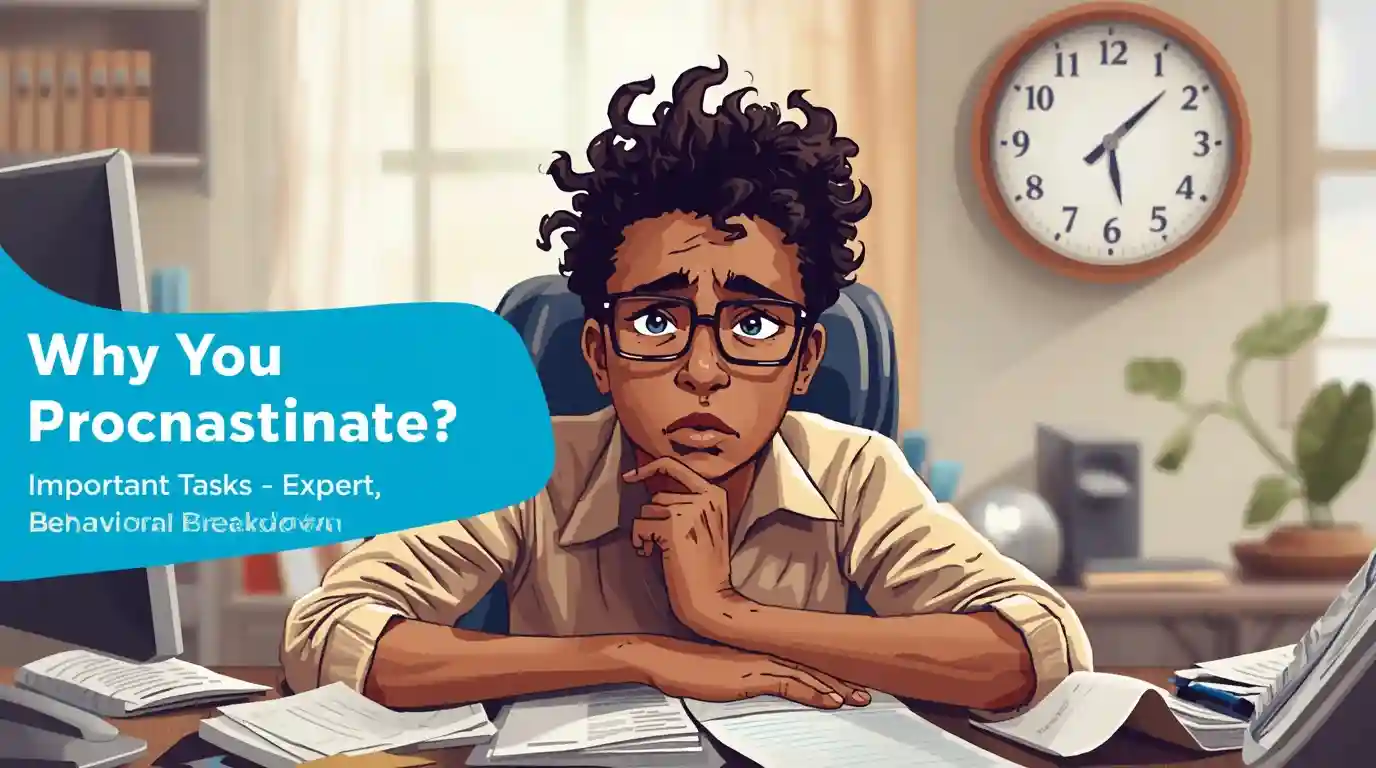
Quick Answer: Why Do We Procrastinate Important Tasks?
Procrastination on important tasks is not a sign of laziness but an emotional regulation issue. Psychologically, we delay high-stakes activities to avoid negative feelings associated with them, such as anxiety, self-doubt, boredom, or the fear of failure. Behavioral patterns like perfectionism, low self-efficacy, and a disconnect from our future selves also contribute significantly. The brain prioritizes short-term mood repair over long-term goals, making the immediate relief of avoidance more appealing than facing a daunting task.
Table of Contents
- Introduction: The Paradox of Avoiding What Matters Most
- It’s Not Laziness, It’s Emotional Regulation
- The Fear of Failure: The Ultimate Paralyzing Force
- Perfectionism: The Enemy of “Good Enough”
- Low Self-Efficacy: The “I Can’t Do It” Loop
- The Disconnect from Your Future Self
- Decision Fatigue: When Your Brain Runs Out of Fuel
- The Role of Dopamine and Instant Gratification
- Strategies to Break the Procrastination Cycle
- Frequently Asked Questions (FAQs)
- Conclusion: Moving from Avoidance to Action
Introduction: The Paradox of Avoiding What Matters Most
You have a critical project deadline looming, a vital report to write, or a life-changing decision to make. You know it’s important. You know the consequences of not doing it are significant. Yet, you find yourself organizing your sock drawer, scrolling through social media, or suddenly deciding it’s the perfect time to deep-clean the kitchen. This frustrating paradox—avoiding the very tasks that matter most—is a universal human struggle. Procrastination is often mislabeled as laziness or poor time management, but the truth is far more complex. It’s a deeply ingrained behavioral pattern rooted in our psychology, driven by a desire to protect ourselves from uncomfortable emotions. Understanding this expert behavioral breakdown is the first step to reclaiming your focus and finally tackling the things that will move your life forward.
Let’s start by dismantling the biggest myth about procrastination.
It’s Not Laziness, It’s Emotional Regulation
The core insight from modern psychology is that procrastination is an emotional regulation problem, not a time management one. When faced with an important task, our brain doesn’t just evaluate the task itself; it evaluates the feelings associated with it. If the task triggers negative emotions—anxiety about not doing it well, boredom with the process, resentment about having to do it, or self-doubt about your abilities—your brain’s limbic system (the emotional part) can override your prefrontal cortex (the rational planning part). Your brain’s immediate priority becomes “mood repair.” It seeks to eliminate the negative feeling right now, and the easiest way to do that is to avoid the task causing it. The relief you feel when you decide to “do it later” is a powerful, albeit temporary, reward that reinforces the cycle of avoidance.
One of the most powerful emotions that drives this avoidance is the fear of being judged.
The Fear of Failure: The Ultimate Paralyzing Force
For truly important tasks, the stakes are high. The outcome is tied to your career, your relationships, or your self-worth. This is where the psychology of fear of failure becomes a primary driver of procrastination. Your brain creates a protective, if illogical, equation: “If I don’t try, I can’t fail.” Procrastinating becomes a form of self-sabotage that shields your ego. By delaying until the last minute, you create a built-in excuse. If the project turns out poorly, you can blame the lack of time rather than a lack of skill or intelligence. This self-handicapping strategy protects your sense of competence at the cost of your actual performance. The task’s importance amplifies the potential for judgment, both from others and from yourself, making avoidance feel like the safest immediate option.
Closely related to the fear of failure is its deceptive cousin, perfectionism.
Perfectionism: The Enemy of “Good Enough”
Perfectionists are often seen as high-achievers, but they are also master procrastinators. The perfectionist mindset creates an impossible standard for important tasks. The pressure to produce something flawless is so immense that starting the task feels overwhelming. The brain gets stuck in “analysis paralysis,” endlessly planning and researching but never moving to execution because the “perfect” first step is never found. This isn’t a quest for excellence; it’s a fear of producing anything less than perfect. The perfectionist procrastinates because the gap between their current reality and their impossibly high standard creates immense anxiety. Delaying the task postpones the inevitable moment when their work will be judged against this perfect ideal.
This ties into another cognitive pattern: a fundamental doubt in one’s own abilities.
Low Self-Efficacy: The “I Can’t Do It” Loop
Self-efficacy is your belief in your ability to succeed in a specific situation. When you face an important task and your self-efficacy is low, you are more likely to procrastinate. If you fundamentally doubt that you have the skills or resources to complete the task successfully, your brain perceives the effort as futile. This creates a feeling of helplessness and a lack of motivation. The thought process becomes, “Why bother starting if I’m just going to struggle and fail anyway?” This isn’t about being lazy; it’s about a deeply held belief that your efforts won’t lead to a successful outcome. This cognitive pattern makes the immediate comfort of avoidance far more appealing than the anticipated struggle of the task itself.
Another abstract but powerful reason for delay is our relationship with our future selves.
The Disconnect from Your Future Self
Behavioral psychology research has shown that we often treat our “Future Self” like a stranger. In our brains, thinking about ourselves a week or a month from now activates different neural pathways than thinking about our “Present Self.” Consequently, we feel a lack of emotional connection to the person who will have to deal with the consequences of our procrastination. When we choose to delay an important task, we are prioritizing the comfort of our Present Self and essentially offloading the stress and hard work onto our Future Self, a person we don’t feel intimately connected to. This temporal disconnect makes it easy to say, “Future Me will have more energy and motivation to handle this,” without truly appreciating that Future Me is still you.
Sometimes, procrastination isn’t about one specific task but the cumulative weight of many.
Decision Fatigue: When Your Brain Runs Out of Fuel
Our ability to make rational, well-thought-out decisions is a finite resource. Throughout the day, every choice you make, from what to wear to how to respond to an email, depletes this mental energy. This phenomenon is known as the psychology behind decision fatigue. When you finally face an important, complex task, your brain may already be running on empty. A daunting project requires numerous micro-decisions: where to start, how to structure it, what resources to use. If your brain is fatigued, it will default to the path of least resistance, which is avoidance. Procrastinating becomes an easy choice simply because your brain lacks the cognitive resources to make the harder choice of engaging with the task.
Finally, our brain’s reward system plays a crucial role in why we choose distraction.
The Role of Dopamine and Instant Gratification
Our brains are wired to seek pleasure and avoid pain. Engaging in a difficult or boring task offers a delayed reward. In contrast, activities like checking social media, watching a video, or eating a snack provide a quick, reliable hit of dopamine, the brain’s “feel-good” neurotransmitter. When faced with the choice between the long, uncertain path to a reward (finishing the important project) and the immediate, easy path to a reward (watching a funny video), our brain’s reward system often chooses the latter. Important tasks simply can’t compete with the instant gratification offered by a million modern distractions. Procrastination, in this context, is your brain choosing a guaranteed small win now over a potential big win later.
Fortunately, understanding these patterns is the first step to overcoming them.
Strategies to Break the Procrastination Cycle
Breaking the habit requires addressing the underlying emotional issues, not just buying a new planner.
- Break It Down: The most effective strategy is to break the daunting task into small, concrete, and non-intimidating steps. Instead of “write the report,” the first step becomes “open a new document and write one sentence.” This lowers the emotional barrier to entry.
- The Two-Minute Rule: Coined by author James Clear, this rule states that if a task takes less than two minutes, do it immediately. For larger tasks, commit to working on it for just two minutes. Starting is the hardest part, and two minutes feels manageable. Often, you’ll find you keep going.
- Practice Self-Compassion: Berating yourself for procrastinating only adds more negative emotion to the task, reinforcing the avoidance cycle. Forgive yourself for past delays and approach the task with kindness. This reduces the fear and shame that fuel procrastination.
- Tie the Task to Your Values: Connect the boring or difficult task to a deeper personal value. “I’m not just writing this report; I’m demonstrating my competence to earn a promotion that will provide a better life for my family.” This reframes the task and boosts intrinsic motivation.
Frequently Asked Questions (FAQs)
1. Is procrastination a sign of ADHD?
While procrastination is a hallmark challenge for individuals with ADHD due to issues with executive function, procrastinating on its own is not a diagnosis. It’s a common human behavior. However, if it’s chronic, severe, and accompanied by other symptoms like inattention and hyperactivity, it may be worth exploring with a professional.
2. Can procrastination be a good thing?
Some psychologists talk about “active procrastination,” where you intentionally delay a task to allow your creative subconscious to work on it, leading to better ideas. However, for most people, procrastination is “passive”—an anxiety-driven avoidance that leads to stress and poorer outcomes.
3. Why do I only procrastinate on important things?
You likely procrastinate on small things too, but you don’t notice it as much. For important tasks, the stakes are higher, which amplifies the negative emotions like fear of failure and anxiety. This makes the emotional drive to avoid the task much stronger.
4. How can I stop procrastinating forever?
You can’t. Procrastination is a fundamental part of the human condition. The goal is not to eliminate it entirely but to reduce its frequency and its negative impact on your life. It’s about learning to manage your emotional responses and building better habits, not achieving perfection.
Conclusion: Moving from Avoidance to Action
Procrastination on important tasks is not a moral failing; it is a deeply human response to difficult feelings. It’s your brain’s clumsy attempt to protect you from anxiety, fear, and self-doubt. By understanding this behavioral breakdown, you can stop blaming yourself for a lack of willpower and start addressing the root cause: emotional avoidance. The path forward lies in self-compassion, breaking down overwhelming goals into manageable steps, and learning to tolerate a little discomfort for the sake of your long-term goals. The next time you feel the urge to delay what matters most, recognize it not as laziness, but as a signal—a call to manage your emotions with kindness and take one small, imperfect step forward.