“The Friction Principle: How Tiny Barriers Kill Action — and How to Remove Them”
Introduction: You’re Not Unmotivated — You’re Overloaded With Friction
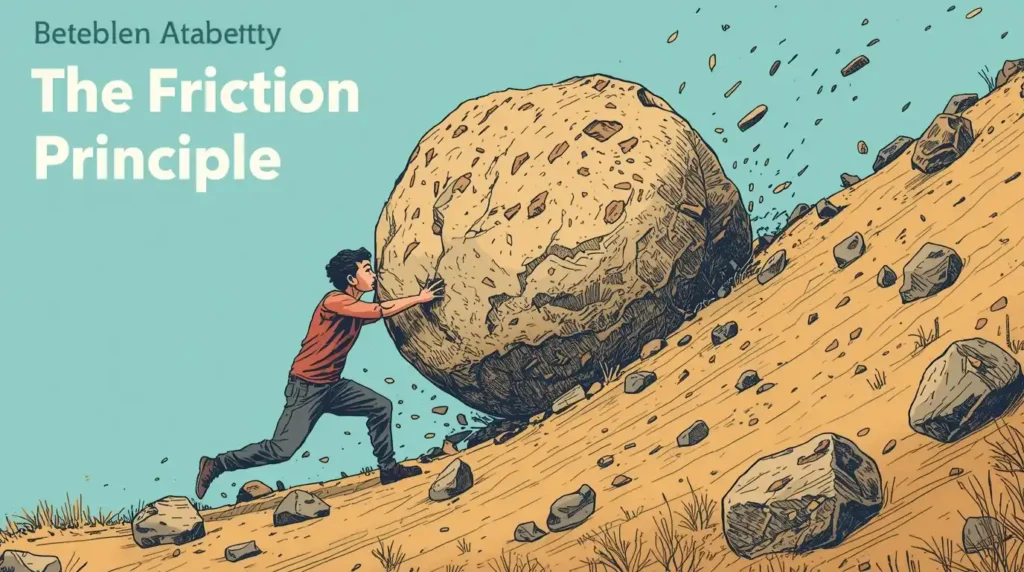
Motivation often dies before action even begins — not because you’re lazy or incapable, but because there’s too much friction between intention and execution. Friction refers to all the small, invisible barriers that make doing the right thing harder than it needs to be. These barriers may be physical (like cluttered spaces), digital (like too many tabs), emotional (like fear of imperfection), or structural (like a chaotic schedule). The brain naturally avoids what feels hard, messy, or unclear. So when there’s too much resistance, even simple tasks can feel overwhelming. In this part of the series, we’ll break down how friction silently sabotages your motivation — and how to reduce it so action becomes effortless.
The Science of Friction and Cognitive Load
Every decision your brain makes consumes energy. When you’re forced to navigate friction — like searching for files, clearing space, or figuring out where to start — it adds to your cognitive load. As that load builds, your mental clarity drops and your stress response rises. Even a 5-minute task can feel heavy if there’s a mountain of resistance in front of it. This explains why you may feel exhausted just thinking about doing something small — your brain is predicting the struggle before you even begin. Understanding this mechanism is the key to unlocking smoother, more automatic motivation.
Friction Is the Hidden Opposite of Flow
When something feels easy to start and rewarding to finish, you’re likely to enter a flow state — that zone of focus and effortlessness. But friction disrupts this entirely. It breaks momentum, increases hesitation, and often leads to procrastination or avoidance. The more steps between you and the task, the less likely you are to begin — especially when your energy or willpower is low. Motivation doesn’t thrive in cluttered, chaotic, or confusing environments. It thrives in simplicity, clarity, and structure. Your goal isn’t to force yourself to do more — it’s to make doing less feel easier.
Types of Friction That Kill Motivation
There are four main types of friction that silently block action:
- Environmental Friction: Messy rooms, disorganized desks, or visual distractions that make it harder to focus or get started.
- Digital Friction: Too many browser tabs, scattered tools, or login requirements that turn quick tasks into cognitive overwhelm.
- Emotional Friction: Perfectionism, fear of failure, or emotional baggage that creates hesitation before you act.
- Process Friction: Unclear steps, lack of systems, or too much decision-making required to begin.
Each layer of friction creates a small resistance. Stack enough of them together — and even your best intentions can’t overcome the drag.
How to Remove Friction and Reignite Motivation
The key to regaining motivation is to remove or reduce as much friction as possible. This isn’t about adding discipline — it’s about designing for ease.
- Simplify your environment: Clear your workspace before working. Lay out your clothes before the gym. Remove clutter that competes for attention.
- Automate your process: Use templates, tools, or pre-set routines so you don’t have to “figure it out” every time.
- Minimize decisions: Pre-decide your work hours, meals, or morning rituals to conserve mental energy.
- Reduce emotional resistance: Let go of perfection. Give yourself permission to do a “bad version” first — just to get moving.
Even one or two tweaks can dramatically change how willing your brain is to start. Less friction = more flow.
Designing Low-Friction Habits for Consistency
The best habits in the world often fail because they’re wrapped in friction. Want to read more? Keep your book visible. Want to drink more water? Leave a bottle on your desk. Want to work out? Pack your gym clothes the night before. These small optimizations lower the “activation energy” needed to begin. Over time, your brain stops resisting because the habit feels like the path of least resistance. That’s when consistency becomes easy — not because you’re more disciplined, but because you’re better designed.
Final Thoughts: Make It Easy to Win
You don’t need to be more motivated. You need to make it easier to move. When you reduce friction, you reduce resistance. And when resistance drops, action becomes more automatic — which reinforces confidence, progress, and identity.
Motivation doesn’t just come from mindset. It comes from environment, structure, and design. Your job isn’t to push harder — it’s to build a system so smooth, action feels inevitable. If you’re struggling to stay consistent, don’t ask what’s wrong with you. Ask:
“What’s in my way — and how can I remove it?”
That’s how you build a life where motivation is built-in — not forced.
FAQs About Friction and Motivation
Q: Why do I always feel resistance, even with things I enjoy?
Because enjoyment doesn’t eliminate friction. You may still be facing disorganization, unclear next steps, or emotional perfectionism. Fix the system — not your passion.
Habits and Behavior Change: Why Willpower Fails and What Works Instead (Part 12)Q: Is friction always a bad thing?
Not always. You can intentionally add friction to break bad habits (e.g., deleting apps, freezing cards). The key is to remove friction from good behaviors and add it to harmful ones.
Q: How long does it take to feel the difference after removing friction?
Often immediately. When the barriers drop, your brain is more willing to act — and even small wins create momentum fast.
Q: What if I can’t control my environment (e.g., shared space)?
Then focus on digital and process friction: streamline your tools, simplify your routines, and use noise-canceling apps or visual boundaries. Even small reductions in friction help.