Quick Answer
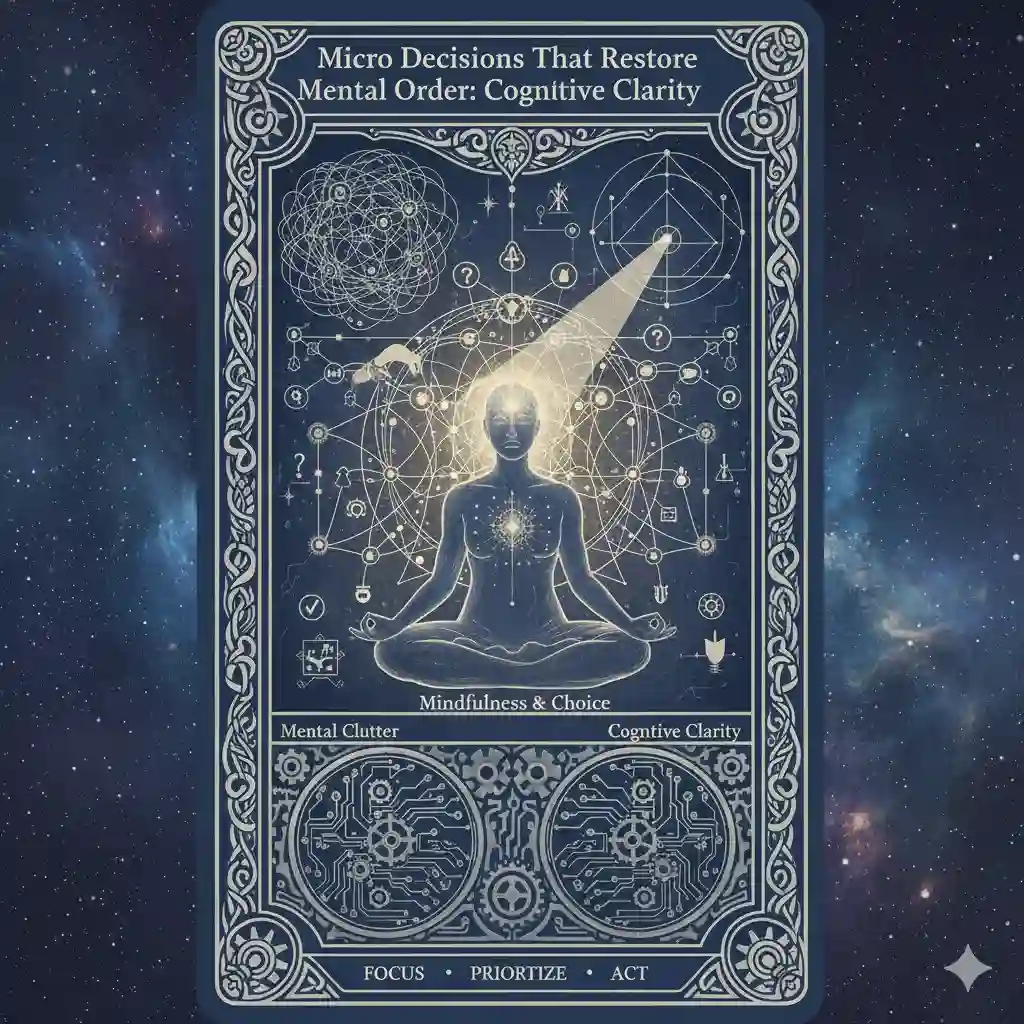
Mental clarity is not regained through sheer force of will or by waiting for inspiration; it is restored through the mechanical closure of open cognitive loops. When the brain is overwhelmed, it suffers from cognitive fragmentation, where attention is split among dozens of unresolved variables. A micro decision—a small, low-stakes commitment executed immediately—acts as a regulatory mechanism. It forces the brain to switch from a passive state of scanning to an active state of concluding. This shift signals the nervous system that agency has been recovered, releasing the working memory previously tied up in holding patterns. Clarity returns because the “noise” of unmade choices is silenced, reducing the overall cognitive load and allowing higher-order thinking to resume.
Table of Contents
- Why Mental Disorder Comes From Unresolved Decisions
- How Micro Decisions Reduce Cognitive Load
- The Difference Between Productive Decisions and Regulatory Decisions
- Why Waiting for Motivation Blocks Clarity
- How Small Commitments Restore Internal Hierarchy
- 3 Core Clarity States
- Micro-Decision Framework
- Real-World Scenario: The Morning Paralysis
- FAQ: Micro Decisions and Cognitive Regulation
- Additional Questions on Behavioral Regulation
- Conclusion
Why Mental Disorder Comes From Unresolved Decisions
The sensation of mental disorder or “brain fog” is rarely the result of having too much to do; rather, it is the result of having too many unresolved decisions hanging in the cognitive workspace. The human brain, specifically the prefrontal cortex, treats every unmade decision as an open loop. This phenomenon, related to the Zeigarnik effect, ensures that incomplete tasks remain active in working memory to prevent us from forgetting them. While this mechanism is evolutionarily adaptive for survival tasks, in a modern information-dense environment, it becomes a liability. When you have ten emails you haven’t answered, a project strategy you haven’t defined, and a dinner choice you haven’t made, your brain is actively expending metabolic energy to keep all of these loops spinning simultaneously.
This state of accumulation leads to fragmentation. Attention is not a limitless resource; it is a finite currency. Each open loop effectively “taxes” your attentional budget. As the number of unresolved choices increases, the available bandwidth for processing new information decreases. You experience this not as physical pain, but as anxiety, distractibility, and an inability to focus on complex concepts. The disorder is structural. Your working memory is overcrowded with “potentialities”—things that might happen or should happen—leaving no room for the reality of what is happening. The brain perceives this backlog as a threat to competence, triggering a stress response that further inhibits clear thinking.
How Micro Decisions Reduce Cognitive Load
A micro decision functions as a release valve for this accumulated pressure. Unlike major strategic decisions which require extensive data analysis and forecasting, a micro decision is contained, immediate, and often binary. It is the act of looking at a cluttered desk and deciding solely to move a coffee cup to the sink. The power of this action lies not in the cleanliness of the desk, but in the neurological signal it sends. By identifying a variable, choosing a course of action, and executing it, you complete a cognitive cycle.
This completion is critical for reducing cognitive load. When a loop is closed, the brain releases the resources that were bound to it. The “holding pattern” energy is reclaimed. Even if the decision is trivial, the mechanics of closure are identical to those of major decisions. The brain registers “task complete” and downregulates the vigilance associated with that specific item. As you stack these micro decisions—filing one paper, deleting one email, choosing one sentence to write—you systematically free up working memory. The “noise” of the mind quiets because the active interference patterns are being resolved one by one. This is why clarity often follows action; the action itself is the mechanism of clearing the mental buffer.
The Difference Between Productive Decisions and Regulatory Decisions
To effectively utilize micro decisions, one must distinguish between productive decisions and regulatory decisions. A productive decision is outcome-oriented; its goal is to advance a project, generate value, or solve a complex problem. These are high-load activities that require a clear mind to execute. Attempting to make high-stakes productive decisions when you are already mentally fragmented often leads to decision fatigue and depletion, as the system lacks the resources to process the variables effectively.
A regulatory decision, by contrast, is process-oriented. Its goal is not necessarily to produce a final output, but to stabilize the internal cognitive environment. Deciding to close all browser tabs except one is a regulatory decision. Deciding to set a timer for ten minutes is a regulatory decision. These choices are designed to curate the environment and the mind, reducing the input variables to a manageable level. When mental order is lost, the mistake most people make is trying to force productive decisions (e.g., “I need to write this report”) without first making the regulatory decisions (e.g., “I need to clear my workspace and silence my phone”). Regulatory decisions act as the scaffolding that supports high-level thinking. They restore the cognitive baseline so that productive work becomes possible.
Why Waiting for Motivation Blocks Clarity
A common behavioral trap is the belief that one must “feel clear” or “feel motivated” before making decisions. From a behavioral regulation perspective, this is a misunderstanding of the causal relationship between action and state. Clarity is an emergent property of order; it is the result of engagement, not the prerequisite for it. Waiting for the fog to lift before acting is often futile because the inaction itself is sustaining the fog.
Motivation is often the result of dopaminergic feedback loops that are triggered by successful interaction with the environment. When you wait to feel ready, you remain in a passive state where information overload and mental noise continue to accumulate. The brain remains in “scanning mode,” looking for a signal strong enough to compel action, but finding only more noise. Micro decisions bypass the need for motivation by relying on behavioral activation. By committing to an action so small that it requires negligible motivational energy, you artificially jumpstart the feedback loop. The completion of the micro task provides a small signal of efficacy, which slightly clarifies the mental landscape, making the next decision easier. You do not think your way into clarity; you act your way into it.
How Small Commitments Restore Internal Hierarchy
When the mind is disordered, all tasks and inputs appear to have equal weight. The urgent email feels as heavy as the long-term career goal, which feels as heavy as the need to buy groceries. This flattening of hierarchy is a hallmark of cognitive overwhelm; the brain loses its ability to prioritize because it is stuck in a reactive state. It cannot discern the “signal” from the “noise” because everything is screaming for attention simultaneously.
Small commitments act as a tool to manually reconstruct this hierarchy. By arbitrarily selecting one small thing to do—regardless of its objective importance—and elevating it to the status of “current priority,” you force the brain to re-establish a point of focus. This act of selection suppresses the neural activity related to all other competing options. Even if the choice is minor, such as deciding to organize a single file folder, the act of prioritizing it creates a temporary structure. It tells the brain: “This is the signal; everything else is noise.” As you move from one small commitment to the next, you practice the cognitive skill of organizing thinking by priority, gradually retraining the mind to filter and rank inputs rather than drowning in them.
3 Core Clarity States
Understanding the state of your cognition is essential for applying the correct intervention. The brain generally cycles through three states regarding decision-making capability.
Cognitive Fragmentation
In this state, attention is scattered across multiple open loops. The subjective experience is one of high mental noise, anxiety, and a feeling of being “busy” without being effective. Working memory is saturated with unfinished business. You may find yourself switching tasks rapidly or staring blankly at screens. The brain is trying to process everything at once and succeeding at nothing.
Decision Paralysis
This state is a freeze response driven by overload. When the fear of error or the sheer volume of variables exceeds cognitive capacity, the brain disengages to protect itself. Avoidance becomes the dominant behavior. You might procrastinate, scroll social media, or engage in low-value tasks to escape the pressure of the unmade choices. This is a defensive posture against delayed decisions and mental cost.
Regulated Clarity
This is the target state. It is characterized by a calm, singular focus. The mind is not empty, but it is ordered. There is a clear hierarchy of attention: one task is in the foreground, and others are safely filed in the background. This state is achieved not by eliminating all tasks, but by regulating the flow of engagement through sequential micro commitments.
Micro-Decision Framework
Restoring mental order is a mechanical process. It does not require inspiration; it requires a protocol. Use this framework when you feel fragmentation setting in.
1. Identify a Low-Stakes Unresolved Decision
Scan your immediate environment or mental list for a decision that carries almost zero risk. Do not choose a strategic work problem. Choose something tangible and binary. Examples include: “Should I close this window?”, “Should I put this book away?”, or “Should I delete this draft?” The lower the stakes, the better. The goal is to find an object of attention that is small enough to be fully encompassed by your current, depleted working memory.
2. Make a Clear, Contained Commitment
Once identified, articulate the decision explicitly. Do not leave it vague. Instead of thinking “I should clean up,” think “I am deciding to put this specific pen in the drawer.” This linguistic precision helps delineate the boundaries of the task. It turns a general impulse into a specific cognitive contract. The containment is crucial; you are defining exactly what success looks like so the brain knows when to release the effort.
3. Complete or Close the Loop Immediately
Execute the decision without delay. The gap between decision and action must be minimal to prevent second-guessing or distraction. If the decision involves deleting an email, do it now. If it involves archiving a file, click the button. This physical action provides the sensory feedback the brain needs to register the loop as “closed.” It serves as a punctuation mark in the stream of consciousness.
4. Allow the Nervous System to Recalibrate
After execution, take a brief pause—just a few seconds. Notice the sensation of completion. This is a form of short resets for clarity. You are allowing the neurochemicals associated with the stress of that open loop to dissipate. You may feel a slight drop in mental tension. This is the signal that bandwidth has been freed. Repeat the process with the next slightly larger micro decision.
Real-World Scenario: The Morning Paralysis
Consider the case of David, a project manager who sits down at his desk at 8:30 AM. He is immediately confronted with a deluge of inputs: 40 unread emails, a Slack channel flashing with notifications, a half-finished report from yesterday, and a calendar invite for a meeting he hasn’t prepared for.
The Formation of Overload:
David’s brain attempts to assess all these threats simultaneously. He opens an email, then worries about the report, then checks Slack, then goes back to the email. He is in a state of cognitive fragmentation. His working memory is trying to hold the content of the email, the deadline of the report, and the social pressure of the Slack messages all at once.
The Compound Confusion:
By 9:00 AM, David has not completed a single task. He feels exhausted and anxious. He enters decision paralysis. He starts scrolling news headlines to numb the feeling of overwhelm. He tells himself he needs to “get motivated” to tackle the report, but the report feels like a mountain because his cognitive capacity is shattered.
The Restoration via Micro Decision:
David recognizes the state he is in. He stops trying to “do work” and starts making regulatory micro decisions.
- Micro Decision 1: “I decide to close the email tab entirely.” He clicks close. (Visual noise reduced).
- Micro Decision 2: “I decide to put my phone in the drawer for 15 minutes.” He moves the phone. (Distraction vector removed).
- Micro Decision 3: “I decide to open a blank document and write only the title of the report.” He types the title.
With that final action, the paralysis breaks. He is no longer thinking about doing the report; he is in the report. The small commitment of writing the title bridged the gap. His mental order is restored not because he finished the work, but because he regulated his attention down to a single, manageable point of entry.
FAQ: Micro Decisions and Cognitive Regulation
How do micro decisions differ from just “breaking things down”?
While similar, the focus of micro decisions is on regulation rather than project management. Breaking things down is usually a planning activity to make a project manageable. Micro decisions are immediate, real-time behavioral interventions used to calm the nervous system and restore focus when you are already overwhelmed.
Can a decision be too small?
Functionally, no. In states of extreme burnout or panic, the smaller the decision, the better. Deciding to take one deep breath or deciding to pick up a pen is sufficient to re-establish agency. The goal is to prove to the brain that it can still direct action.
Does this help with chronic procrastination?
Yes, because chronic procrastination is often an emotional regulation issue, not a time management issue. Micro decisions lower the barrier to entry, reducing the emotional threat of the task. They allow you to bypass the “wall of awful” associated with starting.
How many micro decisions does it take to restore clarity?
It varies, but often a sequence of three to five executed micro decisions is enough to shift the brain state from fragmentation to regulated clarity. It creates a momentum of closure.
What if I make the “wrong” micro decision?
In the context of restoring mental order, correctness is secondary to decisiveness. The cost of indecision (stagnation and load accumulation) is almost always higher than the cost of a suboptimal micro decision (e.g., filing a paper in the wrong folder). The act of deciding is the medicine.
Why does this work better than making a to-do list?
Making a list can sometimes increase anxiety because it visualizes the volume of work without reducing it. A micro decision is the work. It moves you from passive cataloging to active resolution.
Additional Questions on Behavioral Regulation
Can I use micro decisions to transition between work and home?
Yes. Using micro decisions to “close down” the workspace (e.g., “I decide to close my laptop,” “I decide to wash my coffee mug”) signals the brain that the work context is ending, aiding in psychological detachment and recovery.
Do micro decisions help with decision fatigue?
Counter-intuitively, yes. While they are decisions, they are low-load. Executing them provides a sense of competence and closure that can actually be restorative, unlike high-load complex decisions that drain resources.
Is this related to exposure therapy?
There are parallels. You are exposing yourself to the “threat” of work in tiny, manageable doses, desensitizing the brain’s fear response to the overwhelming workload.
Can physical clutter block mental order?
Yes, physical objects are visual stimuli that the brain must process. Each cluttered item represents a latent decision (“Where does this go?”). Clearing clutter via micro decisions directly frees up cognitive processing power.
Should I time my micro decisions?
You can, but it is not necessary. The emphasis should be on the completion of the cycle (decide-act-close) rather than the duration.
Can this method be applied to emotional processing?
Yes. Instead of trying to “solve” a complex emotion, make a micro decision to simply label it or write down one sentence about it. This externalizes the load.
What is the neurological basis for this?
It relies on the interaction between the basal ganglia (habit/action) and the prefrontal cortex (executive control). Small actions engage the motor cortex and basal ganglia, which can help “unlock” a frozen prefrontal cortex.
Why is “closure” so important for the brain?
The brain craves prediction and resolution. Open loops represent prediction errors or incomplete patterns. Closure resolves the pattern, allowing the brain to stop allocating energy to it.
Conclusion
The state of your mind is a reflection of the state of your decisions. Mental disorder is rarely a permanent defect of intellect; it is a temporary condition caused by the accumulation of unresolved choices that fragment attention and saturate working memory. Clarity is not a mystical state that arrives by chance; it is a mechanical state of order that you can actively reconstruct.
By utilizing micro decisions, you engage a powerful regulatory mechanism. You stop trying to solve the entire puzzle at once and instead focus on placing a single piece. This shift from global worry to local action lowers cognitive load, quiets the noise of open loops, and signals to the nervous system that you are safe and in control. Remember that clarity follows commitment, not certainty. You do not need to know the destination to take the first step; you simply need to decide to take the step. Through the discipline of small, completed actions, you recalibrate your cognitive system, turning chaos back into order one decision at a time.