We often think of emotions as the vibrant colors that paint our human experience, the highs of joy and the lows of sorrow that give life its texture. But what happens when those colors begin to fade? Emotional detachment is a state in which a person creates a mental and emotional buffer between themselves and the world around them. It can manifest as an inability to connect with others, a lack of empathy, or a general feeling of numbness often called “emotional blunting.”
While frequently viewed in a negative light, emotional detachment exists on a spectrum. On one end, it is a debilitating symptom of trauma or a mental health condition, an invisible wall that isolates us. On the other, it is a healthy coping skill—a form of emotional regulation that allows us to maintain our peace in the face of chaos. As a psychologist, I’ve seen both sides of this coin in my clients: the person struggling to feel anything at all, and the person who has learned to detach with purpose to survive a high-stress job.
This comprehensive guide will explore the complex psychology of emotional detachment. We will explain why it happens, look at real-life examples of both its unhealthy and healthy forms, and provide actionable tips for managing this state. Understanding the real reason behind emotional detachment is the first step toward either healing from its harmful effects or harnessing its power for a more balanced life.
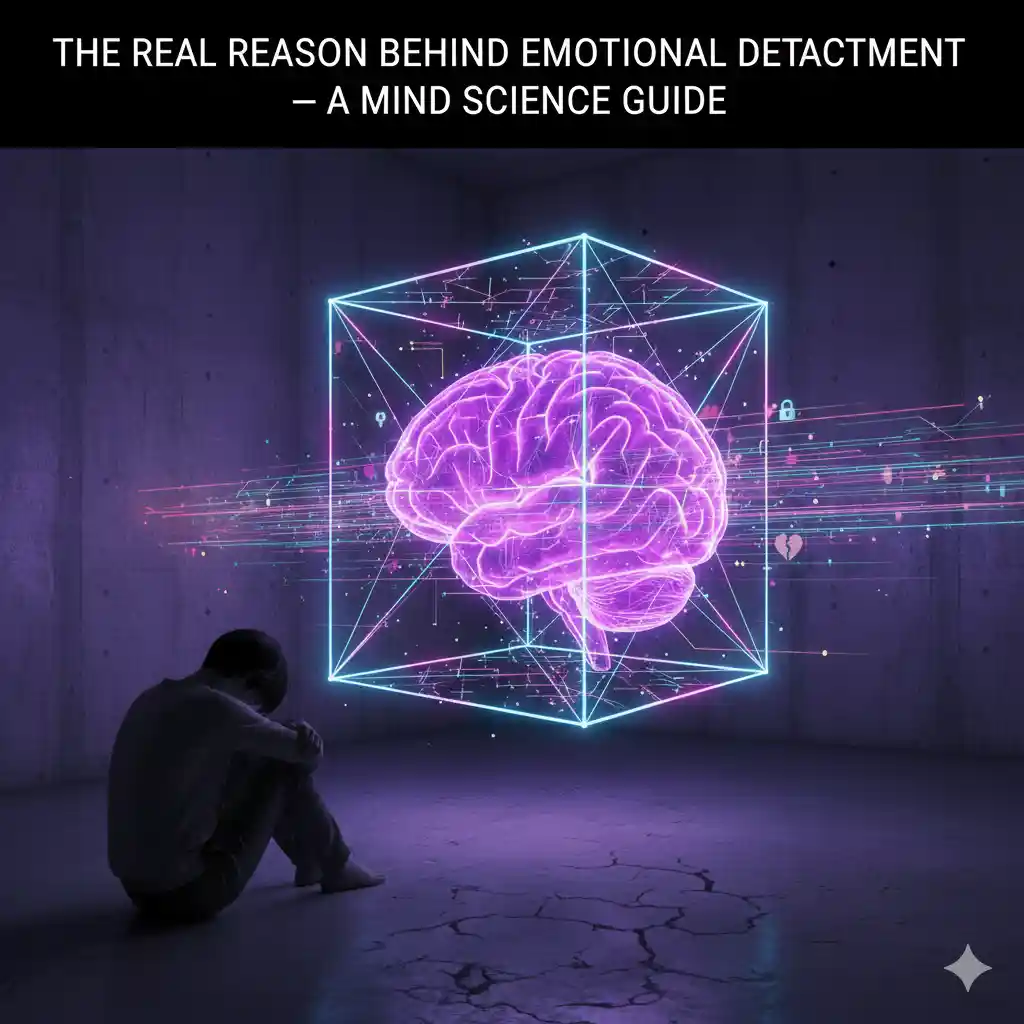
Table of Contents
- The Mind’s Protective Shield: An Explanation of Detachment
- The Trauma Response: When Numbness Becomes Survival
- Learned Behavior and Environment: Conditioning the Heart to Close
- The Spectrum of Detachment: Real-Life Examples
- Healthy Detachment vs. Unhealthy Detachment
- Actionable Tips: Overcoming Unhealthy Detachment
- Actionable Tips: Cultivating Healthy Detachment
- The Role of Professional Help
- Frequently Asked Questions (FAQs)
- Conclusion: Finding Your Emotional Center
The Mind’s Protective Shield: An Explanation of Detachment
Emotional detachment is not the same as a lack of emotion. The feelings are often still there, but they are walled off, inaccessible. From a psychological perspective, this is primarily a defense mechanism—a powerful, often subconscious, strategy the brain employs to protect itself from overwhelming pain, stress, or trauma. When an experience is too much for the psyche to handle, the brain can effectively hit a circuit breaker, severing the connection between an event and the emotional response to it. This psychological tool is a cornerstone of many coping mechanisms.
The Brain’s Emergency Brake
Think of it as your brain’s emergency brake. If you are speeding toward a perceived emotional crash, the brain pulls the lever to stop everything, even if it means you are left stranded and unable to move. The goal is simple: survival. Essentially, the brain learns that if it cannot control the external world, it can try to control its internal reaction to it. Detachment is the ultimate form of internal control, a retreat into a mental fortress where overwhelming feelings cannot reach you. This protective function is crucial, but when the “emergency” is over and the brake stays on, it becomes a problem.
The Trauma Response: When Numbness Becomes Survival
One of the most common reasons for involuntary emotional detachment is trauma. This can be a single, acute event (like an accident or an assault) or chronic, prolonged exposure to a traumatic environment (such as ongoing abuse, neglect, or even the high-stress life of a first responder).
How Trauma Rewires the Brain
Trauma can teach the brain a dangerous lesson: feeling deeply is a threat. To cope with the unbearable emotions associated with the traumatic experience, the brain may numb itself out entirely. This is a core feature of Post-Traumatic Stress Disorder (PTSD).
- Emotional Blunting: This is the clinical term for the numbing sensation. A person may find they can no longer feel joy, love, or even profound sadness. The emotional dial is turned down to zero to avoid the risk of also feeling the terror or grief associated with the trauma.
- Dissociation: In more extreme cases, a person might dissociate, feeling as if they are watching their life from outside their own body. This creates a profound sense of disconnection from oneself and reality, a clear and powerful form of emotional detachment.
Learned Behavior and Environment: Conditioning the Heart to Close
Not all emotional detachment stems from classic trauma. Sometimes, it is a learned behavior, conditioned by our upbringing and social environment. Our earliest relationships serve as a blueprint for how we handle emotions later in life.
When Feelings Weren’t Welcome
If you grew up in an environment where emotions were treated as a sign of weakness, a burden, or something to be punished, you may have learned to suppress them to gain love and acceptance.
- The “Big Boys Don’t Cry” Effect: Children, particularly boys, are often socialized to believe that expressing sadness or fear is unacceptable. They learn to detach from these feelings to fit a rigid masculine ideal.
- Parental Invalidation: If a child’s feelings are consistently ignored or dismissed (“You’re overreacting,” “There’s nothing to be sad about”), they learn that their emotions are invalid. They may stop expressing them, and eventually, stop acknowledging them even to themselves.
- Chaotic Households: In homes with addiction or high conflict, a child might detach emotionally as a way to create a small island of peace for themselves amidst the chaos. Feeling nothing is safer than feeling the constant anxiety of their environment.
The Spectrum of Detachment: Real-Life Examples
Emotional detachment shows up in our lives in vastly different ways. Recognizing its form is key to understanding whether it is a helpful skill or a harmful symptom.
The Invisible Wall of Unhealthy Detachment
This is the kind of detachment that isolates and harms. It’s an involuntary response that creates a barrier to genuine connection.
- The “Robot” Partner: Sarah’s husband, Mark, rarely shows emotion. When she comes to him with a problem, he offers logical solutions but provides no comfort. He seems distant during happy moments and unfazed by sad ones. Mark isn’t heartless; he grew up in a household where emotions were seen as chaotic and dangerous. His brain learned to build a wall to protect itself, but that wall now prevents him from connecting with the person he loves most.
- The Burnt-Out Caregiver: A nurse working in an intensive care unit for years finds she no longer feels the same empathy for her patients. She goes through the motions of care but feels a profound numbness inside. This “compassion fatigue” is a form of emotional detachment her brain has developed to cope with the constant exposure to suffering and death.
The Anchor of Healthy Detachment
This is a conscious skill of creating emotional space. It is not about not feeling, but about not being overwhelmed by feelings—both yours and others’.
- The Calm Parent: A mother’s toddler is having a full-blown tantrum in the middle of a grocery store. Instead of getting flustered or yelling, she takes a deep breath and remains calm. She is not suppressing her frustration; she is choosing not to let her child’s dysregulated emotions dictate her own. This healthy detachment allows her to respond effectively.
- The Person in a Toxic Work Environment: An employee has a boss who is prone to angry outbursts. Instead of internalizing the boss’s anger and feeling anxious all day, the employee learns to see the outbursts as “the boss’s problem.” They create an emotional shield, recognizing that they do not have to absorb that negative energy.
Healthy Detachment vs. Unhealthy Detachment
Distinguishing between the two forms is critical. It often comes down to a single factor: choice.
| Unhealthy Detachment (Involuntary) | Healthy Detachment (Voluntary) |
|---|---|
| Feels like numbness or emptiness. | Feels like calm and control. |
| You cannot access your emotions when you want to. | You can access your emotions but choose when to engage. |
| It is a reaction to protect yourself from your own pain. | It is an action to protect yourself from others’ pain/energy. |
| It hinders relationships and creates isolation. | It strengthens relationships by preventing codependency. |
| It is often a symptom of a deeper issue (trauma, depression). | It is a learned skill of emotional regulation. |
Actionable Tips: Overcoming Unhealthy Detachment
If you are feeling too detached and want to reconnect, the approach must be gentle. You are teaching your brain that it is safe to feel again.
- Practice Mindfulness and Body Scans: Unhealthy detachment often creates a severe disconnect between mind and body. Mindfulness exercises, especially body scans, can help you gently re-inhabit your physical self. Lie down and bring your attention to different parts of your body, from your toes to your head, simply noticing any sensations without judgment. This can start to rebuild the mind-body connection.
- Engage Your Senses: To break through numbness, focus on sensory experiences. Light a candle with a strong scent, listen to a powerful piece of music, hold an ice cube in your hand, or eat a food with a complex flavor profile like a dark chocolate or a sour lemon. Engaging the senses can be a gentle gateway back to feeling.
- Journal Your “Factual” Feelings: If you can’t feel your emotions, try describing them logically. Instead of trying to feel sad, you could write, “Today, a situation occurred that would typically cause sadness. My eyes did not tear up, but I noticed a heaviness in my chest.” This act of labeling can help your brain start to recognize and reconnect with the feelings themselves.
Actionable Tips: Cultivating Healthy Detachment
If you want to build the skill of healthy detachment to protect your energy, the focus is on creating conscious boundaries.
- “Name It to Tame It”: When you feel yourself getting pulled into someone else’s emotional drama, mentally label the emotion. For example, “This is my coworker’s anxiety, not mine.” This simple act, supported by neuroscience, creates a cognitive separation between you and the other person’s feeling.
- Visualize an Emotional Shield: This is a powerful visualization technique. Before entering a stressful situation, imagine a protective bubble of light around you. Set the intention that this shield will allow love and compassion to flow out, but will block negative or overwhelming energy from coming in.
- Practice Loving-Kindness Meditation: This meditation involves sending well-wishes to yourself and others (“May you be happy. May you be safe.”). It teaches you to feel compassion for someone without having to feel their pain with them. It builds the muscle of empathetic concern without empathetic distress.
The Role of Professional Help
It is vital to recognize when self-help is not enough. If your emotional detachment is persistent, causing significant distress in your life and relationships, or if you suspect it stems from trauma or a condition like depression, seeking professional help is a sign of strength. A therapist can provide a safe space to explore the roots of your detachment. Therapies like Somatic Experiencing, EMDR (Eye Movement Desensitization and Reprocessing), or Cognitive Behavioral Therapy (CBT) are specifically designed to help process trauma and re-establish a healthy connection to your emotions.
Frequently Asked Questions (FAQs)
Q: Is emotional detachment a sign of a personality disorder?
A: It can be. Emotional blunting is a feature of several personality disorders, such as Schizoid Personality Disorder. However, it is also a common symptom of many other conditions, like depression and PTSD, and can occur in people with no disorder at all. A diagnosis should only be made by a qualified professional.
Q: Can medications cause emotional detachment?
A: Yes. Some people report experiencing emotional blunting as a side effect of certain antidepressants, particularly SSRIs. If you believe your medication is causing this, it is crucial to speak with your doctor. Do not stop taking any medication without medical guidance.
Q: How do I deal with an emotionally detached partner?
A: First, approach them with curiosity, not accusation. Use “I feel” statements (e.g., “I feel lonely when we don’t connect emotionally”). Encourage them to explore why they might be detached, and suggest couples counseling. It’s important to remember you cannot force someone to feel, but you can create a safe environment where they might feel more comfortable trying.
Q: Is being an introvert the same as being emotionally detached?
A: No. Introversion is about how you gain and lose energy (from being alone vs. with people). Detachment is about how you connect (or don’t connect) with emotions. An introvert can be deeply emotional and connected, just with a smaller circle of people.
Conclusion: Finding Your Emotional Center
Emotional detachment is one of the mind’s most powerful and misunderstood tools. It can be a cage that locks us away from the richness of life, or it can be a key that unlocks a profound sense of inner peace. The difference lies in awareness and choice.
When detachment is an involuntary shield born from pain, the path forward is one of gentle and safe reconnection. It is about teaching your brain, slowly and with compassion, that it is now safe to feel again. When detachment is cultivated as a conscious skill, it becomes one of the most effective emotional regulation strategies available. It allows us to be anchors of calm in a sea of emotional turmoil, to love deeply without losing ourselves, and to navigate the complexities of the human experience with grace and resilience. By understanding the mind science behind this mechanism, we can learn to work with our brains to create a life that is both deeply felt and peacefully managed.