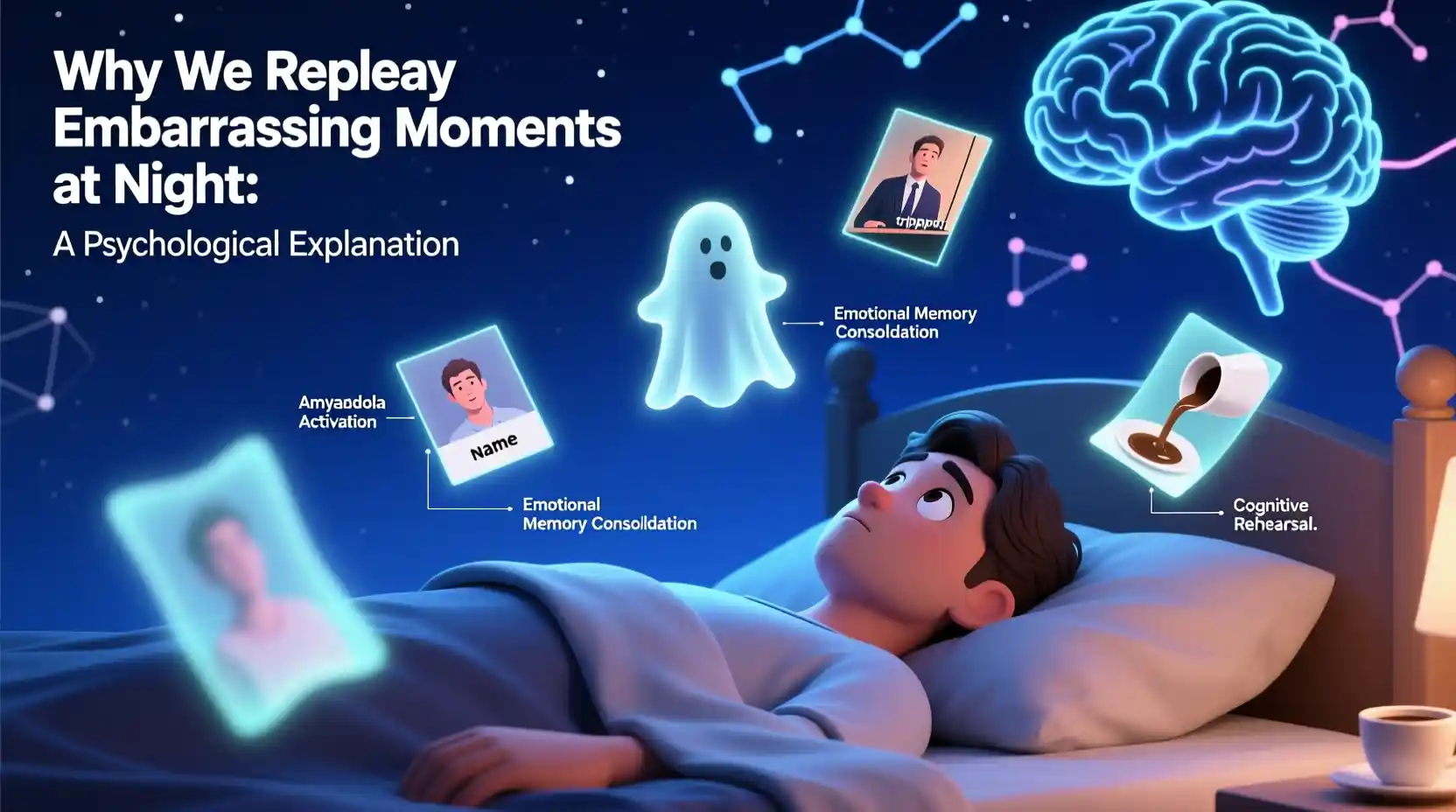
The house is quiet, the lights are out, and you’re finally settling down after a long day. Just as your mind begins to drift toward sleep, it happens. A memory from five years ago—that time you tripped in front of everyone, or when you confidently said the wrong answer in a meeting—comes rushing back with startling clarity. Your cheeks flush, your stomach drops, and you physically cringe in the darkness. You are now the captive audience for a highlight reel of your most embarrassing moments, playing on a loop.
This nightly ritual is a strangely universal human experience. While it can feel isolating, you are not alone in this mental torture chamber. This phenomenon, known as rumination, is a common cognitive pattern where the brain gets stuck on negative thoughts and memories. It’s not just a bad habit; it’s a deeply ingrained psychological mechanism tied to our social nature, our memory systems, and our brain’s chemistry.
In this guide, we will explore the psychological reasons why your brain insists on replaying these cringeworthy moments, especially at night. We will break down the science behind rumination, why these memories feel so potent, and what is happening in your brain during these nocturnal “cringe attacks.” Understanding the “why” is the first step toward breaking the cycle and finally getting some peace.
Table of Contents
- The Spotlight Effect: The Main Character Syndrome
- Rumination: Your Brain’s Broken Record
- Why at Night? The Science of the Quiet Brain
- The Zeigarnik Effect: The Agony of Unfinished Business
- Emotional Memory vs. Factual Memory
- The Social Brain: Fear of Ostracism
- Is It Just Embarrassment or Is It Anxiety?
- Reconsolidation: Why Reliving It Makes It Stronger
- Frequently Asked Questions (FAQs)
- Conclusion: Silencing the Inner Critic
The Spotlight Effect: The Main Character Syndrome
One of the primary psychological drivers behind the power of embarrassing moments is a cognitive bias known as the “spotlight effect.” This is our tendency to believe that other people notice our actions and appearance much more than they actually do. When you stumbled over your words during that presentation, you felt as if a giant, unforgiving spotlight was suddenly trained on you, highlighting your failure for all to see. In my own experience, I’ve had to coach myself through the aftermath of saying “you too” when a barista tells me to enjoy my coffee. The immediate feeling is that everyone heard and is silently judging.
You Are Not the Star of Their Show
In reality, that spotlight is largely imaginary. Research consistently shows that we are the main characters of our own stories, but only minor, background characters in everyone else’s. While you were mentally flagellating yourself for days after the incident, most people who witnessed it likely forgot about it within minutes. They were too busy worrying about their own internal monologues and perceived flaws. Your brain, however, doesn’t get the memo. It replays the event from your first-person perspective, where you were the undisputed star of that disastrous moment. This egocentric bias keeps the memory feeling significant and public, even when its actual social impact was minimal. At night, when you replay the moment, you are not just remembering the event; you are remembering the feeling of being under that imaginary spotlight, which is what makes it so painful.
Rumination: Your Brain’s Broken Record
At its core, the act of replaying embarrassing moments is a form of rumination. In psychology, rumination is the act of compulsively focusing on the symptoms of one’s distress, and on its possible causes and consequences, as opposed to its solutions. It’s like a mental hamster wheel: you are running endlessly but getting nowhere.
The Problem-Solving Brain Gone Wrong
Rumination is not the same as productive reflection. Reflection involves analyzing a past event to learn from it and move on. Rumination, on the other hand, is a passive and repetitive process. Your brain latches onto the embarrassing memory and keeps replaying it, focusing on the negative feelings associated with it—the shame, the awkwardness, the regret. This is your brain’s problem-solving function malfunctioning. Your mind identifies the embarrassing moment as a “problem” or a “threat” to your social standing. It thinks, “If I analyze this enough, I can figure out how to prevent it from ever happening again.” However, because there is no real solution to a past event, the brain gets stuck in the analysis phase. It keeps replaying the “data” (the memory) without ever reaching a conclusion, creating a frustrating and exhausting cognitive loop.
Why at Night? The Science of the Quiet Brain
Have you ever noticed that these cringe attacks are most potent just as you are trying to sleep? This is not a coincidence. It is due to a significant shift in brain activity that occurs when we wind down. When our days are full of tasks, meetings, and social interactions, our cognitive resources are directed outward. But when the world goes quiet, our minds turn inward.
The Prefrontal Cortex Clocks Out
During the day, your prefrontal cortex (PFC) is hard at work. This is the “executive” part of your brain, responsible for logical reasoning, impulse control, and directing your focus. It helps you push away intrusive thoughts and stay on task. At night, as you prepare for sleep, your PFC begins to power down. It’s like the logical, sensible manager of your brain going home for the day. This leaves other parts of your brain, particularly the emotional centers like the amygdala, with less supervision. The amygdala, which processes fear and emotional memories, is now free to bring up whatever it wants without the PFC stepping in to say, “That’s not a productive thought right now.” The silence of the night means there are fewer external distractions to keep your mind occupied, creating the perfect, quiet stage for your most embarrassing memories to perform.
The Zeigarnik Effect: The Agony of Unfinished Business
Another psychological principle that explains this nightly replay is the Zeigarnik effect. This theory, born from observing waiters who could only remember orders until they were paid, suggests that people remember uncompleted or interrupted tasks better than completed tasks. Your brain has a natural desire for closure.
Embarrassment as an Unresolved Task
How does this apply to embarrassing moments? Your brain often codes an embarrassing social interaction as an “unsuccessful” or “incomplete” task. You wanted the conversation to go smoothly (the goal), but you said something awkward (the interruption). Because the interaction did not conclude in the way you intended, your brain flags it as “unfinished business.” At night, when your mind is scanning for loose ends to tie up, these unresolved social moments pop up with a sense of urgency. The memory haunts you because your brain is essentially nagging you to “fix” it. Since you cannot go back in time and undo the awkwardness, the task remains perpetually incomplete, and your brain keeps serving it up for review, hoping you will finally find a way to resolve the unresolved emotional tension.
Emotional Memory vs. Factual Memory
It’s important to understand that your brain does not store all memories equally. There is a significant difference between factual (semantic) memory and emotional (episodic) memory, and embarrassing moments are a prime example of the latter. Think about it: you might struggle to remember a phone number you just heard, but you can vividly recall a moment of humiliation from your childhood.
The Power of Emotional Salience
When you experience an event that triggers a strong emotional response, like shame or embarrassment, your brain tags that memory as “important.” The amygdala works with the hippocampus (the memory center) to encode not just the facts of the event, but the intense feelings associated with it. This process is called “emotional salience.” This is why, years later, you might not remember what you had for breakfast yesterday, but you can recall the exact feeling of your face getting hot when you called your teacher “Mom” in third grade. When you replay the memory at night, you are not just recalling the event; you are re-experiencing the emotional charge. The memory is so vivid because the emotion acts like a powerful glue, making the memory sticky and difficult to dislodge.
The Social Brain: Fear of Ostracism
Humans are fundamentally social creatures. For our ancestors, being accepted by the tribe was a matter of life and death. Ostracism meant losing access to resources, protection, and mating opportunities. While we no longer live in small hunter-gatherer tribes, our brains are still wired with this primal fear of social rejection.
Cringe as a Social Survival Mechanism
Embarrassing moments are, at their core, perceived social failures. When you do something cringeworthy, your brain interprets it as a threat to your social standing. The intense feeling of shame you experience is an evolutionary adaptation designed to be a powerful deterrent. It’s your brain’s way of screaming, “Don’t ever do that again, or you will be cast out of the group!” When you replay these moments, you are engaging in a form of social simulation. Your brain is running through the scenario to analyze what went wrong and how you can avoid similar threats in the future. It’s a primitive survival mechanism that, in the modern world, has become over-sensitized. It treats a minor social faux pas with the same level of alarm as a genuine threat to your survival, which is why the feeling is so disproportionately strong.
Is It Just Embarrassment or Is It Anxiety?
For some people, replaying embarrassing moments is an occasional annoyance. For others, it is a nightly symptom of a deeper issue, such as social anxiety disorder. It’s important to distinguish between the two. The line often comes down to the frequency, intensity, and impact on your daily life.
The Line Between Rumination and an Anxiety Disorder
A key difference is the level of distress and impairment. If your nightly rumination is significantly impacting your ability to sleep, causing you to avoid social situations, or leading to persistent feelings of worthlessness, it may be crossing the line from a common cognitive quirk into a clinical anxiety issue.
People with social anxiety are more prone to rumination because they have a heightened fear of negative evaluation. They are more likely to:
- Interpret ambiguous social cues as negative.
- Catastrophize the consequences of a social misstep.
- Engage in “post-event processing,” which is a clinical term for this exact type of rumination.
If you feel that your “cringe attacks” are controlling your life, it may be beneficial to speak with a mental health professional who can provide strategies for managing anxiety and breaking the cycle of rumination.
Reconsolidation: Why Reliving It Makes It Stronger
Here is the cruel irony: the very act of replaying an embarrassing memory can actually strengthen it. This is due to a neural process known as “memory reconsolidation.” This is a concept I often discuss with my clients, as it helps them understand why “just trying to forget” doesn’t work.
Rewriting the Past, For Worse
Every time you recall a memory, it is not like playing a video file. The memory becomes temporarily malleable and has to be “re-saved” or reconsolidated back into your long-term storage. During this process, the memory can be updated with new information and emotions. When you recall an embarrassing moment at night and pair it with intense feelings of shame and anxiety, you are essentially strengthening the emotional charge of that memory. You are adding another layer of “cringe” to the file before you save it again. You are teaching your brain that this memory is not only important but also highly distressing. This makes it even more likely that your brain will bring it up again in the future, creating a vicious cycle where the replay reinforces the pain, and the pain triggers the replay.
Frequently Asked Questions (FAQs)
Q: Is it normal to physically cringe at old memories?
A: Yes, this is a very common psychosomatic response. The cringing, wincing, or even involuntary vocalization (like a groan) is your body’s physical manifestation of the emotional pain and shame associated with the memory. Your mind is re-experiencing the event so vividly that your body reacts as if it is happening in the present moment.
Q: Why do I remember my embarrassing moments but not my achievements?
A: This is due to a “negativity bias,” a psychological phenomenon where our brains give more weight to negative experiences than positive or neutral ones. From an evolutionary perspective, it was more important for survival to remember the threat of a predator (a negative event) than the pleasure of a good meal (a positive event). This bias makes painful, embarrassing memories stickier than proud, happy ones.
Q: Can I stop my brain from doing this?
A: You cannot completely stop intrusive thoughts, but you can change how you react to them. Techniques like mindfulness, cognitive reframing, and thought-stopping can be very effective. The goal is not to block the memory, but to strip it of its emotional power so that when it appears, it no longer causes distress. One simple technique is to immediately follow the embarrassing memory with a memory of a success or a moment of pride to start rewiring the neural pathway.
Q: Does everyone experience this, or is it a sign of a problem?
A: Nearly everyone experiences this to some degree. It is a fundamental part of having a social brain. It only becomes a “problem” when the frequency and intensity of the rumination cause significant distress, affect your sleep, harm your self-esteem, or lead you to avoid social situations. If it feels debilitating, it is worth seeking professional help.
Q: Why do I sometimes replay other people’s embarrassing moments?
A: This is a result of empathy. Your brain has “mirror neurons” that fire both when you perform an action and when you observe someone else performing that action. When you witness someone else’s embarrassing moment, your mirror neurons can make you feel a secondhand version of their shame, known as “vicarious embarrassment.” Your brain then replays this moment as it tries to process the strong empathetic feeling.
Conclusion: Silencing the Inner Critic
The nightly replay of our most embarrassing moments is a frustrating but deeply human experience, rooted in the intricate wiring of our social brains. It is a combination of cognitive biases like the spotlight effect, a malfunctioning problem-solving drive known as rumination, and the primal fear of social rejection. At night, with our logical brains powered down, these emotionally charged memories are free to take center stage.
While you cannot erase these memories, you can change your relationship with them. By understanding the psychological mechanisms at play, you can begin to see these thoughts not as accurate reflections of your worth, but as predictable glitches in your mental software. By practicing self-compassion, challenging the negativity bias, and reminding yourself that you are the only one still holding onto that moment, you can gradually turn down the volume on your inner critic and finally let the past rest in peace.