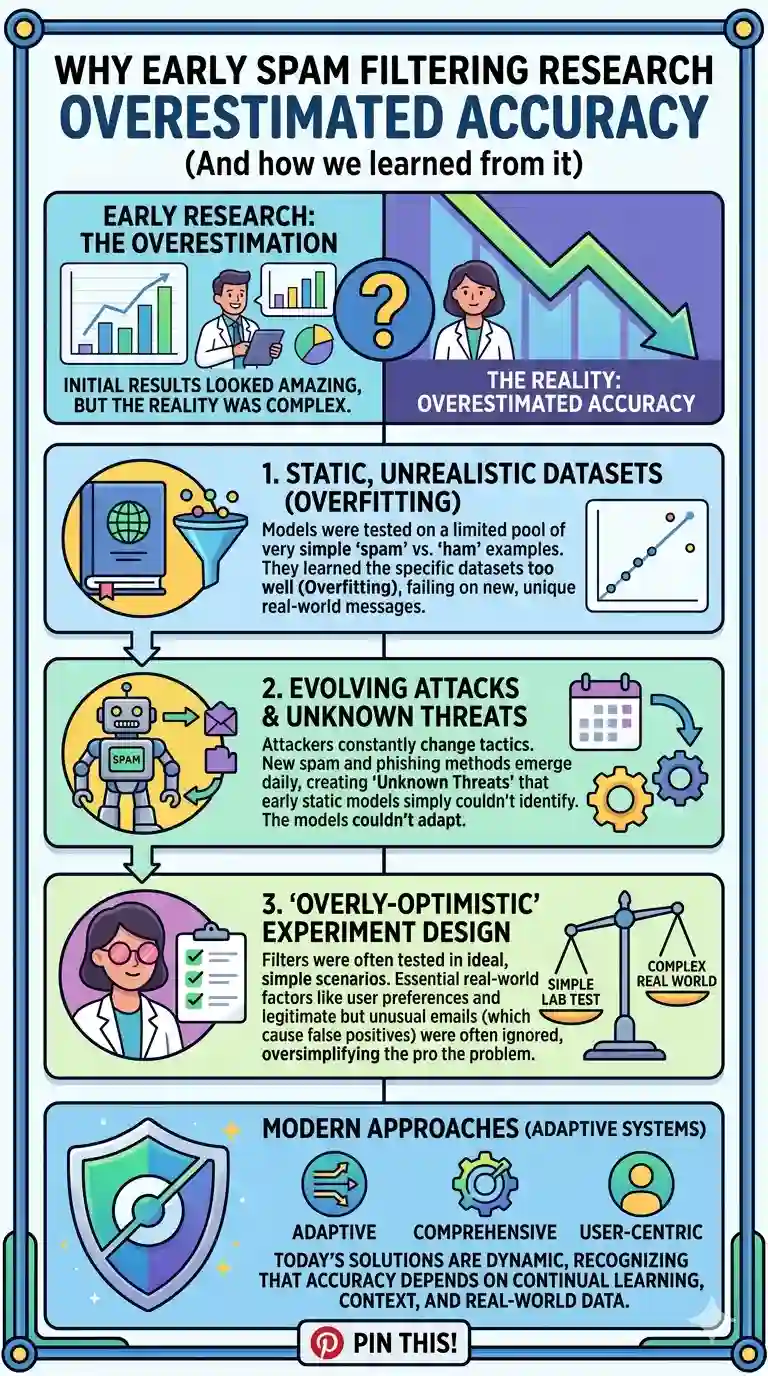
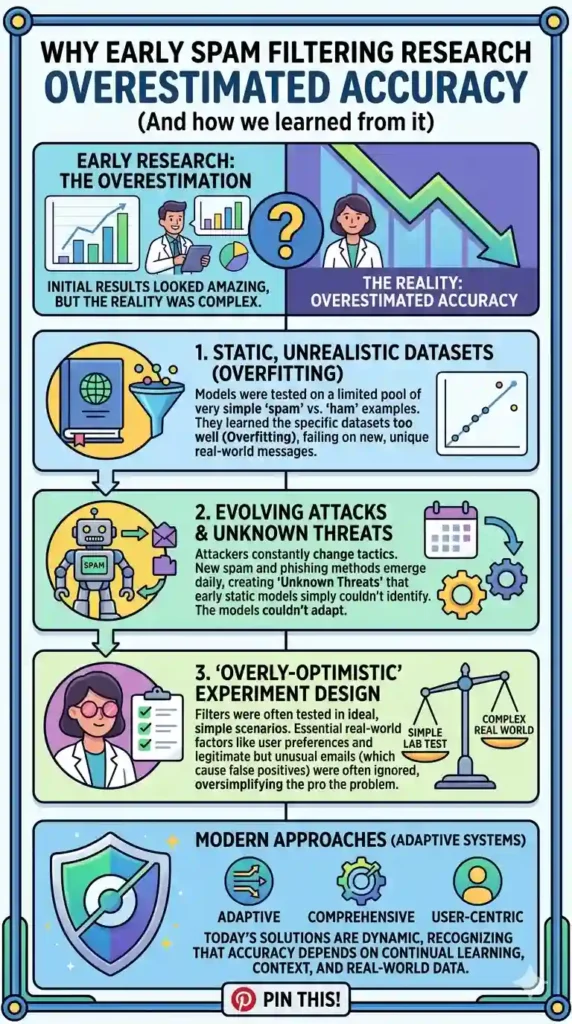
Imagine opening your inbox to find it perfectly sorted, with every single spam message banished forever! That was the thrilling promise of early intelligent spam filtering research. Decades ago, computer scientists introduced groundbreaking methods that seemed to solve the spam problem overnight. I remember first learning about these systems and thinking, wow, we finally beat the spammers!
But the reality of human communication is much messier than a neat laboratory experiment. While foundational papers showed astonishing accuracy rates, those numbers didn’t translate perfectly to our real-world inboxes. Today, we are going to dive deep into why early intelligent spam filtering research overestimated accuracy! We will explore the fascinating gap between early machine learning theory and the chaotic, brilliant way humans actually talk.
1. Fast Summary of the Original Paper
Early research in intelligent message filtering introduced something truly exciting: probabilistic models! Scientists used techniques like Naive Bayes and keyword-based classification to automatically sort messages. They trained these models on carefully labeled datasets, teaching the computer which words meant “spam” and which meant “good email.”
The results were absolutely spectacular on paper! Researchers reported sky-high accuracy, proving that machines could technically filter our mail. It felt like a monumental victory for computer science.
However, while these early models were groundbreaking, their assumptions about language, behavior, and data no longer hold in modern communication environments!
2. Why Early Spam Filtering Models Looked More Effective Than They Really Were
So, why did the early numbers look so incredibly perfect? It all comes down to the environment! Early success was partly due to highly simplified, controlled experimental conditions. Researchers used neat, perfectly formatted datasets that simply do not exist in the wild.
Real-world data is wonderfully messy! Early models assumed spam patterns would remain static, but spammers are highly creative. Furthermore, early tests used a limited vocabulary complexity, completely missing the evolving slang we use every single day.
3. The Core Limitation: Pattern Recognition ≠ Understanding
Here is a wild truth: Naive Bayes detects probability, but it has zero understanding of actual meaning! These systems rely entirely on statistical correlations, not semantic understanding. Keyword filters simply scan for words and completely ignore the context.
Without context, communication falls apart. Think about why we take things personally; it usually happens when we misinterpret someone’s tone! Machines make the exact same mistake. They see a “risky” word and panic, completely failing to understand the joke or nuance you intended.
4. The Obfuscation Problem: Why Simple Models Break
Spammers are clever, and they quickly figured out how to trick early filters! They started using text obfuscation. By changing “free” to “fr33” or “click” to “cl1ck,” they easily bypassed simple keyword checks.
This leads to so much frustration for users, perfectly illustrating why we get angry so fast at our technology! When an obvious image-based spam message slips into your inbox because the text was hidden, it shows exactly why Naive Bayes struggles with altered text patterns.
5. The Short-Text Problem: Why SMS Filtering Is Harder Than Email
Email is one thing, but text messages are an entirely different beast! SMS messages are incredibly short, lack deep context, and are packed with abbreviations. This inherent ambiguity drastically increases misclassification rates!
When we text, we constantly edit ourselves. This is exactly why we reread messages before sending or even figure out why we delete messages before sending. We know our words can be misunderstood by humans, so imagine how easily a simple algorithm misinterprets a three-word text!
6. False Positives: The Cost Ignored in Early Research
Blocking legitimate messages is the hidden nightmare of spam filtering! Early research often celebrated catching spam but glossed over the painful business and personal consequences of false positives.
Missing an important message creates profound anxiety! It is a huge reason why we check our phones without notifications. We worry the system hid something vital from us! Alternatively, if a friend’s message goes to spam, they might think we are ghosting them, highlighting why we ignore messages inadvertently. Reducing these false positives remains a major, unsolved operational constraint today.
7. Dataset Bias: Why High Accuracy Numbers Are Misleading
The datasets used to train early models simply did not match real-world data! They were often imbalanced and entirely lacked sophisticated adversarial samples.
When a system is trained on biased data, it makes bad assumptions. We tend to blindly believe the systems built by major tech companies, which explains why we trust familiar brands to filter our mail perfectly. But when the underlying training data is flawed, the high accuracy numbers reported in early research become incredibly misleading.
8. Adversarial Evolution: Spam Is Not Static
Spam filtering is an intense adversarial problem, not a static classification task! Spammers adapt much faster than static models can update. Today, AI-generated spam is increasing at an astonishing rate, creating a constant arms race.
Sometimes, security teams are so overwhelmed by this evolving threat that they delay updating legacy systems. It perfectly mirrors why we procrastinate even when we know it’s important! The sheer effort required to fight modern, adversarial spam makes early probabilistic models look wonderfully naive.
9. Behavioral Blind Spot: Human Factors Ignored
Early models entirely ignored user perception and cognitive biases! They treated filtering as a pure math problem, forgetting that humans are highly emotional creatures.
We worry constantly about our digital communications, explaining why we overthink and why we replay conversations in our head. Early filters didn’t account for how deeply a missed or spoofed email affects user trust. A bad phishing attack can leave a lasting emotional impact, much like why we forget names but remember insults!
10. From Naive Bayes to Deep Learning — Progress With New Problems
Thankfully, we have moved from Naive Bayes to powerful Neural Networks and Transformers! These modern systems offer vastly higher accuracy. The constant ping of successfully sorted mail is part of why notifications feel addictive!
BUT, deep learning still struggles with context! Even advanced AI is still vulnerable to clever adversarial attacks. The anxiety of digital communication persists—just think about why blue ticks trigger anxiety. Even with the best AI, the human element of messaging remains incredibly fragile.
11. What Effective Message Filtering Actually Requires Today
To build a truly spectacular filter today, we need much more than keyword lists!
First, we need deeply context-aware models that understand the flow of conversation. Just as we obsess over real-time communication cues—like why we check the typing indicator repeatedly—AI must analyze timing and behavior.
Second, behavioral and linguistic analysis is essential. The system should learn your unique style, so you never have to wonder why we overexplain ourselves to a rigid algorithm!
Third, we need continuous learning systems paired with human oversight. A hybrid system prevents the heartbreaking scenario where an urgent text is blocked, leaving someone to wonder why we feel anxious when someone leaves us on read.
12. Balanced Conclusion
The bigger insight here is thrilling: filtering is not just a technical problem! It is a linguistic, psychological, and highly adversarial challenge that requires a deep understanding of human communication patterns.
Early intelligent filtering systems were incredibly foundational! We owe them a massive debt of gratitude. However, they drastically simplified language, completely underestimated adversarial behavior, and significantly overestimated their real-world accuracy.
Modern systems are infinitely more powerful, but the core challenge remains. Machines still struggle to truly understand the beautiful, chaotic way humans connect. We constantly project our emotions onto our devices, sometimes feeling like we self-sabotage our digital habits or assuming a silent inbox means someone is mad at us. For more incredible insights on how our minds interact with the digital world, be sure to visit https://mindbehaviorguide.com/! Embracing both the math and the psychology is the only way forward!