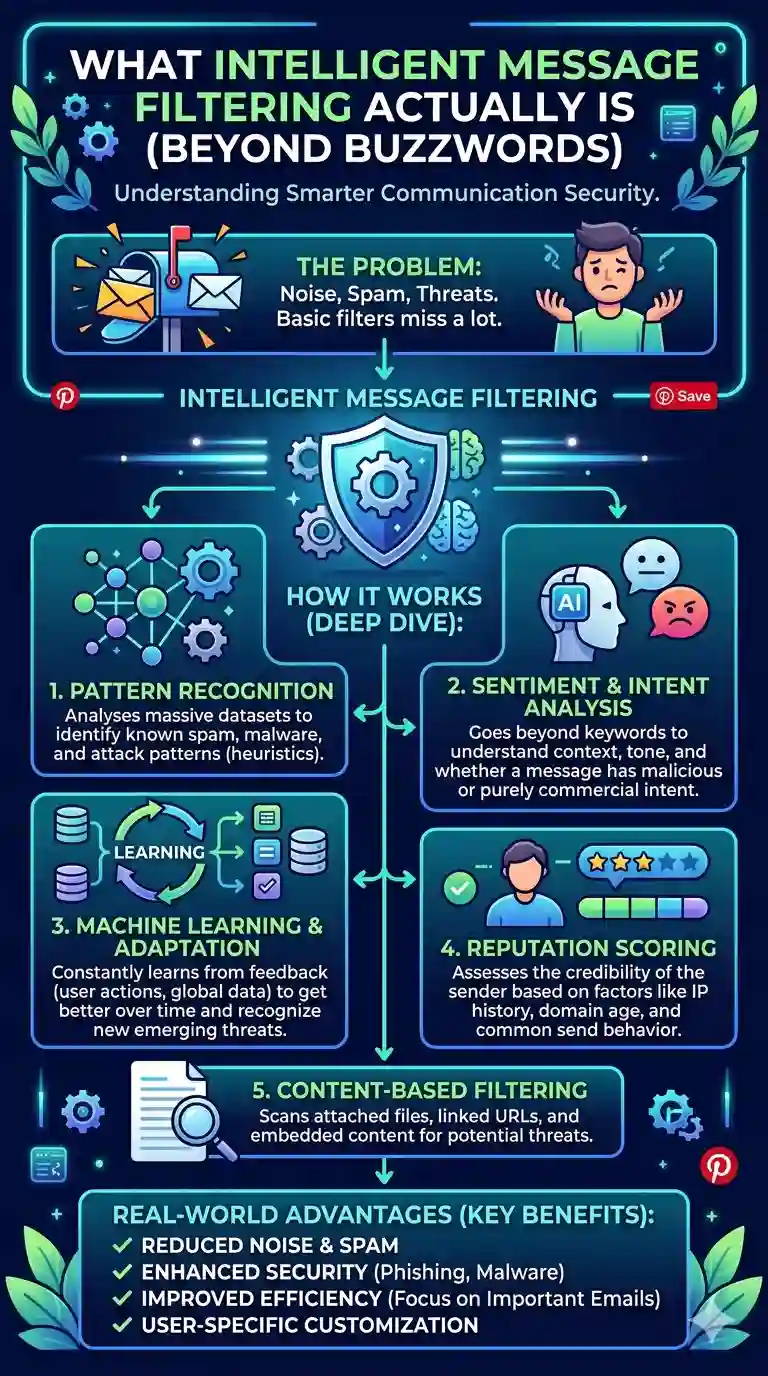
Let’s get right into it! When tech companies talk about “intelligent message filtering,” they make it sound like there is a tiny, super-smart human sitting inside your computer reading your emails. But what is actually happening is a lot less magical and a lot more mathematical!

At its core, intelligent filtering is just a classification system. It looks at an incoming message and forces it into one of two boxes: spam or ham (a funny name for good emails!). To do this, these systems use specific algorithms like Naive Bayes, decision trees, and fascinating neural networks.
Instead of reading your email like you or I would, the machine looks for patterns. It counts how many times certain words appear, checks where the email came from, and looks at the structure. It is pure pattern recognition, not true understanding! The system relies completely on statistical probabilities, meaning it has absolutely no idea what your email actually means or what the sender intends.
The Illusion of “Intelligence” in Message Filtering
Here is a wild thought: these filters do not understand human context at all! They only detect patterns, completely missing the wonderful nuance of how we actually talk to each other.
Think about it! Have you ever sent a sarcastic email to a coworker, or used cultural slang with a friend? We do this all the time. But AI models take things extremely literally. A filter might see a joke and flag it as a severe threat! This lack of nuance is exactly why we take things personally when communication breaks down—even machines struggle with tone!
When legitimate emails get flagged as spam because of a misunderstood phrase, it shatters the illusion of intelligence. The filter is simply guessing based on past data, and when it guesses wrong, it creates a very frustrating experience for you!
Adversarial Reality: Why Filters Constantly Fall Behind
You might be wondering, if these systems are constantly learning, why do I still get so much spam? The answer is simple and a little bit scary: the bad guys are learning, too!
We live in an adversarial reality. Attackers constantly invent new ways to bypass filters using clever text obfuscation. They might hide words inside images, use strange symbols, or alter spelling just enough to confuse the machine but keep it readable for you.
On top of that, AI-generated spam is increasing rapidly! Scammers are using deep learning to write phishing emails that sound incredibly human. This game of cat and mouse is incredibly stressful, and it is a huge reason why we overthink our digital security. Even the most advanced deep learning models struggle to keep up with these entirely novel, unseen attack patterns!
False Positives: The Hidden Cost of “Accuracy”
Let me share a quick story! Last year, I nearly missed out on a fantastic freelance contract because the client’s email went straight to my junk folder. I was furious! This is what we call a “false positive,” and it is the hidden, painful cost of relying on automated accuracy.
When developers tune these filters, they face a tough trade-off between sensitivity and precision. If the filter is too aggressive, important emails get lost or delayed, causing huge business and personal headaches. This uncertainty is exactly why we check our phones without notifications! We constantly wonder if we missed something important that the machine mistakenly hid from us.
Over-Reliance on Automation: A Behavioral Risk
Here is where things get truly fascinating! When we rely too much on automated filters, our own behavior changes. We start trusting the system blindly, assuming that if an email made it to our main inbox, it must be safe.
This is a massive behavioral risk! Our critical thinking drops, and we miss glaringly obvious phishing signals because we assume the AI already did the hard work. We naturally lean toward convenience, which explains why we trust familiar brands and the systems they build for us.
But this over-reliance can backfire. If an important message is delayed by a filter, we might assume the sender is ignoring us, leading us to wonder why we ignore messages in the first place! The automation actually disrupts our natural communication flow.
Data Bias and Personalization Limits
Did you know that these AI models inherit the biases of their creators? Because filters are trained on massive datasets, they pick up on human flaws. If a dataset lacks diversity, the filter might mistakenly classify emails written in certain cultural dialects or languages as spam.
Personalization is also surprisingly limited. The filter tries to learn what you like, but it is clumsy. When a filter keeps blocking a newsletter you actually want to read, it is incredibly annoying! This friction is a great example of why we get angry so fast at our devices. We expect them to know us perfectly, but they really don’t!
The Complexity Gap: Why Real Communication Is Hard to Filter
Human communication is wonderfully ambiguous! We layer our sentences with emotion, complex intent, and rich context. But machine learning models have to simplify all of that down to ones and zeros. When they simplify, they lose the true meaning!
Think about how much anxiety texting causes us. We worry about tone, which is why we reread messages before sending, or why we delete messages before sending. We even stress out over why blue ticks trigger anxiety and why we check the typing indicator repeatedly!
If humans struggle this much with digital communication, how can we expect a simple algorithm to get it right? This complexity gap explains why we think someone is mad at us or why we replay conversations in our head. Communication is hard, and no filter can completely solve that! Sometimes, these digital misunderstandings can even make us feel like we self-sabotage our relationships, or overthink why we feel anxious when someone leaves us on read.
What Effective Intelligent Filtering Should Actually Include
So, how do we fix this? A truly effective intelligent filtering system needs to go beyond basic word counting!
First, we need context-aware NLP (Natural Language Processing) models that can actually grasp the flow of a conversation. Second, we absolutely need human-in-the-loop feedback systems! The machine must learn from your specific corrections.
Third, adaptive learning is crucial. Filters must dynamically update in real-time to catch new threats. Finally, we need complete transparency! The system should tell you exactly why a message was flagged. If we don’t have transparency, we feel a loss of control, much like why we screenshot conversations to keep our own records! When systems are transparent, it reduces the need for us to constantly explain ourselves or wonder why we overexplain ourselves.
The Future: Smarter Filters or Smarter Attackers?
Are we heading toward a future with perfect inboxes? Probably not! The truth is a very balanced view: as AI improves spam detection, it also gives scammers the exact same tools to improve spam generation!
Real-world trends show that AI-generated spam is increasing in both volume and breathtaking sophistication. It is a digital arms race! Sometimes, dealing with this endless flood of digital noise feels overwhelming, helping to explain why notifications feel addictive but also exhausting. We might even delay cleaning our inboxes, perfectly illustrating why we procrastinate even when we know it’s important.
Practical Takeaways for Users
You do not have to be at the mercy of your email provider! Here are some super helpful, practical tips to take back control of your inbox:
- Don’t rely fully on filters: Your human brain is still the best spam detector in the world!
- Check your spam folders regularly: Make it a weekly habit. You might find a hidden gem or an important missed connection in there!
- Be hyper-aware of phishing tactics: If an email creates a sudden sense of urgency or asks for passwords, pause and double-check the sender.
- Understand the limitations of automation: Accept that these systems are just helpful assistants, not infallible guards.
Intelligent message filters are not truly “intelligent”—they are evolving statistical systems operating in a constantly shifting adversarial environment. If you want a deeper dive into the fascinating world of human behavior and technology, be sure to check out https://mindbehaviorguide.com/ for more amazing insights!