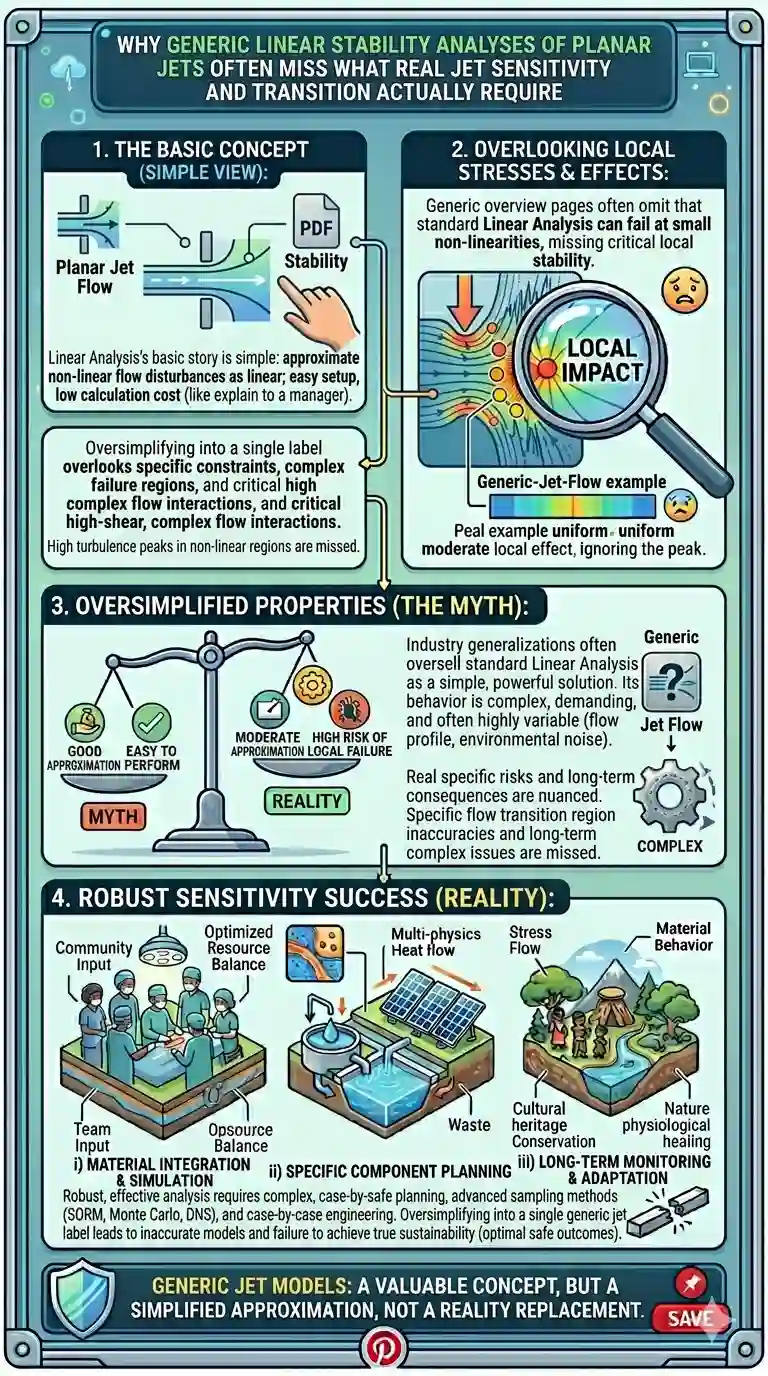
When fluid dynamicists analyze the stability of a planar jet, they often rely on well-established mathematical frameworks. If you read standard literature on the topic, you will likely find elegant, straightforward summaries of how disturbances grow near the nozzle. Analysts and engineers love these methods because they offer clean mathematical solutions and fast computational turnaround times.
But does a localized mathematical equation truly capture how a physical jet transitions to turbulence in the real world?
Often, generic research frames planar jet sensitivity entirely around local linear growth rates. However, real-world fluid dynamics is an incredibly complex science. It requires a deep understanding of spatial evolution, profile relaxation, and nonlinear saturation. Let us critically examine the oversimplified framing of planar jet instability and explore what effective fluid engineering actually requires!
1. Fast Summary of the Original Article
A prominent 2016 paper on the sensitivity of planar jets provides a classic example of this approach. The authors observe that planar jets are much more sensitive to physical disturbances near the orifice than further downstream. To explain this, they utilize a linear stability analysis based on the Orr-Sommerfeld equation, solved via a compound matrix method.
The researchers apply this localized math to analytical models, like the Bickley profile, and computationally derived velocity profiles. They conclude that higher local spatial growth rates near the orifice perfectly explain the heightened sensitivity. They also note that nozzle wall thickness and near-orifice profile shapes deeply influence stability, focusing primarily on varicose modes.
While local linear growth rates provide wonderful insight into initial disturbance amplification, the broader picture of jet sensitivity is far more nuanced. Receptivity and transition to turbulence require deeper exploration of global modes, nonlinear effects, and real-flow complexities.
2. Why the Term “Local Spatial Growth Rate” Is Often Misleading
The term “local spatial growth rate” inherently frames the analysis around an isolated slice of the flow. This localized perspective emphasizes near-orifice instability but heavily downplays streamwise evolution.
Generic conclusions lead readers to mistakenly believe that a higher local growth rate alone fully explains orifice sensitivity. It completely ignores receptivity—the actual physical process of how external noise enters the flow field! Relying blindly on standard, built-in solver packages created by large transnational corporations often hides these spatial evolution errors.
Choosing a simple, local calculation just because it solves quickly mirrors why we self-sabotage our own engineering success for immediate comfort. These overview papers rarely address when local analysis drastically overpredicts or underpredicts real disturbance amplification in a physical laboratory.
3. The Limits of Purely Local Linear Stability Framing
We must critique the foundational math behind purely local frameworks. Relying on “frozen” velocity profiles completely overlooks non-parallel flow effects. As a jet moves downstream, it spreads and changes shape.
When you apply a localized, parallel assumption to a rapidly spreading jet, the Orr-Sommerfeld equation limitations become glaringly obvious. Furthermore, this method stops at the linear regime. It cannot predict the nonlinear saturation or the secondary instabilities that actually trigger turbulence downstream.
A short-term computational win does not equal an accurate prediction of transition. Analysts frequently put off learning the complex math required for spatial evolution, proving exactly why we procrastinate even when we know its important.
4. The Role of Global & Receptivity Literacy in Jet Flow Understanding
Here is a critical element completely missing from local analyses: engineers need a deep understanding of global modes and receptivity theory. Simply calculating a local peak is not enough.
Analysts must actively model how acoustic and ambient disturbances enter the shear layer. Taking proper care of an accurate transition model requires active, relentless engagement. This dynamic process directly reflects the effort required in caretaking vs caregiving.
When a physical experiment completely contradicts a linear model, that failure acts as a harsh signal. Understanding these gaps is like understanding the true roots of our reactions, exploring our primary vs secondary emotions. The surface data might point to one mode, but the underlying global dynamic tells a different story. When these contradictions surface, researchers often obsess over the mismatch, illustrating why we replay conversations in our head trying to debug the wind tunnel setup.
5. Structural & Flow Factors That Affect Outcomes
What happens when we apply these idealized profiles to real-world nozzles? Local overviews typically downplay the physical hardware.
Wall thickness and lip effects drastically alter the initial shear layer, but they also dictate downstream vortex pairing and merging. Reynolds number dependence and three-dimensional effects tear planar jet assumptions apart. Ignoring these real-world uncertainties is a classic case of scientific denial, mirroring repression vs suppression in psychology.
When theoretical analysts ignore the realities of the laboratory environment, a massive communication gap forms. This disconnect perfectly illustrates what kills long distance relationships between numerical researchers and experimental engineers.
6. Behavioral Patterns That Predict Real Transition Success
To achieve true predictive success, fluid dynamics teams must build evidence-based behavioral patterns that go far beyond reading a basic local stability plot.
Predictors of reliable analysis include receptivity coefficient estimation and using Parabolized Stability Equations (PSE) to march the solution downstream. Analysts must look past the surface-level output, applying a mindset similar to third date psychology to truly get to know the flow’s nonlinear evolution.
When a major DNS (Direct Numerical Simulation) run crashes after weeks of computing, the resulting stress is intense, resembling a heavy panic attack hangover. If a peer points out a flaw in the Orr-Sommerfeld setup, team members must remain objective. When researchers get defensive, it shows exactly why we take things personally.
We must break free from rigid, legacy modeling mindsets that shut down global validation, a process similar to healing from narcissistic mother traits in a toxic academic environment.
7. What Effective Jet Instability Analysis Actually Looks Like
Let us contrast the generic local linear framing with robust, effective probabilistic approaches. Effective assessment requires a multi-fidelity mindset.
- Integrated Validation: This means aligning local OS equations with PSE and targeted DNS subsets. Engineers should use methodical testing, akin to a between subjects design in psychology, to compare different transition routes.
- Education over passive reliance: Teams must deeply understand non-parallelism and nonlinear wave interactions.
- Targeted functional goals: Focus on predicting the actual transition location and noise generation, rather than just finding a mathematical maximum.
- Analyst empowerment: We should encourage engineers to grow into their professional competence, mirroring the stages of Erik Eriksons psychosocial development theory. However, we must also teach them when an approximation is adequate to move forward, because unchecked perfectionism is secretly holding you back from publishing vital data.
8. The Pitfall of Equating Local Growth With Overall Sensitivity
Near-orifice growth rates are not the same thing as the overall flow sensitivity. When a research team equates a local peak with the full transition mechanism, analyses easily enter mindless computational loops.
Running fast, local profile comparisons without experimental validation reinforces a dangerous linear-focus. Why do we do this? Often, analysts push for quick plots because they naturally crave validation from others—specifically the principal investigators wanting fast results.
Some engineers become so obsessed with extracting the perfect varicose mode that it turns from a valid goal into an unproductive fixation, blurring the lines of autistic special interests vs ADHD hyperfixations. Emphasize reflective, globally aware stability analysis over isolated local computation.
9. Analyst-Centered Questions Readers Should Ask
Before you accept a local linear stability conclusion for your next jet design project, ask yourself these highly actionable questions:
- What experimental evidence supports the claim that local growth directly translates to real receptivity?
- Are there measurable validation goals against Parabolized Stability Equations or DNS?
- How are non-parallel flow effects mathematically evaluated?
- What sensitivity analyses am I actively performing on the nozzle geometry and acoustic forcing?
- Does the modeling plan adapt to Reynolds number shifts or 3D complexities?
Asking these tough questions elevates our professional integrity, aligning with the highest levels of Kohlbergs stages of moral development theory. By doing the hard validation upfront, we completely remove the stressful need to apologize even when its not our fault when real-world fluid systems fail to act like our clean equations.
10. Balanced Conclusion
Local linear stability analysis undeniably serves a vital role in initial fluid mechanics research. It is absolutely essential for explaining basic orifice effects via profile shape and guiding preliminary jet studies. It saves incredible amounts of computational time.
However, we must argue for better, more realistic framing in our academic overviews. Planar jet sensitivity is not just higher local growth near the orifice. True instability analysis requires active, relentless engagement with receptivity theory, spatial evolution, and nonlinear saturation. By moving beyond generic, localized summaries, engineers can design flow systems that survive not just the linear math, but the rigorous, highly chaotic demands of the real physical world.