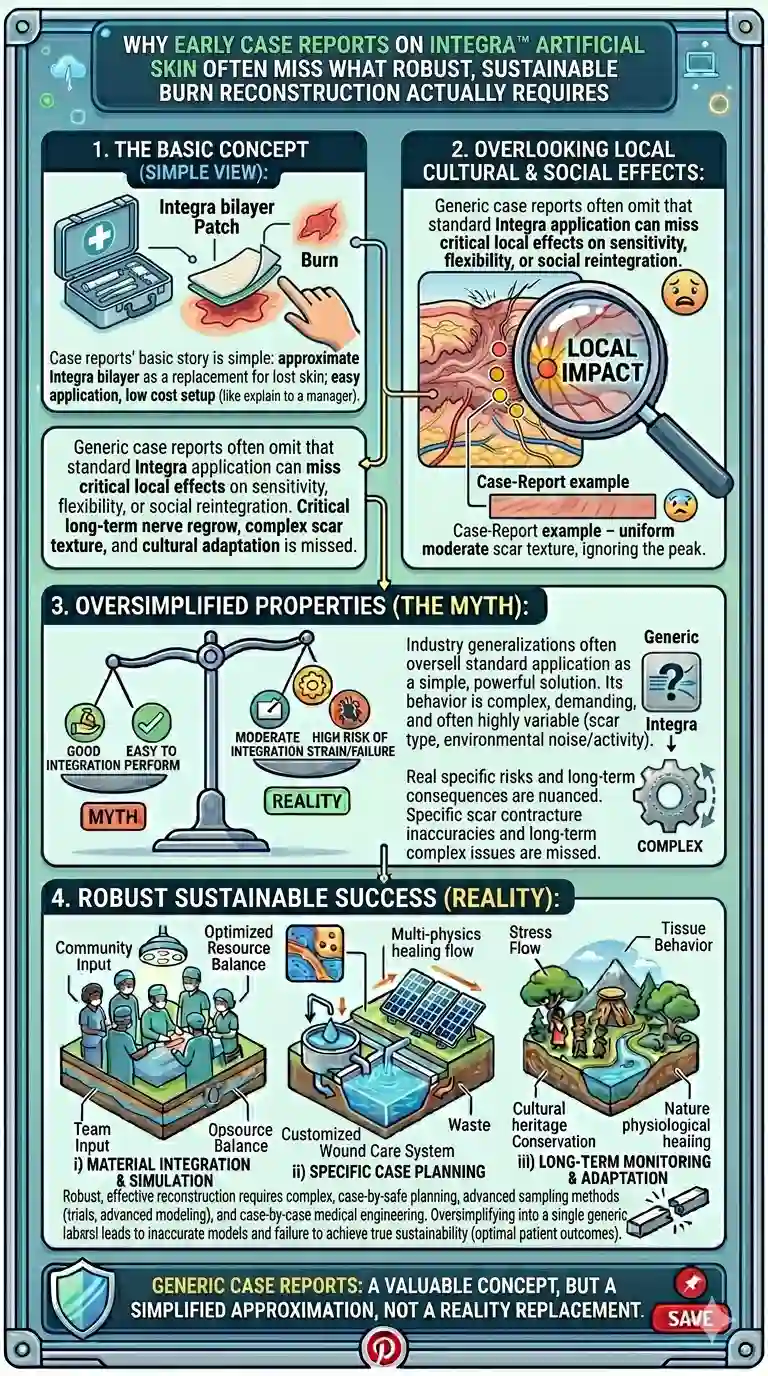
When treating severe burns, securing immediate and durable coverage can save a life. For decades, burn surgeons and wound care specialists have searched for the perfect dermal substitute. When Integra™ artificial skin first arrived on the scene, it felt like a miraculous breakthrough. Early case reports painted a highly optimistic picture, suggesting that this bilaminate template could solve the complex puzzle of massive burn reconstruction.
But does a successful initial application guarantee a functional, lifelong result?
Often, early medical literature treats new dermal templates as straightforward solutions. However, robust burn reconstruction is an incredibly complex biological and mechanical process. It requires a deep understanding of complication rates, long-term scar maturation, and rigorous patient management. Let us critically examine the oversimplified framing of early Integra case reports and explore what sustainable, effective burn reconstruction actually demands.
1. Fast Summary of the Original Article
If you look back at early literature, such as the 2001 paper by Fitton et al., you find a typical initial-experience report. The paper details the use of Integra™—a bilaminate artificial skin made of a collagen-glycosaminoglycan dermis and a silicone epidermis—in three acute burn cases for immediate full-thickness reconstruction.
The authors highlight the incredible potential for superior final function and cosmesis, especially in massive burns where donor sites are severely limited. They honestly note a high dermal graft loss rate and slow epidermal engraftment. However, they ultimately conclude that the outcomes justify continued use, assuming success will grow alongside surgical experience.
While Integra™ represented a promising advancement in the early 2000s, the broader picture of reliable burn reconstruction is far more nuanced. It requires much deeper exploration of complication rates, integration biology, and long-term realities.
2. Why Early “Promising with Experience” Framing Is Often Misleading
Early case series are exciting, but their framing can be dangerously ambiguous. Small reports (like an n=3 study) emphasize potential benefits while heavily downplaying the severe variability in take rates, hidden infection risks, and the eventual donor-site demands for epidermal autografting.
Generic enthusiasm leads readers to think the product is reliably superior. It completely bypasses the grueling learning curves and strict patient selection required. To truly understand a medical intervention, we need rigorous comparative trials, akin to a between-subjects design in psychology, to measure actual efficacy against standard grafts.
Furthermore, the heavy marketing influence of transnational corporations producing these templates can overshadow the reality of long-term contractures, pigmentation mismatches, and durability issues that only appear years later.
3. The Limits of Two-Stage Procedure & Initial Integration Framing
We must critique the foundational design of the two-stage procedure. Relying on a bilayer design with a temporary silicone pseudo-epidermis looks great on day one, but it hides massive risks.
There are high rates of partial or full dermal loss due to silent infections, mechanical shear, and hidden hematomas. Furthermore, the prolonged time to epidermal autograft readiness often takes two to four weeks—or more! This agonizing wait can induce intense anxiety in patients and clinicians alike, resembling the heavy emotional toll of panic attack hangovers.
A short-term coverage win absolutely does not equal consistent long-term scar quality. Patients might avoid looking at the slow-healing wound, showing exactly why we procrastinate even when we know it’s important to engage in daily care.
4. The Role of Wound Bed & Patient Literacy in Successful Regeneration
A critical element missing in early reports is the immense role of the wound bed. Surgeons need a masterful understanding of debridement quality, bacterial load, nutritional status, and shear prevention. It is never just about slapping a product onto a wound.
Patient literacy matters just as much. Patients must transition from passive recipients of treatment to active participants in their healing, highlighting the critical difference between caretaking vs caregiving. If patients only crave validation from others regarding their immediate cosmetic appearance, they will neglect the grueling physical therapy required for true functional recovery.
5. Structural & Systemic Factors That Affect Outcomes
What happens after the patient leaves the sterile operating room? Early papers often downplay severe structural complications.
Infection and biofilm risks skyrocket in staged procedures. We also cannot ignore the donor-site morbidity caused by harvesting the incredibly thin autografts needed for the second stage. Ignoring these long-term issues is a classic case of medical denial, mirroring repression vs suppression in psychology.
When the surgical team fails to communicate these long-term realities to the rehabilitation team, a massive disconnect forms. This gap in care perfectly illustrates what kills long-distance relationships between different hospital departments. Over time, dealing with unpredictable graft failures leaves burn teams feeling burnt out, helping explain why emotional numbness happens in high-stress trauma units.
6. Behavioral Patterns That Predict Long-Term Success
To achieve true reconstructive success, clinical teams must build evidence-based behavioral patterns that go far beyond reading a basic product brochure.
Predictors of better outcomes include optimized wound bed preparation, aggressive antimicrobial protocols, and precise timing of epidermal grafts. Surgeons must look past the initial “take,” applying a cautious, evaluative mindset similar to third date psychology to truly understand how the neodermis is maturing.
When a graft fails, surgeons must remain objective. If clinicians get defensive, it shows exactly why we take things personally. Instead of fixating solely on the artificial skin—blurring the lines of autistic special interests vs ADHD hyperfixations—teams must focus holistically on patient compliance with immobilization and aggressive scar management.
7. What Effective Use of Dermal Templates Actually Looks Like
Let us contrast early-enthusiasm framing with robust, effective surgical approaches. Effective use requires a deeply multidisciplinary mindset.
- Integrated multidisciplinary care: Combine precise excision and template placement with advanced dressings, targeted nutrition, and intensive physical therapy.
- Education over passive reliance: Teams must deeply understand vascularization timelines. We must break free from rigid, legacy protocols that shut down innovation, similar to healing from narcissistic mother traits in a toxic medical hierarchy.
- Targeted functional goals: Focus on minimizing contracture and maximizing range of motion. We should encourage residents to grow into their professional competence, mirroring the stages of Erik Erikson’s psychosocial development theory.
- Surgeon empowerment: Teach surgeons when a wound is “ready” for the second stage, because unchecked perfectionism is secretly holding you back from completing the reconstruction efficiently.
8. The Pitfall of Equating Early Experience With Long-Term Justification
Small-case success and “growing experience” are not the same thing as long-term validation. When a department equates early promise with widespread adoption, they easily enter mindless clinical loops, applying the product routinely without rigorously tracking long-term failures.
We easily confuse the quick thrill of a clean post-op dressing change with the actual value of a functional limb. This highlights the stark difference between our surface primary vs secondary emotions. When a highly anticipated case fails, surgeons often obsess over the error, illustrating why we replay conversations in our head trying to figure out what went wrong in the OR. By ignoring the failure modes present in larger cohorts, we completely self-sabotage our own clinical outcomes.
9. Clinician-Centered Questions Readers Should Ask
Before you commit to a bilayer dermal substitute for a massive burn, ask yourself these highly actionable questions:
- What comparative evidence supports the take rates in this specific burn depth and anatomical location?
- Are there measurable, long-term functional and cosmetic goals established with the therapy team?
- How are integration failures, such as shear or silent infection, actively mitigated?
- What adjunct protocols (like negative pressure wound therapy) am I using to ensure success?
- Does the surgical plan adapt dynamically to patient comorbidities?
Asking these tough questions elevates our professional medical integrity, aligning with the highest levels of Kohlberg’s stages of moral development theory. By planning meticulously, we completely remove the stressful need to apologize even when it’s not our fault when complex burn biology throws us a curveball.
10. Balanced Conclusion
Integra™ and similar bilaminate artificial skins undeniably advanced the field of burn reconstruction in the early 2000s. They provide life-saving coverage in donor-limited scenarios and enable beautiful outcomes in highly selected, meticulously managed cases.
However, we must argue for better, more realistic framing in our medical literature. Dermal regeneration is not just a matter of “promising coverage with experience.” It requires active, relentless engagement with biological integration, complication mitigation, and sustained functional rehabilitation. By moving beyond early optimism, burn teams can deliver reconstructions that survive not just the hospital stay, but the rigorous demands of a patient’s entire life.
Bonus Section A: Why Early Take Rates Don’t Equal Quality in Burn Reconstruction
A high initial take rate simply means the template has adhered to the wound bed. It does not account for the complex biology of neodermis maturation. True quality is defined months and years later by the pliability of the scar, the absence of severe contractures, and the long-term durability of the reconstructed skin against daily friction.
Bonus Section B: Integrative Models That Outperform Early Integra Frameworks
Modern burn care has evolved drastically since 2001. Clinicians now use integrative models that significantly outperform early frameworks. Applying Negative Pressure Wound Therapy (NPWT) over the dermal template dramatically reduces shear and hematoma risks. Additionally, single-stage bioengineered alternatives and the use of cultured epithelial autografts (CEA) have refined how we approach massive total body surface area (TBSA) burns.
Bonus Section C: FAQ
Is Integra always superior for massive burns?
No. While it offers excellent reconstructive potential, its success is highly dependent on rigorous wound bed preparation and patient selection.
How do you measure real long-term success in dermal templates?
Long-term success is measured through functional range of motion, scar pliability (using scales like the Vancouver Scar Scale), patient-reported quality of life, and the absence of restrictive contractures.
When should Integra use adapt to complications?
If a wound bed shows signs of heavy colonization or if the patient cannot tolerate prolonged immobilization, alternative rapid-coverage strategies like meshed split-thickness autografts or allografts should be prioritized.
What’s the difference between early promise and validated outcomes?
Early promise relies on small sample sizes and immediate post-operative appearance. Validated outcomes rely on large, multi-center trials measuring functionality and scar maturation years after the initial injury.