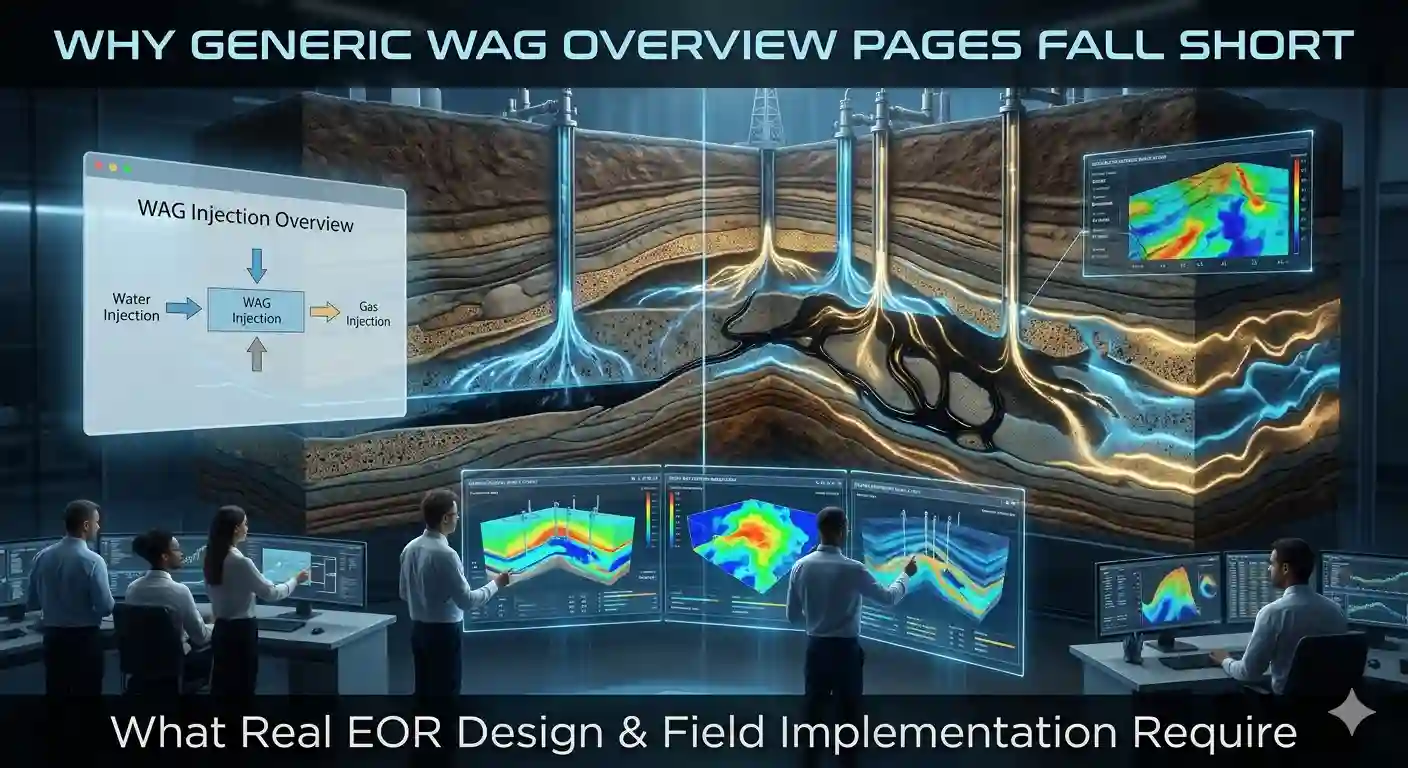
When researching Enhanced Oil Recovery (EOR) techniques, most professionals encounter standard summaries of Water-Alternating-Gas (WAG) injection. These basic overviews paint a highly optimistic picture. They usually highlight how combining water and gas injection improves sweep efficiency, controls mobility, and ultimately recovers more oil than either method alone.
While these fundamental concepts hold true in a laboratory setting, applying them to a massive underground reservoir is a different story entirely. A generic overview rarely prepares a reservoir engineer for the harsh realities of field implementation. The gap between a perfect coreflood test and a profitable field operation is massive.
The purpose of this article is to critically examine this simplified narrative. We will look past textbook definitions to explore the real-world challenges of WAG injection. By understanding the limitations of idealized mobility control, gravity segregation, and economic trade-offs, engineers can design more robust, realistic, and successful EOR projects.
What Generic Overview Pages Usually Promote
Most educational resources describe WAG as a straightforward EOR technique. The process involves alternating cycles of water and gas injection to sweep oil toward producing wells.
The standard narrative claims that WAG combines the best of both worlds. Water provides better mobility control, while gas offers excellent microscopic displacement by swelling the oil or mixing with it. Overview pages often state that this alternating process significantly reduces gas fingering and gravity override. They present it as a universally applicable solution for both sandstone and carbonate reservoirs.
However, accepting this generalized view is a common cognitive trap similar to misunderstanding underlying behaviors. While WAG does offer theoretical benefits, real-field performance is far more nuanced.
Why “Improved Sweep Efficiency” Is Often Misleading
Emphasizing “improved sweep efficiency” focuses heavily on idealized lab results. It routinely downplays the severe physical limitations encountered in thick, complex reservoirs.
Generic descriptions may lead engineers to believe that WAG is always superior to continuous waterflood without addressing the reality of field pilots. Many field applications show only marginal incremental recovery (often just 5–15% of original oil in place) while requiring massive capital investment. Much like how standardized definitions fail to capture complex impacts, broad EOR summaries gloss over operational nightmares like frequent switching, pipe corrosion, and severe injectivity loss.
The Limits of Idealized Mobility Control Framing
At a foundational level, we need a thorough WAG injection critique mobility control. Relying on simplified relative permeability curves and perfect 1:1 WAG ratios overlooks severe subsurface dynamics.
In the real world, gas is incredibly light and water is heavy. This density difference leads to gravity override WAG limitations, where gas quickly rises to the top of the reservoir, bypassing the oil entirely. At the same time, water slumps to the bottom. Instead of a uniform sweeping front, you get early gas breakthrough.
Furthermore, viscous fingering vs gravity segregation WAG dynamics dictate that lab-scale benefits frequently fail to scale. High-permeability streaks amplify channeling, causing expensive gas to cycle uselessly through the reservoir. To avoid falling into a trap of superficial understanding, we must model these physical realities accurately.
The Role of Hysteresis, Gravity, and Heterogeneity Literacy
A critical element missing in most overviews is the complexity of three-phase fluid flow. Engineers need a deep understanding of hysteresis—the process where fluid trapping depends on the direction of flow.
Hysteresis modelling WAG challenges are notoriously difficult. As water displaces gas, and gas displaces water, gas becomes trapped in the rock pores. While trapped gas can divert water into unswept oil zones, it also drastically reduces the well’s ability to inject further fluids. Just as surface-level analysis misses persistent underlying issues, ignoring hysteresis leads to wildly optimistic simulation forecasts.
Additionally, heterogeneity sensitivity WAG performance is a major factor. Natural fractures and varying rock types act as highways for injected fluids, ruining sweep efficiency. Engineers must incorporate robust history matching and uncertainty quantification rather than simply tuning a basic WAG ratio.
Structural and Operational Factors That Affect Outcomes
Overview pages often ignore the operational headaches that make or break a project’s profitability. True WAG success extends far beyond sweep efficiency; it requires operational sustainability.
- Injectivity Loss: Alternating fluids often causes asphaltene or wax precipitation, plugging the reservoir rock near the wellbore.
- Corrosion and Scaling: Mixing water and CO2 creates highly corrosive carbonic acid, requiring expensive metallurgy for surface facilities.
- Pressure Maintenance: Maintaining reservoir pressure in low-permeability zones during gas cycles is incredibly challenging.
The ultimate economic trade-off is balancing higher oil recovery against increased capital expenditures (CAPEX), operating expenses (OPEX), and facility downtime. Overlooking these factors is a form of professional self-sabotage. Long-term WAG project economics depend entirely on anticipating and managing these physical realities.
Behavioral Patterns for Simulation and Field Success
Evidence-based predictors of better WAG outcomes go beyond basic implementation. Success requires rigorous engineering habits and continuous surveillance.
Engineers must use sector and full-field compositional simulation that includes hysteresis and gravity effects. They must tackle WAG ratio optimization issues based on specific reservoir thickness and dip, not generic rules of thumb.
Real-time surveillance using 4D seismic, chemical tracers, and production logging tools (PLT) allows teams to maintain conformance control. Recognizing early warning signs, such as a rapid increase in the gas-oil ratio (GOR), prevents costly failures. Developing these rigorous analytical habits is crucial, much like overcoming the habit of overthinking to take decisive, data-driven action.
What Effective WAG Implementation Actually Looks Like
Contrast the idealized overview framing with robust, field-tested approaches. Effective implementation requires an integrated workflow.
- Integrated Simulation: Combine compositional models with hysteresis, gravity calculations, and real-time monitoring.
- Mechanism Education: Teams must deeply understand gravity segregation and hysteresis trapping, moving beyond mere reliance on simple ratios.
- Functional Goals: Success is measured by maximized Net Present Value (NPV) and minimized fluid handling costs, not just theoretical microscopic displacement.
- Engineer Empowerment: Equip teams with the optimization skills needed to adapt dynamically to field responses. Just as human development requires progressing through complex stages of understanding, a WAG project must mature through rigorous phases of evaluation.
The Pitfall of Equating Lab Results With Field Performance
One of the greatest dangers in EOR planning is assuming that coreflood results directly translate to the field. Generic descriptions fail to emphasize the massive drop-off between theoretical capability and actual incremental recovery.
Many WAG projects deliver far less oil than predicted because simulators fail to model the true extent of reservoir heterogeneity. Routine application of standard WAG ratios without reservoir-specific tuning reinforces theoretical optimism rather than validated field competence. We must critically evaluate incremental recovery vs continuous injection baselines using actual field data, avoiding the trap of seeking validation from idealized models.
Engineer-Centered Questions to Ask About WAG Projects
To ensure a project is built on reality rather than textbook theory, evaluate your design with these high-value questions:
- What actual evidence supports the three-phase relative permeability WAG modeling in our simulation?
- Do we have measurable pilot or surveillance data demonstrating true sweep improvement?
- How are natural fractures, injectivity decline, and facility constraints accounted for?
- What economic sensitivity analysis (oil price, gas availability) has been performed?
- Does the WAG design specifically adapt to this reservoir’s thickness, structural dip, and unique geological features?
Addressing these questions helps teams avoid the perfectionism that secretly holds projects back, moving toward pragmatic, profitable engineering.
Bonus: Why Lab WAG Results Often Fail to Translate to Field Scale
The gap between the lab and the field comes down to scale and geology. A one-foot core sample in a laboratory is perfectly homogenous. It does not contain the faults, fractures, and varying rock layers found in a massive reservoir.
In the lab, fluids are forced linearly from one end of the rock to the other. In the field, fluids move radially away from a wellbore into a massive 3D space. Gravity has miles of vertical room to pull water down and push gas up. These full-field gravity and heterogeneity effects completely alter fluid mobility, explaining why initial expectations often fail to match long-term realities.
Bonus: Integrative Approaches That Outperform Standard WAG
When standard WAG falls short, engineers can turn to integrative EOR strategies.
- Foam-Assisted WAG (FAWAG): Injecting surfactants creates foam that thickens the gas, significantly reducing mobility and preventing gas from bypassing the oil.
- Tapered WAG: Gradually reducing the amount of gas injected in later cycles helps manage early gas breakthrough while maintaining reservoir pressure.
- Smart Water WAG: Altering the salinity of the injected water can change the rock’s wettability, further enhancing microscopic displacement.
These specialized approaches are highly effective when tailored to specific reservoir challenges, much like differentiating specialized interventions from general approaches.
FAQ Block
Is WAG always better than continuous gas injection?
Not necessarily. In highly heterogeneous reservoirs with severe gravity override, WAG can sometimes perform worse or equal to continuous gas injection while adding massive operational complexity and OPEX costs.
Why do many WAG projects underperform lab predictions?
Most projects underperform due to unmodeled reservoir heterogeneity, severe injectivity loss from trapped gas (hysteresis), and early gas breakthrough through high-permeability thief zones.
When should WAG upgrade to foam-assisted or tapered schemes?
If real-time surveillance shows rapid gas breakthrough and poor vertical sweep efficiency despite ratio optimization, upgrading to foam-assisted WAG can drastically improve mobility control.
What’s the real difference between theoretical sweep and actual incremental recovery?
Theoretical sweep assumes uniform fluid movement through homogeneous rock. Actual incremental recovery accounts for the oil realistically produced at the surface after factoring in geological complexity, facility downtime, and economic limits.
Conclusion: Balancing Appreciation With Critical Insight
Water-Alternating-Gas injection remains one of the most widely applied and potentially lucrative EOR methods available to the industry. When properly designed, it can deliver meaningful incremental recovery and extend the life of mature fields.
However, achieving these results requires moving past simplistic overview narratives. Effective WAG is not just about alternating fluids to improve sweep efficiency. It demands active engagement with gravity segregation, hysteresis modeling, heterogeneity management, and surveillance-driven optimization. By embracing these complexities rather than avoiding the difficult realities of the data, engineers can design EOR projects that deliver actual economic value, not just theoretical success.
Further insights into complex system behaviors and evaluating reality versus perception can be explored through topics like caretaking vs caregiving definitions, understanding moral development in decision-making, the reality of psychological hangovers, why we overanalyze outcomes, interpretation bias in data, the psychology of over-apologizing for project failures, debunking simple tips for complex scenarios, navigating emotional triggers in high-stress engineering, understanding emotional numbness during project fatigue, and recognizing systemic blind spots.