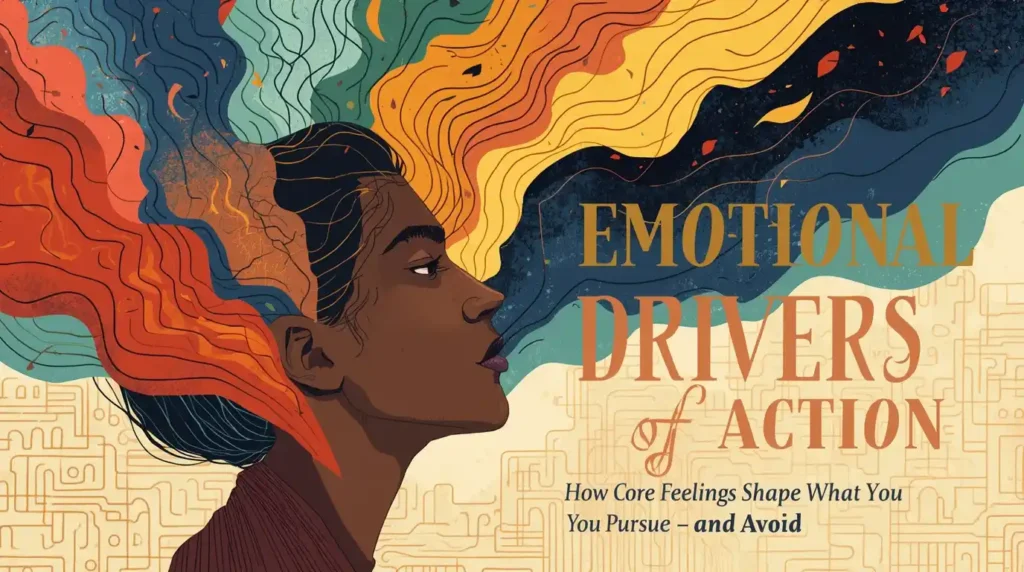
“Emotional Drivers of Action: How Core Feelings Shape What You Pursue — and Avoid”
Introduction: Motivation Is Emotional, Not Logical
We often assume that motivation is a matter of logic — if we understand our goals and have a plan, we should act. But in reality, the engine of motivation isn’t thought — it’s emotion. You don’t act because something makes sense. You act because something feels urgent, exciting, relieving, or meaningful. All human behavior is emotionally charged, even when we’re unaware of it. That’s why motivational breakdowns are often misdiagnosed as laziness or lack of willpower, when in truth, they are rooted in unmet emotional needs. To unlock consistent motivation, we must understand and work with our emotional triggers — not against them.
Why Emotion Is the First Mover in Behavior
Neuroscience confirms that the emotional brain (limbic system) responds faster than the logical brain (prefrontal cortex). This means your feelings are in the driver’s seat before your rational mind even enters the conversation. You might rationalize a choice later, but the real decision was made based on how something made you feel. This is why discomfort, fear, uncertainty, or shame can shut down motivation, even when the task itself is important. And why feelings like curiosity, hope, or pride can energize you into action, even when you’re tired. Simply put, emotion drives behavior — logic just explains it after the fact.
The 6 Core Emotional Drivers of Motivation
Most of your consistent behaviors are connected to a few emotional “drivers” — internal states that you unconsciously seek or avoid. These are not random feelings; they’re psychological forces that shape what you do.
- Desire for Significance: You want to feel important, valuable, and recognized. This drives ambition, leadership, and creation — but can also create burnout or people-pleasing if you’re chasing external validation.
- Desire for Connection: You’re motivated by love, support, or belonging. This driver fuels loyalty and collaboration, but when imbalanced, can lead to dependency or fear of judgment.
- Desire for Safety: You seek stability, certainty, or emotional protection. This often triggers avoidance, risk aversion, or procrastination — especially in high-stakes situations.
- Desire for Freedom: You want autonomy, space, and self-direction. This fuels creativity and rebellion against constraint, but can sabotage progress if it leads to avoiding structure or accountability.
- Desire for Growth: You’re energized by progress, expansion, and learning. This is one of the healthiest intrinsic drivers — though unchecked, it can morph into perfectionism or fear of slowing down.
- Desire for Relief: You’re trying to escape stress, shame, pressure, or overwhelm. This often leads to numbing behaviors — like scrolling, bingeing, or quitting — because temporary avoidance offers emotional comfort.
Which Emotional Driver Is Controlling You?
Each day, your behavior is being steered — not just by goals or habits — but by whatever emotional need feels strongest in that moment. If you’re unaware of which driver is active, you may misinterpret your lack of motivation as a flaw, instead of seeing it as a signal. Ask yourself: What am I really craving right now? What emotion am I trying to create — or avoid? Once you name the emotion, you can meet the need consciously instead of reacting automatically. For example, if you’re avoiding a task because you fear failure, the real need might be for safety or reassurance — not more discipline.
How to Align Emotional Drivers With Healthy Motivation
You don’t need to eliminate emotional drivers — you need to align them with your behavior in a conscious, healthy way. First, identify your top 1–2 recurring drivers. Are you often seeking relief from stress? Validation? Autonomy? Then, look for ways to meet that emotional need before or during the behavior you want to reinforce. For instance, if your driver is “significance,” anchor your writing or leadership habit in the feeling of creating value — not just the task itself. If your driver is “connection,” schedule calls or co-working sessions to link progress with people. The more emotionally meaningful the task becomes, the more naturally your motivation flows.
Emotional Clarity = Motivational Clarity
The more precisely you can name your emotions, the more clearly you’ll understand your motivation — or lack of it. For example, saying “I’m not lazy — I’m overwhelmed” gives you access to a solution. Or “I’m not distracted — I’m emotionally depleted” helps you realize rest is the next right step. Emotional honesty isn’t weakness; it’s a strength. It puts you back in the driver’s seat. Because once you know what you’re feeling, you can choose how to meet that need — with awareness, not avoidance. This is how motivation becomes reliable, even on hard days.
FAQs About Emotion-Driven Motivation
Q: What if I don’t know what I’m feeling — I just feel blocked?
Start with naming something vague: “I feel off.” Then ask, “What do I hope this task will make me feel?” or “What am I avoiding feeling right now?” That usually reveals the deeper emotional layer.
Q: Can emotions really be a strength in performance and decision-making?
Yes — when they’re understood. Suppressed emotion leads to sabotage. Acknowledged emotion can be channeled into creative energy, intuition, and purposeful action.
Q: What if I feel emotional all the time — will that make me inconsistent?
Not if you learn emotional regulation. The goal isn’t to avoid emotions, but to partner with them. With awareness and practice, your emotions can sharpen your decisions and fuel your follow-through.
Final Thoughts: Feel First, Then Move Forward
If you want motivation that lasts, you must stop treating your emotions as obstacles. They are signals — not enemies. You don’t need to suppress your emotional state to get things done. You need to understand it, regulate it, and design systems that work with it. When your actions are emotionally aligned, motivation becomes natural. When your goals reflect what you truly value and feel, you stop needing force.
Because now, your motivation has roots — not just reach.