When the weight of emotional pain becomes unbearable, the question almost inevitably arises: “Are antidepressants right for me?” This question often comes not from a place of idle curiosity, but from a point of exhaustion. You might feel overwhelmed, perpetually anxious, or emotionally numb, and the promise of a pill that could lift the fog feels like a lifeline. In this state of mind, the search for relief can easily replace the quest for understanding.
This article offers a different perspective. It is not for or against medication, nor is it medical advice. Instead, it aims to reframe the question itself. We will explore what antidepressants do from a psychological standpoint, when they might quiet essential signals from your nervous system, and what deeper questions to ask yourself before—or alongside—considering this path.
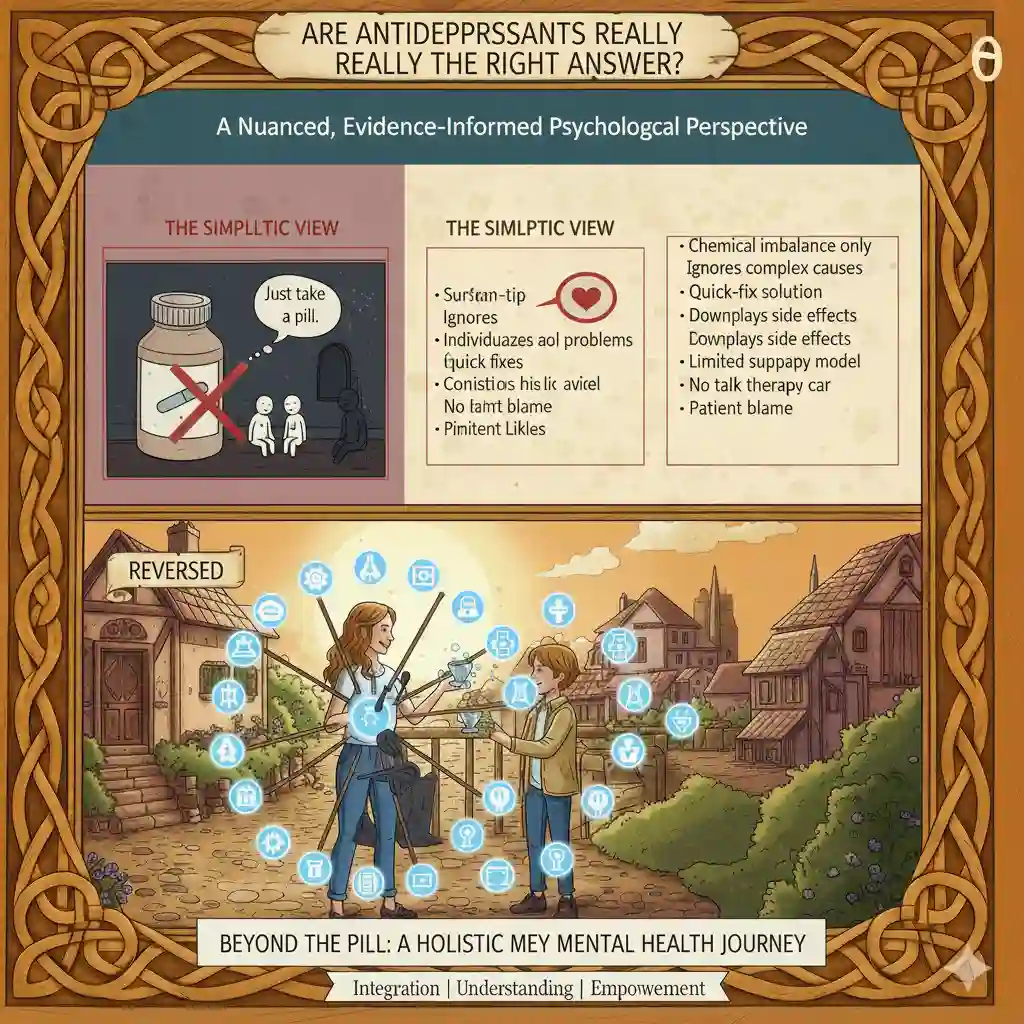
1. Why “Are Antidepressants Right for Me?” Is the Wrong First Question
When you are emotionally depleted, it is natural to focus on symptoms. You want the racing thoughts to stop, the sadness to lift, or the sense of dread to dissipate. Asking if a medication is “right” for you becomes a search for a tool to fix these symptoms. But this symptom-first approach often misses the crucial context of your life.
Your emotional state is not a random malfunction; it is a response. It is your nervous system communicating information about your environment, your relationships, your work, and your internal patterns. By jumping directly to a solution, we risk silencing the messenger before we have understood the message. Many people fall into this trap because they have already tried to understand their feelings through simplistic frameworks. For instance, you may have found that why standard stress vs anxiety articles fall short is because they don’t explain why the feeling persists even when the “stressor” is gone. The real first question is not about a solution, but about the signal: What is this persistent feeling trying to tell me?
2. What Antidepressants Actually Do — And What They Don’t
In the simplest terms, antidepressants work by modulating neurotransmitters like serotonin or norepinephrine in the brain. The goal is to regulate mood and reduce the intensity of depressive or anxious symptoms. For many, this can be a life-changing intervention that provides the stability needed to engage in therapy and make life changes.
However, it is vital to understand the distinction between neurochemical modulation and emotional resolution. Antidepressants can turn down the volume on your pain, but they do not resolve the reason the pain exists. Your mood may lift, but the underlying patterns—people-pleasing, avoidance, or perfectionism—often remain.
This is why some people on antidepressants report feeling “less pain” but also “less feeling” in general. The medication can sometimes blunt the sharp edges of all emotions, both negative and positive. This experience of feeling muted or disconnected is a common reason people wonder why they feel emotionally numb, as the medication addresses the chemical symptom without necessarily healing the emotional cause.
3. When Antidepressants Help — And When They Quiet Signals
A balanced perspective acknowledges that antidepressants can be an essential tool. In cases of severe depression or anxiety, where a person is unable to function, medication can provide the foundational stability needed to prevent further harm and begin the work of recovery. It can be the life raft that gets you to shore.
However, in other situations, emotional distress is a signal that something in your life is not working. It could be a signal of burnout from a demanding job, an unresolved threat from a toxic relationship, or the strain of living out of alignment with your own values. In these cases, numbing the symptom with medication before understanding its source can be like taking a painkiller for a broken leg without setting the bone. It might delay a deeper, more necessary repair. Investigating the root cause, such as understanding the science of emotional burnout, is a critical step that should not be bypassed.
4. High-Functioning Anxiety, Productivity, and the “Invisible Struggle”
A significant number of people who consider antidepressants are high-functioning. They excel at their jobs, manage busy households, and appear successful to the outside world. Internally, however, they are powered by a relentless engine of anxiety. Their performance is a way of masking a deep-seated fear of failure or letting people down.
For these individuals, an antidepressant might be prescribed to “take the edge off.” The medication may successfully reduce the feeling of being constantly on high alert, but it often does not change the underlying pressure to perform. The invisible struggle continues, just with a slightly lower emotional volume. The core issue—a nervous system conditioned to equate productivity with safety—remains untouched. This is a common reason why high-functioning anxiety feels invisible; the problem is not a lack of function, but a dysregulated system driving that function.
5. ADHD, Misdiagnosis, and the Antidepressant Trap
Another layer of complexity arises with conditions like ADHD. The daily struggle with executive functions—planning, organization, emotional regulation—can create a constant state of anxiety and feelings of failure that look very much like depression. As a result, antidepressants are often prescribed as the first line of treatment.
This can lead to the common experience of feeling like the medication “helped a bit, but something’s still off.” The antidepressant may slightly lift the secondary mood symptoms, but it does not address the core executive function challenges. Because of this significant overlap, it is important to understand that there are ADHD diagnostic caveats to consider. A nuanced approach to what is often labeled executive dysfunction is crucial before deciding on a course of treatment.
6. Why Emotional Pain Isn’t Always a Chemical Imbalance
The narrative that depression is simply a “chemical imbalance” or “low serotonin” is an outdated and oversimplified model. While brain chemistry is certainly part of the picture, our emotional state is profoundly shaped by our experiences. Chronic stress, unresolved loss, social rejection, and trauma all create physiological changes in the brain and body.
Neuroscience shows that emotional pain is processed in the same brain regions as physical pain. This is why emotional pain hurts more than physical pain for many people—it carries a social and psychological weight. The sting of being excluded or abandoned is not just a feeling; it is a biological threat signal. This helps explain why rejection feels physical. Framing this pain solely as a chemical issue dismisses the very real impact of life experiences on our well-being.
7. What to Explore Before (or Alongside) Antidepressants
If you are considering antidepressants, it is empowering to also explore other avenues of healing. These are not necessarily alternatives, but foundational pillars that support long-term mental health, whether you take medication or not.
- Nervous System Regulation: Learn practices like deep breathing or grounding techniques to help your body move out of a chronic fight-or-flight state.
- Cognitive Load Reduction: Examine where your mental energy is going. Are you overcommitted? Are you doom-scrolling? Reducing the input can lower the output of anxiety.
- Emotional Processing vs. Suppression: Often, we are taught to bottle up our feelings. Understanding the psychology of emotional suppression and learning to process emotions safely can be transformative.
- Environmental Stressors: Take an honest inventory of your life. Is your job, your relationship, or your living situation contributing to your distress?
- Identity and People-Pleasing: Persistent anxiety can be a sign of living out of alignment with your true self. Exploring patterns of emotional dysregulation can reveal where you are abandoning yourself to please others.
8. A Better Question to Ask Yourself
Instead of starting with the question, “Do I need antidepressants?” perhaps a more empowering place to begin is with gentle, curious self-inquiry. The goal is not to find a quick answer, but to deepen your understanding of your own internal world.
Consider asking yourself:
- What is my nervous system responding to?
- What pain is this feeling trying to protect me from?
- What in my life hasn’t been addressed yet?
These questions shift the focus from pathology to protection, from brokenness to communication. They open the door to a more holistic form of healing, one that may or may not include medication. Sometimes, the deepest need is not for a chemical solution, but for a sense of resolution and understanding—a concept explored in the psychology of closure.