You are standing in line at the grocery store. Or perhaps you are waiting for a friend to arrive at a cafe. Maybe you are just sitting on your couch during a commercial break. Without making a conscious decision, your hand reaches into your pocket, pulls out your phone, unlocks it, and your thumb hovers over a familiar icon. Before you even realize what has happened, you are scrolling. You didn’t decide to check Instagram or Twitter; it just happened.
This phenomenon—automatic, mindless engagement—is one of the defining behavioral patterns of the modern age. It is not a sign of weakness, laziness, or a lack of willpower. Rather, it is the result of sophisticated psychological engineering colliding with ancient biological hardwiring. Understanding why we open social media without thinking requires peeling back the layers of habit formation, neuroscience, and cognitive psychology to reveal the invisible forces that guide our thumbs.
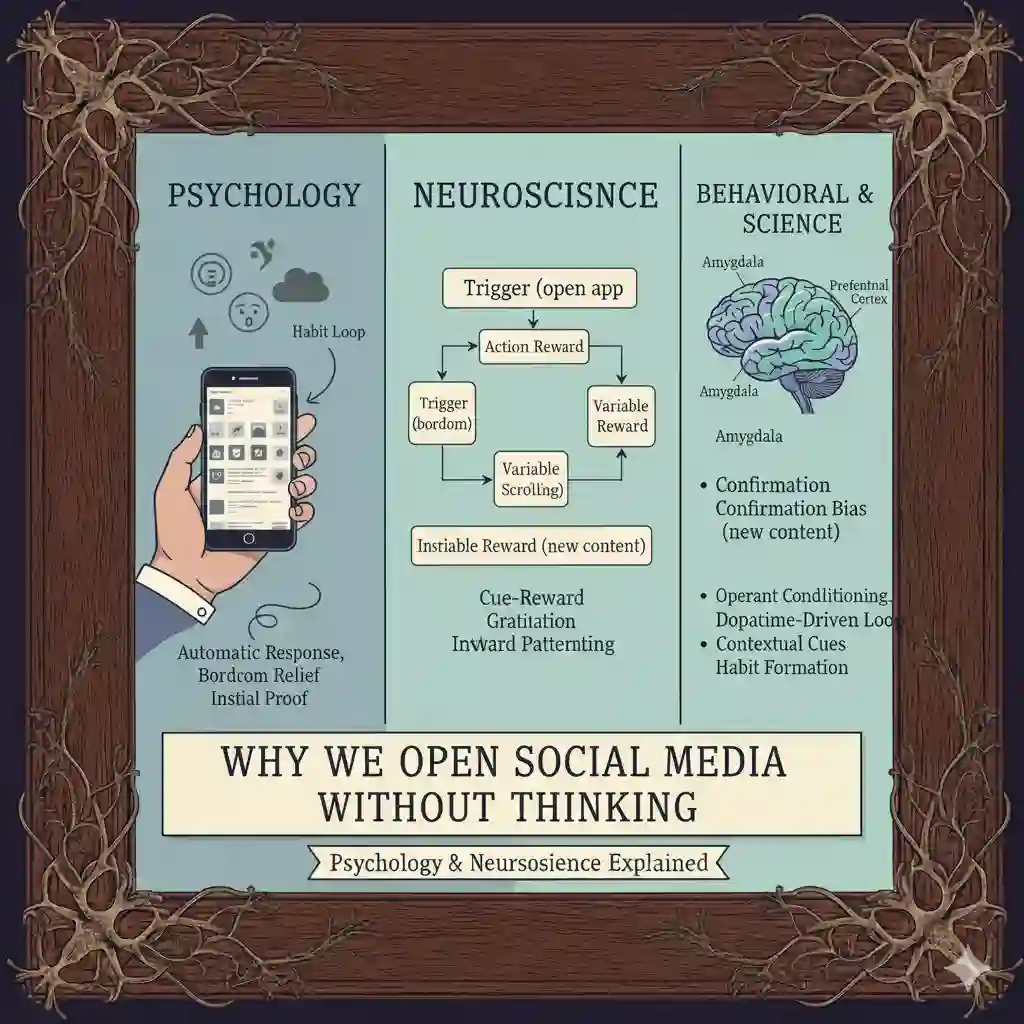
Fast Answer: Why We Open Social Media Without Thinking
We open social media automatically because our brains have forged powerful habit loops driven by dopamine reward systems and cognitive efficiency. Every time we check an app and find something interesting—a like, a funny video, a news update—our brain releases dopamine, reinforcing the behavior. Over time, the action shifts from the decision-making part of the brain (prefrontal cortex) to the habit-forming part (basal ganglia). This transition makes the behavior automatic, triggered by cues like boredom, stress, or a notification ping, bypassing conscious thought entirely.
Introduction: The Habitual Pull of Social Media
Most of us like to believe we are the architects of our own day, making rational choices about how we spend our time. However, behavioral science suggests that a significant portion of our daily activity is governed not by conscious choice, but by habit. A habit is a behavior that has been repeated enough times to become automatic.
Social media apps are designed to be the ultimate habit-forming technologies. They are ubiquitous, always accessible, and provide immediate feedback. They have become woven into the fabric of our daily lives, filling every micro-moment of downtime. The transition from “using social media” to “being used by social media” happens when the behavior becomes reflexive.
The central question is not why we enjoy social media, but why we engage with it without intent. Why does the phone end up in our hand before we’ve even formulated the thought, “I want to check my messages”? The answer lies in the intersection of brain chemistry and behavioral conditioning.
Brain Science Behind Automatic Social Media Use
To understand this automaticity, we must look at the neurology of reward. The human brain is wired to seek out information and social connection, and it is wired to repeat behaviors that result in a reward.
The Dopamine Loop
Dopamine is often misunderstood as the “pleasure chemical,” but it is more accurately the “desire chemical.” It drives seeking behavior. When you see a notification badge or refresh your feed to see new content, your brain anticipates a reward. If you find something engaging, dopamine is released. This release strengthens the neural pathway associated with the action (opening the app).
From Choice to Autopilot
Initially, checking social media is a goal-directed behavior managed by the prefrontal cortex—the area responsible for planning and decision-making. However, as you repeat the action thousands of times, the control shifts to the basal ganglia (specifically the striatum), an area deeply involved in habit formation and motor control.
Once a behavior is encoded in the basal ganglia, it requires much less cognitive energy to perform. The brain is an energy-conserving organ; it prefers habits because they are efficient. This is why you can unlock your phone and open an app while thinking about something completely different—your conscious mind isn’t driving the bus anymore; your habit system is.
The Morning Reflex
Consider the common habit of reaching for the phone first thing in the morning. For many, this happens before their eyes are fully focused. The cue (waking up) triggers the routine (grab phone) to get the reward (connection/information/dopamine). The brain has learned that this action reliably alleviates the mild stress of waking up and facing the day.
Psychological Mechanisms at Play
Beyond the basic neurology, specific psychological mechanisms make social media particularly prone to automaticity.
Variable Rewards: The Slot Machine Effect
If you opened your fridge and saw the exact same food every time, you wouldn’t open it out of curiosity. But if the contents magically changed every time you opened the door—sometimes a gourmet meal, sometimes nothing—you would open it constantly. This is the principle of variable rewards, pioneered by psychologist B.F. Skinner.
Social media feeds are infinite slot machines. You pull the lever (scroll down) and you don’t know what you’re going to get. A boring ad? A life update from a friend? A viral video? The unpredictability of the reward spikes dopamine levels higher than a predictable reward would. This uncertainty keeps the brain in a state of low-level craving, driving automatic checking.
FOMO and Social Comparison
The fear of missing out (FOMO) is a powerful driver of automatic behavior. It taps into our deep-seated evolutionary need to be aware of our social standing and environment. We check not just to see what is happening, but to ensure we haven’t been excluded. This links closely to why we crave validation from strangers, where the brain interprets likes and views as signals of social survival and acceptance.
Attention Hijacking
Our cognitive bandwidth is limited. Social media platforms are engineered to exploit “bottom-up” attention mechanisms—the kind of attention that is grabbed by bright colors, movement, and emotional triggers—rather than “top-down” attention, which is directed by our goals. The bright red notification badge is biologically hard to ignore; it mimics a warning signal in nature (like a ripe fruit or a poisonous animal), bypassing our logical filter and triggering an automatic orientation response.
Habit Loops and Behavioral Conditioning
The framework of the “Habit Loop,” popularized by Charles Duhigg, explains the mechanics of mindless scrolling perfectly. Every habit consists of three parts: a Cue, a Routine, and a Reward.
1. The Cue (The Trigger)
The cue is the signal that tells your brain to go into automatic mode. Cues fall into a few categories:
- External Cues: A buzz in your pocket, a lit-up screen, or seeing someone else on their phone.
- Internal Cues: Boredom, anxiety, loneliness, or a pause in conversation.
- Temporal/Spatial Cues: Waiting for the elevator, sitting on the toilet, or getting into bed.
Often, the internal cue is the most powerful. A momentary feeling of awkwardness in a silent room can trigger the phone reach to soothe the discomfort, a phenomenon related to the neuroscience of silence discomfort.
2. The Routine (The Action)
This is the behavior itself: pulling out the phone, unlocking it, and tapping the app icon. App designers work hard to make this routine as frictionless as possible. Features like FaceID, “stay logged in,” and infinite scroll remove any “stopping cues” that might prompt a conscious decision. The infinite scroll, in particular, removes the natural end point of reading (like turning a page), encouraging an endless loop of consumption.
3. The Reward (The Payoff)
The reward is what your brain gets out of the routine. It might be a laugh (entertainment), a feeling of connection (social validation), or just a distraction from a difficult thought (numbing). Crucially, the reward satisfies the craving created by the cue. If the cue was boredom, the reward is stimulation.
Social and Cultural Reinforcement
Our individual habits do not exist in a vacuum; they are reinforced by the world around us.
Social Proof and Norms
Humans look to others to determine appropriate behavior. If you look around a subway car, a waiting room, or a restaurant, and see everyone looking at their screens, your brain registers this as the “correct” behavior. This is social proof. Resisting the urge to check your phone requires fighting against the collective norm.
Validation Loops
The culture of social media creates a reciprocal obligation. If you post, you check for likes. If someone comments, you feel compelled to reply. If a friend sends a meme, you must acknowledge it. These social contracts create multiple “open loops” in our minds that drive us back to the platform repeatedly.
The Influence of Micro-Trends
The fast-paced nature of internet culture means that content becomes obsolete within hours. To stay culturally literate—to understand the memes and references your friends are using—you must check frequently. This creates a sense of urgency that fuels automaticity.
Cognitive Biases and Shortcuts
Several cognitive biases work in the background to justify and reinforce our automatic checking.
Availability Bias
The availability bias leads us to overestimate the importance of information that is readily available. Because social media is always at our fingertips, our brains trick us into thinking the information on it is urgent and vital, even when it is mostly trivial.
Habituation and Desensitization
With repeated exposure, we become habituated to the act of checking. We stop noticing we are doing it. Just as you don’t think about the mechanics of walking, you stop thinking about the mechanics of scrolling. The physical action becomes transparent to your conscious mind.
Loss Aversion
Psychologically, the pain of losing something is twice as powerful as the pleasure of gaining something. Loss aversion drives us to check because we are afraid of losing connection, losing status, or losing out on information. We check to prevent a perceived loss, rather than to gain a specific benefit. This fear often overrides logic, much like why emotional pain hurts more than physical pain, keeping us tethered to the source of potential alleviation.
Consequences of Automatic Social Media Use
While checking Instagram isn’t inherently harmful, doing so without thinking carries cognitive and emotional costs.
Fragmented Attention
Constant switching between the physical world and the digital world fragments our attention. This state of “continuous partial attention” makes it difficult to engage in deep work or sustained focus. Our brains take time to refocus after an interruption, meaning that frequent “quick checks” can sabotage productivity for hours.
Emotional Volatility and Anxiety
When we open social media automatically, we are surrendering control of our emotional input. We might see a disturbing news story, a post that triggers jealousy, or a mean comment, all within seconds of unlocking the phone. This unpredictable input can spike cortisol levels. Understanding how stress impacts emotional responses reveals that this constant low-grade stress reduces our resilience and patience in the real world.
Erosion of Solitude
By filling every spare moment with input, we lose the capacity for solitude. Solitude—being alone with one’s thoughts—is essential for processing emotions, self-reflection, and creativity. When we automatically plug every gap with scrolling, we deny our brains the downtime they need to consolidate memories and generate new ideas. We might even be trying to escape difficult feelings, leading to behaviors like why we laugh when we’re scared or nervous, using the screen as a deflection mechanism.
Strategies to Regain Conscious Control
The goal is not necessarily to delete social media, but to move from mindless usage to mindful usage. We want to break the automatic link between the cue and the routine.
1. Identify Your Triggers (Cues)
The first step is awareness. For one day, try to notice every time you reach for your phone. Ask yourself: “Why am I doing this right now?” Are you bored? Anxious? Procrastinating? Identifying the internal trigger is crucial. If you realize you check your phone every time you feel socially awkward, you can start to address the awkwardness directly rather than numbing it.
2. Create Friction (Disrupt the Routine)
Habits thrive on ease. To break a habit, add friction.
- Move the Icons: Move your social media apps off your home screen and into a folder on the last page. Even that extra second of searching gives your prefrontal cortex a chance to intervene.
- Log Out: Force yourself to log in every time you want to check.
- Greyscale Mode: Turn your phone screen to black and white. Without the vibrant colors stimulating your visual cortex, the “candy” aspect of the apps disappears, making them far less addictive.
3. Redesign Your Environment
If your phone is on your desk, you will check it. If it is in another room, you likely won’t. Create “phone-free zones” in your house (like the bedroom or dining table). Buy a physical alarm clock so your phone isn’t the first thing you touch in the morning.
4. Replace the Reward
If you are checking because you need a break from work (the cue is fatigue), find a different reward. Stretch, get a glass of water, or look out the window. If you are checking for connection, text a friend directly instead of scrolling a feed.
5. Practice “Urge Surfing”
When you feel the itch to check, don’t fight it, but don’t give in immediately. Wait 60 seconds. Observe the urge like a wave—it will rise, crest, and then fall. Often, the compulsion passes on its own if you just ride it out. This builds tolerance for the mild discomfort of boredom or silence.
Everyday Applications
Regaining control over automatic scrolling has profound benefits for our daily lives.
- Workplace Focus: By removing the automatic trigger of the phone, you allow yourself to enter “flow states”—periods of deep, immersive work that are highly satisfying and productive.
- Personal Relationships: Being fully present with friends and family without the subconscious itch to check your phone signals respect and deepens connection. It prevents the subtle rejection of “phubbing” (phone snubbing).
- Emotional Resilience: Learning to sit with boredom or anxiety without immediately soothing it with a screen builds emotional strength. It forces us to confront our internal states rather than escaping them. This is vital for processing complex emotions, like why heartbreak feels unbearable, which requires time and space to heal, not distraction.
Deep Behavioral Insight
We open social media without thinking because our brains are wired to seek rewards and social information efficiently. It is a biological imperative hijacked by modern design. However, awareness disrupts the autopilot. By recognizing the habit loops and cognitive biases at play, we can insert a pause between the urge and the action. This pause allows us to reclaim control over our attention, ensuring that technology serves us, rather than the other way around.
Frequently Asked Questions (FAQs)
Why do I instinctively reach for my phone?
This is a conditioned reflex driven by the basal ganglia. Your brain has learned that the phone provides a quick, reliable dopamine hit that alleviates boredom or stress. The movement has become a motor habit, independent of conscious thought.
How do notifications hijack my attention?
Notifications use “bottom-up” attention capture. The sudden sound or visual flash triggers an orienting response in the brain, which is an evolutionary mechanism designed to alert us to potential threats or opportunities in the environment.
Can social media use ever be fully mindful?
Yes. Mindful use means checking with a specific purpose (e.g., “I am going to post this photo” or “I am going to message Sarah”) and then closing the app. It involves setting an intention before unlocking the screen.
How does habit formation affect social media addiction?
Addiction often starts as a habit. As the habit loop (cue-routine-reward) becomes stronger, the craving for the reward intensifies. Eventually, the behavior continues even despite negative consequences, which is the hallmark of addiction.
What strategies reduce mindless scrolling?
Turning off non-human notifications, setting app time limits, using greyscale mode, and keeping the phone physically out of reach are effective friction-building strategies.
How does social comparison influence automatic checking behavior?
The drive to assess our social standing is primal. We check automatically to see how we stack up against peers—who is doing what, who is successful, who is included. This taps into deep evolutionary fears of exclusion or lower status, sometimes leading to judgments based on superficial traits, like why we instantly judge people by shoes.
Internal Links for Further Reading
- Why We Crave Validation from Strangers
- Why We Instantly Judge People by Shoes
- Why We Laugh When We’re Scared or Nervous
- Why We Forget Names But Remember Insults
- The Neuroscience of Silence Discomfort
- How Stress Impacts Emotional Responses
- Why Heartbreak Feels Unbearable
- Why Emotional Pain Hurts More Than Physical Pain