Table of Contents
- Introduction: Leadership Starts with the Self
- Step 1: What Emotional Maturity Really Means
- Step 2: The Neuroscience of Reaction vs. Response
- Step 3: Understanding Emotional Triggers and Pain Loops
- Step 4: The Pause: How to Create Space Between Stimulus and Reaction
- Step 5: How to Respond from Power (Not Past Pain)
- Step 6: The Pillars of Self-Leadership
- Step 7: Reparenting Your Inner Emotional World
- Step 8: Emotional Integrity and Identity Alignment
- Final Thoughts: Mature Response Is the Highest Form of Strength
- FAQs About Emotional Maturity and Self-Leadership
Introduction: Leadership Starts with the Self
Before you can lead anyone else — a business, a team, a relationship, or a mission — you must learn to lead yourself.
That means knowing how to feel emotion without being ruled by it, and how to act with clarity even under pressure.
This is emotional maturity:
The skill of responding from wisdom, not from wounding.
The discipline of holding your power, rather than handing it to the trigger.
This is the true foundation of resilience, confidence, and personal mastery.
Step 1: What Emotional Maturity Really Means
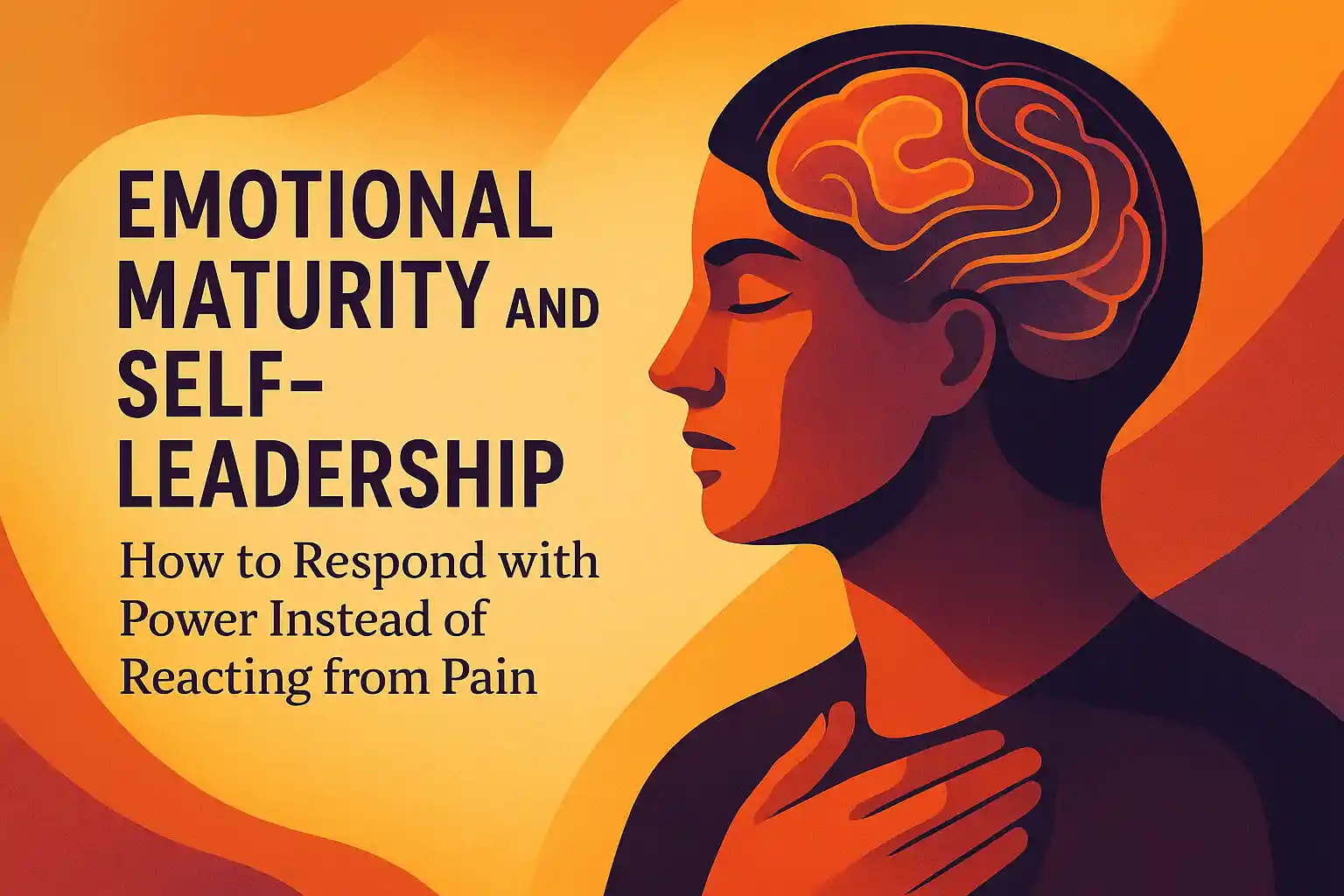
Emotional maturity is not about being emotionless — it’s about being emotionally intelligent and emotionally honest.
It looks like:
- Feeling anger without lashing out
- Feeling sadness without collapsing
- Holding boundaries without guilt
- Speaking truth without blame
- Owning your impact, even when unintentional
Immaturity reacts.
Maturity reflects, regulates, and responds.
Action Step:
Write this mantra down:
“My emotions are valid, but my reactions are my responsibility.”
Step 2: The Neuroscience of Reaction vs. Response
Reactions happen in the amygdala — the fear center.
It’s fast, emotional, and impulsive.
Responses come from the prefrontal cortex — the part of the brain responsible for reflection, logic, and long-term planning.
When you pause before reacting, you shift activation from the amygdala to the prefrontal cortex — literally changing how your brain processes the moment.
This is called top-down emotional regulation — the neurobiological basis of maturity.
Action Step:
When triggered, silently count:
“3… 2… 1… I choose my response.”
This tiny pause can change your entire trajectory.
Step 3: Understanding Emotional Triggers and Pain Loops
A trigger is not the problem — the unprocessed pain it points to is.
Most overreactions are echoes of unresolved emotional injuries.
Examples:
- Criticism may trigger childhood shame
- Rejection may trigger abandonment wounds
- Being ignored may trigger “I’m not important”
Unhealed pain creates distorted perception.
Action Step:
Ask yourself when triggered:
“What am I really feeling beneath this?”
Name the original wound, not just the surface irritation.
Awareness breaks the pain loop.
Step 4: The Pause: How to Create Space Between Stimulus and Reaction
The most powerful thing you can do in any emotional situation is pause.
This is where self-leadership begins — in the space between what happens and what you choose to do next.
“Between stimulus and response there is a space. In that space is our power to choose. In our choice lies our growth and our freedom.”
— Viktor Frankl
Action Step:
Build a 3-step pause habit:
- Breathe (4 seconds in, 6 seconds out)
- Label the emotion
- Ask: “What would the mature version of me do here?”
Step 5: How to Respond from Power (Not Past Pain)
Reacting from pain often sounds like:
- “You always…”
- “I can’t believe you…”
- “Whatever, forget it.”
Responding from power sounds like:
- “Here’s how I feel, and here’s what I need.”
- “This matters to me, and I want to handle it with care.”
- “I need space to reflect. Let’s revisit this calmly.”
Power isn’t aggression. It’s clarity + control + groundedness.
Action Step:
When you feel emotionally charged, practice using this phrase first:
“I want to respond, not react. Give me a moment.”
Step 6: The Pillars of Self-Leadership
Self-leadership is the ongoing practice of holding your center, regardless of chaos. It includes:
1. Self-awareness
Recognizing your emotions and unconscious patterns
2. Self-regulation
Managing impulses and staying emotionally centered
3. Self-honesty
Telling yourself the truth, even when it’s uncomfortable
4. Self-alignment
Acting in accordance with your values and highest vision of self
5. Self-respect
Making decisions that honor your worth
Action Step:
Each morning, ask:
“How can I lead myself well today?”
Then act accordingly.
Step 7: Reparenting Your Inner Emotional World
Sometimes, emotional immaturity isn’t your fault — it’s unhealed programming from childhood where you weren’t modeled healthy emotional regulation.
Reparenting is the process of giving your inner self what your younger self never received:
- Validation
- Compassion
- Boundaries
- Emotional literacy
Action Step:
When you feel overwhelmed, imagine speaking to your inner child:
“I see you. I’m here now. I’ll keep you safe, and we will respond with strength, not fear.”
This bridges the gap between past and present self.
Step 8: Emotional Integrity and Identity Alignment
When your actions, words, and internal state match — that’s emotional integrity.
This is how you lead yourself with authenticity and confidence.
When there’s a mismatch — like smiling while you’re angry, or agreeing when you’re uncomfortable — it creates internal fracture.
The result?
Resentment, self-doubt, and chronic fatigue.
Action Step:
Before responding in any situation, check for alignment:
- Does what I’m saying match what I feel?
- Is this reaction true to who I want to become?
If not, pause. Align. Then respond.
Final Thoughts: Mature Response Is the Highest Form of Strength
You can master productivity, build habits, grow confidence, and rewrite identity —
but until you master your response to pain, you won’t be free.
Emotional maturity is what turns chaos into clarity.
It allows you to be calm when others are reactive, wise when others are impulsive, and grounded when life shakes your core.
This is self-leadership.
Not just the ability to influence others — but the power to lead yourself through your hardest moments with dignity, clarity, and emotional strength.
FAQs About Emotional Maturity and Self-Leadership
Q: Can emotional maturity be developed, or is it innate?
A: It’s absolutely developable. With awareness, reflection, and practice, anyone can become emotionally grounded and intentional.
Q: How do I know I’m reacting from pain?
A: Overreactions, resentment, repeated emotional spirals, or “triggers” often point to old wounds — not the present moment.
Q: What does self-leadership look like in relationships?
A: Holding boundaries without blame, owning your feelings without projecting, and communicating with honesty instead of control.
Q: Is pausing really that effective?
A: Yes. Even a 3-second pause creates space for the prefrontal cortex to engage — helping you respond instead of react.
Q: How can I stay emotionally mature under stress?
A: Develop daily self-regulation rituals (breathwork, journaling, movement) and practice reframing stress as feedback, not threat.