You stand in the middle of your kitchen, a profound sense of confusion washing over you. You know you came in here for a reason. You were on a mission. But what was it? You mentally retrace your steps from the living room, trying to recapture the thought, but it’s gone—vanished into thin air the moment you crossed the threshold. This frustrating, almost comical, experience is so common it’s a universal human quirk.
This isn’t a sign of early memory loss or a failing brain. This phenomenon, known by psychologists as the “Doorway Effect,” is a fascinating glimpse into how our memories are organized and influenced by our environment. The real reason we forget what we entered a room for is that our brains are designed to compartmentalize information based on location. When you walk through a doorway, you are essentially telling your brain to close one mental file and open a new one.
This article will explore the mind science behind the Doorway Effect, explaining why our intentions seem to evaporate at the entrance to a new room and what this reveals about the intricate workings of our memory.
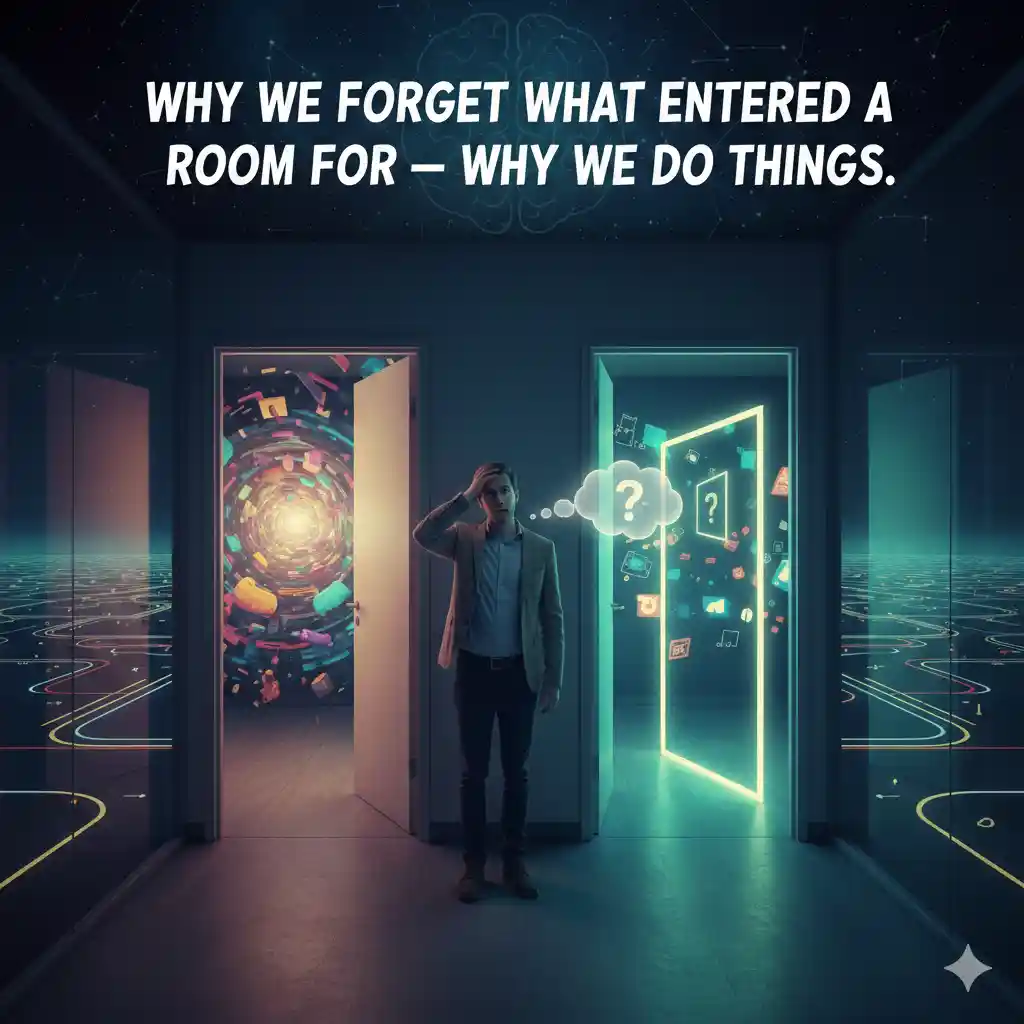
Table of Contents
- Introducing the “Doorway Effect”
- Your Brain as a Filing Cabinet: The Power of Context
- Event Boundaries: The Mental Reset Button
- Working Memory vs. Long-Term Memory
- The Role of Cognitive Load and Distraction
- An Echo of Our Evolutionary Past?
- Is It a Sign of a Bigger Problem?
- Tricks to Jog Your Memory
- Harnessing the Doorway Effect for Good
- Why This Simple Quirk Is a Good Thing
Introducing the “Doorway Effect”
The “Doorway Effect” is the formal name for this specific type of memory lapse. It was first documented in a series of experiments by researchers at the University of Notre Dame. In these studies, participants moved through virtual and real-world environments, carrying objects from one room to another. Researchers found that their memory for the object they were carrying was significantly worse right after they walked through a doorway, compared to when they simply walked the same distance within a single room.
This confirmed what many of us have experienced anecdotally: the act of passing through a doorway serves as a kind of mental dividing line. It seems to trigger the brain to clear its “working memory” slate to make room for information relevant to the new environment. It’s not about the distance you travel, but about the act of crossing a boundary.
Your Brain as a Filing Cabinet: The Power of Context
To understand the Doorway Effect, it helps to think of your brain as a massive, intricate filing cabinet. Each “file” contains information about a specific event, thought, or plan. But these files aren’t just organized randomly; they are heavily tagged with contextual cues—the time, the place, the smells, the sounds, and the emotions associated with the memory. This is known as context-dependent memory.
When you form an intention in the living room—for example, “I need to go to the kitchen to grab my keys”—that intention is mentally “filed” under the context of “living room.” The thought is linked to the physical space you are in. When you walk through the doorway into the kitchen, you have changed your physical context dramatically. Your brain, in its effort to be efficient, thinks, “Okay, we’re in a new location. The information from the ‘living room’ file is probably less important now. Let’s open the ‘kitchen’ file.” In this mental shuffle, the original intention can get misplaced.
Event Boundaries: The Mental Reset Button
Psychologists refer to doorways as “event boundaries.” Our brains naturally segment our continuous experience of life into a series of distinct events, much like scenes in a movie. An event boundary is a point where the brain decides one “scene” has ended and another is beginning. Walking through a doorway is one of the most clear-cut event boundaries we encounter in daily life.
When your brain perceives an event boundary, it performs a quick mental update. It offloads information that it deems relevant only to the previous event to make cognitive space for the new one. This process is usually highly efficient. It prevents our minds from being cluttered with outdated information. For example, when you leave your office, you don’t need to keep the details of your last email at the forefront of your mind. However, this helpful “clearing” mechanism is also what can cause you to forget why you went into the kitchen. Your brain has logically, but incorrectly, assumed that your intention was only relevant to the previous “scene.”
Working Memory vs. Long-Term Memory
This phenomenon highlights the difference between our working memory and our long-term memory. Long-term memory is where we store vast amounts of information for extended periods, like childhood memories or learned skills. Working memory, on the other hand, is like your brain’s temporary notepad or RAM. It holds a small amount of information (typically about 7 items) that you are actively using at any given moment.
Your intention to “get the keys” is held in your working memory. This type of memory is incredibly useful for immediate tasks, but it is also fragile and highly susceptible to interference. The mental reset that occurs at an event boundary is a major source of this interference. The new context of the kitchen—the sight of the sink, the smell of coffee, the thought of what to have for dinner—floods your working memory with new information, effectively pushing out the original, fragile intention. This explains how memory distorts everyday experiences; our active thoughts are constantly being overwritten by new input.
The Role of Cognitive Load and Distraction
The Doorway Effect is more likely to strike when your cognitive load is high. “Cognitive load” refers to the total amount of mental effort being used in your working memory. If you are already juggling multiple thoughts, you are much more likely to forget your original intention when you change rooms.
Imagine you’re in your home office and you think, “I need to ask my partner a question.” But as you walk to the living room, your phone buzzes with a notification, you notice a plant that needs watering, and you’re also mentally rehearsing what you’ll say. Each of these thoughts adds to your cognitive load. By the time you walk through the living room doorway, your working memory is already crowded. The event boundary reset is just the final push that sends your original intention into the abyss. This is why feeling busy can be a mental trick; the perception of having a lot on our mind makes our working memory less reliable.
An Echo of Our Evolutionary Past?
While the Doorway Effect is a byproduct of how our brains are structured to organize information, some evolutionary psychologists speculate that it may have deeper roots. For our ancestors navigating complex and potentially dangerous environments, it would have been highly adaptive to refresh their awareness and goals upon entering a new space.
When moving from an open field into a dark cave, for example, the goal of “look for berries” would need to be instantly replaced with “watch out for predators.” The ability to quickly purge old intentions and reorient to the immediate priorities of a new environment would have been a significant survival advantage. In our modern, safe homes, this mechanism is less critical, but the underlying wiring remains. Your brain still treats moving from the bedroom to the bathroom as a significant environmental shift that warrants a mental refresh.
Is It a Sign of a Bigger Problem?
For most people, the Doorway Effect is a completely normal and harmless quirk of human memory. It happens to people of all ages. However, if you notice that these memory lapses are becoming significantly more frequent, are accompanied by other cognitive difficulties (like forgetting names or recent events), or are starting to interfere with your ability to function in daily life, it may be worth discussing with a healthcare professional.
While the Doorway Effect itself is not a symptom of dementia or Alzheimer’s disease, a marked increase in general forgetfulness could be. The key difference is context. The Doorway Effect is specifically tied to the act of changing location. If you are forgetting things while staying in the same room, or if you have trouble with more than just fleeting intentions, it could indicate an underlying issue. But the occasional “Why did I come in here?” moment is simply part of the human condition.
Tricks to Jog Your Memory
When you find yourself standing in a room, utterly baffled, there are a few simple tricks you can use to retrieve the lost thought.
- Retrace Your Steps: This is the most classic and often most effective method. Walk back through the doorway into the room where you first had the thought. Re-exposing your brain to the original context can often bring the memory back online.
- Verbalize Your Intention: As you decide to go to another room, say your intention out loud. “I am going to the kitchen to get a glass of water.” The act of speaking creates an additional, auditory memory trace that is more robust than the thought alone. This is a practical application of why we talk to ourselves.
- Create a Visual Cue: As you form the intention, associate it with a physical gesture. For example, if you’re going to get your glasses, you could tap the side of your head. This links the thought to a motor action, creating another retrieval pathway.
Harnessing the Doorway Effect for Good
While it can be frustrating, you can actually use the principle of the Doorway Effect to your advantage. If you are trying to move on from a negative or unproductive thought loop, physically getting up and walking into a different room can help.
For instance, if you’re sitting at your desk feeling stressed and overwhelmed by a work problem, staying in that same spot can keep you stuck in that mental state. Getting up, walking outside, or even just moving to the kitchen can create an “event boundary” that helps to reset your perspective. The change in context can interrupt the negative rumination and allow you to approach the problem with a fresh mind when you return. This is a simple but powerful way to manage your mental environment and escape the cycle of feeling stuck.
Why This Simple Quirk Is a Good Thing
Ultimately, the Doorway Effect is a sign that your brain is working exactly as it should. It’s a demonstration of your brain’s incredible ability to manage a constant firehose of information by segmenting it into manageable chunks. Without this ability to create event boundaries and clear out old information, our minds would be a chaotic jumble of every thought and intention we’ve ever had. We would be unable to focus on the present moment.
So, the next time you walk into a room and forget why you’re there, don’t get frustrated. Take a moment to appreciate the elegant, if occasionally inconvenient, efficiency of your mind. It’s not a bug; it’s a feature. It’s a reminder that your brain is constantly working behind the scenes to help you navigate the world, one room, and one “scene,” at a time. Then, walk back into the living room. You’ll probably remember you were just looking for the remote.