You’re trying to focus on a task, but your mind keeps drifting. A minor inconvenience, like a slow computer or a misplaced pen, suddenly feels like a monumental personal attack. Your patience evaporates. A well-meaning question from a coworker is met with a sharp, irritable response you almost instantly regret. You’re not just hungry; you’re hangry. This powerful, often comical, combination of hunger and anger is a real and surprisingly complex psychological phenomenon.
The reason we get angry when hungry isn’t a failure of willpower or a sign of a bad temper. It’s a direct result of how our brains and bodies respond to a lack of fuel. “Hanger” is a survival mechanism gone sideways in the modern world. It’s a complex interplay of blood sugar, hormones, and emotional regulation. This article will unpack the mind science behind hanger, explaining why a simple drop in glucose can turn you from a reasonable human into an irritable grouch, and what you can do about it.
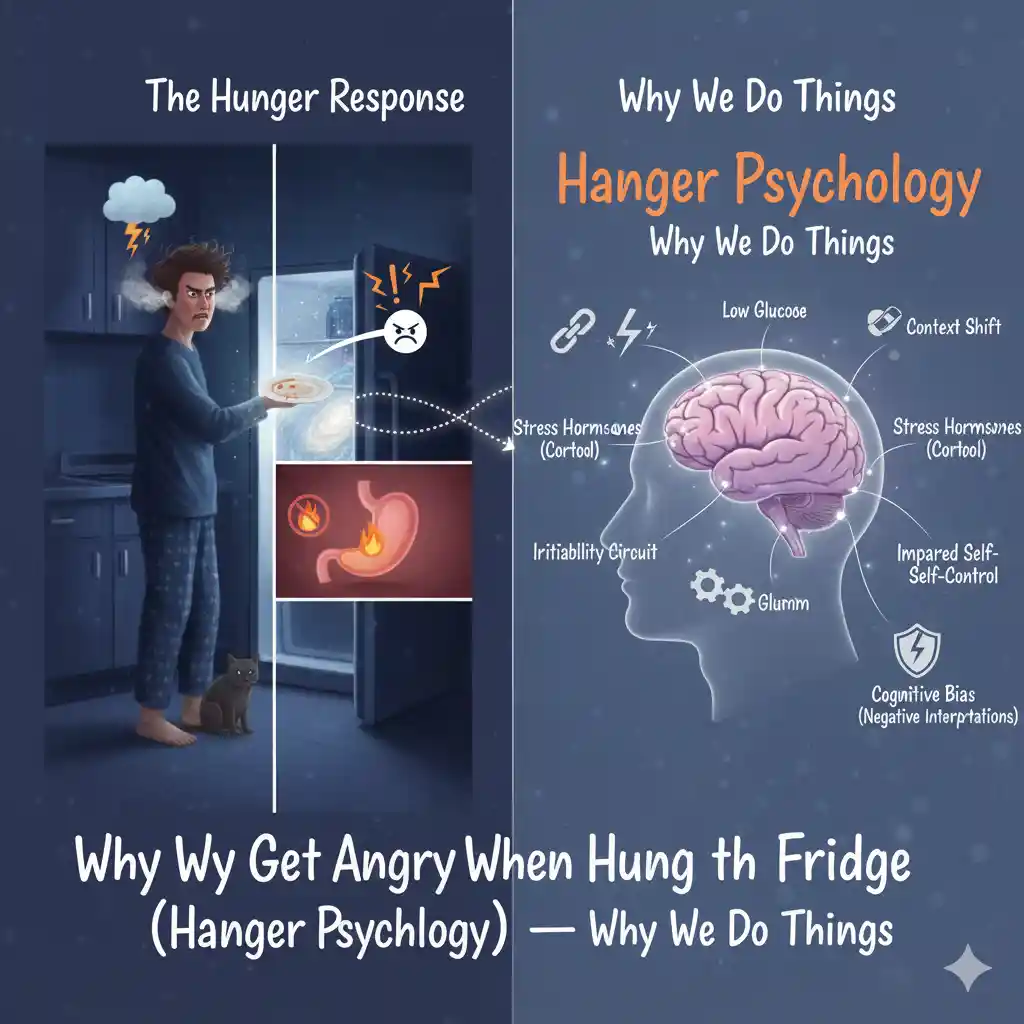
Table of Contents
- What is “Hanger”? More Than Just a Mood
- The Blood Sugar Rollercoaster: How Glucose Fuels Your Brain
- The Brain on Low Fuel: When Self-Control Shuts Down
- Hormones in Overdrive: The Role of Adrenaline and Cortisol
- An Evolutionary Hangover: Why Hunger Triggers Aggression
- The Link Between Hunger and Emotional Interpretation
- Why Some People Get Hangrier Than Others
- It’s Not Just You: How Hunger Affects Relationships and Decisions
- How to Tame the Hanger Monster: Practical Strategies
- Beyond the Snack: Building a Hanger-Proof Lifestyle
What is “Hanger”? More Than Just a Mood
Hanger is more than just feeling grumpy because your stomach is rumbling. It is a genuine emotional and physiological response to a lack of food. The term itself, a blend of “hungry” and “angry,” perfectly captures the experience. Psychologists recognize it as an emotional state where the physical sensation of hunger is expressed as irritability, frustration, and anger.
This isn’t a new concept. The connection between hunger and aggression has been observed for centuries. However, modern science is now giving us a clear picture of what’s happening inside our bodies and brains during a bout of hanger. It’s not an imagined feeling; your brain chemistry is actively changing, making you more prone to negative emotions and less able to control your impulses. Understanding this helps us move from self-judgment (“Why am I so irritable?”) to self-awareness (“My body is signaling it needs fuel”).
The Blood Sugar Rollercoaster: How Glucose Fuels Your Brain
The primary culprit behind hanger is low blood glucose, or blood sugar. Everything you eat is eventually broken down into simple sugars (like glucose), which are released into your bloodstream and transported to your body’s cells for energy. Your brain, despite being only about 2% of your body weight, is an energy hog, consuming about 20% of your daily calories. It is incredibly dependent on a steady supply of glucose to function properly.
When you haven’t eaten for a while, the glucose levels in your blood drop. Your brain perceives this as a life-threatening situation. Unlike other organs that can use different fuel sources, the brain’s primary fuel is glucose. When that fuel runs low, high-level cognitive functions are the first to suffer. Think of it like a city experiencing a power brownout—the non-essential services flicker and fail first. For your brain, “non-essential” services include things like emotional regulation and impulse control.
The Brain on Low Fuel: When Self-Control Shuts Down
One of the most energy-intensive jobs your brain has is self-control. It takes a lot of mental power to be patient, resist temptation, and manage your emotional responses. This willpower is managed by the prefrontal cortex, the most evolved part of our brain. Because self-control requires so much energy, it’s one of the first abilities to decline when glucose levels are low.
When you’re hangry, your ability to inhibit angry or aggressive impulses is significantly weakened. That snarky comment you would normally keep to yourself suddenly slips out. You have less patience for a partner’s annoying habit or a child’s repeated questions. Your brain, in its fuel-deprived state, doesn’t have the energy to override its more primitive, emotional responses. It defaults to a more direct and less filtered mode of operation, which often manifests as irritability. It’s the same mechanism that contributes to decision fatigue, where your brain runs out of the energy needed to make rational choices.
Hormones in Overdrive: The Role of Adrenaline and Cortisol
When your blood sugar drops, your brain doesn’t just sit back and wait for you to eat. It triggers a counter-regulatory response to try and raise glucose levels. It sends signals to several organs to release hormones that can increase the amount of sugar in your blood. Two of these hormones are adrenaline (also known as epinephrine) and cortisol, the same hormones that are released during a “fight or flight” stress response.
These hormones are incredibly effective at getting stored glucose into the bloodstream, but they come with a side effect: they also make you feel tense, jittery, and on edge. The release of adrenaline is what makes your heart race and your palms sweat when you’re scared. When released due to hunger, it creates a state of physiological arousal that can easily be misinterpreted as anger or anxiety. Your body is in a state of stress, making you more likely to perceive situations as threatening and to react with aggression. This is the same hormonal cascade behind general stress accumulation.
An Evolutionary Hangover: Why Hunger Triggers Aggression
From an evolutionary standpoint, a link between hunger and aggression makes perfect sense. For our ancestors, hunger was a direct threat to survival. An animal that became passive and lethargic when hungry would starve. An animal that became more assertive, aggressive, and willing to take risks to secure food would live to pass on its genes.
Therefore, the psychological state we call “hanger” may be an echo of this ancient survival mechanism. The irritability and aggression are meant to motivate you to go out and acquire food, even if it means fighting a competitor for it. In the modern world, we don’t need to fight for our food at the grocery store, but the primal wiring remains. The aggressive impulse is still there, but without a clear target, it often gets misdirected at the nearest available source of frustration—be it a slow driver, a chatty coworker, or an uncooperative piece of technology.
The Link Between Hunger and Emotional Interpretation
Hanger doesn’t just make you feel bad; it changes how you see the world. Studies have shown that when people are hungry, they are more likely to interpret ambiguous situations in a negative light. A neutral facial expression might be perceived as angry or disapproving. A simple question might sound like a criticism.
This happens because your brain, in its stressed and fuel-deprived state, is primed for threat detection. It’s on high alert, scanning the environment for potential problems. This negative bias in perception means you’re more likely to experience something as annoying or provocative when you’re hungry than you would if you were well-fed. This can create a vicious cycle: you feel irritable due to hunger, you interpret someone’s actions negatively, you react angrily, and the situation escalates—all because your brain’s interpretation filter was skewed by a lack of glucose. This is closely related to why we imagine worst-case scenarios; a hungry brain is a pessimistic brain.
Why Some People Get Hangrier Than Others
Not everyone experiences hanger with the same intensity. Several factors can influence your susceptibility to hunger-induced rage.
- Genetics: Some people’s bodies are simply more sensitive to drops in blood sugar. Genetic factors can influence how efficiently your body regulates glucose and releases counter-regulatory hormones.
- Emotional Awareness: Individuals who have lower emotional awareness—meaning they have difficulty identifying and understanding their own feelings—are more likely to get hangry. They might not consciously recognize that they are hungry. Instead, they just know they feel awful, and they misattribute that feeling to external circumstances, lashing out at the world instead of grabbing a snack.
- Habitual Diet: What you eat matters. Diets high in simple sugars and refined carbohydrates can lead to rapid spikes and crashes in blood sugar, making you more prone to hanger. A diet rich in protein, fiber, and complex carbohydrates provides a more stable source of energy.
It’s Not Just You: How Hunger Affects Relationships and Decisions
Hanger is not just a personal inconvenience; it can have real-world consequences for your relationships and your performance. Numerous studies have shown that hunger can negatively impact our social behavior. For example, one famous study found that married couples were more likely to be aggressive toward each other on days when they had lower blood sugar levels.
It also affects our decision-making. When you’re hungry, you’re more likely to make impulsive choices and take bigger risks, often for a smaller reward. Your brain is in a “get resources now” mode, prioritizing immediate gratification over long-term planning. This is why you should never go grocery shopping on an empty stomach—you’re far more likely to fill your cart with junk food. Understanding this can help you strategically plan important decisions and conversations for times when you are well-fed and your brain is operating at full capacity.
How to Tame the Hanger Monster: Practical Strategies
The most obvious solution to hanger is to eat something. But by the time you’re fully hangry, your judgment is already impaired, and you might reach for the quickest, least healthy option. The key is prevention.
- Don’t Skip Meals: This is the golden rule. Eating at regular intervals helps to keep your blood sugar stable throughout the day.
- Choose Smart Snacks: Keep healthy snacks on hand that contain a good mix of protein, fiber, and healthy fats. Things like nuts, Greek yogurt, an apple with peanut butter, or a hard-boiled egg will provide sustained energy, unlike a candy bar that will lead to another crash.
- Recognize Your Early Warning Signs: Learn to identify your personal hunger cues before they escalate to hanger. Do you have trouble concentrating? Do you start to feel a little spacey or irritable? This is your body’s signal to find a healthy snack. This self-awareness connects to why we talk to ourselves; checking in with your internal state is a crucial skill.
- Communicate Your Needs: If you feel hanger coming on, it’s okay to tell people, “I’m feeling really hungry and I’m getting irritable. I need to eat something before we continue this conversation.” This is far more productive than lashing out.
Beyond the Snack: Building a Hanger-Proof Lifestyle
While managing your food intake is critical, building a generally resilient lifestyle can also fortify you against hanger. This involves managing your overall stress levels. When you are already chronically stressed, your cortisol levels are already elevated, making you much more sensitive to the additional stress of low blood sugar.
Practices like regular exercise, adequate sleep, and mindfulness can help to regulate your nervous system and improve your body’s overall stress response. When your baseline stress level is lower, a drop in blood sugar is less likely to push you over the edge into full-blown hanger. It’s about creating a larger buffer zone so that minor physiological stressors don’t immediately trigger an emotional explosion. Building healthy habits that support your mental health creates a foundation of well-being that makes you less vulnerable to the whims of your blood sugar.
Conclusion
Getting angry when you’re hungry is not a character flaw—it’s a biological imperative. It’s your brain’s ancient, powerful, and slightly outdated way of screaming for fuel. The combination of low glucose, a compromised prefrontal cortex, and a flood of stress hormones creates a perfect storm for irritability and aggression. By understanding the science behind hanger, you can stop blaming yourself and start managing the situation. Recognizing the early signs of hunger, making smart food choices, and building a resilient lifestyle are the keys to keeping the hanger monster at bay. So, the next time you feel that familiar wave of irrational irritation, pause and ask yourself a simple question: “Am I really angry, or do I just need a sandwich?” More often than not, the answer is the sandwich.