Quick Summary
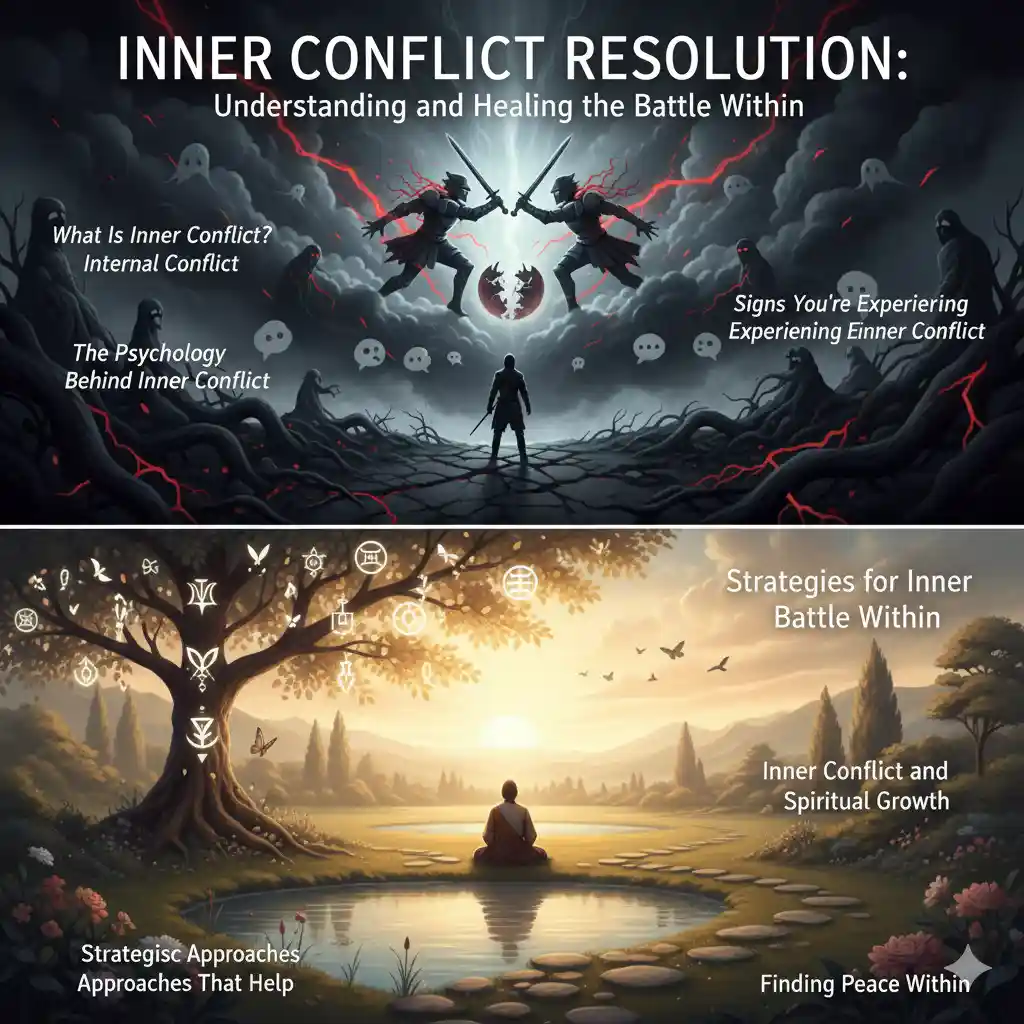
Inner conflict occurs when opposing thoughts, emotions, or desires clash within the mind, creating tension, confusion, and emotional distress. These conflicts can stem from past experiences, unconscious beliefs, or conflicting values—and left unresolved, they can impact decision-making, relationships, mental health, and self-esteem.
This article explores what inner conflict is, where it comes from, how it manifests, and—most importantly—how to resolve it using principles from psychology, including Freudian theory, depth psychology, and modern therapeutic practices.
Table of Contents
- What Is Inner Conflict?
- Common Causes of Internal Conflict
- Types of Inner Conflict
- Signs You’re Experiencing Inner Conflict
- The Psychology Behind Inner Conflict
- Strategies for Inner Conflict Resolution
- Therapeutic Approaches That Help
- Long-Term Benefits of Resolving Inner Conflict
- Inner Conflict and Spiritual Growth
- Conclusion: Finding Peace Within
1. What Is Inner Conflict?
Inner conflict refers to the mental and emotional struggle between competing desires, beliefs, or needs. It often feels like being “torn in two,” unsure of what to do or who to be. These conflicts can be subtle or overwhelming and can involve moral dilemmas, life choices, emotional repression, or unresolved trauma.
In psychological terms, inner conflict is often a symptom of deeper unconscious dynamics, especially when it interferes with well-being or leads to chronic anxiety, guilt, or indecision.
2. Common Causes of Internal Conflict
- Conflicting Values: Wanting to succeed professionally but also desiring a simple, peaceful life.
- Unconscious Guilt or Shame: Feeling undeserving of happiness due to past actions or beliefs.
- Suppressed Desires: Longing for emotional intimacy while fearing vulnerability.
- Cognitive Dissonance: Holding two opposing beliefs, like “I want to be free” vs. “I need security.”
- Role Confusion: Struggling to balance personal identity with social or family expectations.
3. Types of Inner Conflict
Moral Conflict
Struggles between right and wrong, ethics and desires.
Emotional Conflict
Conflicting feelings, like love and resentment toward the same person.
Identity Conflict
A disconnect between how you see yourself and how others see you.
Cognitive Conflict
Holding incompatible beliefs or being unsure of your personal values.
Behavioral Conflict
Feeling driven to act one way but behaving differently due to fear, obligation, or habit.
4. Signs You’re Experiencing Inner Conflict
- Persistent indecision or procrastination
- Anxiety or irritability without clear cause
- Feelings of guilt, shame, or self-doubt
- Repeating unhealthy patterns or self-sabotage
- Feeling “split” or out of alignment with yourself
- Difficulty committing to goals or relationships
5. The Psychology Behind Inner Conflict
Freud’s View
Freud saw inner conflict as the struggle between the id, ego, and superego. The id demands pleasure, the superego demands morality, and the ego must mediate between them. When these forces are in conflict, anxiety and neurosis can result.
Jung’s View
Carl Jung framed inner conflict as a battle between the conscious ego and the shadow—the repressed, denied aspects of the self. Resolving conflict involves integrating the shadow to become whole.
Modern View
Today, therapists see inner conflict as a signal that parts of the self are not in agreement. Resolution comes through awareness, emotional processing, and self-compassion—not by “choosing” a side but by reconciling the parts.
6. Strategies for Inner Conflict Resolution
1. Identify the Conflict Clearly
Name the opposing forces. What parts of you are in disagreement? What do they each want?
2. Use Journaling or Dialogue
Write down the perspectives of each side of the conflict. You can even write a conversation between them.
3. Practice Self-Compassion
Each part of you developed for a reason. Don’t judge—listen.
4. Mindfulness and Meditation
Become aware of the emotional reactions beneath the thoughts. Accept them without trying to fix them right away.
5. Values Clarification
Explore what truly matters to you. Sometimes inner conflict is rooted in outdated beliefs or external expectations.
6. Inner Child Work
Conflicts often stem from unmet childhood needs or wounds. Reconnecting with and nurturing your inner child can provide clarity and healing.
7. Therapeutic Approaches That Help
Talk Therapy
Working with a therapist to explore both sides of the conflict, their origins, and potential resolutions.
Parts Work/Internal Family Systems (IFS)
Views the mind as made up of “parts” with different roles (protector, critic, wounded child). Healing comes through dialogue and integration.
Psychodynamic Therapy
Explores how early experiences, unconscious drives, and defenses contribute to present-day conflict.
Gestalt Therapy
Helps clients confront and resolve internal polarities through experiential techniques (e.g., the empty chair dialogue).
Jungian Analysis
Facilitates shadow integration and individuation—bringing unconscious content into conscious awareness.
8. Long-Term Benefits of Resolving Inner Conflict
- Increased self-awareness and emotional clarity
- Improved decision-making
- Greater inner peace and confidence
- Enhanced relationships due to less projection and reactivity
- More aligned and purposeful living
- Reduced anxiety and depression
9. Inner Conflict and Spiritual Growth
In many traditions, inner conflict is not a flaw but a necessary step in personal evolution. The tension between opposites can lead to transformation and a deeper understanding of self. Psychospiritual approaches encourage embracing inner conflict as a call to integrate, not eliminate what we struggle with.
10. Conclusion: Finding Peace Within
Inner conflict is part of being human. It signals growth, complexity, and the need for reflection. Rather than suppress or avoid these struggles, healing comes from understanding, honoring, and integrating the different parts of ourselves.
True resolution is not about silencing one voice but learning how to let all parts of you be heard—so they can move in harmony rather than opposition.