Table of Contents
- Introduction: The Myth of Endless Willpower
- Step 1: The Neuroscience of Self-Control — Why Willpower Depletes
- Step 2: Decision Fatigue — How Mental Energy Shapes Behavior
- Step 3: The Stress–Impulse Connection — When the Brain Defaults to Comfort
- Step 4: The Limits of Motivation and the Power of System Design
- Step 5: Identity-Based Habits — Moving From Effort to Alignment
- Step 6: Energy Management — The Real Foundation of Discipline
- Step 7: Emotional Regulation — Training the Mind Before the Moment
- Step 8: Building Self-Control Through Structure, Not Strain
- Final Thoughts: When Discipline Becomes Effortless
- FAQs About Willpower and Sustainable Behavior Change
Introduction: The Myth of Endless Willpower
We often glorify willpower — the ability to push through resistance, fight distraction, and force consistency.
But modern neuroscience shows that willpower is not a renewable resource; it’s a limited one.
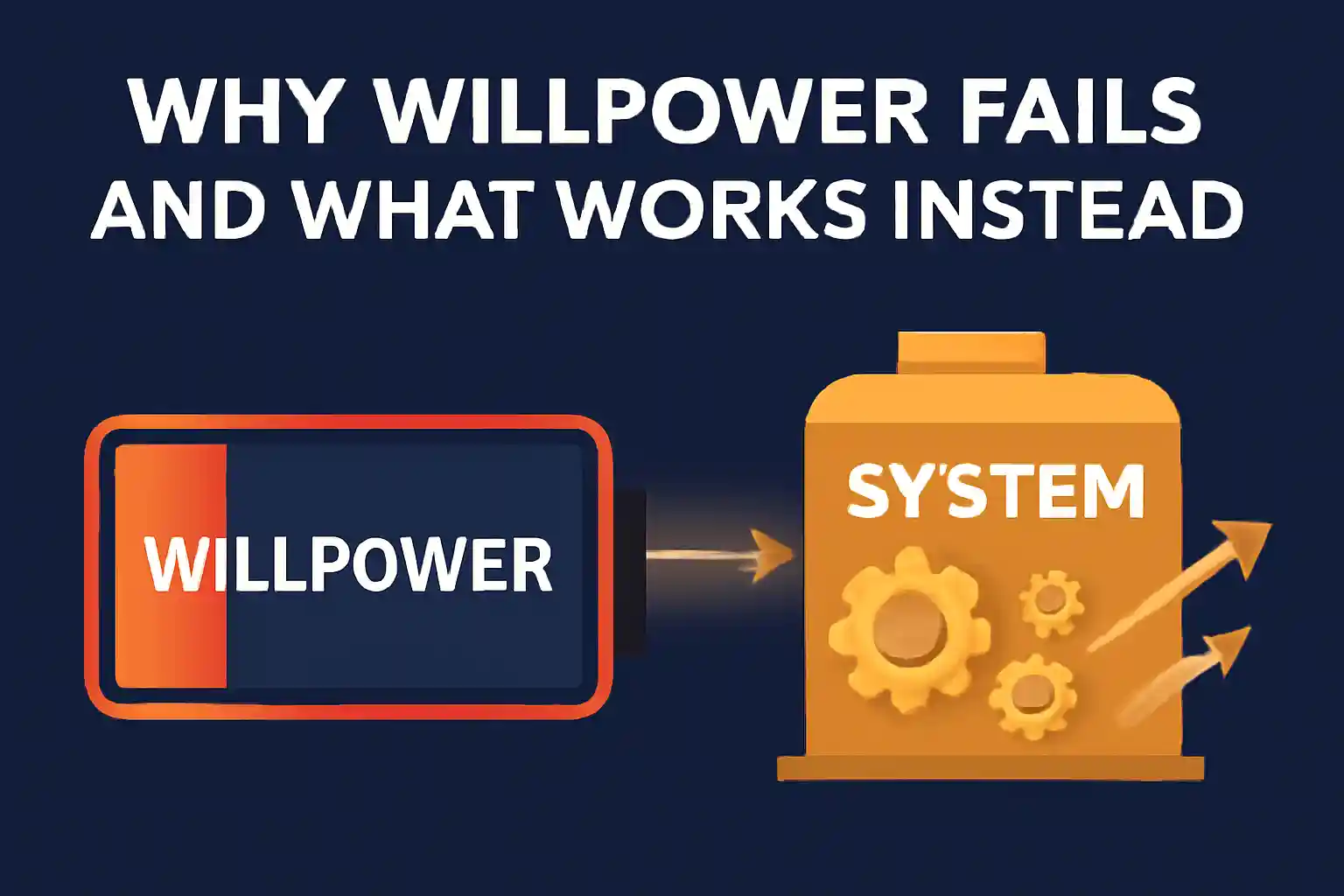
Like a battery, it drains throughout the day as we make decisions, resist temptations, and manage stress.
When the battery runs low, emotion takes over logic, and we default to old, automatic habits.
True discipline doesn’t come from more willpower — it comes from needing less of it.
By designing systems, routines, and environments that support your goals, you replace struggle with structure.
Step 1: The Neuroscience of Self-Control — Why Willpower Depletes
Willpower lives in the prefrontal cortex, the brain’s executive control center responsible for focus, decision-making, and impulse regulation.
But under mental fatigue, stress, or emotional overload, this region weakens, allowing the limbic system — the emotional brain — to dominate.
That’s why it’s easy to stay disciplined in the morning but hard at night. Your prefrontal resources have been spent.
Action Step:
Front-load your most important habits early in the day — when willpower reserves are highest.
Protect the first few hours for creation, not consumption.
Step 2: Decision Fatigue — How Mental Energy Shapes Behavior
Every choice you make consumes cognitive energy.
The more micro-decisions you face — what to wear, what to eat, when to work — the faster your mental battery drains.
This is called decision fatigue, and it’s why consistency collapses under chaos.
Successful people don’t have superhuman willpower — they have fewer unnecessary decisions.
Action Step:
Automate what doesn’t matter: meal prepping, morning routines, work schedules.
The less you decide, the more energy you preserve for what counts.
Step 3: The Stress–Impulse Connection — When the Brain Defaults to Comfort
Under stress, your body floods with cortisol, and the brain seeks relief through immediate gratification — scrolling, snacking, or procrastinating.
This is not weakness — it’s biology.
The limbic system interprets stress as danger and prioritizes short-term safety over long-term goals.
That’s why willpower fails when you’re anxious or overwhelmed — the brain’s survival circuits override self-discipline.
Action Step:
Instead of resisting stress, regulate it.
Use breathing, journaling, or short walks to calm the nervous system before acting.
Self-control begins in a regulated mind, not a strained one.
Step 4: The Limits of Motivation and the Power of System Design
Motivation is emotional energy. Willpower is mental effort. Both fluctuate.
Systems, however, are consistent.
When you automate discipline — through structure, routines, and environmental cues — your behavior no longer depends on energy or emotion.
This is behavioral architecture in practice.
Action Step:
Replace “I’ll try harder” with “I’ll design better.”
Set clear triggers (time, place, cue) for every key habit.
Design removes the need for daily decision-making.
Step 5: Identity-Based Habits — Moving From Effort to Alignment
Willpower struggles when your actions conflict with your identity.
If you see yourself as inconsistent, every disciplined act feels like resistance.
But when your behavior reflects your identity — “I’m the kind of person who follows through” — discipline feels natural.
This shift engages the brain’s cognitive consistency bias — your subconscious wants to align behavior with self-image.
Action Step:
Reinforce your desired identity daily:
“I am a focused person.”
“I am a disciplined leader.”
“I follow through even on small things.”
You act in alignment with the story you believe.
Step 6: Energy Management — The Real Foundation of Discipline
Willpower is not just mental — it’s physiological.
Sleep, nutrition, hydration, and exercise all directly affect prefrontal function.
When your body is drained, your brain cannot sustain self-control.
Discipline collapses not from lack of desire, but from lack of energy.
Action Step:
Audit your energy rhythm:
- Morning: creative work
- Afternoon: collaborative tasks
- Evening: reflection and rest
Align your habits with your natural energy cycles, not arbitrary schedules.
Step 7: Emotional Regulation — Training the Mind Before the Moment
Most failures of willpower are failures of emotional management.
We don’t lose focus because we forget what to do — we lose focus because our feelings hijack us.
Practices like mindfulness, gratitude, and visualization strengthen the anterior cingulate cortex, the region responsible for emotional stability and attentional control.
You can train this like a muscle.
Action Step:
Before you start a challenging habit, pause for 60 seconds.
Breathe deeply and set a clear intention: “I am choosing this action.”
This activates conscious awareness over emotional impulse.
Step 8: Building Self-Control Through Structure, Not Strain
The secret to lasting discipline is removing friction between intention and action.
When your environment supports your habits, willpower becomes unnecessary.
It’s not about pushing harder; it’s about designing smarter.
Examples:
- Use “If–Then” planning (If it’s 6 PM, then I start my workout).
- Create accountability partners.
- Batch similar tasks to reduce switching fatigue.
- Simplify — fewer goals, better systems.
Action Step:
Each week, identify one habit that feels difficult.
Ask: “What system or structure would make this effortless?”
Then implement it. Systems succeed where willpower fails.
Final Thoughts: When Discipline Becomes Effortless
Willpower is a spark — systems are the engine.
If you rely only on force, you’ll burn out.
But when you design your habits around structure, identity, and energy, consistency becomes effortless.
The goal isn’t to have more willpower — it’s to need less of it.
That’s sustainable discipline: when your environment, emotions, and identity work with you, not against you.
That’s not self-control. That’s self-alignment.
FAQs About Willpower and Sustainable Behavior Change
Q: Is willpower ever useful?
A: Yes — it’s great for starting change, not sustaining it. Use it to build systems, not maintain them.
Q: Why do I have strong willpower in some areas but not others?
A: Because willpower is domain-specific. You protect energy where identity and interest are strongest.
Q: Can willpower be trained like a muscle?
A: To an extent. Small acts of self-control strengthen prefrontal circuits — but rest and recovery are equally essential.
Q: What’s stronger than willpower?
A: Environment, structure, and identity. These automate discipline and make behavior self-sustaining.
Q: How do I stop relying on motivation entirely?
A: Replace emotional dependency with systems thinking: automate, schedule, and simplify every key behavior.