
Leading a team through a digital interface is fundamentally different from managing a collocated group in a physical office. When researchers first attempted to define this shift at the dawn of the internet era, they built complex conceptual models to explain how technology and leadership interact.
If you dive into the foundational literature on remote work, you will likely encounter early models heavily reliant on Adaptive Structuration Theory (AST) and Group Support Systems (GSS). These models suggest a neat, reciprocal relationship where technology reshapes leadership structures, and leadership structures reshape the technology.
But does a simple mutual-shaping theory truly capture the messy, exhausting, and highly nuanced reality of leading a modern distributed workforce?
Often, generic academic overviews treat e-leadership as a natural byproduct of adopting advanced information technology. However, robust virtual leadership is an intensely human challenge. It requires a deep understanding of asynchronous trust mechanisms, digital equity, and post-pandemic exhaustion. Let us critically examine the oversimplified framing of early e-leadership frameworks and explore what effective, technology-mediated team dynamics actually require today.
1. Fast Summary of the Original Article
A seminal 2000 paper in The Leadership Quarterly by Avolio, Kahai, and Dodge provides the classic foundation for this discussion. The authors reviewed existing literature to define “e-leadership” as a process emerging from the interaction between Advanced Information Technology (AIT) and organizational structures.
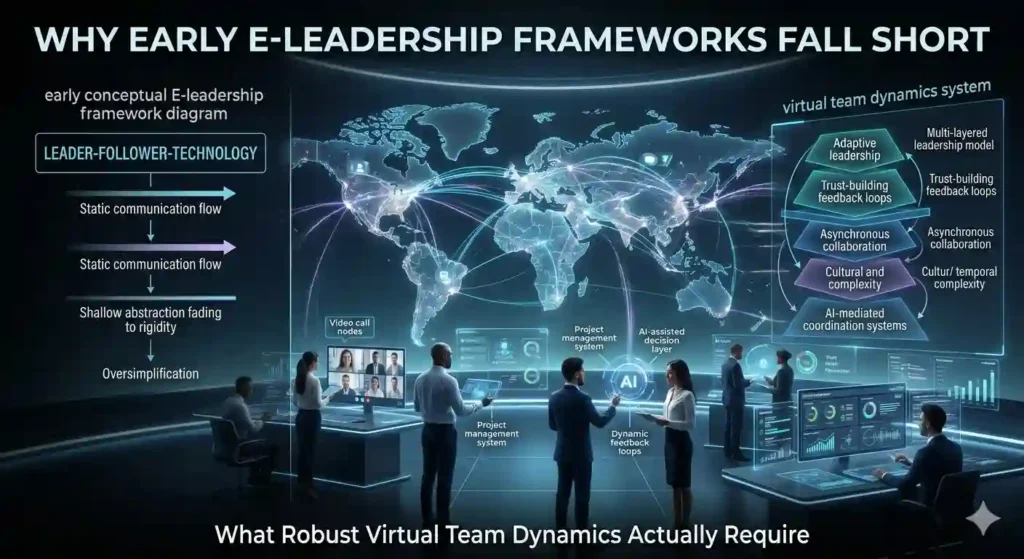
The researchers proposed Adaptive Structuration Theory (AST) as their primary framework. AST posits that AIT and leadership mutually shape one another over time. The paper highlighted critical gaps in existing Group Support Systems (GSS) research, noting that leadership was often ignored or confounded by the presence of third-party facilitators. Furthermore, they correctly identified trust-building in virtual teams as a massive future challenge and recommended a research agenda integrating socio-technical systems.
While the AST lens was incredibly innovative in 2000, the broader picture of technology-mediated leadership is far more nuanced today. It requires deeper scrutiny of trust dynamics, facilitation confounds, and modern distributed realities.
2. Why the Term “E-Leadership via AST” Is Often Misleading in Conceptual Overviews
The proposition that leadership and technology simply “mutually shape” each other inherently downplays the reality of technological determinism. In many modern implementations, the software dictates the workflow long before the leader has a chance to adapt it.
Generic academic summaries lead readers to mistakenly believe that introducing new collaboration tools automatically transforms a company’s leadership structure. This completely ignores the massive friction of adoption barriers and digital divides. Much like how standardized procedures rolled out by transnational corporations frequently mask local team nuances, rolling out a single digital platform rarely creates uniform leadership outcomes.
Relying on a static academic theory to solve active team disconnects perfectly mirrors why we self-sabotage our own management potential for the comfort of a pre-packaged software solution.
3. The Limits of Socio-Technical & GSS-Centric Framing
We must absolutely critique the foundational reliance on early Group Support Systems (GSS) studies. The 2000-era research relied heavily on highly controlled laboratory settings.
When you apply these early lab findings to real-world asynchronous work, massive gaps appear. GSS lab studies frequently featured a neutral third-party facilitator, which completely confounded the actual emergence of team leadership. Furthermore, AST frameworks fail to fully address the dark side of digital work, such as surveillance tools and the emotional exhaustion caused by algorithmic monitoring.
Ignoring these modern stressors proves exactly why we procrastinate even when we know it’s important—it is easier to study software features than to confront severe team burnout. When remote workers withdraw, it acts as a clear signal of underlying distress, highlighting the difference between surface-level tech complaints and deeper psychological fatigue.
4. The Role of Trust & Distributed Literacy in Effective E-Leadership
Here is a critical element often missing in early frameworks: digital leaders need a masterful understanding of psychological safety and swift trust formation. You cannot simply install a collaboration app and expect cohesion.
Leaders must actively build connection without physical proximity. You have to look past the surface-level output of a project tracker, applying an investigative, empathetic mindset similar to third date psychology to truly get to know your team’s unwritten norms and working styles.
When a team goes suddenly quiet on a messaging app, that silence is diagnostic. Understanding these communication gaps requires differentiating our own primary vs secondary emotions. The secondary emotion might be frustration over a missed deadline, but the primary issue is a lack of asynchronous trust.
5. Structural & Modern Factors That Affect Outcomes
What happens when we apply 2000-era models to modern hybrid work? Early overviews typically downplay massive environmental and structural forcing factors.
Time zone differences, varying levels of digital literacy, and poor home-office setups create massive inequities in participation. Ignoring these realities is a classic case of management denial, mirroring repression vs suppression in psychology.
When leaders ignore the chaotic realities of their employees’ physical environments, a massive communication gap forms. This disconnect perfectly illustrates what kills long-distance relationships between remote employees and their corporate headquarters. Over time, dealing with unpredictable virtual communication leaves workers feeling profoundly exhausted, helping explain why do I feel emotionally numb after months of consecutive video calls.
6. Behavioral Patterns That Predict Long-Term Success
To achieve true distributed success, management teams must build evidence-based behavioral patterns that go far beyond socio-technical alignment.
Predictors of reliable virtual leadership include adopting shared facilitation models, establishing strict asynchronous communication norms, and protecting deep work blocks. Without these guardrails, employees sit in a constant state of hyper-vigilance, and overthinking is a habit that halts remote productivity completely.
When a major project fails due to misaligned software and poor leadership communication, the resulting stress resembles a heavy panic attack hangover. Effective leaders recognize these behavioral patterns early and intervene before trust permanently fractures.
7. What Effective E-Leadership Actually Looks Like
Let us contrast the early AST framing with robust, modern distributed practices. Effective e-leadership requires a highly intentional, multi-disciplinary mindset.
- Integrated Hybrid Practices: This means combining reliable asynchronous tools with high-value, synchronous team-building rituals.
- Stewardship Education: Leaders must understand burnout signals and ensure equity in virtual meetings. This highlights the intense effort required in active caretaking vs caregiving when managing a team’s digital wellbeing.
- Targeted Functional Goals: Focus on psychological safety and reduced turnover, rather than just forcing tech adoption.
- Leader Empowerment: We should encourage newly remote managers to grow into their digital competence, mirroring the distinct stages of Erik Erikson’s psychosocial development theory. However, we must also teach them to communicate works in progress, because unchecked perfectionism is secretly holding you back from keeping remote colleagues in the loop.
8. The Pitfall of Equating AST Propositions With Modern Effectiveness
Generating an elegant theoretical model about technology shaping structure is not the same thing as keeping a virtual team engaged. When organizations equate software deployment with leadership evolution, analyses easily enter mindless administrative loops.
Often, leaders push new tech platforms because they naturally crave validation from others—wanting to appear innovative to shareholders—rather than solving actual workflow bottlenecks. Some managers become so obsessed with tweaking project management software that it blurs the lines of autistic special interests vs ADHD hyperfixations, completely distracting them from human leadership.
When a virtual meeting goes poorly, remote workers often obsess over the lack of visual feedback, illustrating exactly why we replay conversations in our head. E-leadership must address this unique digital anxiety directly.
9. Practitioner-Centered Questions Readers Should Ask
Before you rely on early frameworks to guide your remote leadership strategy, ask yourself these highly actionable questions:
- What explicit mechanisms support swift trust formation in our specific digital environment?
- Are there measurable indicators tracking digital burnout and tool fatigue?
- How are facilitation equity and meeting participation actively evaluated?
- What guidelines exist to separate human leadership from AI or algorithmic management tools?
- Does our approach adapt dynamically to time zone differences and asynchronous needs?
Asking these tough questions elevates our professional integrity, aligning directly with the highest levels of Kohlberg’s stages of moral development theory. By setting clear virtual boundaries upfront, we remove the stressful need to apologize even when it’s not our fault for tech glitches. Furthermore, transparent protocols prevent employees from misreading short text messages, addressing why we take things personally in text-heavy work environments.
10. Balanced Conclusion
Early frameworks mapping the intersection of technology and leadership undeniably serve a vital historical role. They established the academic baseline for studying how digital tools alter team dynamics, correctly predicting that virtual collaboration would define the future of business.
However, we must argue for better, more comprehensive framing in our management literature. E-leadership is not just mutual transformation via Adaptive Structuration Theory. True virtual effectiveness requires active, relentless engagement with trust repair, psychological safety, hybrid equity, and burnout prevention. If a company relies purely on top-down software enforcement, it risks creating a toxic digital culture resembling narcissistic mother traits—demanding constant visibility without offering genuine support. By moving beyond early socio-technical models, leaders can build distributed teams that thrive in the modern era.
Bonus Section A: Why AST Alone Doesn’t Capture Modern E-Leadership
Adaptive Structuration Theory was designed when “logging on” was a distinct, scheduled activity. It fails to account for the modern reality of the smartphone, where workers are perpetually connected. The difference between a controlled GSS lab experiment and a global team navigating a crisis via Slack requires entirely different leadership competencies.
Bonus Section B: Integrative Approaches That Outperform Early Frameworks
Modern HR strategy is moving rapidly beyond basic socio-technical models. We must test new virtual workflows using rigorous comparative methodologies, akin to a between-subjects design in psychology. Integrative approaches that blend AI-augmented facilitation with strict asynchronous mental health protocols provide a vastly superior picture of sustained organizational health.
Bonus Section C: FAQ
Does technology automatically transform leadership structures?
No. While technology provides new affordances and constraints, leadership structures only transform if human behaviors, incentives, and cultural norms are intentionally adapted alongside the tool.
How reliable were early GSS studies for real-world virtual teams?
They were highly reliable for understanding basic human-computer interaction in meeting rooms, but they are poor predictors of modern asynchronous, globally distributed work due to the presence of lab facilitators and the lack of real-world organizational stakes.
When should e-leadership upgrade from AST to modern trust models?
Organizations should upgrade immediately if they notice high turnover, low psychological safety, or chronic meeting fatigue, as these are human issues that socio-technical alignment alone cannot solve.
What’s the difference between theoretical mutual shaping and practical team cohesion?
Mutual shaping describes the structural evolution of a tool and a team over time. Team cohesion is the functional, emotional, and psychological trust that actually allows the team to execute complex work effectively within that structure.