
When scientists look at how proteins interact, initial data often paints a seemingly perfect picture. A classic example is the 1993 study by Bennett et al., which investigated the interaction between E. coli uracil-DNA glycosylase (Ung) and the bacteriophage PBS2 inhibitor protein (Ugi). Using fluorescence quenching and stopped-flow kinetics, the study concluded that Ugi inactivates Ung through an exceptionally stable, virtually irreversible two-step complex.
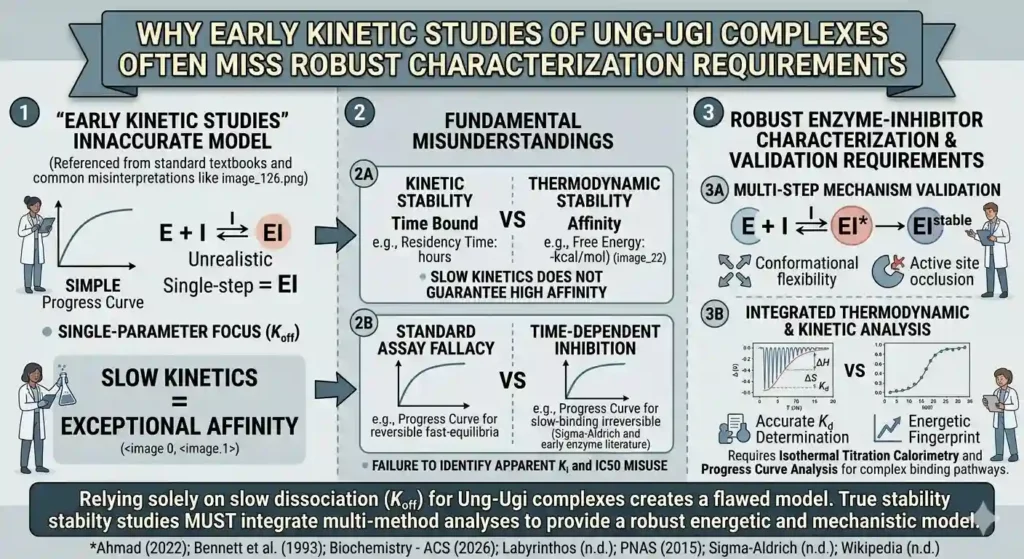
At first glance, this base excision repair inhibition mechanism appears fully resolved. However, taking these early kinetic snapshots as the absolute truth can limit our broader understanding of DNA repair. The purpose of this article is to provide a comprehensive Ung-Ugi complex critique. We will look past the simple two-step association model to explore the limitations of early fluorescence studies, the critical need for orthogonal validation, and what reliable enzyme-inhibitor characterization truly demands.
Fast Summary: What the Original Article Promotes
To understand the gaps, we first need to review the baseline claims of the 1993 paper. The researchers studied the kinetics of the Ung-Ugi interaction using a fluorescein-labeled version of the enzyme (F-Ung).
Their main findings included:
- A 1:1 binding stoichiometry between Ung and Ugi.
- An exceptionally stable complex where no free Ugi exchange was observed.
- Saturable fluorescence quenching that plateaued at about 15%.
- Stopped-flow data suggesting a specific two-step mechanism: a rapid pre-equilibrium phase (Kd = 1.3 μM) followed by an irreversible complex formation step (k = 195 s⁻¹).
- The conclusion that Ugi completely occludes nucleic acid binding, heavily impairing the enzyme’s function.
While these kinetic data provide early insights into Ugi inhibition, the broader picture of the Ung-Ugi interaction is far more nuanced. It requires deeper scrutiny of potential quenching artifacts, model assumptions, and modern structural validation.
The Ambiguity of “Exceptionally Stable” Claims in Kinetics
Labeling a protein complex as “exceptionally stable” or featuring an “irreversible step” based purely on in vitro fluorescence data can be misleading. These claims rely heavily on highly specific, controlled laboratory conditions that do not replicate the chaotic reality inside a living cell.
Generic conclusions from early studies can lead readers to think Ugi completely and irreversibly blocks Ung activity forever. This framing ignores potential partial dissociation, subtle allosteric effects, or competition when high concentrations of nucleic acids are present. Relying too heavily on a single narrative creates blind spots, much like how standardized definitions fail to capture complex impacts. A true understanding of stability requires looking beyond test-tube limitations.
The Limits of Fluorescence Quenching and Stopped-Flow Framing
We must critique the foundation of these early findings: the methods themselves. Relying primarily on F-Ung quenching—especially when it only achieves 15% saturable quenching—and a strict two-step model can overlook massive biological realities.
First, fluorescence quenching artifacts F-Ung are incredibly common. Attaching a bulky fluorescent label can induce conformational changes in the protein, altering how it binds. Furthermore, the pre-equilibrium Kd stopped-flow issues often lead researchers to over-interpret an “irreversible” step simply because they lack long-time-scale dissociation data.
Additionally, nucleic acid competition Ung-Ugi results might merely reflect physical steric hindrance rather than the complete, active site occlusion that early models suggest. Just as we must recognize why standard stress vs anxiety articles fall short by missing underlying issues, we must acknowledge that steady-state kinetic data alone do not equal a comprehensive thermodynamic picture.
The Critical Role of Orthogonal Validation and Structural Context
A critical element frequently missing in early kinetic papers is the use of diverse, complementary methodologies. To fully map out a base excision repair inhibition mechanism, researchers need a deep understanding of orthogonal tools.
Techniques like Surface Plasmon Resonance (SPR), Isothermal Titration Calorimetry (ITC), and X-ray crystallography provide structural and thermodynamic layers that fluorescence completely misses. Treating early kinetic models as the final answer is a cognitive trap, similar to hyper-focusing on specialized interests while ignoring broader contexts. Post-1993 crystal structures of the Ung-Ugi complex have since provided far richer mechanistic details, proving that multi-method consensus matters far more than single-technique kinetic parameters.
Structural and Biological Factors Often Downplayed
Early kinetic studies also tend to strip away the messy reality of biology. The 1993 paper downplays several critical factors that dictate how this complex behaves in nature.
Inside a cell, proteins face extreme crowding. They are surrounded by massive concentrations of competing nucleic acids and other repair proteins. The evolutionary context of Ugi as a targeted phage defense mechanism suggests highly specific, dynamic interactions rather than simple, static blockades. Arguing that a complex is completely irreversible without testing it in cellular conditions is like assuming you understand the complex reality of emotional reactions based solely on a single observation. True functional inhibition extends far beyond in vitro kinetics to actual cellular repair efficiency.
Research Behaviors That Predict Long-Term Mechanistic Success
Evidence-based predictors of strong mechanistic conclusions always push beyond basic kinetics. Successful research teams exhibit specific behavioral patterns that prevent them from falling in love with a flawed model.
- Seeking diverse data: They use orthogonal binding assays (SPR/ITC) and structural studies.
- Testing boundaries: They perform mutational analysis on interface residues to see how the complex breaks.
- Embracing reality: They run cellular assays measuring Ung activity in the presence of Ugi, rather than relying solely on purified proteins.
- Recognizing warnings: They stay aware of early warning signs, like incomplete quenching or condition-dependent Kd shifts.
Developing these rigorous habits is vital, much like overcoming the habit of overthinking to take decisive, objective action.
What Effective Ung-Ugi Interaction Analysis Actually Looks Like
Contrast the classic 1993 kinetic framing with robust, modern approaches. Effective analysis requires a multi-layered strategy.
- Integrated Characterization: Combine kinetics, thermodynamics, structure, and cellular validation.
- Artifact Education: Researchers must deeply understand fluorescence limitations, labeling effects, and the risks of two-step assumptions. Ignoring these risks is like suppressing vital information, a concept explored in misconceptions about modern perspectives.
- Functional Goals: The ultimate goal is understanding base excision repair regulation and designing novel inhibitors, not just calculating a Kd value.
- Researcher Empowerment: Equip scientists with the skills to validate their own findings critically, moving through complex stages of understanding to reach mature scientific conclusions.
The Pitfall of Equating Fluorescence Kinetics With Complete Understanding
It is a massive pitfall to equate quenching data and stopped-flow rates with the actual quality of an inhibition model. Early interpretations easily overstate irreversibility or occlusion because they lack modern structural confirmation.
Routine acceptance of two-step models without actively ruling out alternative mechanisms reinforces a narrow kinetic focus. It prevents scientists from developing comprehensive mechanistic competence. Avoiding this validation because it is difficult is a subtle form of avoidance and emotional resistance. We must prioritize reflective molecular biology over single-method conclusions.
High-Value Questions Researchers Should Ask
To ensure a kinetic study is genuinely robust, readers and reviewers should ask these critical questions:
- What actual structural evidence supports the two-step association model limitations over alternative binding mechanisms?
- Are there measurable orthogonal binding data, or are we relying solely on fluorescence?
- How strictly were potential artifacts, such as labeling-induced conformational changes, controlled?
- What cellular or in vivo relevance was demonstrated to support the exceptionally stable complex claims critique?
- Does the interpretation hold up when subjected to physiological conditions or competing cellular ligands?
Asking these questions prevents the perfectionism that secretly holds scientific progress back.
Bonus: Why Fluorescence Quenching Data May Overstate Complex Stability
From a biophysical standpoint, fluorescence quenching only tells us that the local environment around a specific labeled amino acid has changed. It does not prove that an entire protein complex has locked into an irreversible state.
Quenching can occur due to minor structural shifts, transient interactions, or even the physical presence of a neighboring molecule, long before true thermodynamic stability is achieved. This difference between a local signal and global stability explains why early models often crumble when tested with modern tools. Failing to recognize this difference is like struggling with nuanced emotional definitions.
Bonus: Integrative Approaches That Outperform Early Kinetic Studies
When basic kinetic models fall short, modern researchers turn to integrative approaches. Co-crystal structures of Ung and Ugi provide precise visual evidence of exactly which amino acids interact. SPR kinetics allow scientists to measure binding and dissociation in real-time without bulky fluorescent labels. Cellular Ung activity assays reveal whether the inhibitor actually functions inside a living organism. Using a between-subjects design approach to evaluate limitations, researchers can test multiple variables simultaneously, creating a much stronger, more reliable model of DNA repair inhibition.
FAQ on Ung-Ugi Kinetics and DNA Repair Inhibition
Is the Ung-Ugi complex truly irreversible under physiological conditions?
While highly stable, calling it strictly “irreversible” is an overstatement. In the dynamic, crowded environment of a cell, protein complexes experience constant competition and degradation that test-tube kinetics cannot capture.
Why might fluorescence quenching give incomplete pictures of binding?
Fluorescence quenching only measures local environmental changes near the fluorescent tag. It cannot distinguish between full active-site occlusion and simple steric hindrance, and the tag itself may alter the protein’s natural binding behavior.
When should kinetic studies upgrade to structural and cellular validation?
Immediately. Kinetic data should be viewed as a starting hypothesis that absolutely requires validation through X-ray crystallography, SPR, and in vivo cellular assays to confirm long-term inhibitor design relevance Ugi.
What is the difference between an in vitro Kd and functional inhibition in DNA repair?
An in vitro Kd measures binding affinity in a pure, isolated buffer. Functional inhibition measures whether the inhibitor can actually stop the enzyme from repairing DNA inside a living cell, where thousands of other molecules are actively competing for space.
Conclusion: Balancing Appreciation With Critical Insight
The 1993 study by Bennett et al. provided pioneering kinetic insights into the stable Ung-Ugi complex. It undeniably laid the groundwork for our early understanding of how bacteriophages defend themselves against host DNA repair systems.
However, we must move past early oversimplifications. Ung-Ugi protein association is not just an exceptionally stable two-step complex with occluded nucleic acid binding. It is about active engagement with multi-method validation, artifact control, structural context, and cellular relevance. By embracing a more critical, comprehensive approach, we avoid systemic blind spots in our data and unlock much deeper insights into the regulation of base excision repair.
Further insights into complex system behaviors, cognitive biases, and evaluating reality versus perception can be explored through topics like understanding moral development in decision-making, the reality of psychological hangovers, why we overanalyze outcomes, interpretation bias in data, the psychology of over-apologizing for project failures, debunking simple tips for complex scenarios, navigating emotional triggers in high-stress analysis, understanding emotional numbness during project fatigue, seeking validation from idealized models, evaluating complex interactions under stress, and recognizing professional self-sabotage.