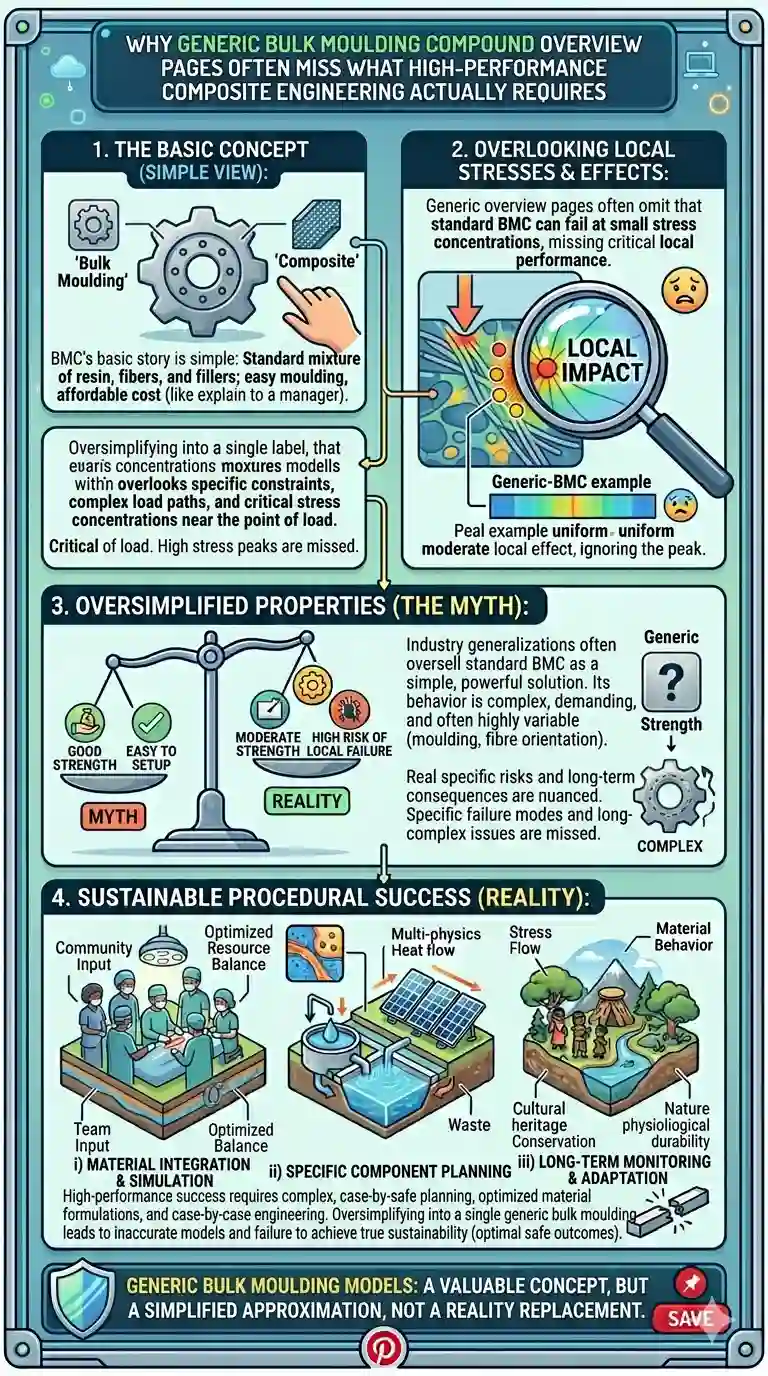
If you look up composite materials online, you will likely find neat, simple summaries praising their ease of use. This is especially true for Bulk Moulding Compound (BMC). Engineers and manufacturers love this material for its low cost and fast processing. But does the standard, textbook description really capture what happens when you put these parts to the test in the real world?
Often, generic engineering overviews treat BMC like a simple putty that magically solves manufacturing problems. But high-performance composite engineering is a complex science. It requires a deep understanding of processing behaviors, mechanical trade-offs, and long-term durability.
Let us critically examine the oversimplified framing of Bulk Moulding Compound. We will look past the basic descriptions and explore what sustainable, high-performance composite engineering actually requires to succeed!
1. Fast Summary of the Original Page
Most basic technical overviews, like those found on ScienceDirect Topics, introduce Bulk Moulding Compound as a putty-like or dough-like thermoset composite. They explain that it primarily consists of an unsaturated polyester resin blended with chopped glass fibers (usually 10% to 30%) and a very high filler content, like calcium carbonate. Unlike other composites, BMC requires no maturation step.
These pages heavily highlight the key advantages. They praise BMC for its easy handling, suitability for both compression and injection molding, and its generally good electrical and thermal properties. The text usually positions it as a highly cost-effective solution for creating complex, small-to-medium parts, like automotive under-hood components, electrical insulators, and home appliances.
While BMC certainly offers real processing and cost benefits, the broader picture of high-performance composite engineering is far more nuanced. It desperately needs deeper exploration of structural trade-offs and long-term realities.
2. Why the Term “Bulk Moulding Compound” Is Often Misleading
The very term “Bulk Moulding Compound” frames the material around convenience. The “bulk” label emphasizes its dough-like ease of use. However, this simple naming convention downplays major engineering challenges, like anisotropic property differences, fiber degradation risks, and scale limitations.
Generic descriptions often lead readers to believe that BMC is a universal, low-cost substitute for much stronger composite materials. Making material choices based solely on initial cost is a dangerous game. In fact, choosing a weaker material just because it is cheaper perfectly mirrors why we self-sabotage our own long-term success for short-term comfort!
Furthermore, many transnational corporations market these bulk materials as identical commodities across the global supply chain. But overview pages rarely address how these “identical” materials respond to aging, environmental exposure, or processing-induced defects deeply.
3. The Limits of High-Filler, Short-Fiber Framing
We must critique the foundational framing of BMC! Standard BMC relies heavily on cheap fillers and very short fibers, typically measuring just 6 to 12 millimeters long.
This formulation leads to significantly reduced mechanical performance when compared to longer-fiber alternatives. For example, the tensile strength of BMC usually sits around 28 to 55 MPa. Compare that to Sheet Moulding Compound (SMC), which boasts a much stronger 82 to 138 MPa!
When engineers ignore these limits, they run into severe impact and fatigue limitations, as well as significant fiber breakage during injection molding. Other serious risks include fiber migration, hidden voids, resin de-mixing, and trapped air pockets.
A short-term processing win does not equal long-term functional durability. Recognizing mechanical stress requires deep focus. Much like why standard stress vs anxiety articles fall short, persistent material stress is not always what you think it is until the part actually breaks. Yet, we frequently put off doing the hard testing required, proving why we procrastinate even when we know its important.
4. The Role of Processing Literacy in Long-Term Composite Performance
Here is a critical element completely missing from basic overview pages: engineers need a deep understanding of flow, cure kinetics, and defect risks. Basic bulk handling is simply not enough.
Fiber orientation, precise viscosity control, and strategic mold design predict long-term reliability far better than the initial consistency of the dough. Molding quality and the post-cure process matter infinitely more than premix convenience.
When a part fails suddenly, that defect acts as a harsh signal. Understanding these failures is like understanding the science of emotional triggers—the immediate break points to a deeper systemic flaw. When these flaws surface, design teams often obsess over the error, illustrating why we replay conversations in our head trying to figure out where the process went wrong. Taking proper care of the molding process requires active engagement, much like the active effort required in caretaking vs caregiving.
5. Structural & Environmental Factors That Affect Outcomes
What happens to a BMC part after it leaves the factory? Original overview pages almost entirely ignore real-world aging effects.
Over time, short fibers and hidden voids cause the modulus and strength of the part to drop significantly. Real applications face severe thermal cycling, harsh chemical exposure, and constant mechanical fatigue. Additionally, the high filler content creates massive recyclability challenges, hurting the material’s overall sustainability.
Ignoring these long-term environmental factors is a classic case of denial, mirroring repression vs suppression in psychology. When the design office ignores the reality of the field environment, a massive disconnect forms. This gap in communication perfectly illustrates what kills long distance relationships between engineering teams and manufacturing floors. Over time, dealing with constant, unexplained part failures leaves engineers feeling burnt out, helping explain why emotional numbness happens in high-stress production environments.
6. Behavioral Patterns That Predict Long-Term Success
To achieve true composite success, engineering teams must build evidence-based behavioral patterns that go far beyond reading a basic spec sheet.
Predictors of long-term success include optimized fiber length selection and strict orientation control. Engineers must actively monitor for defects like voids and migration, utilizing adaptive molding techniques. They must also choose between compression and injection molding based strictly on part geometry, not just convenience.
Awareness of early warning signs, such as inconsistent material flow or tiny post-mold cracks, is vital. When a major run fails due to poor monitoring, the resulting stress in the facility is intense, resembling a heavy panic attack hangover. If an engineer points out a flaw, team members must stay objective. When people get defensive, it shows exactly why we take things personally.
We must also break free from rigid, legacy manufacturing mindsets that shut down innovation, similar to identifying and healing from narcissistic mother traits in a toxic workplace culture. However, simply worrying about flow rates without making adjustments is useless; action is required, because overthinking is a habit that halts production completely.
7. What Effective BMC Use Actually Looks Like
Let us contrast the generic overview framing with robust, effective engineering approaches. Effective BMC use requires a multidisciplinary mindset.
- Integrated multidisciplinary design: This means aligning material selection directly with mold flow simulation and rigorous post-mold testing. Engineers should use methodical testing, akin to a between subjects design in psychology, to truly compare different mold iterations.
- Process education over passive reliance: Teams must understand the complex resin cure kinetics and filler interactions. You have to look past the surface-level data, applying a mindset similar to third date psychology to truly get to know the material’s behavior.
- Targeted functional goals: Focus on achieving a specific fatigue life, electrical reliability, and environmental resistance, rather than just chasing a quick molding cycle.
- Engineer empowerment: Give teams the tools to mitigate defects confidently. We should encourage teams to grow into their professional competence, mirroring the stages of Erik Eriksons psychosocial development theory. However, we must also teach them when a mold is “good enough,” because unchecked perfectionism is secretly holding you back from launching successful products.
8. The Pitfall of Equating Ease of Handling With Long-Term Progress
Bulk convenience and incredibly short cycle times are not the same thing as quality. When a manufacturer equates speed with success, parts easily enter mindless “molding loops” where thousands of units are produced without ever addressing underlying aging or defect risks.
Running high-volume shifts without mechanical validation reinforces a dangerous cost-focus rather than genuine durability competence. Why do we do this? Often, managers push for speed because they naturally crave validation from others—specifically the stakeholders watching the budget.
We confuse the quick thrill of a fast production run with the actual value of a reliable part, failing to distinguish between our immediate relief and our long-term goals. This highlights the difference between our surface primary vs secondary emotions. Some engineers become so obsessed with shaving seconds off a cycle time that it turns from a valid goal into an unproductive fixation, blurring the lines of autistic special interests vs ADHD hyperfixations. We must emphasize reflective, thoughtful engineering over routine, blind production.
9. Engineer-Centered Questions Readers Should Ask
Before you select Bulk Moulding Compound for your next high-performance application, ask yourself these highly actionable questions:
- What specific testing evidence supports the mechanical claims under real aging and thermal loads?
- Are there measurable, long-term functional goals for fatigue and impact resistance?
- How are processing defects, such as internal voids and fiber migration, actively evaluated and mitigated?
- What advanced design skills am I applying beyond basic compression modeling?
- Does the production plan adapt if the part complexity increases or performance stagnates?
Asking these tough questions elevates our professional integrity, aligning with the higher levels of Kohlbergs stages of moral development theory. By doing the hard work upfront, we build a process we can stand behind. We completely remove the stressful need to apologize even when its not our fault when the material limits finally show themselves in the field.
10. Balanced Conclusion
Bulk Moulding Compound undeniably serves a vital role in modern manufacturing. It is absolutely essential for creating complex electrical insulators, specialized small automotive parts, and high-volume electrical housings. It keeps costs down and allows for highly efficient production floors.
However, we must argue for better, more realistic framing in our engineering overviews. BMC is not just a magical, dough-like convenience. True composite engineering requires active, relentless engagement with processing trade-offs, defect mitigation, and functional life improvements. By moving beyond the generic summaries, engineers can design composite parts that survive not just the molding press, but the rigorous demands of the real world.