
When you design a furnace, the materials you choose make or break your operation. For many engineers and plant operators, the first step is reviewing textbook summaries or online reference guides. These pages offer neat categories and impressive melting points. But relying solely on basic definitions can quickly lead to catastrophic failures and massive financial losses.
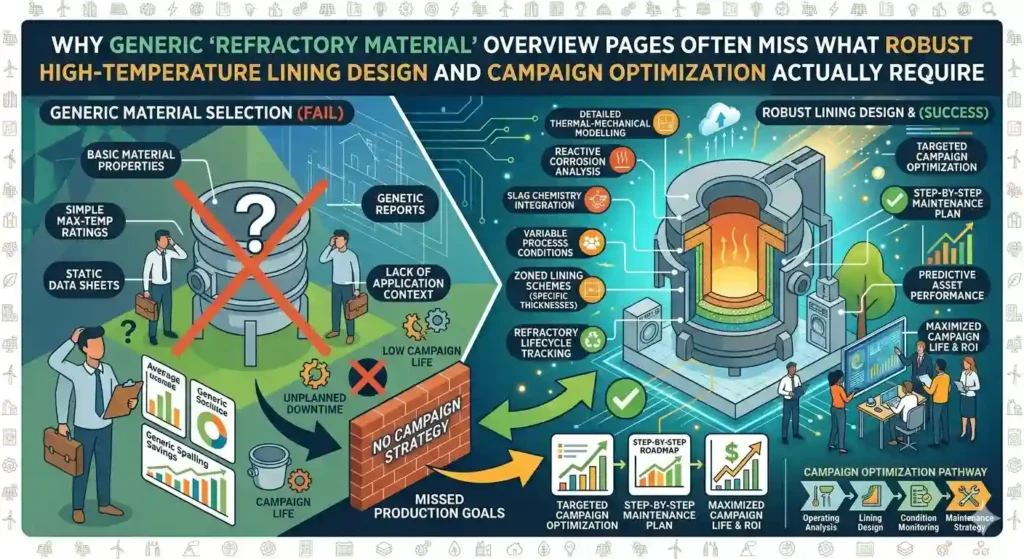
Today, we are addressing the problems with refractory material overview pages. We will look past the simplified charts to explore what truly drives furnace performance. By understanding wear mechanisms, phase interactions, and operational realities, we can move from basic material selection to robust campaign optimization.
1. Fast Summary: What the Original Pages Promote
If you visit a standard reference site, such as a ScienceDirect Topics page, you will find a predictable breakdown of refractories. These pages define them as non-metallic, heat-resistant materials essential for high-temperature processing. They proudly list melting points ranging from 1,000 to over 1,800 °C.
The text usually classifies these materials into three basic categories: acidic (like silica), basic (like magnesia or dolomite), and neutral (like alumina, chromite, and carbon). These summaries highlight key properties like refractoriness, thermal shock resistance, and mechanical strength. They also list common applications, from steelmaking basic oxygen furnaces (BOF) to cement kilns. While classification lists are useful starting points, the broader picture of refractory performance in real furnaces is far more nuanced. It requires a deeper exploration of wear mechanisms, phase interactions, and campaign-limiting factors.
2. Why the Term “Refractory” Is Misleading in Educational Overviews
Focusing heavily on the word “refractory” creates a false sense of security. The emphasis on a “high melting point” downplays a harsh reality: most linings fail at temperatures well below their melting point. They fail due to chemical corrosion, thermal cycling, or severe physical erosion.
Generic tables often lead readers to believe that higher alumina content automatically means a better product. They completely ignore critical factors like slag basicity, temperature gradients, or redox (reduction-oxidation) conditions. A material might withstand intense heat in a clean lab, but it will melt away quickly when exposed to aggressive liquid slag.
3. The Limits of Property-Centric Framing Alone
Relying entirely on standard property tests is a massive risk. Tests like cold crushing strength (CCS) or refractoriness under load (RUL) offer a snapshot, but they overlook how a material behaves during service. For example, a brick might have excellent cold strength but suffer a complete hot modulus of rupture (HMOR) collapse at operating temperatures.
Comparing lab results without context is a flawed approach. It is similar to the weaknesses found in a between-subjects design in psychology, where comparing isolated groups without understanding their specific environments leads to skewed conclusions. Furthermore, the disconnect between lab conditions and the harsh reality of the plant floor creates long-term friction, much like understanding what kills long distance relationships—distance from the ideal state ultimately causes a breakdown. A high lab ranking does not equal furnace reality where multiple destructive mechanisms interact simultaneously.
4. The Role of Wear Mechanism & Phase Literacy
To build a reliable lining, engineers need a deep understanding of ternary phase diagrams, slag-refractory reaction products, and corrosion kinetics. You must perform a rigorous refractory material critique selection process.
Sometimes, engineers hyper-fixate on a single data point, like porosity. This intense, narrow focus resembles the rigid behaviors seen when comparing autistic special interests vs adhd hyperfixations. Instead, we need a broad view. We must distinguish between the main cause of wear and the resulting symptoms, much like psychologists separate primary vs secondary emotions. For instance, structural spalling (the secondary symptom) is often caused by chemical penetration (the primary wear mechanism). Understanding how a lining degrades over time requires looking at its entire lifecycle, a process that mirrors the structural stages outlined in Erik Erikson’s psychosocial development theory.
5. Structural & Operational Factors Affecting Campaign Life
Overview pages frequently ignore severe operational factors. Redox cycling heavily degrades advanced MgO-C bricks. Thermal gradient cracking destroys monolithics faster than pre-shaped bricks. Broad, standardized material specifications pushed by massive transnational corporations often fail because they ignore the unique, localized chemistry of a specific cement kiln or steel ladle.
When a furnace undergoes severe thermal cycling, the internal stresses act like physiological trauma. The lining suffers lingering damage even after temperatures stabilize, much like the exhausting physical aftermath of panic attack hangovers. True refractory performance extends far beyond the material class; it relies heavily on furnace-specific zoning and daily operational habits.
6. Behavioral Patterns Predicting Long-Term Success
You can predict campaign life prediction refractories will achieve by examining the “behavioral patterns” of the maintenance and operations teams. Successful plants use zoned lining designs, regular thermography, and strict slag chemistry control.
Plants that fail often practice passive observation rather than proactive intervention. This illustrates the vital difference between basic caretaking vs caregiving in maintenance strategies. When teams delay necessary gunning repairs, they actively procrastinate even when they know its important, leading to early shell burn-through. Sometimes operators blame the refractory supplier for a failure caused by poor oxygen blowing practices. This instinct to deflect blame explains why we sometimes apologize even when its not our fault or point fingers to avoid operational accountability.
7. Effective Refractory Engineering
Effective engineering moves past generic class reliance and embraces complex, hybrid solutions. Robust approaches include:
- Integrated zoned design: Using expensive, high-wear materials only at the slag line, while using cost-effective safety layers elsewhere.
- Mechanism education: Understanding the thermal shock vs corrosion tradeoff refractories face and matching the material to the exact zone.
- Functional goals: Focusing on maximizing the campaign length and minimizing the specific refractory cost per ton of product.
Engineers must adapt their strategies based on data. Evolving past simple textbook rules requires mature technical reasoning, similar to reaching the higher ethical tiers in Kohlberg’s stages of moral development. Furthermore, we must stop chasing the “flawless” universal brick. This unrealistic pursuit is exactly why perfectionism is secretly holding you back in industrial design.
8. The Pitfall of Equating Nominal Properties With Campaign Performance
Buying a refractory brick solely because it has the highest lab numbers is a dangerous game. Materials that rank high in a pristine lab often fail catastrophically in the furnace due to unaccounted mechanisms.
When engineers rely strictly on a supplier’s datasheet, they are seeking a false sense of security. This behavior is driven by a psychological need, similar to why we crave validation from others. We must look past the initial presentation. Just as third date psychology teaches us that true character takes time to reveal itself, the true durability of a lining only shows after weeks of thermal cycling.
Choosing a cheap material to save budget upfront often ruins the entire campaign, perfectly illustrating why we self-sabotage. Furthermore, a procurement department that forces engineers to buy subpar materials acts like a toxic manager, displaying controlling traits similar to a narcissistic mother. If the plant then ignores the resulting wear data, they are practicing technical denial. Understanding the difference between repression vs suppression in psychology helps us recognize when teams consciously bury failure reports to protect their jobs.
9. Engineer-Centered Questions Readers Should Ask
To perform a thorough evaluation, engineers must ask critical questions during the selection process:
- What dominant wear mechanism (corrosion, erosion, or thermal shock) is expected in each specific furnace zone?
- Are there measurable post-mortem reports or thermography data from similar historical campaigns?
- How are shifting slag chemistry, redox atmospheres, and thermal cycling accounted for in the design?
- What zoned alternatives or hybrid monolithic solutions have we benchmarked?
During post-mortem reviews, teams often get stuck arguing over the same failures without changing their strategy. They engage in endless mental and verbal loops, much like why we replay conversations in our head. When structural flaws are pointed out, designers must remain objective. Getting defensive over a failed lining is a major barrier to progress, highlighting exactly why we take things personally when our professional choices are questioned.
10. Balanced Conclusion
Refractory materials remain absolutely essential for high-temperature containment, and standard classifications are helpful for initial screening. However, a successful refractory lining requires much more than high refractoriness and good shock resistance.
True campaign optimization involves active engagement with wear mechanism analysis, precise zoned lining design, and a deep understanding of phase equilibrium. By moving past the oversimplified summaries found on generic overview pages and embracing the harsh, complex realities of furnace operation, engineers can maximize campaign life and achieve the lowest possible cost per ton. Step away from the textbook tables and start analyzing your actual slag today!