The Fast Answer
We often label procrastination as a simple time management issue or a character flaw rooted in laziness, but psychology tells a much more complex story. At its core, procrastination is an emotional regulation problem, not a productivity problem. When you delay important tasks, your brain is prioritizing immediate mood repair over long-term achievement. You aren’t avoiding the work itself; you are avoiding the negative feelings—anxiety, insecurity, boredom, or self-doubt—attached to that work. The amygdala (your threat detector) overrides the prefrontal cortex (your planner), causing a “fight, flight, or freeze” response that manifests as scrolling social media or cleaning the kitchen instead of finishing that crucial report. Understanding this emotional mechanism is the first step to breaking the cycle.
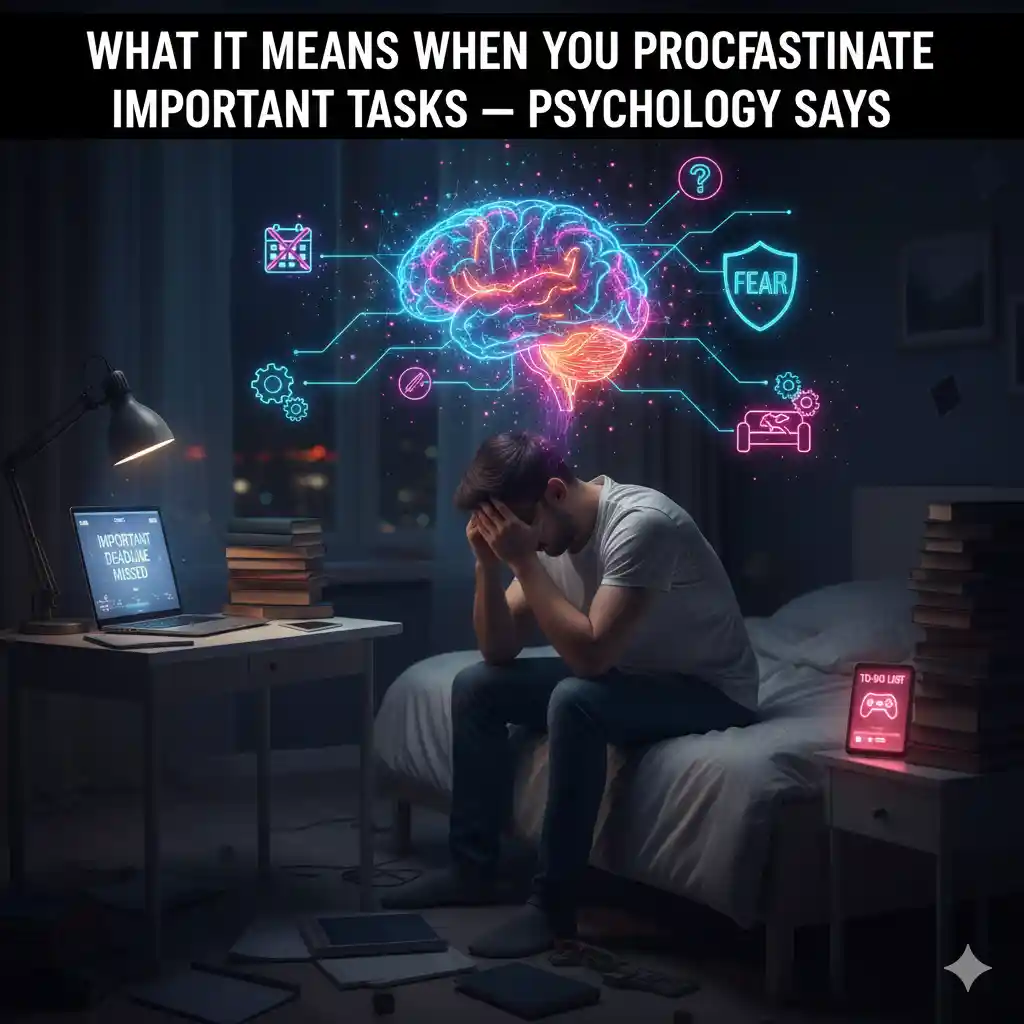
We have all been there: staring at a blinking cursor on a blank document, knowing the deadline is looming, yet finding ourselves physically unable to type a single word. Or perhaps there is a stack of important paperwork sitting on the kitchen counter that you have successfully ignored for three weeks, despite the growing knot of dread in your stomach. It is a baffling and frustrating experience. You know the task is important. You know the consequences of not doing it. And yet, a powerful, invisible force seems to push your hands away from the work.
This experience is often followed by a wave of shame. We tell ourselves we are lazy, undisciplined, or just “bad” at adulting. But as someone who has studied behavioral patterns extensively, I can tell you that laziness is rarely the culprit when it comes to high-stakes procrastination. The reality is far more nuanced and deeply rooted in our neurobiology. Your brain is engaging in a sophisticated, albeit maladaptive, protection mechanism. By understanding the psychological underpinnings of why we delay, we can stop fighting against our own nature and start working with it to reclaim our time and our peace of mind.
Table of Contents
- The Psychology Behind Delay: It’s Not Laziness
- The Procrastination-Perfectionism Loop
- Emotional Regulation: The Root Cause
- Fear of Failure vs. Fear of Success
- The Dopamine Trap: Instant Gratification vs. Long-Term Reward
- Executive Function and Decision Fatigue
- Task Paralysis and the “Wall of Awful”
- The Role of Self-Compassion in Breaking the Cycle
- Practical Psychology-Backed Strategies to Start
- Frequently Asked Questions
- Conclusion
- Next Articles
The Psychology Behind Delay: It’s Not Laziness
When we see someone (or ourselves) putting off a task, “lazy” is the easiest label to slap on the behavior. It suggests a lack of desire to exert effort. However, most chronic procrastinators often expend a tremendous amount of energy worrying about the task they aren’t doing. They aren’t lounging in blissful ignorance; they are trapped in a state of high-anxiety paralysis. This distinction is crucial because it shifts the focus from a moral failing to a psychological hurdle.
The Conflict Between Brain Systems
Procrastination is essentially a tug-of-war between two parts of the human brain: the limbic system and the prefrontal cortex. The limbic system is ancient, unconscious, and dominant. It includes the pleasure center and the threat response mechanism (the amygdala). It wants immediate safety and mood repair now. The prefrontal cortex is the newer, “smarter” part of the brain responsible for planning, future-thinking, and decision-making. It knows that finishing the project will be good for you next week. The problem is that the limbic system is much stronger and faster. When a task makes you feel anxious or insecure, the amygdala views that task as a threat—literally a predator to be avoided. Before your prefrontal cortex can rationalize that “it’s just a spreadsheet,” your limbic system has already hijacked the controls and steered you toward Netflix to soothe the perceived danger.
Temporal Discounting
Another psychological factor at play is a cognitive bias known as temporal discounting, or hyperbolic discounting. This is the tendency for the human brain to value immediate rewards significantly more than future rewards. Even if the future reward is much larger (like a promotion or a completed degree), the brain struggles to connect emotionally with that distant future “you.” The “you” of right now wants to avoid the pain of working. The “you” of next month who gets the reward feels like a stranger. Because the brain prioritizes the needs of the present self so heavily, the logical argument of “this is important for my future” often falls on deaf neural ears unless we can make the present moment feel less painful.
The Procrastination-Perfectionism Loop
It seems counterintuitive that perfectionists—people who care deeply about doing things right—would be prone to not doing things at all. Yet, perfectionism is one of the strongest predictors of procrastination. This isn’t about having high standards; it’s about having unrealistic standards that paralyze action. When your self-worth is tied inextricably to your performance, every task becomes a referendum on your value as a human being.
The All-or-Nothing Mindset
The perfectionist operates in a binary world: either the work is flawless, or it is a total failure. There is no middle ground for “good enough” or “work in progress.” This creates immense pressure. If you believe that the report you need to write must be a masterpiece from the first draft, the psychological weight of starting becomes unbearable. You delay starting because as long as you haven’t started, the potential for perfection still exists. Once you start, you risk proving that you aren’t perfect. Procrastination becomes a shield protecting you from the reality of your own imperfections. You tell yourself, “I didn’t do a bad job; I just ran out of time,” which feels safer to the ego than trying your hardest and failing to meet your own impossible standards.
Analysis Paralysis
Closely linked to perfectionism is analysis paralysis, where the desire to find the “perfect” strategy prevents any actual execution. You might spend hours researching the best way to organize your closet, reading reviews of storage bins, and watching tutorials, but never actually pick up a single shirt. The brain tricks you into feeling productive because you are engaging with the topic, but you are actually procrastinating the risk of making a “wrong” decision. This endless preparation is a common symptom of fear-based procrastination, where the anxiety of making a suboptimal choice outweighs the cost of making no choice at all.
Emotional Regulation: The Root Cause
Dr. Tim Pychyl and Dr. Fuschia Sirois, leading researchers in this field, have famously defined procrastination as “mood repair.” This concept fundamentally changes how we approach the issue. If you are procrastinating, you aren’t having a time-management crisis; you are having an emotion-management crisis. The task itself isn’t the issue; the feelings the task provokes are.
Avoiding Negative Affect
Think about the last important task you delayed. Did it make you feel incompetent? Bored? Resentful? Overwhelmed? These are uncomfortable emotional states (negative affect). Humans are biologically wired to avoid discomfort. When you think about doing your taxes, you might feel a spike of anxiety about math or fear about money. Your brain immediately says, “Abort! This hurts!” and directs you toward something that generates positive affect, like eating a snack or playing a video game. This switch provides immediate relief. You feel better instantly. This reinforces the habit: when I feel bad about a task, avoiding it makes me feel good. Over time, this creates a deeply ingrained neural pathway that equates task avoidance with safety and relief.
The Guilt Spiral
The tragedy of emotional regulation procrastination is that the relief is temporary. The task doesn’t go away, and now you have added a new layer of negative emotion: guilt. You feel bad for not working, which increases your overall stress levels. Now, when you look at the task again, it has the original anxiety plus the new shame and time pressure attached to it. The negative affect is even stronger, making you want to avoid it even more. This creates a spiral where the more you delay, the worse you feel, and the harder it becomes to start. Breaking this requires learning to sit with uncomfortable emotions without immediately reacting to them—a skill called distress tolerance.
Fear of Failure vs. Fear of Success
Fear is a massive driver of human behavior, and it sits at the center of procrastination psychology. While fear of failure is a well-known concept, fear of success is an equally potent, though often subconscious, force that keeps us from completing important work. Both fears stem from a desire to protect the self from future pain or disruption.
Protecting the Ego from Failure
Fear of failure is straightforward: if I try and fail, it confirms I am not good enough. Procrastination offers a convenient excuse known as “self-handicapping.” If you study for a test only the night before and get a C, you can say, “Well, I didn’t really study.” It protects your intelligence. If you had studied for two weeks and got a C, you would have to confront the limit of your ability. By delaying, you preserve the illusion of your potential. You maintain the belief that if you had tried, you would have succeeded, which is less painful than trying and failing.
The Hidden Anxiety of Success
Fear of success is trickier. Success brings change, and the brain hates change. If you complete that big project and it’s a hit, what happens next? Will people expect this level of work from you all the time? Will you be given more responsibility that you might not be able to handle? Will your friends be jealous? Success often means stepping into a new identity or a bigger spotlight, which feels dangerous to the primitive brain that prefers the safety of the known status quo. You might procrastinate on launching your business not because you think it will fail, but because you are terrified of the lifestyle changes that will occur if it actually works.
The Dopamine Trap: Instant Gratification vs. Long-Term Reward
Our brains run on neurochemicals, and dopamine is the star of the show when it comes to motivation. It is the “reward” chemical. Unfortunately, modern life has short-circuited our dopamine reward pathways, making it incredibly difficult to engage in tasks that offer delayed gratification.
The High-Stimulation Environment
We live in an environment of “super-stimuli.” Social media, video games, and junk food are engineered to trigger massive, instant dopamine releases. In comparison, writing a report or cleaning the garage offers a very low, slow dopamine release. When you have to choose between the two, your brain naturally gravitates toward the high-dopamine activity. It’s not just a preference; it’s a chemical craving. Attempting to work on a boring task when your phone is next to you is like trying to eat plain broccoli while smelling fresh pizza. The procrastination is your brain seeking the higher caloric (or dopaminergic) reward.
Addiction to Urgency
Some chronic procrastinators claim they “work better under pressure.” Psychologically, this is often because they have become dependent on the adrenaline and dopamine rush of the last minute. When the deadline is weeks away, there is no chemical stimulation to motivate action. But when the deadline is tomorrow, the brain switches into emergency mode. Adrenaline spikes, focus narrows, and you get a massive rush of energy. This state allows you to hyper-focus and complete the task. However, this is not sustainable. It leads to burnout and reinforces the idea that you can’t work without a crisis. You become addicted to the urgency because it is the only thing powerful enough to override your dopamine tolerance.
Executive Function and Decision Fatigue
For many people, especially those with ADHD or neurodivergent traits, procrastination is a symptom of executive dysfunction. Executive functions are the mental skills that allow us to plan, organize, manage time, and initiate tasks. When these systems are overloaded or impaired, procrastination is the inevitable result.
The Burden of “Starting”
Starting a task is neurologically distinct from doing the task. It involves “task switching,” which requires a significant amount of cognitive energy to disengage from one state and engage in another. If your executive functioning is low, the mental energy required to simply open the laptop feels insurmountable. This is often called “initiation deficit.” You might be sitting on the couch screaming at yourself internally to get up, but your body remains frozen. This isn’t unwillingness; it’s a disconnect between intention and action in the brain’s command center.
Decision Fatigue and Overwhelm
Every decision you make throughout the day depletes your cognitive resources. By the time you get to the important but ambiguous task—like “work on the thesis”—your brain is out of decision-making juice. Complex tasks require hundreds of micro-decisions: Where do I start? Which source do I read first? How do I phrase this sentence? If a task isn’t broken down into tiny, concrete steps, the ambiguity overwhelms the executive system. The brain looks at the vague, massive blob of “work” and shuts down to conserve energy. Procrastination here is a defense mechanism against cognitive overload.
Task Paralysis and the “Wall of Awful”
Brendan Mahan, an ADHD expert, coined the term “Wall of Awful” to describe the emotional barrier that separates us from our tasks. Every time we fail to do a task, we add a brick of shame, guilt, or anxiety to the wall. Eventually, the wall becomes so high that we cannot simply climb over it to get to work.
The Cumulative Weight of Delay
Imagine you need to send a simple email. You delay it one day. Now you feel a little guilty. You delay it two days. Now you feel rude. A week goes by. Now you feel like a terrible person and assume the recipient hates you. The task is no longer “send an email”; the task is now “confront the fact that I am a rude failure.” The emotional stakes have been artificially inflated by the delay itself. This is task paralysis. You are no longer avoiding the task; you are avoiding the massive emotional confrontation that the task now represents.
Staring at the Wall
When we are stuck in this paralysis, we often engage in what looks like “staring at the wall.” We might sit at our desk doing absolutely nothing, or scroll mindlessly without actually enjoying the content. We are in a freeze state. We are expending huge amounts of emotional energy trying to scale the Wall of Awful, but to an outside observer, we look completely passive. Breaking through this requires lowering the wall, not trying to climb harder. This involves validating the difficulty and removing the bricks of shame one by one.
The Role of Self-Compassion in Breaking the Cycle
This might be the most surprising psychological insight of all: being hard on yourself makes procrastination worse. We often think we need to be stricter, use harsher discipline, or “kick ourselves” into gear. However, research consistently shows that self-criticism drains the very emotional reserves needed to do difficult work.
Forgiveness Predicting Future Action
A study by Dr. Timothy Pychyl and colleagues found that students who forgave themselves for procrastinating on studying for a first exam actually procrastinated less on the second exam. Those who beat themselves up procrastinated more. Why? Because procrastination is linked to negative emotions. If you pile shame and self-hatred on top of the task, you are increasing the negative associations with the work. You are making the Wall of Awful higher. Forgiving yourself (“I procrastinated, I’m human, it’s okay, let’s try again”) reduces the guilt and anxiety, making it emotionally safer to approach the task next time.
Changing the Internal Narrative
Most procrastinators have a brutal inner critic. “You’re so lazy,” “You always ruin things,” “You’ll never get this done.” This internal abuse creates a high-stress internal environment. No one works well when they are being bullied, even if the bully is their own brain. Shifting to a narrative of curiosity and support—”I notice I’m avoiding this. I wonder why? Maybe I’m tired or scared. What’s one small thing I can do?”—reduces the threat response in the amygdala and allows the prefrontal cortex to come back online.
Practical Psychology-Backed Strategies to Start
Understanding the why is essential, but we also need the how. Psychology offers specific interventions that bypass the emotional and executive hurdles of procrastination.
The “Just Five Minutes” Rule
Since the brain fears the long-term commitment of a hard task, make a deal with yourself: “I will do this for just five minutes. If I want to stop after five minutes, I can.” This lowers the threshold of entry. The amygdala doesn’t react as strongly to five minutes of pain as it does to four hours. Once you start, the “initiation deficit” is overcome, and you will likely find that the anticipation was worse than the reality. Often, you will keep going because the hardest part—starting—is over.
Temptation Bundling
This concept, popularized by behavioral economist Katy Milkman, involves pairing a task you dread with something you love. Only listen to your favorite podcast while doing dishes. Only drink your fancy coffee while working on the budget. This artificially boosts the dopamine associated with the unpleasant task. It helps balance the “dopamine trap” by adding immediate gratification to a long-term activity.
Cognitive Reframing
Change how you talk about the task. Instead of “I have to finish this,” say “I choose to work on this because…” This restores a sense of agency. Furthermore, break the ambiguity. Instead of “Write Report,” write down “Open document and type the header.” Make the steps so small they sound ridiculous. A small step is not threatening to the amygdala. It slips under the radar of your fear response, allowing you to gain momentum.
Frequently Asked Questions
Is procrastination a sign of mental illness?
Not necessarily, but chronic, debilitating procrastination can be a symptom of underlying conditions like ADHD, depression, anxiety disorders, or OCD. If procrastination is significantly impacting your quality of life, it is worth speaking to a mental health professional.
Why do I procrastinate even on things I enjoy?
This is often due to perfectionism or fear of the activity ending. You might delay playing a video game you love because you feel you need “perfect” energy to enjoy it fully, or you delay a hobby because you’re afraid you won’t be as good at it as you want to be.
Does fear of failure ever go away?
The fear usually doesn’t disappear completely, but your relationship with it changes. As you build a track record of facing fears and surviving failures, you develop resilience. You learn to act despite the fear, rather than waiting for the fear to vanish.
Can I cure procrastination?
Procrastination is a behavioral pattern, not a disease, so “manage” is a better word than “cure.” You can learn to regulate your emotions and build habits that significantly reduce procrastination, but you will likely always have the impulse. The goal is to shorten the gap between intention and action.
Why does cleaning suddenly seem important when I have a deadline?
This is called “productive procrastination.” Your brain seeks a dopamine hit from completing a task (like cleaning) to offset the anxiety of the big task. It tricks you into feeling productive to shield you from the guilt of not doing the main work.
Conclusion
Procrastination is a complex, deeply human response to a world that demands more from our executive functions than they were perhaps designed to handle. It is a signal, not a sentence. When you find yourself delaying an important task, try to view it not as a failure of character, but as data. Your brain is telling you that it feels unsafe, overwhelmed, or under-rewarded.
By shifting your focus from “trying harder” to “feeling safer,” you can dismantle the psychological blocks holding you back. Remember that the goal isn’t to become a robot who never delays; the goal is to build a relationship with yourself where fear doesn’t dictate your actions. Be kind to yourself, break the task down until it looks laughable, and take just one tiny, imperfect step. That step is the antidote to the fear.
Next Articles
If you are ready to master your mind and behavior, these deep dives into habit formation and psychology will help you take the next step:
- Understand the Basics: The Real Reason We Procrastinate Simple Tasks
- Break the Cycle: How to Break Any Bad Habit Step-by-Step
- Master Your Habits: The Habit Loop: Cue, Routine, Reward Explained
- Overcome Resistance: Why Willpower Fails and What Works Instead
- Find Your Drive: Behavioral Triggers Behind Motivation